When operations searches expose weak notes, slow follow-up, and title-only screening, this article helps recruiters judge a hire platform that preserves context and avoids costly shortlist mistakes.
That sounds obvious until a search becomes complex. A recruiter is not just moving applicants from one stage to the next; they are balancing outreach, hiring-manager calibration, candidate replies, résumé review, scheduling, and internal updates at the same time. When the role is operationally critical, delays create real damage: shortlist quality drops, passive candidates disengage, hiring managers lose confidence in the process, and smaller firms feel the cost in wasted hours and missed placements.
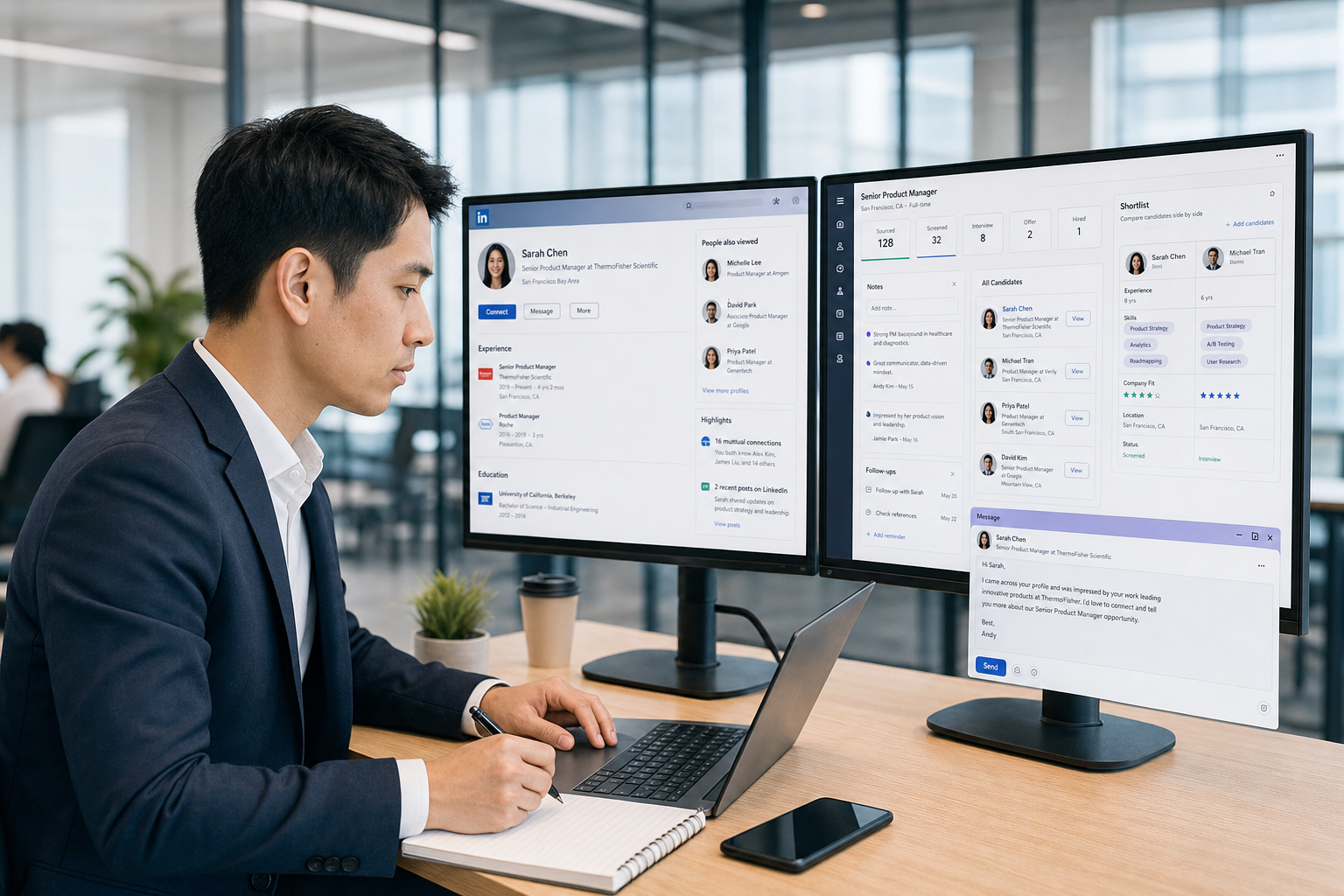
That is why I now separate software hype from workflow relief. In my own sourcing work, tools like StrategyBrain AI Recruiter have been most useful when the bottleneck is repetitive outreach and after-hours candidate follow-up, especially on LinkedIn. Its always-on messaging, multilingual communication, and automated collection of résumés and contact details can keep conversations moving while the recruiter still owns final screening, résumé judgment, and whether a candidate should advance. If you want to see how that kind of workflow is set up in practice, the implementation overview is a better reference point than any generic AI claim.
You see the value of that distinction most clearly on searches for operations managers. In that kind of assignment, the question is rarely just, “Who has the title?” Recruiters and employers are weighing leadership, process discipline, industry adjacency, supply-chain awareness, and whether the person can improve a live operation rather than simply maintain it. In tougher searches, the direct competitor pool may be too small, so the recruiter has to compare candidates from adjacent environments where precision, throughput, budget control, and delivery standards are similar.
That same search often breaks down in two very practical places. First, the recruiter needs candidates to open up about how they actually run an operation, not just repeat résumé bullets. Second, the hiring team needs a system that preserves context around strategic scope, technology exposure, and transition risk when a role is tied to change, succession, or growth. Those are exactly the moments where choosing the best recruiting software becomes a real hire platform decision rather than a simple ATS purchase.
If you are comparing the best recruiting software, the fastest way to get lost is to assume every hire platform does the same job. In practice, teams use that phrase to mean an ATS, a recruiting CRM, a sourcing workflow, or a broader talent acquisition system that supports both execution and judgment. For searches like operations leadership, where the role touches production, logistics, systems, strategy, and team culture, the software has to hold more than candidate records. It has to support how recruiters gather evidence, how hiring teams compare adjacent backgrounds, and how candidates experience the process.
- The best recruiting software is usually the best-fit system for your hiring model, not the flashiest all-in-one.
- A hire platform should be evaluated against real recruiting work: outreach, screening, context capture, collaboration, and candidate communication.
- Operations and leadership searches expose whether your system can handle strategic context, not just stage tracking.
- A candidate experience platform matters most when communication speed, scheduling, and mobile responsiveness affect conversion.
- Automation works best when it removes repetitive work but leaves final hiring judgment with recruiters and hiring managers.
Why operations searches reveal software gaps
Leadership hiring in operations is a useful stress test for recruiting systems because the role sits at the intersection of execution and strategy. An operations manager may be responsible for output, quality, timeliness, margin discipline, supply coordination, team leadership, and future process improvement all at once. That means recruiters need software that helps them evaluate more than linear experience.
In these searches, three recurring questions come up:
- Skill set fit: does the candidate need exact industry experience, or is adjacent operational complexity enough?
- Strategic scope: will the role mainly execute an established plan, or influence direction, investment, and change?
- Technology readiness: can the person work with ERP, reporting, process systems, and operational improvement data?
Those questions come straight from real recruiting judgment, not from software marketing. A weak system forces recruiters to keep these distinctions in notes, inboxes, and memory. A stronger hire platform makes them visible across the team.
Practical takeaway: if your software cannot capture why a candidate from an adjacent industry is viable, it will underserve complex searches even if its pipeline looks tidy.
What a hire platform should mean in practice
The term hire platform gets overused because buyers apply it to different layers of the recruiting stack. In one company it means an ATS. In another it means ATS plus CRM. In another it means a modular system that includes sourcing automation, candidate messaging, analytics, and a candidate experience platform layer.
The best way to define it is by the job it needs to do:
- If you mainly need requisition control, interview stages, approvals, and reporting, you are looking at ATS-led software.
- If your recruiters build pipelines, engage passive talent, and revisit previous prospects, you need CRM depth too.
- If candidate drop-off, response delay, or scheduling friction are consistent problems, candidate-facing workflow matters as much as internal workflow.
- If your team relies heavily on LinkedIn outreach, then sourcing automation may need to sit alongside the core system rather than inside it.
I have seen this become especially clear in retained and hard-to-fill searches. The recruiter may begin in LinkedIn, continue by email, log details in the ATS, and then summarize candidate viability for the client or hiring manager. That is one reason I have used AI Recruiter as a support layer rather than treating it as a replacement for recruiting judgment. It handles the repetitive first-contact and follow-up rhythm well, while the actual platform hire decision still depends on whether the core system can organize evidence, feedback, and decisions cleanly.
How recruiting software categories compare
Before choosing the best recruiting software, separate software categories by what they are meant to solve.
| Software type | Best for | Core strengths | Possible limitations |
|---|---|---|---|
| ATS | Structured hiring workflows | Requisition control, interview stages, approvals, compliance, reporting | Often weaker for long-term relationship building and proactive sourcing |
| Recruiting CRM | Pipeline building and passive talent engagement | Talent pools, outreach history, segmentation, nurture workflows | Usually needs ATS support for formal process governance |
| End-to-end talent acquisition platform | Teams seeking one connected environment | ATS plus CRM, collaboration, analytics, scheduling, automation | Can require more process maturity and change management |
| Candidate experience platform | Communication and conversion improvement | Messaging, self-scheduling, branded updates, mobile experience | May complement rather than replace the system of record |
| Sourcing automation layer | LinkedIn-heavy and outbound workflows | Always-on outreach, follow-up consistency, scale support | Needs human review for qualification and next-step decisions |
A sensible platform hire strategy often blends categories. Many teams need one system of record and one workflow accelerator rather than a single tool pretending to do everything equally well.
Best recruiting software by use case
Most buyers do not need a universal winner. They need the best recruiting software for the type of hiring they actually run.
Best for small and midsize businesses
SMB teams usually benefit from an intuitive ATS with straightforward setup, communication templates, easy scheduling, and reporting that does not require an analyst to interpret. The main value here is consistency. Recruiters and hiring managers stop relying on spreadsheets and side-channel updates.
Best fit: ATS-first software with enough CRM or outreach support to avoid fragmentation.
Best for search firms and outbound recruiters
Agency recruiters and headhunters need more than applicant processing. They need sourcing workflows, message continuity, talent rediscovery, and fast context capture across multiple searches. If your day starts in LinkedIn and ends with shortlist presentation, a basic ATS alone will feel thin.
Best fit: CRM-capable hiring system plus outbound workflow support. For recruiters doing high volumes of first-touch outreach, a tool like StrategyBrain AI Recruiter can be useful in keeping conversations active across time zones and after-hours windows, while the recruiter still decides whether the résumé and operating background actually fit the brief.
Best for high-volume hiring
High-volume teams need speed, mobile apply, automation, bulk communication, and low-friction scheduling. In these environments, candidate abandonment is often a bigger issue than sourcing volume.
Best fit: ATS or suite with strong automation and candidate-facing workflows, often with a meaningful candidate experience platform component.
Best for enterprise recruiting
Enterprise teams need governance, integrations, permissions, multi-region consistency, workflow standardization, and analytics leadership can trust. They also need room for local variation without destroying reporting structure.
Best fit: enterprise ATS or full-suite environment with configurable workflows, strong admin control, and mature reporting.
Best for strategic and leadership hiring
When the role influences business direction, software should help recruiters compare strategic readiness, technology exposure, operational scale, and transition risk. That is where note structure, collaboration quality, and history matter more than résumé storage alone.
Best fit: ATS plus CRM or end-to-end platform with strong context capture, search notes, and hiring-team collaboration.
Features that actually matter in evaluation
A strong hire platform should be judged by what it improves in daily recruiting work, especially in nuanced searches like operations leadership.
1. Workflow control that supports real recruiting
Look for configurable stages, approvals, scorecards, recruiter notes, and hiring-manager visibility. The point is not just moving candidates forward. It is understanding why they should move forward.
2. Context capture for adjacent-fit candidates
In operations hiring, exact-industry candidates are not always available. Your system should make it easy to record why a candidate from a similar process environment is still credible.
3. Candidate communication and scheduling
Software should shorten response time, reduce missed handoffs, and help candidates self-schedule where appropriate. This is where a candidate experience platform often earns its place.
4. Practical sourcing and outreach support
If your team relies on LinkedIn, evaluate how the platform connects to outbound workflows. In my experience, recruiters gain the most from automation when it handles repetitive messaging and résumé collection rather than pretending to replace selection judgment. That is where AI Recruiter workflow support can fit cleanly.
5. Technology and systems visibility
For operations and process-heavy roles, candidates often need exposure to ERP, reporting tools, and operational systems. Your software should support structured notes or fields that make these comparisons usable later.
6. Integrations that reduce duplicate work
Look at calendar sync, email, HRIS, assessments, background checks, sourcing tools, and reporting layers. Recruiters abandon software quickly when they have to enter the same information in three places.
7. Reporting that reflects decision quality
Basic funnel metrics matter, but they are not enough. Better systems help you see stage delays, response lag, source quality, and where complex searches are narrowing too early.
8. Admin usability and implementation fit
The best recruiting software is maintainable. If every workflow change requires vendor support, the system will age badly.
Why candidate experience belongs on the shortlist
Candidate experience is no longer a separate branding topic. It is operational performance. In tough searches, especially with candidates who are not actively looking, delays and vague communication cost you momentum.
A strong candidate experience platform or candidate-facing workflow should improve:
- Speed: candidates get timely answers and updates.
- Scheduling: less friction between recruiter, candidate, and interviewers.
- Mobile completion: fewer drop-offs in application or response steps.
- Continuity: communication history stays intact across the process.
- Credibility: the employer looks organized, thoughtful, and responsive.
This matters even more in leadership and operations hiring, where strong candidates are often evaluating the employer while the employer evaluates them. If the company says it values process excellence but runs a messy interview process, candidates notice.
Technology, strategy, and business context in hiring
One of the most useful lessons from operations hiring is that candidate fit cannot be separated from business context. A recruiter needs to know whether the role is maintaining an existing operation, supporting expansion, managing a supply-chain challenge, leading a systems implementation, or navigating a transition from an outgoing leader.
That context changes the entire search:
- A smaller company may need an operations manager who can influence strategy directly with the owner.
- A larger employer may need someone who can execute within a structured hierarchy while partnering with supply chain and production leaders.
- A company in change may need a leader who can judge whether another shift, a capital investment, or process redesign is feasible.
- A technology-heavy environment may favor candidates who have gone through ERP or operational system implementations.
When software fails here, recruiters start carrying the search in their heads. That is risky. The right hire platform helps preserve the bigger picture, so the search does not collapse into title matching and calendar management.
Field note: the strongest recruiters do not just ask whether a candidate has done the job before; they ask whether the operating conditions are similar enough for that experience to transfer.
How to choose the right platform hire setup
The easiest way to make a good platform hire decision is to test software against actual recruiting work rather than generic demos.
- Define the hiring model. Are you mostly handling inbound applicants, outbound searches, recurring pipelines, or executive-style assignments?
- Clarify your decision complexity. Are you filling standardized roles, or roles where industry adjacency, technology exposure, and strategic scope matter?
- Map the process friction. Is the biggest problem outreach volume, slow follow-up, weak notes, scheduling, hiring-manager visibility, or reporting?
- Separate source tools from system-of-record needs. A sourcing accelerator is not the same thing as your core ATS or CRM.
- Audit candidate experience. Review response speed, self-scheduling, status visibility, and mobile ease.
- Check business-context support. Can the system capture why the role exists, what success looks like, and how candidates compare beyond titles?
- Review integrations and admin burden. Implementation quality matters as much as feature count.
- Test with a real search. Use an actual requisition, ideally one with some complexity, and see where the tool helps or gets in the way.
If your team does meaningful LinkedIn outreach, include that in the evaluation. In my own process, the best results came from treating StrategyBrain AI Recruiter as a workflow assistant for first-touch communication and résumé capture, while keeping the primary ATS or CRM responsible for candidate history, client or hiring-manager notes, and advancement decisions. That division of labor is often more realistic than expecting one product to do everything well.
Common buying and implementation mistakes
Even experienced recruiting teams make repeatable mistakes when selecting the best recruiting software.
Buying for features instead of search reality
A polished demo is not a hiring workflow. If the tool cannot support how your recruiters actually source, compare, and present candidates, it will disappoint quickly.
Ignoring strategic context in software design
For operational and leadership roles, context is part of qualification. A system that only tracks stage movement will flatten important distinctions.
Underestimating candidate communication
Slow follow-up hurts search quality. Good recruiters know that responsiveness is part of conversion, not an optional courtesy.
Forgetting the handoff between automation and judgment
Automation can accelerate outreach and follow-up, but final qualification, résumé interpretation, and shortlist judgment still belong to the recruiter.
Overcomplicating the stack
Sometimes teams buy enterprise-grade complexity for a process that needs only disciplined basics. Adoption suffers when recruiters have to fight the system to do ordinary work.
FAQ
What is the difference between a hire platform and an ATS?
An ATS is usually the workflow core for applications, stages, approvals, and reporting. A hire platform can mean that ATS alone, or a broader setup that includes CRM, sourcing tools, automation, analytics, and candidate-facing workflows.
How do I choose the best recruiting software for a search firm?
Start with your actual workflow. If recruiters spend significant time in LinkedIn, outreach, and passive candidate nurturing, look beyond applicant processing. Search firms often need CRM depth, clean note structure, and sourcing support in addition to ATS discipline.
When does a candidate experience platform matter most?
It matters most when communication speed, scheduling friction, and mobile responsiveness affect conversion. High-volume hiring and passive candidate recruiting both benefit from stronger candidate-facing workflows.
Can automation replace recruiter judgment?
No. Automation can help with repetitive outreach, follow-up, and information capture, but recruiters still need to assess the résumé, judge fit, interpret context, and decide next steps.
Why are operations manager searches useful when evaluating recruiting software?
Because they expose whether your system can support nuanced judgment. These searches often involve strategic scope, adjacent industry fit, technology exposure, supply-chain understanding, and transition planning, not just title matching.
What should I ask in a software demo?
Ask the vendor to walk through a real search: sourcing, candidate communication, note capture, hiring-manager review, stage movement, and reporting. Also ask how the system handles candidates who are credible because of process similarity rather than exact industry match.
Conclusion
The best recruiting software is the system that supports the way experienced recruiters actually make decisions. In straightforward hiring, that may be a clean ATS. In more complex searches, especially those involving operations, strategy, and adjacent-fit evaluation, the right hire platform has to support context, collaboration, and candidate communication as well as compliance and workflow.
If you remember one thing, let it be this: software should make it easier to understand the role, compare candidates intelligently, and move the right people forward without losing momentum. For many teams, that means combining a strong system of record with workflow support where outreach volume or response speed creates friction. That is also where a well-used candidate experience platform or LinkedIn automation layer can improve outcomes without replacing recruiter judgment.