Missed placements often start before applications do, and this article helps recruiters judge candidate CRM tools that preserve fit signals and re-engage talent fast.
That sounds simple until a desk is juggling similar searches, old finalist pools, half-updated notes, and candidates who replied after hours with just enough signal to deserve follow-up. For small agency owners, solo recruiters, and in-house talent teams, the cost of weak candidate management in recruitment is not just admin drag. It shows up as missed placements, duplicated outreach, slower shortlist delivery, weaker candidate trust, and hiring managers who feel the market is colder than it really is.
In my own workflow, tools that reduce repetitive message handling have been most useful when they support, rather than replace, recruiter judgment. One example is AI Recruiter, which can keep LinkedIn conversations moving, respond across time zones, and collect resumes or contact details from interested prospects while I still make the final call on fit, resume quality, and whether someone should move into a live search.
The same underlying problem shows up on the candidate side too. A finance professional polishing a resume for one comptroller opening and then a planning-and-analysis management role cannot rely on one generic document and one generic LinkedIn summary. They need to scan the language of each opportunity, mirror the terms that matter, and describe skills with precision instead of broad claims. If they wait until the opportunity is live, the update work becomes rushed, and good-fit interest can cool before the conversation even starts.
That candidate behavior matters more than many software buyers admit. When strong people tailor language, sharpen keywords, and keep a ready-to-send profile, recruiters need systems that can capture those signals, remember prior context, and surface them later for the next role. That is where the best recruiting software stops being just an applicant workflow tool and starts acting as a true candidate CRM and, more specifically, useful candidate relationship management software.
If you are researching the best recruiting software, the real buying question is rarely just feature volume. It is whether your system helps recruiters recognize fit sooner, keep conversations alive longer, and hand off qualified people into formal hiring workflow without losing context. That is why this article focuses on candidate CRM, how it differs from an ATS, and what matters most when candidate management in recruitment depends on tailored outreach rather than one-time applications.
- Why tailored hiring needs more than an ATS
- ATS vs candidate CRM: where the line really sits
- What the best recruiting software should include
- Feature breakdown for candidate relationship management software
- Where LinkedIn workflow support fits
- Who benefits most from recruiting CRM
- How to evaluate software step by step
- Common buying mistakes
- FAQ
Why tailored hiring needs more than an ATS
The resume-tailoring lesson is straightforward: generic language weakens fit. Candidates improve their odds when they adapt wording to the role, use strategic keywords, and describe capabilities precisely enough for a recruiter to understand what they can actually do. Recruiting teams face the mirror image of that challenge. If your software cannot preserve those details, segment people by relevance, or bring old conversations back into view, your team ends up treating every search like a cold start.
That is why candidate CRM has become central to modern recruiting. A good system helps recruiters source, organize, segment, nurture, and re-engage talent before a person becomes an active applicant. In practice, this includes silver medalists, past finalists, passive prospects from LinkedIn, alumni networks, event leads, and candidates whose profile language has improved since the last time you spoke.
The best recruiting software supports this longer memory. It helps a recruiter notice that a candidate who once looked broad now looks highly relevant because their resume, LinkedIn profile, or stated interests are more aligned to the new role. Without that continuity, candidate management in recruitment becomes a repetitive exercise in list rebuilding.
Key insight: Tailored candidate signals are only valuable if your recruiting system can store them, search them, and put them back in front of a recruiter at the right time.
ATS vs candidate CRM: where the line really sits
One of the most common buying mistakes is assuming an applicant tracking system and a candidate CRM solve the same problem. They do not.
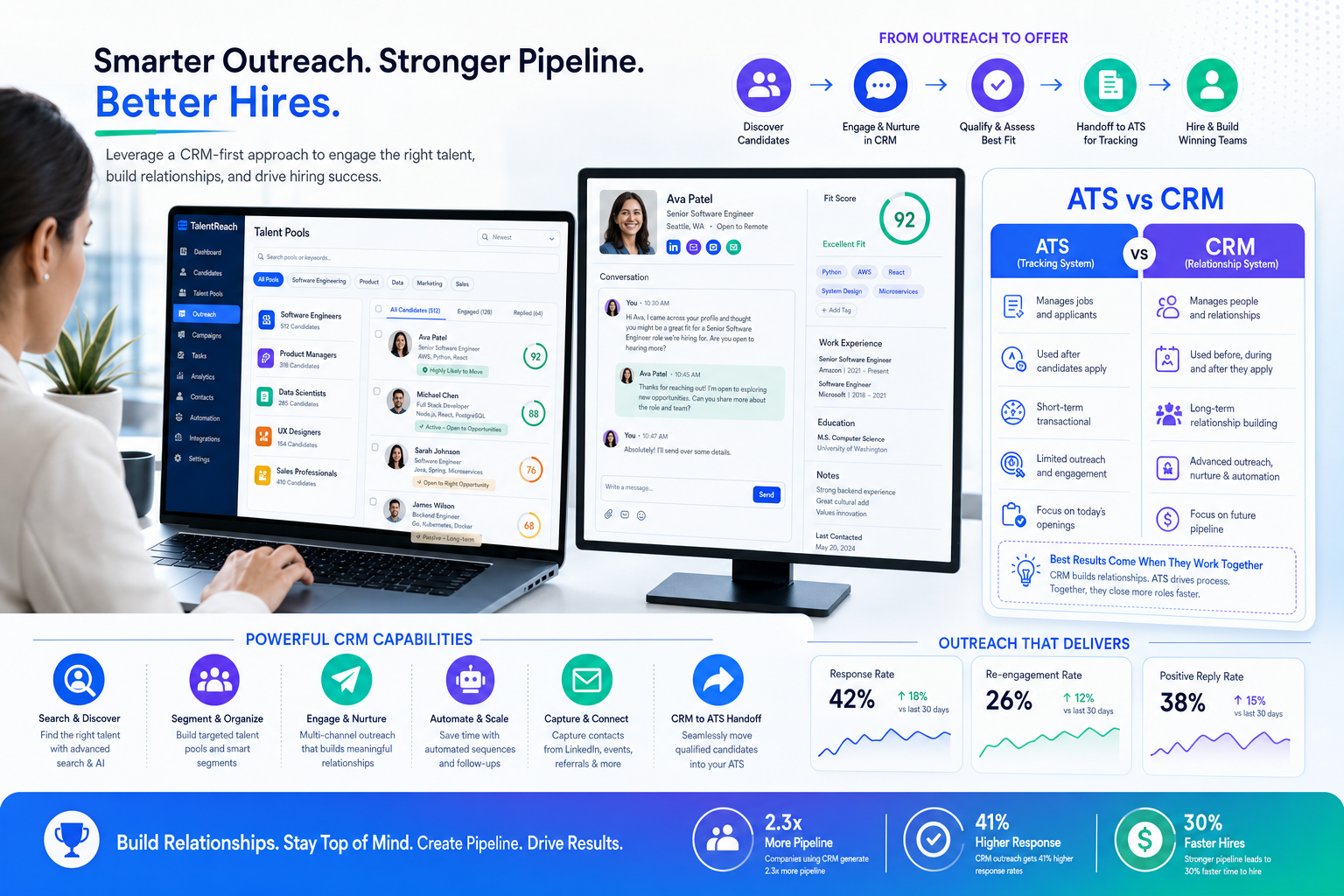
An ATS is built for active hiring. It manages applicants, interview stages, approvals, req-based workflow, and compliance steps. A candidate CRM is built for relationship continuity. It supports outreach before application, segmented follow-up, talent pooling, and re-engagement after a process ends.
| Function | ATS | Candidate CRM |
|---|---|---|
| Main purpose | Manage active applicants for open roles | Build and maintain talent relationships over time |
| Best fit | Interview workflow, requisitions, approvals | Sourcing, nurture, re-engagement, talent communities |
| Primary timeline | Current hiring cycle | Pre-applicant and repeat engagement cycle |
| Typical recruiter action | Move applicants through stages | Segment, message, and re-surface relevant talent |
| Key outcome | Operational control | Pipeline quality and relationship memory |
This matters because candidate management in recruitment usually breaks down before formal application. A recruiter remembers a strong profile, but not the reason it was strong. Or a candidate replied positively months ago, but the note lives in an inbox rather than a searchable system. Or a hiring manager wants “leadership” in one search and “planning depth” in another, yet the recruiter has no clean way to pull candidates whose records reflect those distinctions.
Many suites now offer both ATS and CRM capabilities. That can be valuable, but buyers still need to inspect which side is truly mature. Some are ATS-first products with light nurturing tools. Others are stronger as candidate relationship management software and only adequate for active req administration.
What the best recruiting software should include
Whether you want a full suite or a CRM layer that integrates with your existing ATS, the best recruiting software usually shares a practical set of capabilities.
- Searchable candidate history: notes, source, prior roles, outreach history, and engagement signals in one place.
- Segmentation and talent pools: the ability to group candidates by skill, role family, geography, seniority, interest, or prior process outcome.
- Campaign-based outreach: email or messaging tools that support personalized, repeatable follow-up.
- Automation for reminders and triggers: especially for re-engagement, event follow-up, and dormant pools.
- Resume and profile context preservation: not just document storage, but searchable relevance markers tied to the kinds of keywords recruiters actually use.
- Reporting: engagement, conversion patterns, source quality, and pipeline health.
- Talent community capture: landing pages or forms for evergreen pipelines.
- ATS integration: clean handoff when a nurtured prospect becomes an active applicant.
The strong systems also help with a subtle but important problem raised by the resume-tailoring example: they make it easier to tell the difference between a generalist profile and a profile that has become specifically relevant to a role. That distinction is often where the best recruiting software creates leverage.
Feature breakdown for candidate relationship management software
1. Search quality that reflects recruiter behavior
The database is the foundation of any candidate relationship management software. If recruiters cannot quickly find past finalists for a planning role, previous controllers who emphasized leadership, or passive candidates who answered after hours, they stop trusting the system. Look for strong filters, visible source history, reliable notes, and search logic that works even when data is imperfect.
This is especially important when candidate management in recruitment depends on role nuance. Recruiters rarely search for one exact title. They search by adjacent language, transferable experience, and hints of readiness.
2. Segmentation that goes beyond job title
Good candidate CRM software lets teams segment by more than title and location. You should be able to build pools around previous interview outcome, event attendance, salary band, client type, communication response, or future interest area.
That matters because tailored recruiting is about matching language and context. A person who looked broad in one search may fit well in another because the role emphasis changed. Segmentation helps recruiters act on that difference rather than losing it in one large database.
3. Campaigns that support precise follow-up
Outreach at scale is useful only if it stays relevant. Recruiters need campaign tools that preserve personalization, support follow-up timing, and keep the tone aligned with the opportunity. The lesson from tailored resumes applies here too: language matters. Generic messaging produces generic response quality.
A strong candidate CRM gives structure to that communication. It helps teams keep in touch with silver medalists, specialist talent communities, and passive prospects without relying on memory alone.
4. Automation that removes delay, not judgment
Automation is most valuable when it keeps recruiting motion alive between human decisions. In my own testing, the best use is not auto-selection. It is handling repetitive communication steps that too often sit in a recruiter's inbox until the candidate has gone cold.
That is where StrategyBrain AI Recruiter can be helpful inside a LinkedIn-heavy sourcing motion. I have found it useful for continuing first-touch conversations, replying outside normal work hours, and collecting resumes or contact details from candidates who are willing to proceed. It does not replace my fit assessment. I still review the resume, judge whether the profile actually matches the brief, and decide who moves forward. But it can reduce the lag that damages candidate experience and wastes sourcing effort.
5. Analytics that show future pipeline strength
Reporting should answer more than applicant-stage questions. The best recruiting software should show whether talent pools are growing, which messages are earning replies, which sources produce re-engageable talent, and where candidates stall before applying.
That forward-looking view is one of the clearest signs that a system is truly a candidate CRM rather than an ATS with a contact list attached.
6. Capture tools for evergreen interest
Talent communities, event landing pages, and simple profile capture forms matter because not every strong candidate is ready to apply today. This is another place where candidate relationship management software earns its keep. It gives recruiters somewhere useful to place future-fit talent instead of letting them vanish into email folders or scattered spreadsheets.
7. Handoff quality into the ATS
Even the best CRM work loses value if the handoff into formal hiring is clumsy. Ask how records sync, how duplicates are handled, and whether conversation history follows the candidate into the next stage. Recruiters and hiring managers should not have to reconstruct context once a nurtured person becomes an applicant.
Where LinkedIn workflow support fits
For many recruiters, LinkedIn is where the CRM problem becomes visible first. Conversations start there, candidate intent gets signaled there, and sourcing volume can easily outrun a single recruiter's ability to reply quickly and consistently.
That does not mean LinkedIn automation alone is the best recruiting software. It means LinkedIn activity often needs to be supported by a broader candidate CRM discipline. In practical terms, that includes:
- keeping role messaging aligned to the job's real language and priorities
- capturing candidate responses and contact details without losing them in inboxes
- replying fast enough to preserve interest across time zones
- moving promising people into a structured database for future searches
When I have used AI Recruiter in a LinkedIn sourcing workflow, the main benefit has been continuity. The system can keep outreach moving and gather the basics from interested candidates, while I stay responsible for the actual recruiting judgment: brief calibration, resume review, shortlist quality, and client or hiring-manager alignment. That division of labor is important. Good software should compress admin time without pretending qualification is fully solved.
For teams doing international search or after-hours sourcing, multilingual and always-on messaging can also support candidate management in recruitment where human response coverage is inconsistent. Again, that helps most when it connects back to a searchable CRM process rather than sitting as an isolated conversation tool.
Who benefits most from recruiting CRM
In-house talent acquisition teams
Internal teams benefit when they hire repeatedly for related skill sets and need to preserve long-term engagement. Candidate CRM helps them revisit known talent instead of restarting sourcing every quarter.
Recruitment agencies and search firms
Agencies often gain the most because relationship memory is part of the business model. A strong candidate CRM helps protect market knowledge, preserve prior conversations, and re-activate prospects quickly when client needs shift.
Campus and early-career recruiting
These programs depend on timing, nurture, and event follow-up. Candidate relationship management software is useful because not every interested student is an immediate fit for a live role.
Executive and specialist hiring
For senior and hard-to-fill roles, role language and fit criteria can change significantly between searches. CRM depth matters because the same person may be a weak match for one brief and a strong match for the next.
LinkedIn-heavy sourcing teams
If your recruiters live in outbound search, the best recruiting software should support fast communication, accurate record capture, and smooth movement from social conversation to structured pipeline.
How to evaluate software step by step
- Start with your real bottleneck. Is the problem weak nurture, slow follow-up, poor searchability, or a bad ATS handoff?
- Map how recruiters identify fit. If they rely on language nuance, adjacent titles, and old notes, test the system against those behaviors.
- Audit your current ATS honestly. It may already handle active workflow well, while your real gap sits in candidate CRM.
- List your highest-value relationship use cases. Silver medalists, passive LinkedIn talent, campus pipelines, or specialist communities.
- Test segmentation live. Ask the vendor to pull candidates from a past search using role-specific language, not a perfect title match.
- Inspect message and automation controls. Outreach should stay personalized and recruiter-approved where needed.
- Validate resume and contact capture. Especially if much of your sourcing starts on LinkedIn or through direct outreach.
- Review reporting for future planning. You should be able to judge pipeline quality, not just applicant counts.
- Confirm ATS integration and duplicate handling. This is where many implementations quietly fail.
A useful buying exercise is to bring one frontline recruiter, one recruiting operations lead, and one hiring stakeholder into the review. Recruiters surface usability issues, operations tests data integrity, and stakeholders can judge whether communication quality and pipeline readiness will actually improve.
Common buying mistakes
- Confusing contact storage with CRM maturity. A database alone is not a candidate CRM.
- Overvaluing automation language. The real question is whether follow-up gets better and faster.
- Ignoring role-language nuance. If the system cannot reflect how recruiters search and classify talent, adoption will suffer.
- Underestimating segmentation. Broad pools create broad messaging and weaker responses.
- Letting LinkedIn activity stay disconnected. Valuable candidate intent gets lost when outreach and CRM are not linked.
- Forgetting that recruiters still own the decision. Software can support speed and consistency, but not replace final fit judgment.
FAQ
What is candidate relationship management software?
Candidate relationship management software is a recruiting system that helps teams source, segment, nurture, and re-engage talent over time. Unlike an ATS focused mainly on active applicants, it is built to maintain long-term talent relationships.
How is candidate CRM different from ATS?
An ATS manages applicants, interviews, approvals, and requisition workflow. A candidate CRM focuses on pre-applicant outreach, talent pooling, follow-up, and re-engagement. Many of the best recruiting software platforms include both, but they are not the same function.
Why does tailored candidate language matter in CRM?
Because recruiters often judge fit through role-specific language, detailed skills, and changing priorities between searches. A good candidate CRM helps preserve and re-surface that context instead of forcing the team to start from scratch.
What features matter most in candidate CRM?
The essentials are search quality, segmentation, campaign outreach, automation, analytics, talent capture tools, and ATS integration. If your team sources heavily on LinkedIn, conversation continuity and contact capture also matter.
Can LinkedIn automation replace recruiter screening?
No. It can help with first-touch communication, follow-up speed, and resume or contact collection, but recruiters still need to assess fit, review resumes, and decide next steps.
Who needs recruiting CRM the most?
Agencies, in-house sourcing teams, executive recruiters, campus programs, and any employer with recurring or hard-to-fill roles usually benefit the most from stronger candidate management in recruitment.
Final takeaway
The best recruiting software is not the system with the longest feature list. It is the one that helps recruiters preserve context, tailor communication, and return to good candidates with speed and precision. If your team already has workable applicant flow but keeps losing momentum before people apply, the missing layer is often a stronger candidate CRM.
That is the bigger lesson behind both tailored resumes and better recruiter tooling. Precision matters, timing matters, and relationship memory matters. The teams that improve candidate management in recruitment are usually the ones that choose candidate relationship management software capable of carrying those details forward, search after search.