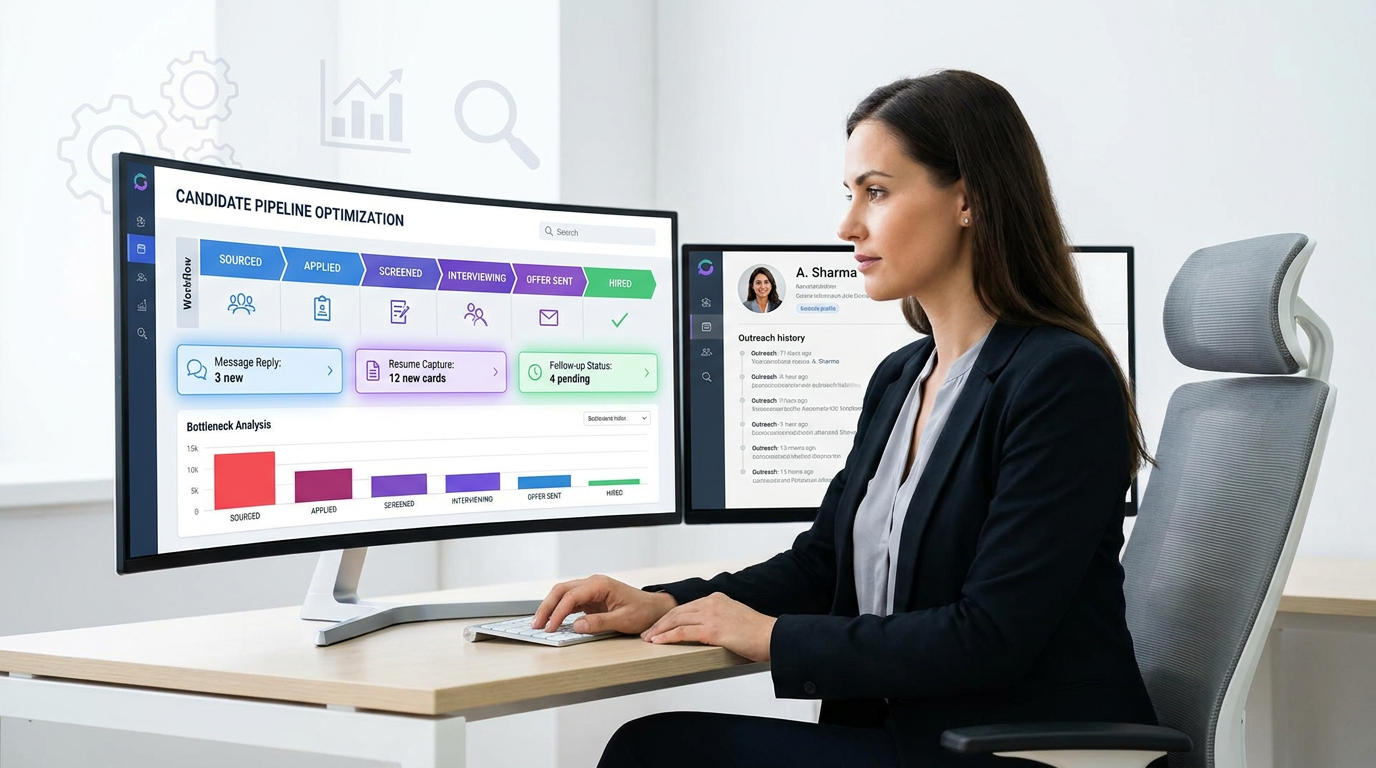
When recruitment online for recruiters feels slow, this article helps agency leaders judge software by workflow leaks they can fix to avoid lost placements.
That sounds operational, but it is also commercial. Smaller search firms and lean in-house teams rarely lose momentum because recruiters suddenly forget how to recruit. They lose it because too much effort gets trapped in admin, follow-up happens inconsistently, candidate records live in scattered places, and hiring teams cannot see where delays are building. The result is slower placements, weaker client confidence, longer time-to-fill, and avoidable pressure on recruiter relationships and working capacity.
That is where targeted automation can help without removing recruiter judgment. In my own workflow, StrategyBrain AI Recruiter has been most useful for the repetitive front end of sourcing on LinkedIn: starting candidate conversations, handling after-hours replies, and collecting resumes or contact details from interested prospects. I would still review every profile, assess fit, and decide who moves forward, but tools like AI Recruiter can reduce the manual drag that usually sits between outreach and shortlist building.
You can see the same logic in how growth companies think about resource pressure. When investor money tightens, finance leaders do not just ask how to cut spend; they look for cash trapped in broken workflows, mismatched approvals, duplicated records, poor payment terms, and delayed collections. In recruiting, the equivalent problem is value trapped between sourcing, response handling, scheduling, notes, and follow-up. A recruiter sends outreach, checks one inbox for replies, updates another system by hand, chases a manager for feedback, and then loses track of a warm candidate because the process has no disciplined timeline.
That is why the best recruiting software is not simply the platform with the most features. It is the system that helps recruiters recover wasted capacity the way a strong operator recovers trapped working capital: by tightening approvals, standardizing records, improving visibility, and making each handoff easier to manage. For teams comparing tools, that also connects to where to find recruiters, how head hunters jobs are actually executed, and what software really supports modern recruitment online for recruiters.
Table of Contents
- What Makes Recruiting Software the Best?
- Why Recruiters Need Resource Discipline, Not Just Features
- Core Features That Remove Trapped Recruiting Work
- Best Recruiting Software by Team Type
- Three Recruiting Software Categories Worth Comparing
- ATS vs Recruiting CRM
- How to Choose the Right Platform
- Where Recruiters Find Candidates
- Where to Find Recruiters
- How Headhunters Work and What Head Hunters Jobs Involve
- Common Selection Mistakes
- FAQ
- Conclusion
What Makes Recruiting Software the Best?
The best recruiting software helps a team move from first contact to signed offer with less leakage in the process. In practice, that means fewer missed replies, cleaner candidate histories, faster handoffs, better reporting, and stronger recruiter control over the pipeline.
Experienced recruiters usually define “best” differently from software marketers. We do not need a dashboard that looks impressive in a demo if daily work still depends on spreadsheets, inbox digging, and memory. We need systems that support recruiting as it is actually done: sourcing, outreach, qualification, shortlist management, interview coordination, stakeholder follow-up, and post-search pipeline reuse.
That is the real promise behind modern recruitment online for recruiters. It is not just digitizing applications. It is building an operating model where recruiter time is used on judgment and relationship work rather than manual chasing.
Why Recruiters Need Resource Discipline, Not Just Features
One of the most useful lessons from operations and finance is that growth problems often hide inside process problems. A company can look busy and still have cash trapped in receivables, approvals, or poor supplier controls. Recruiting teams can look active and still have hiring capacity trapped in weak systems.
Think about the recruiting equivalents:
- Payables discipline becomes approval and scheduling discipline
- Vendor duplication becomes duplicate candidate records and fragmented sourcing tools
- Receivables delays become slow candidate follow-up and delayed hiring manager feedback
- Poor invoice capture becomes weak note capture and incomplete communication history
The point is not to turn recruiting into finance language. The point is to recognize that the same operational waste exists. When a recruiter cannot see who replied last night, which hiring manager is holding the process, or where candidate interest dropped, that team is carrying trapped value in the workflow.
Practical takeaway: the best recruiting software restores recruiter capacity the same way a disciplined business process restores working capital: by tightening handoffs, reducing duplication, and improving visibility.
This framing also helps when evaluating software. Instead of asking which platform “has AI,” ask which platform removes the most expensive friction from your current process.
Core Features That Remove Trapped Recruiting Work
If you are evaluating recruiting tools seriously, these are the capabilities that matter most.
1. Recruiter-friendly ATS workflow
An applicant tracking system for recruiters should make stage movement, feedback collection, and recordkeeping easy enough that recruiters actually use it. If updating the system feels slower than working outside it, adoption will collapse.
2. Recruiting CRM and long-term relationship memory
A strong recruiting CRM turns old searches into future advantage. Silver-medalist candidates, passive prospects, referrals, and prior finalists should remain searchable and useful. This is one of the most practical applicant tracking system benefits when CRM capability is integrated well.
3. Reliable sourcing and outreach support
Good software should help recruiters build, segment, and revisit talent pools by skill, geography, function, seniority, and prior engagement. It should also make outreach history easy to read, so candidates are not approached twice with no context.
4. Automation that respects recruiter control
Automation works best on repeatable tasks: reminders, status nudges, pipeline updates, outreach sequences, and interview coordination. In my own experience, this is where StrategyBrain AI Recruiter can be especially practical for LinkedIn-heavy sourcing. It can keep initial conversations moving, respond outside office hours, and gather resumes from interested candidates while the recruiter stays responsible for final review and next-step decisions.
5. Interview scheduling and stakeholder accountability
Many hiring delays have nothing to do with candidate quality. They happen because calendars, feedback, and approvals drift. A useful platform makes it obvious who owes feedback, what stage a candidate is in, and how long they have been waiting.
6. Reporting that shows bottlenecks, not just activity
Hiring analytics should tell you where the process slows down: source quality, time in stage, conversion rates, response rates, and recruiter follow-through. Leaders need this to improve process design, and recruiters need it to defend changes with evidence.
7. Career site and recruitment marketing support
For in-house teams, software should connect attraction with conversion. Job distribution, application flow, and employer messaging all affect whether the top of funnel produces qualified candidates or just noise.
8. Data quality and compliance basics
Even the most advanced software underperforms when records are duplicated, ownership is unclear, or communication logs are incomplete. Clean data is not glamorous, but it is part of what makes software useful in real recruiting work.
Best Recruiting Software by Team Type
The right platform depends heavily on how your team hires.
Agency recruiters
Agency teams need speed, searchability, CRM depth, candidate ownership clarity, and flexible reporting. Their version of recruitment online for recruiters is relationship-led and pipeline-driven.
Priorities:
- Fast search and tagging
- Submission and shortlist tracking
- Reusable talent pools
- Strong outreach history
- Recruiter-level and client-level reporting
In-house talent acquisition teams
Internal teams need a balance between process control and usability. They often care more about approvals, hiring manager visibility, scheduling, and consistent reporting across departments.
Priorities:
- Reliable ATS workflow
- Career site support
- Interview scheduling
- Department-level analytics
- Communication and HR integrations
Executive search and headhunters
Search professionals need relationship depth, discretion, detailed note capture, and long-cycle pipeline memory. For them, software should preserve context, not flatten nuanced searches into a generic applicant funnel.
Priorities:
- Detailed candidate records
- Project-based shortlist organization
- Long-term relationship tracking
- Discreet outreach support
- Clear collaboration controls
High-volume hiring teams
At scale, consistency matters as much as recruiter craft. High-volume teams need automation, standardized screening, scheduling efficiency, and source reporting.
Priorities:
- Bulk workflow automation
- Dashboard visibility
- Screening support
- Fast scheduling
- Operational reporting
Three Recruiting Software Categories Worth Comparing
Because this topic is software-focused, it helps to compare three common categories recruiters evaluate in the market: enterprise ATS platforms, agency CRM platforms, and sourcing automation tools. These categories often overlap, but they solve different problems.
| Software Category | Use Experience | Likely Effect | Cost Pattern | Best Fit | How It Works with StrategyBrain AI Recruiter |
|---|---|---|---|---|---|
| Enterprise ATS platforms | Strong structure, often more process-heavy | Improves compliance, approvals, reporting | Usually higher total cost and more implementation effort | Mid-size to large in-house teams | Useful as the system of record while AI Recruiter supports LinkedIn outreach and resume capture upstream |
| Agency CRM platforms | More recruiter-centric, faster search and relationship workflows | Better talent pool reuse and candidate ownership visibility | Varies widely by seat count and feature depth | Staffing firms, search boutiques, contingency desks | Strong pairing when recruiters want CRM depth plus automated front-end sourcing conversations |
| Sourcing automation tools | Fast for repetitive outbound work, depends on setup quality | Can increase response handling speed and reduce manual messaging | Often lower entry cost than full ATS replacement | LinkedIn-heavy teams, solo recruiters, lean search firms | StrategyBrain AI Recruiter fits here well by handling outreach, multilingual replies, and interest capture while recruiters make qualification calls |
That last category matters more than many teams expect. In real recruiting work, a lot of waste happens before a candidate ever reaches the ATS. If your recruiters spend hours sending LinkedIn messages, checking replies late at night, and manually asking for resumes, a sourcing automation layer can remove meaningful friction even if you keep your main ATS or CRM unchanged.
My own view is that the strongest setup is often not one giant system trying to do everything. It is a clean core record system plus a few recruiter-facing tools that remove repetitive work where it actually occurs.
ATS vs Recruiting CRM
An applicant tracking system is mainly for managing active candidates inside active hiring workflows. A recruiting CRM is for managing relationships before and after a live requisition exists. Most mature teams need both.
The distinction matters because many recruiting problems start before application. A recruiter may know excellent talent from earlier searches, but if that history is not searchable or tagged properly, the team acts as if it is starting from zero.
That is why modern recruitment online for recruiters usually requires two operating layers:
- ATS: process control, stage tracking, compliance, interview flow
- CRM: pipeline building, relationship memory, segmentation, re-engagement
When teams add LinkedIn sourcing automation on top of that, they can also reduce manual outreach load without giving up judgment.
How to Choose the Right Platform
The simplest way to choose well is to score software against the real points where work gets stuck.
- Map your actual workflow. Include sourcing, outreach, review, stakeholder feedback, and offer stages.
- Find trapped effort. Where do recruiters repeat work, lose context, or wait too long?
- Separate active-process needs from relationship needs. This usually reveals whether your bigger problem is ATS depth or CRM weakness.
- Test your top three workflows live. Run a passive sourcing workflow, an active requisition workflow, and a hiring-manager follow-up workflow.
- Check whether reporting exposes delays. Visibility matters more than feature count.
- Review implementation discipline. Even strong software fails when timelines, ownership, and templates are inconsistent.
- Evaluate automation by outcomes, not novelty. Ask whether it reduces admin and improves response handling.
One lesson I keep coming back to is borrowed from process-heavy business functions: software is only as strong as the workflow discipline around it. A weak approval chain or inconsistent recordkeeping will make even expensive recruiting software feel average.
Where Recruiters Find Candidates
People searching for the best recruiting software are often really trying to solve a sourcing problem. Recruiters usually find candidates through active applicants, old databases, referrals, social platforms, niche communities, prior finalists, and direct outreach.
The difference between average and strong recruiting operations is not access to one magical source. It is whether the team can systematically reuse what it learns. Good software helps recruiters:
- Store candidates from earlier searches in reusable pools
- Track message history and response timing
- Tag by function, market, level, and readiness
- Measure source quality instead of just source volume
- Keep warm prospects from disappearing between searches
That is also why LinkedIn-heavy recruiters increasingly look for workflow support rather than just more job board exposure. If you already know where candidates are, the bigger question is how efficiently your team can engage, track, and revisit them.
Where to Find Recruiters
The phrase where to find recruiters has two different audiences behind it.
For companies
Companies usually find recruiters through specialist firms, executive search boutiques, referrals, and industry networks. The most credible partners tend to show market knowledge, process discipline, and communication consistency rather than broad promises.
Questions worth asking:
- How do you build and maintain your pipeline?
- What search records do you keep between assignments?
- How do you track candidate communication?
- What does your shortlist process look like?
- How do you keep stakeholders updated?
For candidates
Candidates looking for where to find recruiters should focus on specialists by function, level, and sector. The right recruiter is usually the one who understands your market and can speak clearly about active demand, not simply the one with the largest online presence.
How Headhunters Work and What Head Hunters Jobs Involve
The search term head hunters jobs often reflects curiosity about what headhunters actually do. In practice, the work is highly structured even when it looks relationship-driven from the outside.
Most head hunters jobs include market mapping, identifying target profiles, sending outreach, handling objections, collecting resumes, screening, calibrating with the client, and managing a shortlist. The best recruiters are not just persuasive communicators. They are disciplined operators who preserve context across long search cycles.
That is one reason I prefer software that captures more than status. On retained or specialist searches, the difference between a useful record and a shallow one becomes obvious quickly. You need notes, timing, outreach history, candidate sentiment, and a clear view of who should be re-approached later.
For LinkedIn-based sourcing, I have found that using StrategyBrain AI Recruiter as a support layer works best when the role requires broad outbound coverage but final fit still depends on recruiter judgment. It helps with first-touch communication and continuous follow-up, but the recruiter still owns qualification, shortlist construction, and client advice.
Common Selection Mistakes
Even experienced teams repeat the same errors when choosing recruiting software.
- Buying for demos, not workflows: polished presentations hide daily friction.
- Ignoring upstream sourcing work: many teams optimize ATS stages but neglect outbound effort.
- Overlooking data discipline: duplicate records and poor note capture quietly weaken the system.
- Underestimating follow-up delays: the real bottleneck is often stakeholder response time, not candidate supply.
- Assuming AI replaces recruiter judgment: it should support speed and consistency, not make hiring decisions.
- Choosing one system to do everything badly: sometimes a core platform plus focused automation is the better setup.
A useful test is simple: can your chosen setup show you, at a glance, who replied, who stalled, who needs follow-up, and where the process is leaking time? If not, it is probably not the best recruiting software for your team.
FAQ
What does recruiting software do?
Recruiting software helps teams manage sourcing, applications, communication, interviews, pipeline stages, and reporting. The best systems reduce admin work while improving visibility and follow-through.
What is the difference between an ATS and a recruiting CRM?
An ATS manages active candidates in live hiring processes. A recruiting CRM manages longer-term relationships with prospects, referrals, and passive talent. Most mature recruiting teams need both.
What is the best recruiting software for agency recruiters?
Agency recruiters usually need fast search, relationship tracking, reusable talent pools, flexible reporting, and strong outreach support. A recruiter-friendly CRM is often as important as ATS functionality.
What is the best recruiting software for in-house teams?
Internal teams usually prioritize process consistency, hiring manager collaboration, career site support, scheduling, and analytics. The best fit depends on hiring volume and organizational complexity.
Where do recruiters find candidates?
Recruiters find candidates through applications, referrals, prior databases, niche communities, social sourcing, and direct outreach. Good software makes those sources easier to track and reuse.
Where to find recruiters as a company or candidate?
Companies usually find recruiters through specialist firms, referrals, and industry networks. Candidates should look for recruiters who focus on their function, level, or sector.
How do headhunters work?
Headhunters run targeted searches through market mapping, direct outreach, screening, and shortlist building. They rely heavily on relationship memory, process control, and disciplined follow-up.
Conclusion
The best recruiting software is the system that helps your team recover wasted time, preserve candidate context, and move searches forward with fewer breakdowns. That is the real standard behind modern recruitment online for recruiters.
If you evaluate tools through that lens, the decision becomes clearer. Look at where work gets trapped, where records go incomplete, where follow-up slows down, and where recruiter judgment is being wasted on repetitive tasks. Then choose software that fixes those specific problems.
For many teams, that means combining a reliable ATS or CRM with focused sourcing automation. For LinkedIn-heavy recruiting, a tool such as StrategyBrain AI Recruiter can support the repetitive front end while recruiters retain control over qualification and hiring decisions. That balance is usually what strong recruiting operations need most: more leverage, not less judgment.