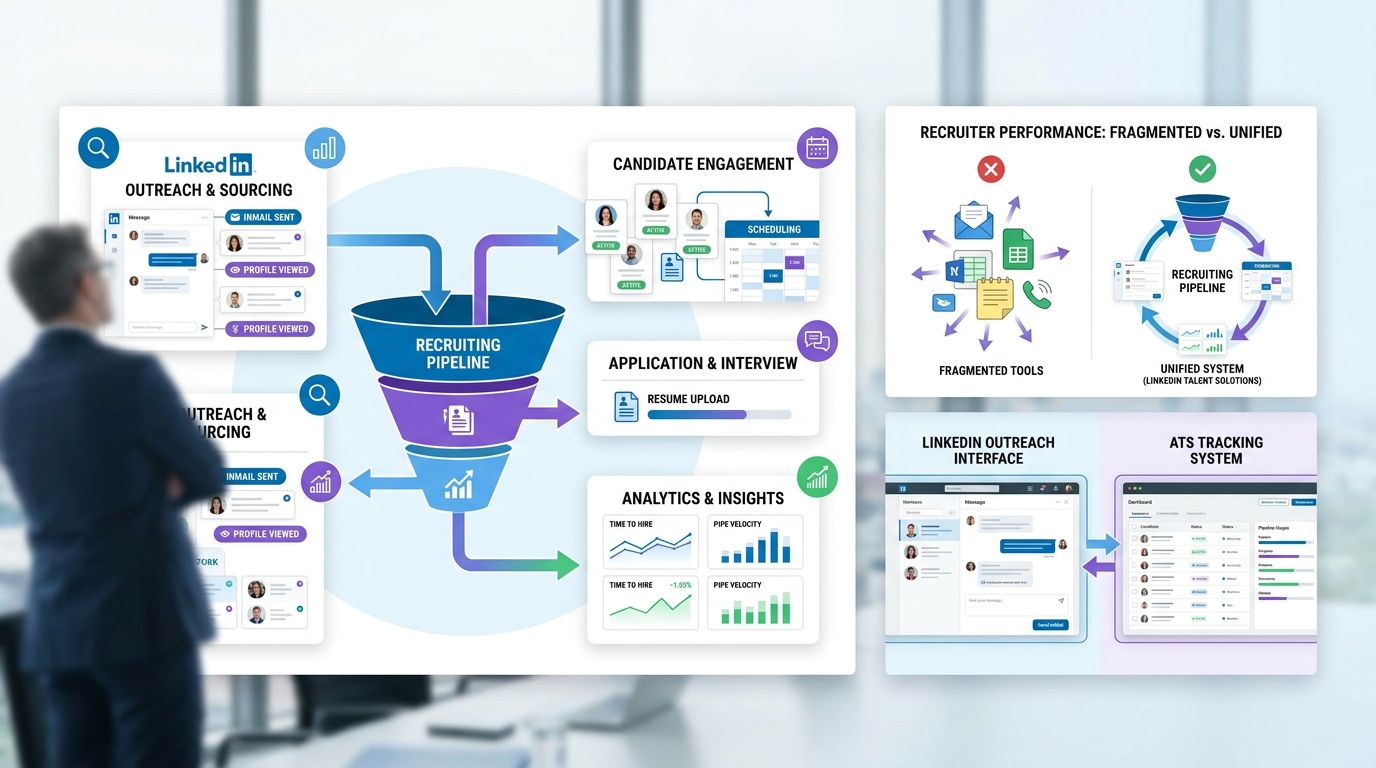
When recruiter visibility breaks down, this article helps staffing leaders assess recruitment online for recruiters, fix workflow gaps, and avoid the wrong software stack.
That matters because most recruiting teams are not only filling jobs. They are constantly explaining their work to hiring managers, clients, finance leaders, and founders who do not always see the sourcing, follow-up, market mapping, scheduling, and pipeline recovery happening underneath the surface. When that work lives across inboxes, spreadsheets, LinkedIn tabs, and disconnected notes, recruiters lose time, lose context, and often lose credibility when asked why a search is moving slowly.
In my own workflow, tools that reduce repetitive outreach and keep communication moving have helped most when the real bottleneck is visibility rather than effort. One example is StrategyBrain AI Recruiter, which can keep LinkedIn conversations active, respond across time zones, and collect resumes or contact details from interested candidates while the recruiter still handles final review, resume judgment, and interview decisions. Used carefully, that kind of support is less about replacing recruiters and more about protecting momentum in the parts of the process that are easiest to drop.
That same visibility problem shows up in another kind of work pressure that recruiters understand well: self-reporting. In many organizations, professionals are asked to write self-assessments before a performance review, and the hardest part is rarely the writing itself. It is turning a year of scattered actions into a clear account of contribution. The manager may not have seen the daily details, especially in more independent or remote work, so the employee has to reconstruct what was done, what obstacles appeared, and where support is still needed.
Recruiting teams face an almost identical operational challenge. If your system does not capture the real work of recruiting, then sourcing effort, candidate conversations, market feedback, and stage delays become hard to explain, hard to improve, and hard to defend. That is why the best recruiting software matters so much for recruitment online for recruiters, for firms competing on searches like headhunters near me, and for regional specialists serving demand such as job recruiters in florida.
- Why recruiter visibility matters before software selection
- What recruiting software actually includes
- Which recruiting teams need which type of system
- Must-have features in the best recruiting software
- How ATS benefits show up in day-to-day work
- Where LinkedIn workflow support fits in
- How needs change by recruiting model
- Metrics that should drive your buying decision
- What local-intent searches reveal about recruiter operations
- How to choose software without buying the wrong stack
- Common buying mistakes
- FAQ
Why recruiter visibility matters before software selection
One lesson from performance self-assessments applies directly to recruiting operations: if people cannot see your work clearly, they underestimate both effort and value. In hiring, that becomes a software problem very quickly. Recruiters are expected to show pipeline movement, justify sourcing decisions, explain market constraints, and identify where manager delays are slowing down outcomes. Without a system that records these activities, the team ends up arguing from memory.
Good recruiting software solves more than administration. It helps recruiters create a usable record of what happened, why it happened, and what should happen next. That is especially important in distributed teams where managers are not closely observing day-to-day recruiter actions. A strong system supports a better dialogue between recruiter, hiring manager, client, and leadership because the process is visible instead of anecdotal.
In practice, the best recruiting software should help teams do three things well:
- Clarify the recruiter’s role by showing where sourcing, screening, communication, and coordination happen.
- Document specific contribution through candidate history, stage movement, source tracking, and notes.
- Support honest evaluation by making it easier to discuss bottlenecks, manager delays, and areas that need process improvement.
That framework is useful because it shifts the buying conversation away from feature overload and back toward operational proof.
What recruiting software actually includes
The phrase best recruiting software is often used too broadly. In actual buying cycles, recruiters are usually comparing four connected categories: applicant tracking systems, recruiting CRM tools, sourcing and outreach tools, and automation layers that reduce manual work. Knowing the difference early helps avoid buying a platform that only solves one slice of the workflow.
An applicant tracking system for recruiters is usually the core system for open roles, applications, pipeline stages, interview feedback, compliance records, and hiring decisions. A recruiting CRM is more focused on passive talent, relationship history, nurture campaigns, and long-term engagement. Sourcing and outreach tools support market search, candidate identification, and initial communication. Automation features help with repetitive tasks such as scheduling, data capture, status updates, and message follow-up.
For teams handling recruitment online for recruiters, the right mix depends on the real daily motion:
- Application-heavy hiring: ATS depth matters most.
- Passive candidate sourcing: CRM and outreach functions matter more.
- Fast agency desks: search speed, rediscovery, and candidate matching are critical.
- Executive search: detailed relationship history and confidentiality matter more than applicant volume.
- Distributed recruiting teams: communication records and activity visibility become essential.
If recruiters are constantly rebuilding context from emails and chat threads, the software stack is usually fragmented.
Which recruiting teams need which type of system
The best recruiting software for one team can be the wrong system for another. Software fit should follow recruiting model, not category popularity.
In-house recruiting and HR teams
Internal talent teams usually need strong requisition control, structured pipelines, interviewer coordination, hiring-manager visibility, and reporting consistency. The most practical applicant tracking system benefits here are process discipline and cleaner collaboration across stakeholders.
Staffing firms
Agencies often need faster sourcing, more reusable talent pools, stronger search filters, and clearer client communication. In this environment, recruitment online for recruiters depends on speed and memory. A recruiter should be able to return to previous conversations, identify who was already qualified, and re-engage talent without rebuilding the search from scratch.
Executive search teams and independent headhunters
For retained search, candidate depth and market intelligence matter more than top-of-funnel volume. Detailed notes, discreet workflows, and relationship mapping become essential. That is also why local-intent searches such as headhunters near me are more than SEO phrases. They reflect a real buyer need for specialization, trust, and local market knowledge.
Regional recruiting firms
Firms working across state or metro-level demand need software that can segment by geography, function, niche, and client history. Searches like job recruiters in florida signal the importance of local coverage and market-specific pipeline organization, especially when candidate availability and salary expectations shift by region.
Must-have features in the best recruiting software
Recruiters often ask which features separate average tools from the best recruiting software. In my experience, the answer is not one flashy capability. It is whether the system helps recruiters be specific, evidence-based, and consistent in the same way a strong self-assessment requires specifics rather than vague claims.
Centralized candidate records
Recruiters need one place to find resumes, communication history, role status, notes, source information, and next steps. When records are fragmented, recruiter value becomes harder to prove and pipelines become harder to manage.
Resume parsing and profile creation
Manual entry slows teams down and often creates inconsistent records. Parsing makes profiles searchable and reduces the friction of getting candidates into the system quickly.
Candidate sourcing and talent pooling
Good software should support active applicants and passive prospects. Recruiters need pools organized by skills, industry, geography, seniority, and client relevance so they can reuse prior work instead of restarting every search.
Interview scheduling and coordination
Scheduling delays create candidate drop-off and frustrate hiring managers. Software should make handoffs, calendar visibility, and stage progression more reliable.
Reporting and analytics
If a system cannot show where a pipeline is slowing down, it cannot support better recruiter judgment. Reporting should help teams explain what happened, just as an employee in a self-assessment needs specifics to show contribution clearly.
Compliance and audit trail
Structured stages, access controls, and documented decisions are critical for consistency and risk control, especially in in-house environments.
Automation with human review
Automation is most useful when it removes repetitive work but leaves fit evaluation to the recruiter. Messaging, scheduling, and data collection can be streamlined, but hiring judgment still needs a human owner.
How ATS benefits show up in day-to-day work
Teams often describe ATS value too generically. In real recruiting operations, the strongest advantages of applicant tracking system adoption show up when a recruiter needs to explain a search clearly, recover context quickly, or identify where support is missing.
| Recruiting challenge | How an ATS helps | Practical result |
|---|---|---|
| Scattered applicant records | Centralizes profiles and stage history | Faster retrieval and fewer missed follow-ups |
| Weak manager visibility | Shows notes, activity, and status in one place | More informed hiring conversations |
| Unclear recruiter contribution | Documents sourcing, outreach, and movement | Better accountability and easier reporting |
| Slow scheduling | Supports interview coordination workflows | Shorter delays between stages |
| Poor source tracking | Captures source-of-hire data | Smarter channel decisions |
| Inconsistent process steps | Uses structured stages and audit trails | Cleaner operations and better compliance |
From a recruiter’s perspective, the value is practical. You can find the last candidate interaction without searching three systems. You can show a hiring manager exactly where feedback stalled. You can explain why a role is hard to fill using evidence instead of instinct. Those are the moments when applicant tracking system benefits become real.
Where LinkedIn workflow support fits in
For many agency recruiters, search consultants, and corporate sourcers, LinkedIn is where early pipeline momentum is won or lost. The problem is that LinkedIn work is repetitive, time-sensitive, and easy to under-document. Recruiters connect, message, qualify interest, answer basic role questions, chase resumes, and then manually move information into other systems. That creates exactly the kind of invisible work that later becomes hard to evaluate.
I have found that this is where a dedicated support layer can help, especially on searches with broad outbound volume or after-hours candidate response patterns. AI Recruiter from StrategyBrain is designed around LinkedIn recruiting workflows: it can automate initial candidate outreach, continue conversations with interested prospects, respond in multiple languages, and collect resumes or contact details when candidates want to move forward. The recruiter still reviews the resume, decides whether the profile actually fits the role, and owns the next interview step.
What I consider useful about that setup is not the promise of replacing recruiter judgment. It is the practical benefit of preserving continuity when messages come in late, when multiple searches are active, or when individual headhunters want more consistency without hiring additional coordinators. For search-heavy teams, that can make the software stack more complete rather than more bloated.
If your recruiting model depends heavily on LinkedIn, it is worth reviewing the workflow examples and product details directly at this AI Recruiter page and comparing them to how your team currently handles response lag, candidate handoff, and resume collection.
How needs change by recruiting model
The best recruiting software depends heavily on whether your team is running internal hiring, staffing, executive search, or high-volume recruiting. The same way a self-assessment needs to reflect a person’s actual role, software evaluation needs to reflect the recruiter’s actual operating model.
Corporate hiring
Internal teams usually need requisition workflow, stage control, interviewer alignment, and reliable reporting. The best setup often begins with a strong ATS and only adds CRM or outreach depth if passive talent acquisition is a major priority.
Staffing agencies
Agencies need speed, talent rediscovery, fast outreach, and stronger desk-level productivity. In this environment, recruitment online for recruiters works best when the system reduces repetitive tasks and preserves candidate history for reuse.
Executive search
Search teams need discretion, market mapping, relationship intelligence, and detailed note capture. Searches resembling headhunters near me often depend on local credibility and niche specialization, so software should support nuanced records rather than just applicant throughput.
High-volume hiring
Volume hiring requires efficient screening, automation, scheduling, and status communication. Here, the main applicant tracking system benefits are throughput and consistency.
Key insight: The wrong software is often not a bad tool. It is a tool built to make someone else’s work visible instead of yours.
Metrics that should drive your buying decision
Demos can make most recruiting platforms look similar. Experienced recruiting leaders compare systems through measurable outcomes and through the quality of operational evidence the system can produce.
The most useful metrics include:
- Time to hire: how long it takes from candidate entry to accepted offer.
- Time to fill: how long the requisition stays open.
- Source of hire: which channels actually produce placements.
- Stage conversion rate: where candidates advance or drop out.
- Offer acceptance rate: how often finalist conversations convert.
- Recruiter activity visibility: whether the system shows outreach, follow-up, and pipeline work clearly enough for manager review.
That last point is easy to overlook. A software stack should not only accelerate recruiting; it should make the work legible. That is one of the most transferable lessons from the self-assessment model in the reference material: specificity improves both evaluation and decision quality.
What local-intent searches reveal about recruiter operations
At first glance, phrases such as headhunters near me and job recruiters in florida can look unrelated to software selection. In reality, they reveal how recruiting services are discovered, trusted, and organized at the market level.
Local-intent recruiting usually requires:
- Geographic segmentation
- Local market notes and compensation context
- Candidate pools by city or state
- Client communication history by territory
- Role-specific pipeline reuse
For a search consultant, software value is not just storing names. It is knowing which relationships are active in a given market, which candidates already discussed relocation or compensation, and which clients are moving faster than others. This is why the best recruiting software for regionally specialized firms should support both execution and market memory.
How to choose software without buying the wrong stack
If you are evaluating systems now, start with workflow reality rather than a vendor checklist. The strongest software decisions usually follow a simple sequence.
- Clarify the actual role of the recruiting team. Are you doing internal hiring, contingent search, retained search, or high-volume recruiting?
- Be specific about what the team accomplishes today. Borrow the self-assessment principle here: document real actions, not vague goals.
- Identify where visibility breaks down. Is the issue sourcing volume, candidate follow-up, manager feedback, resume collection, or reporting?
- Decide whether you need ATS depth, CRM depth, or LinkedIn workflow support.
- Match features to measurable outcomes. Connect each capability to a metric you actually care about.
- Test edge cases. Include confidential searches, regional roles, after-hours responses, and passive candidate re-engagement.
This process keeps software evaluation grounded in recruiter work instead of presentation-layer features.
Common buying mistakes
Most software mistakes happen because buyers skip operational diagnosis and move straight to feature comparison. The most common errors include:
- Choosing based on category reputation instead of workflow fit.
- Expecting one system to handle ATS, CRM, sourcing, and outreach equally well.
- Ignoring visibility gaps. If recruiter activity cannot be seen, software adoption value is harder to prove.
- Overvaluing automation without defining human checkpoints.
- Forgetting regional and niche requirements. This matters for searches tied to headhunters near me and job recruiters in florida.
- Skipping recruiter input during selection.
- Failing to set a baseline for success before rollout.
These mistakes are avoidable when recruiters, managers, and operations leads agree on what the system needs to make visible, not just what it needs to automate.
FAQ
What does recruiting software do?
Recruiting software helps manage sourcing, applications, communication, interviews, pipeline stages, and hiring decisions. For recruitment online for recruiters, it can also support passive talent engagement, reporting, and workflow automation.
How is an ATS different from a recruiting CRM?
An ATS manages applicants tied to active roles and formal hiring stages. A recruiting CRM focuses more on passive candidates, relationship building, and long-term engagement.
Why does recruiter visibility matter when choosing software?
Because recruiters are often judged on outcomes that depend on activities hiring managers do not fully see. Good software creates a clear record of sourcing, follow-up, stage progression, and blockers.
Where does LinkedIn automation fit in?
It fits best as a workflow support layer for outbound sourcing and early candidate communication. Tools like StrategyBrain AI Recruiter can help maintain message continuity and collect candidate details, while the recruiter still owns final qualification.
Why do local searches like headhunters near me matter in software selection?
Because they reflect real demand for regional specialization, market memory, and trust signals. Firms serving local or state-level markets need stronger geographic segmentation and communication history.
What should job recruiters in florida look for in recruiting software?
They should look for systems that support local pipeline segmentation, reusable candidate records, market-specific search notes, and clear client communication tracking across regions and role types.
Conclusion
The best recruiting software is not simply the tool with the longest feature list. It is the system that makes recruiter work visible, supports stronger judgment, and keeps pipeline activity connected from first outreach to final decision.
That is the core reason recruitment online for recruiters should be evaluated through workflow fit. Whether you are an internal recruiter, agency desk lead, executive search consultant, or regional specialist fielding searches like headhunters near me or job recruiters in florida, your software should help you show what was done, what is blocked, and what should happen next.
In practical terms, the strongest advantages of applicant tracking system adoption and the most useful outreach support tools are the ones that reduce invisible work. When candidate records, communication history, and activity evidence are easy to capture, recruiters spend less time reconstructing their value and more time moving searches forward.