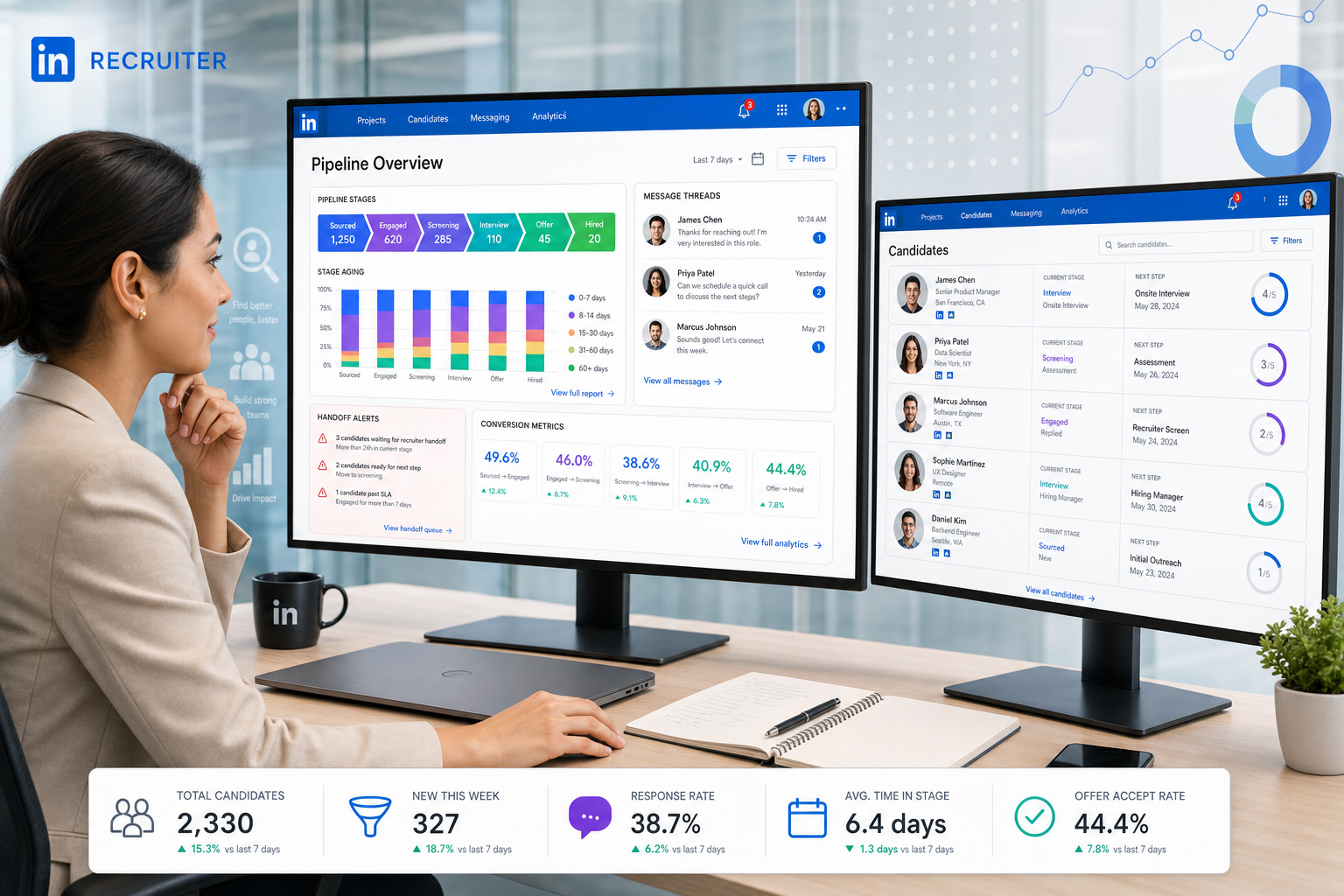
When recruitment leaders review recruitment monitoring, this article shows how to spot timing and handoff risks before delays hurt candidate trust and close rates.
That matters more than most teams admit. When recruiter notes live in inboxes, LinkedIn threads, and side spreadsheets, small delays become expensive ones: promising candidates go quiet, hiring managers lose confidence, and recruiters damage relationships by reacting late instead of managing the process with intention. For boutique search firms, solo recruiters, and in-house teams alike, the cost is not just slower hiring. It is weaker judgment, messier handovers, and a less professional candidate experience.
In my own workflow, tools that reduce repetitive outreach and keep communication moving have been the most useful support layer before I even get to reporting. One example is StrategyBrain AI Recruiter, which can keep candidate conversations active around the clock, continue follow-up in the candidate's language, and collect resumes and contact details when interest is real. That helps with the exact moments where recruitment monitoring usually breaks down: missed replies, uneven follow-up, and incomplete records. The recruiter still makes the final call on fit, resume review, and next-step decisions, but the workflow becomes much easier to track cleanly.
A familiar version of this problem shows up when a candidate decides to leave a specialized role, such as an accounting position, and everything depends on timing. A resignation made in frustration, without a transition plan, creates avoidable risk for the candidate and for anyone recruiting around that move. Notice periods, final dates, handover expectations, and professional messaging all suddenly matter. From the recruiter side, that means active conversations can change status quickly, and if those updates are not captured properly, the process slips out of sync fast.
Then the transition pressure starts. The candidate is wrapping up work, trying to leave on good terms, and thinking carefully about how they will be remembered. Meanwhile the recruiter is checking message history, confirming availability, updating stage status, chasing a resume, and making sure the hiring manager understands whether the move is real or still tentative. That is exactly where software selection becomes a recruitment monitoring question, not just a database question. The best recruiting software helps teams track these decision moments, connect them to talent acquisition metrics, and focus on the key recruitment metrics that reveal whether timing, communication, and conversion are under control.
Table of Contents
- Why recruitment monitoring comes first
- What the best recruiting software should actually do
- The three recruiting pressures the right system must handle
- Key recruitment metrics and talent acquisition metrics that matter
- Quick metric reference table
- Three software categories recruiters compare most
- How to choose by team use case
- Common buying mistakes
- FAQ
Why Recruitment Monitoring Comes First
Experienced recruiters rarely lose control because they lack a feature. They lose control because they cannot see movement clearly enough to act early. That is why recruitment monitoring is a better lens than a generic software checklist.
When a candidate is weighing a resignation, serving notice, or trying to exit professionally, the recruiter needs more than contact storage. They need visibility into conversation status, timeline confidence, handoff risk, and next actions. The same is true on the employer side. Hiring managers want to know whether a candidate is truly progressing or just loosely interested, whether a delay is minor or structural, and whether recruiter effort is translating into real movement.
Good recruiting software turns that uncertainty into an operating system. It lets teams see where candidates stall, which roles absorb too much recruiter effort, and which process steps damage speed or candidate trust. That is the practical foundation behind stronger talent acquisition metrics.
Practical takeaway: The best recruiting software is the one that helps a recruiter manage delicate timing and professional transitions without losing data, context, or momentum.
What the Best Recruiting Software Should Actually Do
The phrase best recruiting software gets overused because it mixes very different buying needs. In practice, most teams are comparing three overlapping things: a core applicant tracking system, a broader recruiting suite, or an outreach-and-automation layer that feeds the top of funnel.
What matters is not which category sounds most modern. What matters is whether the system helps recruiters run a process with fewer blind spots.
- Capture real activity: emails, outreach, replies, resumes, stage moves, interview coordination, and decision notes
- Show pipeline health: where people are waiting, dropping off, or converting
- Support handoffs: between recruiter, hiring manager, sourcer, and coordinator
- Preserve context: so a recruiter can see not just status, but why a candidate is at that status
- Make reporting usable: so dashboards support action instead of becoming leadership wallpaper
In my experience, the strongest systems are the ones that reduce the gap between conversation work and reporting work. When recruiters have to reconstruct activity after the fact, data quality collapses. When the workflow itself creates the record, monitoring gets easier and the metrics become more credible.
The Three Recruiting Pressures the Right System Must Handle
The reference scenario about leaving an accounting job with professionalism maps surprisingly well to software evaluation. It highlights three pressure points recruiters deal with every week: timing, transition, and professional brand.
1. Timing pressure
A candidate may feel ready to move, but not every moment is the right moment to act. In search work, that means the recruiter must distinguish between frustration and readiness. A system should help log those signals clearly: who is exploratory, who is interviewing, who is waiting for bonus timing, and who cannot move until notice terms are clear.
If software cannot capture this nuance, pipelines look healthier than they are. That leads to weak forecasts and misleading speed metrics.
2. Transition pressure
Once a move becomes real, the recruiter has to manage transition details carefully. Final interview timing, resignation timing, notice period, replacement risk, and communication pacing all start to matter. This is where recruitment monitoring becomes operational. Recruiters need reminders, activity histories, status confidence, and stakeholder alignment in one place.
In one stretch of sourcing-heavy work, I used AI Recruiter as an always-on conversation layer for LinkedIn outreach while I handled shortlisting and final judgment myself. What stood out was not just saved effort. It was the continuity: overnight replies were captured, interested candidates shared resumes without long lag, and I did not have to manually chase every thread before updating the ATS. For roles where timing changed quickly, that was genuinely useful.
3. Professional brand pressure
The original resignation advice also emphasized leaving on good terms. Recruiters should pay attention to that, because candidate reputation often affects close rates. A candidate who wants to exit professionally is usually more thoughtful about communication, availability, and next steps. Software should make it easier to preserve that professionalism rather than disrupt it with duplicate follow-ups, missed messages, or confused stage changes.
That is another reason the best recruiting software does more than track applicants. It protects the quality of interaction around the candidate's move.
Key Recruitment Metrics and Talent Acquisition Metrics That Matter
Once the workflow is stable, the next question is measurement. The most useful key recruitment metrics are the ones that connect directly to recruiter decisions. I usually group them into four buckets: speed, funnel efficiency, quality, and cost.
Speed metrics
- Time-to-fill: days from approved requisition to accepted offer or filled role
- Time-to-hire: days from candidate entry to accepted offer
- Stage aging: how long candidates sit at each step
- Pipeline velocity: how quickly movement happens from one stage to the next
These matter because resignation timing, notice periods, and decision windows are all time sensitive. If a system cannot show where time is being lost, it cannot support strong recruitment monitoring.
Funnel efficiency metrics
- Applicant-to-interview ratio: how many applicants generate an interview
- Interview-to-offer ratio: how many interviews produce an offer
- Offer acceptance rate: the share of offers accepted
- Source-of-hire: which channels produce successful hires
These are among the most actionable talent acquisition metrics because they show whether recruiter effort is being invested in the right channels and the right candidates.
Quality metrics
- Quality-of-hire: often a mix of manager satisfaction, ramp speed, retention, or early performance
- Early retention: whether hires stay through a defined period
Quality is harder to measure, but it matters most when the process includes sensitive transitions. A rushed hire can look fast in the dashboard and still be a poor business decision later.
Cost metrics
- Cost-per-hire: total recruiting cost divided by total hires
- Source efficiency: relative value of each sourcing channel based on conversion and outcomes
For firms managing recruiter capacity carefully, cost should be interpreted alongside workflow efficiency. Lower admin effort is useful only if quality and conversion hold up.
Quick Metric Reference Table
| Metric | What It Shows | Why It Matters |
|---|---|---|
| Time-to-fill | How long it takes to close a role | Reveals planning gaps and process drag |
| Time-to-hire | How long a candidate spends in process | Reflects candidate-facing speed |
| Stage aging | Where candidates sit too long | Highlights handoff and approval delays |
| Pipeline velocity | Stage-to-stage movement speed | Supports recruitment monitoring directly |
| Applicant-to-interview ratio | How many applicants produce an interview | Shows screening precision and top-of-funnel quality |
| Interview-to-offer ratio | How many interviews lead to an offer | Reveals calibration issues |
| Offer acceptance rate | Percentage of offers accepted | Signals competitiveness and candidate alignment |
| Source-of-hire | Where hires come from | Helps optimize sourcing spend |
| Quality-of-hire | Post-hire success indicators | Connects recruiting work to business outcomes |
| Cost-per-hire | Average cost of hiring | Supports budgeting and efficiency reviews |
When comparing software, ask whether these metrics are merely displayed or truly usable. Can definitions be edited? Can the data be trusted? Can recruiters and hiring managers actually use the report in a live decision conversation?
Three Software Categories Recruiters Compare Most
Rather than listing specific brands, it is more useful to compare the three software categories most teams evaluate when searching for the best recruiting software.
1. Traditional applicant tracking systems
Best for: teams that need structured requisition workflows, candidate records, interview coordination, and baseline reporting.
Strengths: process control, compliance support, hiring manager collaboration, centralized records.
Limitations: many ATS platforms are better at recordkeeping than at top-of-funnel engagement or nuanced conversation tracking.
Best fit: in-house teams, growing HR functions, and firms that need consistency first.
How they work with AI support: an ATS can remain the system of record while an outreach layer such as StrategyBrain AI Recruiter helps keep sourcing and candidate responses moving before final recruiter review.
2. Recruiting suites with built-in analytics
Best for: teams that want workflow plus more advanced reporting and dashboarding.
Strengths: stronger cross-team visibility, better trend analysis, broader support for talent acquisition metrics.
Limitations: can be heavier to implement and may still depend on recruiters to manually maintain top-of-funnel activity quality.
Best fit: larger internal talent teams and multi-role environments.
How they work with AI support: useful when leadership wants reliable metrics but recruiters still need help handling volume, off-hours replies, and multilingual candidate communication.
3. Sourcing and outreach automation layers
Best for: headhunters, sourcing-heavy teams, and recruiters who live in LinkedIn and outbound workflows.
Strengths: faster outreach, better response continuity, reduced repetitive messaging work, stronger top-of-funnel coverage.
Limitations: these tools usually do not replace final recruiter judgment, hiring-stage governance, or full ATS needs.
Best fit: agency recruiters, executive search, hard-to-fill roles, and lean teams needing scale.
How they work with AI support: this is where AI Recruiter is most relevant, especially for recruiters who need ongoing candidate messaging, multilingual communication, and resume capture without losing control of shortlist decisions.
How to Choose by Team Use Case
For solo recruiters and boutique search firms
Prioritize visibility and communication continuity. You need to know who replied, who is qualified, who is serious, and what happens next without rebuilding the story from message threads. Strong recruitment monitoring matters more than a flashy interface.
For in-house recruiting teams
Prioritize stage discipline, hiring manager collaboration, and consistent metric definitions. If the team cannot agree on what counts as open, active, or closed, the software will not fix the reporting problem.
For sourcing-heavy headhunters
Prioritize outreach tracking, source performance, and resume capture. This is especially important when candidates are moving cautiously and may not formally commit until timing is right.
For talent leaders focused on reporting
Prioritize dashboards that can connect frontline workflow to board-level reporting. The most useful systems let you move from recruiter action to key recruitment metrics without a lot of manual cleanup.
Common Buying Mistakes
Buying for feature volume instead of decision support
If the system stores more than it clarifies, recruiters will still operate from side channels.
Ignoring transition moments
Many teams track sourcing and interviews well, but lose visibility when candidates enter notice periods, pause for timing reasons, or need more deliberate communication. That gap directly affects close rates.
Tracking too many metrics too early
Start with the basics: time-to-fill, time-to-hire, stage aging, source-of-hire, offer acceptance rate, and conversion ratios. Expand only when the data hygiene is stable.
Assuming automation replaces recruiter judgment
It does not. Automation can handle repetitive communication and improve data continuity, but final qualification, resume assessment, and shortlist decisions still belong to the recruiter.
Forgetting candidate brand and employer brand
The original resignation advice is useful here: people remember how transitions are handled. Software should support professional exits and professional hiring conversations, not make them feel more transactional.
FAQ
What is recruitment monitoring in recruiting software?
Recruitment monitoring is the ongoing tracking of candidate movement, stage aging, conversion, communication activity, and hiring outcomes. It helps recruiters spot bottlenecks early and manage the process with more confidence.
What are the most important key recruitment metrics?
For most teams, start with time-to-fill, time-to-hire, stage aging, applicant-to-interview ratio, interview-to-offer ratio, offer acceptance rate, and source-of-hire.
How do talent acquisition metrics differ from recruiting activity data?
Activity data shows what happened in the workflow. Talent acquisition metrics connect that activity to business outcomes such as speed, quality, retention, and efficiency.
Can AI tools help without replacing recruiters?
Yes. In practice, AI-supported outreach and communication tools are most helpful when they reduce repetitive work, maintain follow-up continuity, and capture candidate information cleanly while recruiters keep control of evaluation and decision-making.
What type of team needs the best recruiting software most urgently?
Usually the team handling high candidate volume with limited recruiter time. That includes boutique search firms, sourcing-heavy recruiters, and in-house teams scaling quickly without strong workflow discipline yet.
Conclusion
The best recruiting software is not the platform with the longest feature list. It is the one that helps recruiters handle timing well, manage transitions cleanly, and protect professional relationships while producing reliable recruitment monitoring.
If you evaluate software through that lens, the right questions become clearer. Can the system show where candidates stall? Can it preserve context around a sensitive career move? Can it support the key recruitment metrics and talent acquisition metrics your team actually uses to make decisions?
When the answer is yes, software stops being a storage tool and becomes an operating advantage.