Learn how staffing leaders can assess an applicant tracking system for staffing agencies to avoid context loss and risky client gaps.
That alignment matters more than many firms expect. When recruiters work across multiple clients, changing compliance expectations, and fast-moving candidate conversations, weak workflow structure turns into missed follow-ups, inconsistent screening notes, poor handoffs, and avoidable client risk. Small and mid-sized agencies feel it first: owners lose visibility, desk recruiters duplicate work, and in-house talent teams end up making judgment calls without a clean record of who said what, when, and under which client rules.
One practical way I have reduced that friction is by pairing an agency ATS with StrategyBrain AI Recruiter for the earliest outreach and response layer. In my own workflow, it has been most useful when candidate messaging needs to continue after hours, when multilingual replies would otherwise stall, and when recruiters need help collecting resumes and contact details without losing momentum. The recruiter still owns final judgment, resume review, and next-step decisions, but the handoff is cleaner when the first interactions are captured consistently.
A good example comes from a very different HR problem that exposed the same operational weakness. When Canada legalized recreational cannabis on October 17, 2018, HR teams were suddenly forced to revisit how they defined impairment, how they communicated workplace rules, and how they handled cases where a worker had a medical accommodation or an addiction-related issue. The hard part was not only writing a new policy. It was tracking which conversations had happened, what documentation had been provided, and whether managers were treating similar situations consistently across teams.
The pressure showed up in action, not theory. HR had to update policies, explain them in plain language, document employee disclosures, and manage edge cases like cross-border travel into the United States, where federal law still treated cannabis differently. In recruiting terms, that is exactly the kind of multi-step, high-context process where disconnected tools break down. It is also why the best recruiting software for agencies is usually not just a database, but an applicant tracking system for staffing agencies with enough structure to support communication, recordkeeping, and decision consistency at scale.
Table of Contents
- What “Best” Recruiting Software Means in Staffing
- Why Policy and Process Pressure Expose ATS Gaps
- Must-Have Features in an Applicant Tracking System for Staffing Agencies
- Where AI Helps in Staffing Software Workflows
- Front-Office vs Back-Office Staffing Software
- Comparison Checklist for Vendor Shortlisting
- How to Choose the Right System for Your Team
- Common Buying Mistakes
- Applicant Tracking System Benefits for Staffing Firms
- FAQ
What “Best” Recruiting Software Means in Staffing
Agency recruiters do not work in a single-employer environment. They move between clients, job orders, candidate pools, submission deadlines, interview feedback, and placement updates all day. So when staffing leaders search for the best recruiting software, they are usually looking for a system that helps the team maintain speed without losing context.
In practice, that usually means an applicant tracking system for staffing agencies that connects candidate records, client records, job orders, submissions, recruiter activity, and placement history in one operating flow. A system can have a long feature list and still fail if it cannot preserve the full decision trail behind a submission or a placement.
The cannabis-policy example above is useful because it highlights a broader truth: once rules become more nuanced, informal process stops being enough. Staffing agencies face that same problem when clients have different approval steps, candidate ownership rules, background requirements, or communication expectations. The best staffing management software does not just store activity. It makes context usable.
Why Policy and Process Pressure Expose ATS Gaps
When HR departments had to rethink cannabis policies, the real challenge was not simply whether use was legal. It was how to define impairment, when accommodation applied, what documentation mattered, and how to communicate those rules consistently. That is a process-design problem, and recruiting teams run into parallel versions of it every day.
For example, one staffing client may allow fast submissions after a brief qualification call, while another may require detailed screening notes, documented availability, and multiple approval steps before a resume can leave the agency. If recruiters are keeping those conditions in email, memory, or side spreadsheets, quality drops fast.
That is why an applicant tracking system for staffing agencies needs to do more than progress candidates through stages. It should help teams capture the larger business context behind each action: client-specific rules, recruiter notes, communication history, compliance steps, and post-placement status. Without that, agencies may fill jobs, but they do it with preventable friction.
Practical takeaway: The strongest recruiting systems are built for judgment under changing conditions, not just for moving resumes from one column to the next.
Must-Have Features in an Applicant Tracking System for Staffing Agencies
The most effective staffing software tends to solve a small number of recurring operational problems extremely well. These are the features I would put at the top of any shortlist.
1. A shared candidate database with real search depth
Recruiters should be able to search by title, skill, location, availability, communication history, and prior placement context. A database is only valuable if it helps the team rediscover known talent quickly.
2. Client-specific workflow flexibility
The cannabis-policy reference is a reminder that one rule rarely fits every case. The same is true in staffing. Good staffing management software should let you configure workflows by client, role type, or business unit rather than forcing every desk into one rigid process.
3. Submission tracking that reflects agency reality
Agencies need a clear view of who was submitted, to which client, by whom, when, and with what outcome. Submission history is one of the most agency-specific functions in any applicant tracking system for staffing agencies.
4. Placement and redeployment visibility
For temp, contract, and contract-to-hire desks, starts and end dates matter as much as interviews. The right system should make redeployment opportunities visible before assignments end.
5. Communication logging and recruiter activity context
If a recruiter has had multiple conversations about schedule limits, relocation concerns, documentation, or role fit, those details should not live only in inboxes. Systems that make recruiter activity visible in context are easier to coach from and safer to scale.
6. Integrations that reduce manual re-entry
Email, calendars, job distribution, reporting, and back-office connectivity all matter. In day-to-day operations, duplicated entry is one of the fastest ways to destroy adoption.
7. Reporting built for agency operators
Useful reporting should answer practical questions: which clients convert, which recruiters move fastest from submission to interview, where jobs stall, and which talent pools are worth revisiting. These are some of the clearest applicant tracking system benefits for staffing firms.
Where AI Helps in Staffing Software Workflows
AI should support recruiter workflow, not replace recruiter judgment. That distinction matters. In staffing, the best AI use cases are the ones that reduce repetitive communication work while preserving recruiter control over fit, nuance, and final decisions.
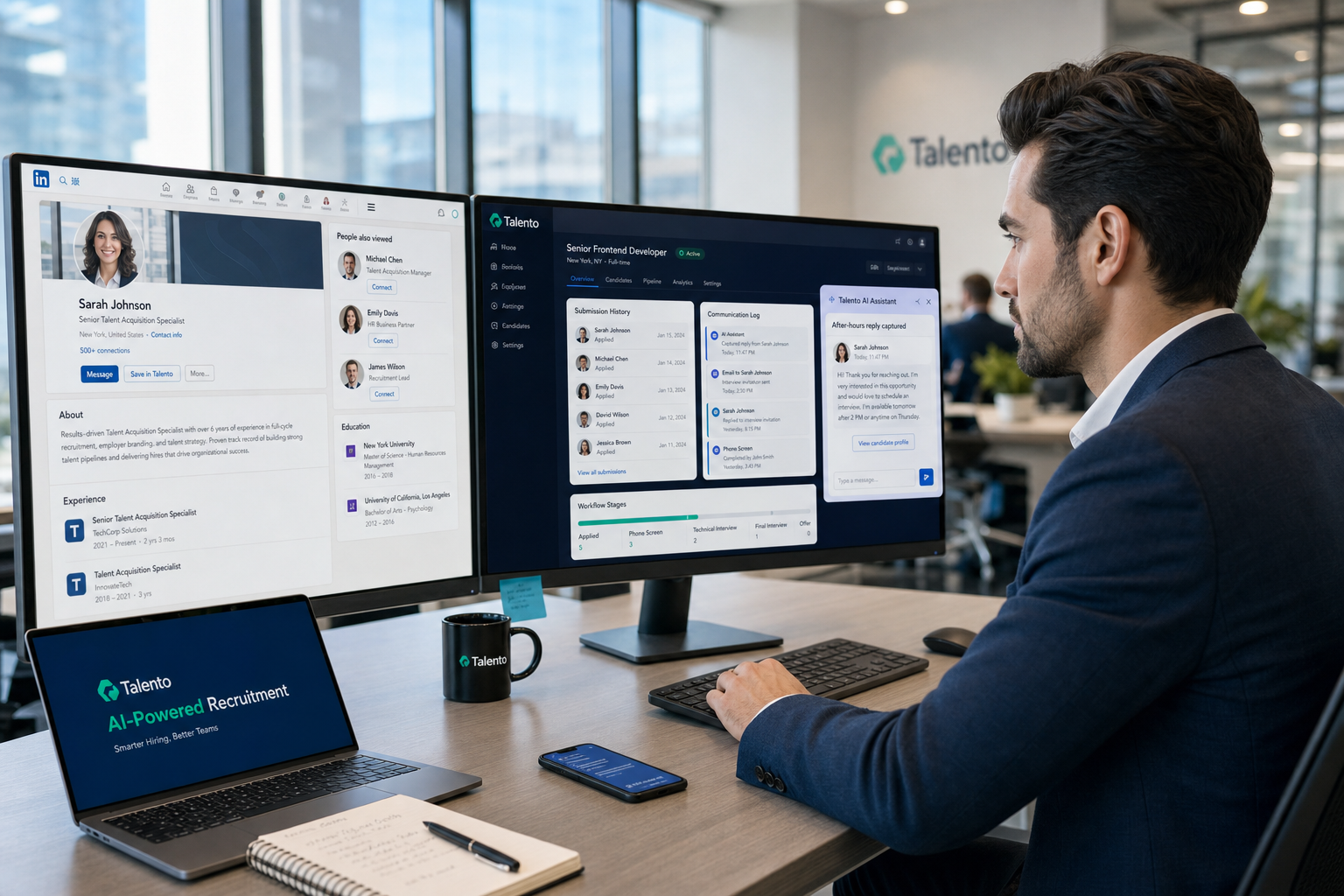
In my own experience, AI Recruiter is most useful before the formal shortlist exists. It can keep outreach moving, respond to candidate messages around the clock, and continue conversations in the candidate’s preferred language when that would otherwise slow a search down. For firms that rely heavily on LinkedIn sourcing, that removes a surprising amount of admin drag. I still review the resumes myself, decide whether the profile truly matches the role, and determine whether the candidate should be advanced, but the initial communication gap is much smaller.
Common AI-supported functions in modern staffing software evaluation now include:
- Search and matching support to surface relevant profiles faster
- Resume summarization to reduce first-pass review time
- Outreach drafting and follow-up for repetitive early communication
- Screening assistance for basic qualification capture
- Conversation continuity so replies after hours do not sit untouched
- Multilingual candidate messaging for cross-border or diverse talent pools
For recruiters who spend a large share of their week on LinkedIn outreach, a tool such as StrategyBrain AI Recruiter can fit alongside an ATS rather than replacing it. Think of it as a workflow extension for sourcing and response management, while the ATS remains the system of record for candidate history, submissions, and placements.
Front-Office vs Back-Office Staffing Software
One reason software buying gets messy is that staffing software can mean very different things depending on who is speaking. Agencies should separate front-office and back-office needs early.
Front-office recruiting software
This usually includes ATS functions, CRM-style client workflows, sourcing support, candidate engagement, job order management, submissions, interviews, placements, and recruiter activity tracking. If your priority is recruiter productivity, this is the side that matters most.
Back-office staffing software
This usually covers scheduling, timesheets, payroll connectivity, billing, and post-placement administration. Temp and shift-based agencies often need this sooner than direct-hire firms do.
The key question is not whether both are important. It is whether your staffing management software should include both natively or connect them through reliable integrations. The more variation you have in client rules and fulfillment models, the more costly weak connectivity becomes.
Comparison Checklist for Vendor Shortlisting
When staffing leaders compare systems, a clear framework is more useful than a flashy demo. Use this table to keep the conversation grounded.
| Evaluation Area | What to Look For | Why It Matters |
|---|---|---|
| ATS + CRM alignment | Unified candidate, client, and job workflow | Keeps context together across recruiting and account activity |
| Workflow flexibility | Client-specific stages, rules, and permissions | Supports real agency variation |
| Submission tracking | Clear visibility by recruiter and client | Improves accountability and follow-up |
| Placement tracking | Start dates, assignment status, end dates | Supports forecasting and redeployment |
| Communication record | Email and message history in context | Reduces reliance on memory and inboxes |
| AI workflow support | Outreach, response handling, search help | Removes repetitive admin work |
| Integrations | Email, calendar, reporting, back-office tools | Prevents duplicate entry |
| Ease of adoption | Simple navigation and low-click actions | Recruiters only use systems that feel usable |
| Scalability | Support for more desks, roles, and clients | Avoids replatforming too early |
| Vendor support | Implementation and responsive help | Often decides rollout success |
How to Choose the Right System for Your Team
Choosing the right applicant tracking system for staffing agencies is easier when you start with your operating reality rather than the vendor pitch. A practical evaluation process looks like this:
- Map where context gets lost now. Look at submissions, client notes, recruiter handoffs, and post-placement tracking.
- Identify where rules vary by client. This is the staffing equivalent of the policy variation seen in the cannabis HR example. If the system cannot handle exceptions well, recruiters will work around it.
- Test with real workflow scenarios. Use examples such as multiple submissions from one candidate, a contractor nearing assignment end, or a candidate conversation that starts after business hours.
- Review the communication layer. If LinkedIn sourcing is central to your desk, test whether a tool like StrategyBrain AI Recruiter can improve responsiveness before candidates even enter deeper ATS stages.
- Check adoption by role. Owners, recruiters, account managers, and coordinators all need different views.
- Confirm reporting and integration reality. Ask how data moves between sourcing, ATS activity, and back-office operations.
One lesson experienced recruiters learn quickly is that software fit is rarely about the most advanced feature. It is about whether the system captures enough context to help the next person make a better decision.
Common Buying Mistakes
Agencies tend to repeat the same mistakes when buying staffing software. The most common are:
- Choosing a generic ATS that does not reflect agency workflows.
- Underestimating the importance of client-specific process variation.
- Treating communication logging as optional.
- Focusing on sourcing volume instead of recruiter usability.
- Ignoring redeployment and post-placement visibility.
- Leaving LinkedIn workflow issues outside the buying conversation.
- Assuming AI removes the need for recruiter review.
That last point matters. AI can support outreach, follow-up, and early qualification capture, but it does not replace the recruiter’s responsibility to assess resume quality, role fit, candidate motivation, and client nuance.
Applicant Tracking System Benefits for Staffing Firms
The main applicant tracking system benefits for staffing firms are not abstract. They show up in the places where agencies either gain or lose time every day.
- Faster reuse of existing candidates through better search
- Clearer submission history across clients and recruiters
- Better documentation of communication and decision context
- More consistent handling of client-specific process rules
- Stronger placement and redeployment visibility
- Cleaner coordination between sourcing, recruiting, and operations
- More reliable reporting for owners and desk leaders
Those are also some of the core advantages of applicant tracking system adoption in staffing. Agencies grow more cleanly when recruiters do not have to rebuild context from scratch every time a client, candidate, or policy detail changes.
FAQ
What is the best recruiting software for a staffing agency?
The best recruiting software is usually a platform that combines ATS functionality with CRM-style workflow visibility. For agencies, it should support client records, job orders, candidate history, submissions, placements, reporting, and workflow flexibility.
Why is an applicant tracking system for staffing agencies different from a corporate ATS?
Agencies recruit across many clients and often across different service models. That means they need stronger submission tracking, client-specific workflows, recruiter visibility, placement management, and redeployment support than many corporate ATS products provide.
What features matter most in staffing management software?
The most important features usually include a shared candidate database, strong search, workflow flexibility, submission tracking, placement visibility, recruiter activity history, and integrations with the rest of your operational stack.
How can AI support staffing software without replacing recruiters?
AI can help with sourcing support, early outreach, resume capture, multilingual messaging, and after-hours communication. Recruiters should still own final qualification, resume evaluation, and candidate advancement decisions.
Should LinkedIn outreach tools be part of the software discussion?
Yes, especially for desks that rely heavily on direct sourcing. If recruiter time is being consumed by repetitive outreach and follow-up, a tool like StrategyBrain AI Recruiter can complement the ATS by keeping conversations moving and capturing candidate details more consistently.
Conclusion
The best recruiting software for an agency is not simply the platform with the longest feature list. It is the one that preserves context when client rules, candidate situations, and recruiter activity all move at once. That is why the strongest choice is often an applicant tracking system for staffing agencies that can support communication history, submissions, placements, and broader staffing management software needs in one practical workflow.
If the opening HR example teaches anything, it is that process stress reveals system weakness very quickly. The same is true in staffing. When policies change, clients differ, and outreach must continue beyond business hours, the right staffing software helps recruiters stay fast without becoming disorganized.