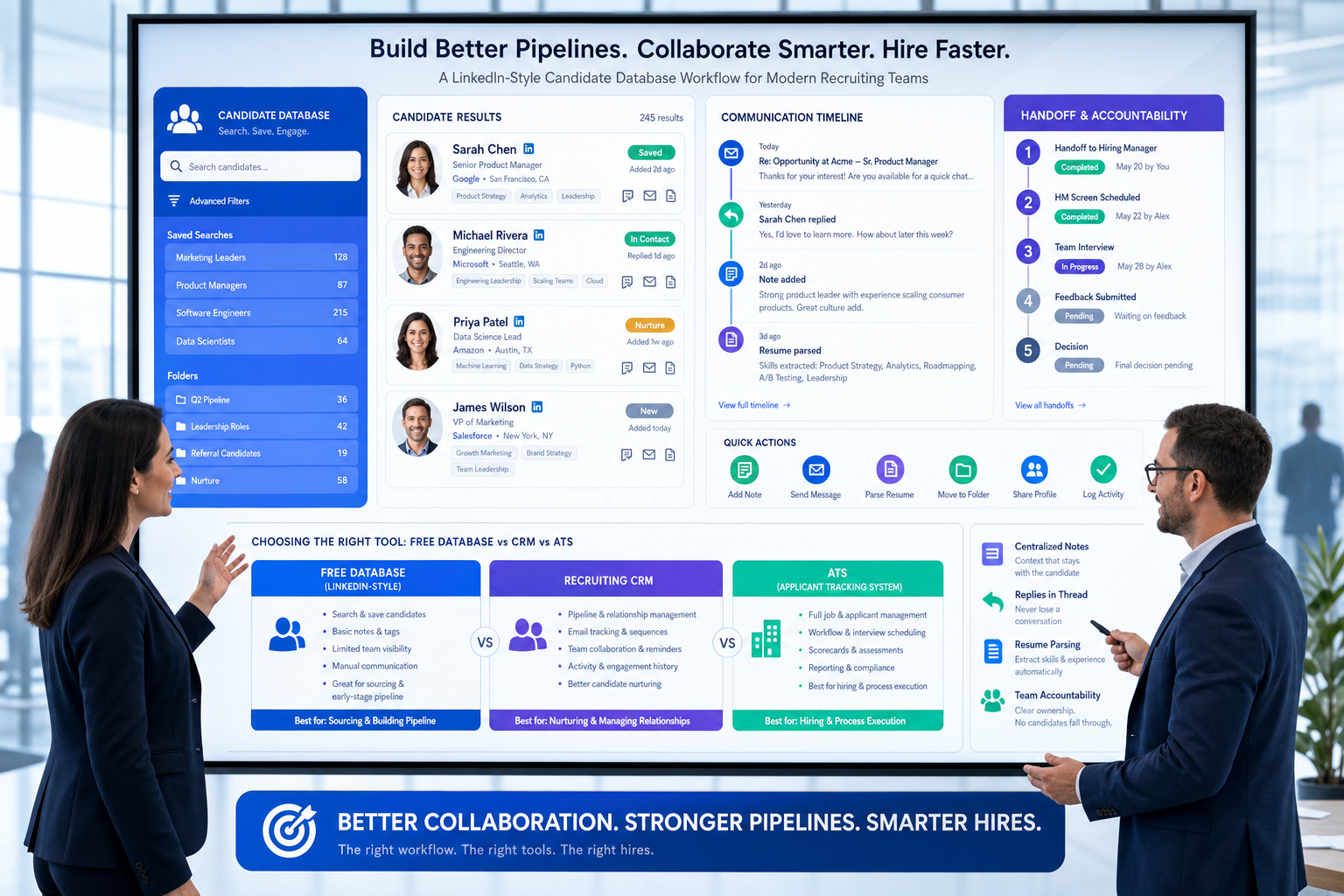
This guide shows recruiting leaders how to judge a candidate database for recruiters before weak handoffs slow hiring.
That distinction matters more than most demos admit. When recruiters, hiring managers, coordinators, and part-time interviewers all touch the same search, shortlist, and follow-up flow, weak systems create hidden costs: duplicate outreach, missed candidate replies, poor handoffs, and slow decisions. Smaller staffing firms feel it in lost billable time. Solo recruiters feel it in late-night admin. Internal talent teams feel it when hiring managers stop trusting pipeline updates because records are incomplete or scattered.
In my own workflow, I have found that StrategyBrain AI Recruiter is most useful when the problem is not sourcing volume alone, but continuity. Its always-on candidate messaging, multilingual communication, and automated collection of resumes and contact details can keep early conversations moving while the recruiter still handles final judgment, resume review, and shortlist decisions. In other words, it can reduce the gap between first contact and usable candidate records without pretending to replace recruiter assessment.
The teamwork problem is easy to miss until a hiring process depends on people who do not work the same schedule. A growing employer may rely on full-time staff, part-time specialists, contractors, and rotating interviewers to fill one urgent role. The work itself is interdependent: one person opens the requisition, another reviews skills, a manager checks team fit, and someone else needs to answer candidate questions quickly enough to keep interest alive. If those contributors rarely overlap, trust and coordination become operational issues, not soft culture topics.
That is exactly why the best recruiting software should be judged by more than features. When a hiring team needs shared goals, visible communication, clear accountability, and fast feedback across mixed schedules, the real question becomes whether your system acts as a true candidate database for recruiters, whether free resume lookup can support the search long enough, and when a free candidate database stops being enough for a team-based hiring workflow.
- The best recruiting software supports teamwork across recruiters, hiring managers, and part-time stakeholders, not just applicant storage.
- A strong candidate database for recruiters should preserve search context, communication history, and rediscovery value across mixed schedules.
- Free resume lookup can help find talent, but it does not solve coordination, accountability, or team visibility on its own.
- A free candidate database may work for early-stage hiring, but collaborative teams usually outgrow it quickly.
- The biggest value in modern recruiting software comes from shared goals, trust, open communication, and repeatable workflow discipline.
Table of Contents
- Why Teamwork Matters in Recruiting Software
- What Best Recruiting Software Really Means
- Why a Candidate Database for Recruiters Is the Core Layer
- Team Building Signals That Translate Into Software Needs
- How Free Resume Lookup Works in Real Recruiting
- Free Candidate Database vs ATS vs Recruiting CRM
- Features That Matter Most
- Best Fit by Team Type
- Common Buying Mistakes
- FAQ
Why Teamwork Matters in Recruiting Software
A lot of hiring software gets evaluated as if recruiting were a solo activity. In reality, most hiring outcomes depend on coordinated work between full-time recruiters, part-time interviewers, hiring managers, coordinators, and sometimes external specialists. The larger and more time-sensitive the process, the more teamwork becomes a system requirement.
That is especially true in complex or fast-moving environments. In teams that handle urgent staffing, hard-to-fill roles, or high-volume hiring, success depends on more than finding names. People need to trust each other, understand the broader hiring goal, share feedback quickly, and make decisions without waiting for perfect schedule overlap. A weak system breaks that chain.
From a recruiting operations perspective, the best software helps teams stay aligned even when contributors work different hours or carry different responsibilities. It should make candidate history visible, preserve notes, centralize communication, and support immediate feedback on next steps. Those are not just collaboration nice-to-haves. They are workflow controls.
What Best Recruiting Software Really Means
The phrase best recruiting software only becomes useful when tied to actual hiring behavior. A retained search firm, an in-house talent team, and a small staffing business will all define “best” differently. But in every case, the platform should reduce friction between sourcing, communication, evaluation, and team coordination.
That is why I do not start with a long feature checklist. I start with operating questions:
- Can the team see the same candidate history without chasing notes?
- Can someone picking up later understand the larger hiring goal quickly?
- Can feedback move fast enough to keep candidates warm?
- Can recruiters rediscover previous talent instead of restarting each search?
- Can the system support both independent recruiter work and shared accountability?
If the answer is no, the tool may still look polished in a demo, but it will struggle in live hiring. The best recruiting software is not just about collecting applicants. It is about helping a team move together.
Why a Candidate Database for Recruiters Is the Core Layer
A candidate database for recruiters is more than a storage area for resumes. It is the searchable memory of your hiring operation. When built and maintained well, it allows full-time and part-time contributors alike to work from shared context rather than fragmented recollection.
This matters because modern teams often lose value between searches. A recruiter speaks to a good candidate, a hiring manager likes the profile, the role closes, months pass, and no one can easily find or trust the old record. Then the next search begins from zero. That is wasted sourcing effort.
The better alternative is a database that supports:
- structured resume parsing
- Boolean and filtered search
- saved searches for repeat hiring patterns
- tagging by function, seniority, and campaign
- communication history across users
- candidate rediscovery for silver medalists and prior finalists
Those capabilities are where software begins to improve real hiring operations. They also reinforce one of the most practical applicant tracking system benefits: preserving institutional knowledge, not just documenting applicants.
Key insight: Teams do not lose hiring speed only because they lack candidates. They lose speed because they lack shared memory.
Team Building Signals That Translate Into Software Needs
One useful way to assess recruiting software is to borrow from team-building logic. Strong teams tend to share a clear goal, recognize that the end result is larger than any one person's contribution, communicate openly, respect each other’s input, and use leadership and process discipline to stay aligned. In hiring, those same traits map directly to software requirements.
1. Shared goals require visible hiring context
If recruiters and hiring managers do not understand the broader business goal behind a role, search quality drops. A good system should let users record not only job requirements but also context: why the role matters, what the team lacks, what trade-offs are acceptable, and what success looks like after hire.
2. Trust requires clean records
Trust is difficult when different contributors rarely cross paths. Part-time stakeholders especially need confidence that what they see in the system is current and complete. If communication history, feedback, or resume versions are missing, people start relying on side messages and memory.
3. Fast feedback requires communication design
Open communication with positive feedback sounds cultural, but it is also technical. Can the team log questions? Can notes be shared outside immediate inboxes? Can recruiters see whether a candidate already replied? Even a simple system should make this easier, not harder.
4. Good team composition requires contribution visibility
A recruiting workflow works better when each stakeholder knows their part. The recruiter sources. The manager calibrates fit. The coordinator moves scheduling. The interviewer adds focused feedback. The software should support those roles without forcing everyone into the same behavior.
5. Leadership and process require accountability
Teams move faster when ownership is clear. The best software lets everyone see who owns outreach, who owes feedback, which stage a candidate is in, and what action is next. Without that, delays are blamed on “the process” when the real issue is invisible accountability.
I have also used AI Recruiter alongside manual workflow in situations where response timing was the bottleneck. What stood out was not just automation, but how it kept candidate intent, contact details, and resume collection from slipping through the cracks after hours or across time zones. That helped the recruiting team preserve momentum, while I still made the final call on fit and whether to advance someone.
How Free Resume Lookup Works in Real Recruiting
Many users searching for free resume lookup are really trying to solve two problems at once: finding candidates without immediate paid database spend and creating a workable first-pass sourcing process. Free methods can help with the first problem, but only partly with the second.
In practice, free resume lookup usually means combining public and owned sources:
- Internal database search: old applicants, referrals, imported resumes, and prior finalists
- Search engine sourcing: targeted searches that surface public profiles and portfolio pages
- Niche communities: role-specific forums and visible professional communities
- Public job-board traces: where usage terms allow lawful review of visible profile data
- Personal and shared recruiter notes: previous conversations that have been captured properly
The method works best when recruiters move useful findings into a structured system immediately. Otherwise, free lookup creates a pile of browser tabs instead of a durable talent asset.
How to make free resume lookup usable for a team
- Start with the team goal. Clarify the must-have skills, acceptable adjacencies, timeline, and what the hiring manager can compromise on.
- Capture source and context. Record where the person was found and why they looked relevant.
- Store communication history early. The next person touching the search should know what happened already.
- Tag for future reuse. Good recruiters build reusable pools by market, skill, geography, and seniority.
- Check owned talent first on repeat roles. Internal rediscovery often beats another external sourcing sprint.
Free resume lookup is most valuable as a discovery layer. It becomes far less valuable when your team needs shared accountability, response tracking, and long-term reuse.
Free Candidate Database vs ATS vs Recruiting CRM
A free candidate database can be a useful starting point, but it is not the same thing as a mature recruiting platform. To evaluate options properly, it helps to separate three jobs: finding candidates, managing relationships, and controlling the hiring process.
| Capability | Free Candidate Database | Recruiting CRM | Applicant Tracking System |
|---|---|---|---|
| Basic candidate search | Usually yes | Yes | Yes |
| Owned talent pool growth | Limited or partial | Strong | Moderate to strong |
| Resume parsing | Basic or limited | Often included | Often included |
| Outreach history | Limited | Strong | Varies |
| Stage management | Minimal | Light to moderate | Strong |
| Hiring team visibility | Basic | Moderate | Strong |
| Rediscovery across old searches | Basic | Strong | Moderate to strong |
For occasional hiring, a free candidate database may be enough. But once multiple stakeholders are involved, or once part-time and full-time contributors need to coordinate reliably, limitations show up fast. Search without process creates duplication. Process without usable search creates dependency on constant new sourcing. The strongest setup is the one that combines both.
Features That Matter Most
If you are comparing the best recruiting software, prioritize the capabilities that support both recruiter productivity and team alignment.
1. Resume parsing that creates usable records
Parsing should produce searchable fields, not just file attachments. Otherwise the database becomes an archive, not a working asset.
2. Strong search with filters and saved views
Recruiters still need Boolean logic, title filters, geography filters, and reusable searches. Teams also need consistent ways to revisit the same talent set later.
3. Shared communication history
This is critical in mixed-schedule teams. When one contributor speaks to a candidate and another picks up later, the full context should be visible.
4. Transparent matching and ranking
Automated matching is useful only when recruiters can understand why a profile surfaced. Black-box ranking creates weak shortlists and poor manager trust.
5. Rediscovery and reactivation tools
One of the biggest gains in recruiting operations comes from reusing previous talent instead of restarting every search externally.
6. Support for asynchronous work
This is often overlooked. The best systems help teams work across time zones, part-time schedules, and delayed feedback cycles without losing continuity.
That last point is where I have seen StrategyBrain AI Recruiter help most directly in LinkedIn-heavy outreach. Candidates often reply outside business hours, and it is easy for intent signals to cool off before a recruiter gets back to them. In my experience, having AI handle first-response continuity and information gathering made follow-up cleaner, especially when I was balancing multiple searches. But the resume review, qualification decision, and hiring recommendation still sat with me.
Best Fit by Team Type
Different teams need different levels of database depth, workflow control, and communication support.
Agency recruiters and headhunters
Agency teams usually need strong sourcing, fast outreach, and a candidate database for recruiters that compounds over time. If consultants split markets, specialize by function, or hand searches between team members, communication history and rediscovery matter as much as top-of-funnel access.
In-house talent acquisition teams
Internal teams often need balanced software: enough ATS structure for process control, enough CRM behavior for relationship tracking, and enough database power to avoid losing past applicants after requisitions close.
HR teams with occasional hiring
These teams can start lighter, especially if hiring volume is low. But even then, they should choose a system that can preserve notes, context, and reusable talent data as hiring becomes less centralized.
Mixed full-time and part-time hiring groups
This is where collaboration design matters most. Teams that depend on part-time reviewers, rotating managers, or intermittent interviewers need visible records, simple communication trails, and clear next-step ownership. A tool that works for one recruiter alone may fail badly here.
Common Buying Mistakes
Most software mistakes happen when companies buy for the visible part of recruiting and ignore the coordination layer underneath.
- Focusing on sourcing volume only: More profiles do not solve poor follow-up or weak team visibility.
- Treating the ATS like storage: If no one searches old records, previous hiring work never compounds.
- Ignoring mixed schedules: Teams with part-time stakeholders need systems that support asynchronous collaboration.
- Confusing free access with full workflow: A free candidate database may help you start, but it rarely supports mature operations.
- Overvaluing automation labels: Automation should accelerate work, not replace recruiter judgment or create opaque decisions.
- Skipping team communication design: If people cannot share notes, questions, and feedback easily, the process will leak value.
My rule of thumb is simple: if the team still depends on spreadsheets, forwarded emails, and memory to connect sourcing with decisions, you do not have the best recruiting software yet.
FAQ
What is a candidate database for recruiters?
A candidate database for recruiters is a searchable repository of applicants, sourced profiles, resumes, notes, and communication history. The best versions help recruiters and hiring teams reuse knowledge across searches instead of starting over each time.
Is free resume lookup enough for professional recruiting?
Free resume lookup can support discovery, especially for lean teams, but it rarely solves collaboration, outreach tracking, or long-term candidate rediscovery on its own.
When is a free candidate database enough?
A free candidate database can work for small teams or occasional hiring. It becomes limiting when you need structured outreach, cleaner team handoffs, better search depth, and process visibility across multiple roles.
Why does teamwork matter when choosing recruiting software?
Because recruiting is usually shared work. Full-time recruiters, part-time interviewers, hiring managers, and coordinators all need access to the same candidate context. Software that ignores that reality creates delays and duplicated effort.
What are the main applicant tracking system benefits for recruiters?
The main benefits include cleaner records, stage visibility, centralized communication, easier collaboration, and a more repeatable process. Those gains become stronger when the ATS also supports strong search and database rediscovery.
How should recruiters use AI in sourcing and outreach?
Use AI to reduce repetitive messaging, improve response continuity, and capture candidate information efficiently. Keep final screening, resume evaluation, and advancement decisions with the recruiter.
Conclusion
The best recruiting software is not just the one with the most features. It is the one that helps a real hiring team work together toward a shared goal, even when contributors have different schedules, different responsibilities, and different levels of context.
If you are evaluating tools now, start with the operational truth exposed by team-based hiring: trust, communication, accountability, and rediscovery all depend on system design. From there, judge whether your current setup truly functions as a candidate database for recruiters, whether your free resume lookup process is only a stopgap, and whether a free candidate database can realistically support the workflow your team needs.