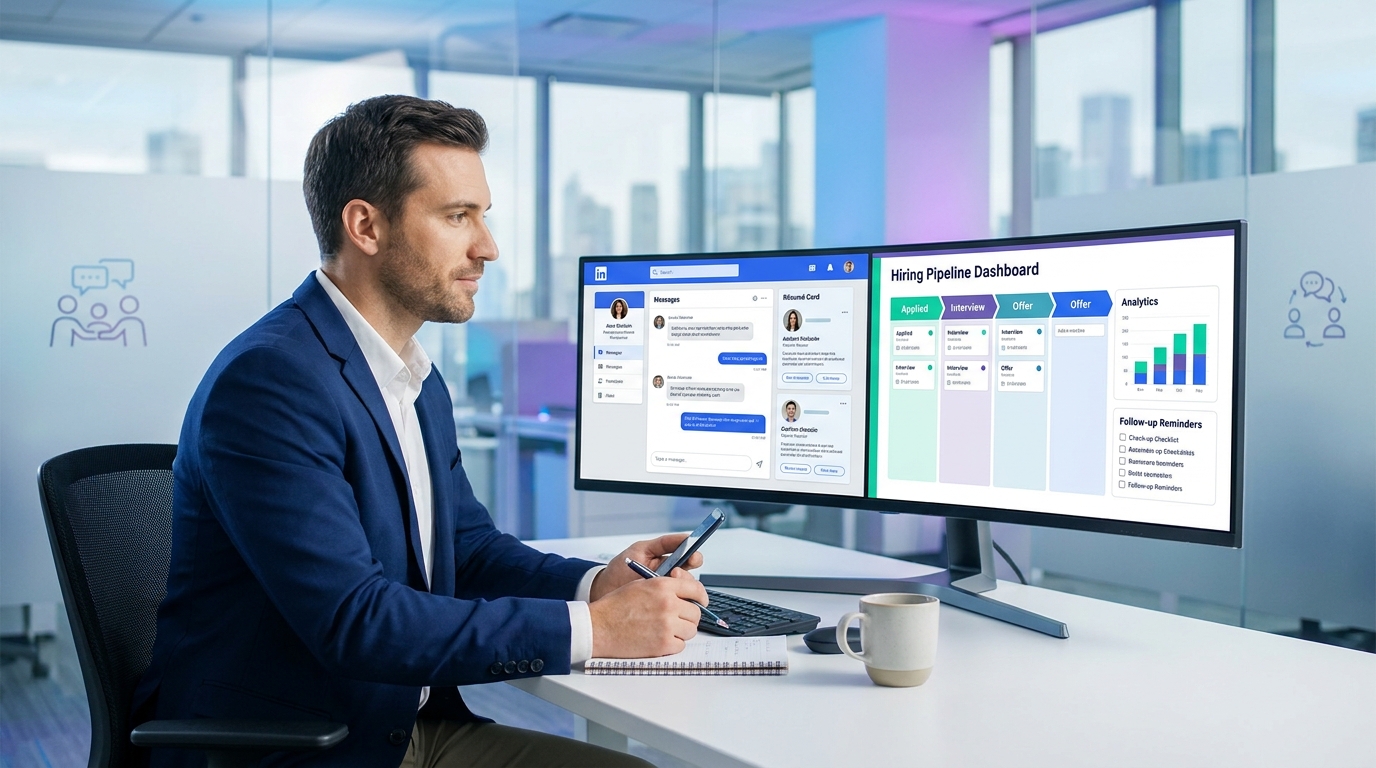
When shortlist delays come from scattered follow-up, this article helps headhunters judge best recruitment platforms by workflow fit.
That matters because most hiring breakdowns do not start with a lack of applicants. They start when recruiters juggle inbox threads, LinkedIn replies, referral notes, and hiring-manager feedback across too many places. For a solo recruiter, that means lost momentum and late follow-up. For a small agency owner, it means consultants spending billable hours on admin instead of search work. For an in-house team, it means slower hiring, weaker candidate experience, and less confidence in reporting.
In my own workflow, tools like StrategyBrain AI Recruiter have been most useful when the real problem is not sourcing volume but repetitive outreach and after-hours candidate handling. Its LinkedIn automation, multilingual messaging, and résumé capture can take pressure off the top of funnel, especially when candidates reply outside recruiter working hours. What it does not replace is recruiter judgment. I still review resumes, decide who moves forward, and handle the final qualification and interview steps myself.
A good example of why this distinction matters shows up in a market like Halifax, Nova Scotia. Halifax is not just a scenic Atlantic city with a major port, universities, and a military presence; it is also a growing hiring market. In 2024, the city added 13,900 jobs and reached a record employment level of 277,400. In that kind of environment, employers do not simply need more exposure. They need better ways to compare recruiters, manage applications, and keep momentum across executive, professional, temporary, and industrial hiring.
When companies in a market like Halifax start comparing local recruiters, they quickly run into a broader operational question. One firm may be strongest in executive search, another in relationship-led talent work, another in tech hiring, temporary staffing, or industrial placements. That choice is not only about who can post a role on the best website to hire employees. It also reveals why online hiring platforms and recruiting systems matter: different hiring models need different workflow support, different collaboration habits, and different levels of tracking discipline.
If you are comparing the best recruitment platforms, that is the lens worth using from the start. Not every tool solves the same hiring problem. Some are built to control applicant flow. Some support outbound sourcing and candidate relationship management. Some are closer to full hiring operations systems. The right decision depends less on feature marketing and more on whether the software matches how your team actually recruits.
Table of Contents
- Why local hiring context changes software needs
- What best recruitment platforms really mean
- Recruitment software vs the best website to hire employees
- Best recruiting software by hiring model
- Applicant tracking system benefits in real operations
- How to evaluate online hiring platforms
- Signs you need more than basic hiring tools
- FAQ
Why Local Hiring Context Changes Software Needs
One thing the Halifax recruiter landscape makes clear is that hiring software should be chosen in context, not in the abstract. A city with a strong and expanding labor market creates different pressures than a flat one. More open roles, more movement, and more specialization mean more complexity for recruiters and hiring teams.
In Halifax, employers may be hiring across technology, healthcare, finance, legal, industrial, temporary operations, or executive leadership. That mirrors what happens in many regional markets: the recruiting challenge is not just generating applicants but handling very different search motions under one roof. A search firm working on senior-level placements needs a very different setup from a staffing team managing temporary labor or a fast-moving internal TA team supporting several departments.
That is why lists of top recruiters are often more useful than they first appear. They show the real segmentation of recruiting work. Some firms are known for executive and mid-senior placements across many industries. Some are relationship-driven talent partners focused on long-term fit. Some serve small businesses with flexible recruiting support. Others are built around temporary staffing or industrial contract placements. Those differences are exactly the differences software buyers should map before choosing the best recruiting software.
Practical takeaway: Before comparing features, identify your hiring motion. Executive search, agency recruiting, contract staffing, and internal TA operations do not need the same platform design.
What Best Recruitment Platforms Really Mean
The phrase best recruitment platforms gets used loosely, but buyers usually mean one of four categories: applicant tracking systems, recruiting CRMs, sourcing tools, or broader talent acquisition platforms.
An applicant tracking system is designed to manage active applicants through your hiring funnel. It centralizes resumes, interview stages, notes, decisions, and communication history. For many teams, this is where the first operational gains appear because hiring stops living in spreadsheets and scattered messages.
A recruiting CRM serves a different purpose. It is more useful before application, when recruiters are building talent pools, running outreach, and re-engaging passive candidates. A full talent platform often combines ATS functions with sourcing, scheduling, reporting, and workflow automation.
In practice, the best recruiting software is rarely the system with the longest feature list. It is the one that supports the real work happening on the desk: reviewing applicants, tracking conversations, coordinating hiring managers, and keeping requisitions moving without losing candidate context.
Core capabilities worth expecting
- Job posting distribution
- Applicant tracking and stage management
- Search and sourcing workflows
- Talent pool or CRM functionality
- Interview scheduling support
- Career page management
- Offer and approval workflows
- Analytics and funnel reporting
- Integrations with HR systems and communication tools
If you recruit heavily through LinkedIn, there is also a useful distinction between your core system of record and the tools that support top-of-funnel execution. I have used StrategyBrain AI Recruiter in that supporting role rather than as a replacement for the ATS. It helped with initial candidate outreach, late-hour follow-up, and contact capture, while the actual platform remained the place where I tracked decisions and coordinated next steps.
Recruitment Software vs the Best Website to Hire Employees
Many buyers begin by searching for the best website to hire employees, but that question often hides a larger one. Do you need more candidate visibility, or do you need better hiring operations once candidates arrive?
A job site helps attract applicants. A recruiting platform helps process, evaluate, and move those applicants through a structured workflow. They work together, but they are not interchangeable.
| Category | Main Purpose | Best For | Typical Limitation |
|---|---|---|---|
| Job site | Role visibility and applicant generation | Employers needing reach | Little control after apply |
| ATS | Manage active applicants | Internal TA and structured hiring teams | May be light on outbound sourcing |
| Recruiting CRM | Build relationships before application | Proactive recruiters and search teams | Not always enough as a standalone system |
| End-to-end recruiting platform | Combine sourcing, tracking, scheduling, and reporting | Scaling or complex hiring organizations | More implementation effort |
Think again about the Halifax example. If an employer is deciding between a local executive recruiter, a staffing partner, or a relationship-based search firm, posting the role is only the first step. What happens after interest comes in matters just as much. Who tracks communication? Where is candidate history stored? How are hiring managers updated? Which stages create delay? Those are software questions, not job-board questions.
That is why the best website to hire employees is not always enough. Once candidate volume grows or multiple stakeholders join the process, employers need systems that can support execution, not just attraction.
Best Recruiting Software by Hiring Model
The most practical way to compare the best recruitment platforms is by hiring model rather than by generic feature checklist.
Small businesses and lean internal teams
Smaller employers usually need simplicity first. Their risk is not missing advanced automation but buying a platform that takes too much effort to configure and maintain. The right setup should make application review, interview coordination, and hiring-manager collaboration easier within days, not months.
For these teams, a lightweight ATS with intuitive stage tracking and reporting often beats a bloated suite. If sourcing happens mainly on LinkedIn, support tools like AI Recruiter can help reduce manual messaging workload without forcing the company into a complex enterprise stack.
Mid-market hiring teams
Mid-sized organizations usually feel the pain of inconsistency first. Different departments use different hiring habits, feedback arrives late, and reporting becomes unreliable. Here, the best recruiting software typically includes configurable workflows, scorecards, approvals, and better analytics.
This is often the point where software moves from convenience to operating discipline. Hiring leaders start caring less about posting reach and more about process visibility.
Enterprise organizations
Large organizations need governance as much as functionality. Multi-location hiring, compliance, role-based permissions, and integrations all become more important. The strongest platforms at this level are not simply feature-rich. They are durable under complexity.
Enterprise buyers should also be skeptical of overpromised automation. Tools can speed communication and reduce repetitive work, but they do not fix unclear hiring ownership or poor decision habits.
Staffing agencies and search firms
This is where the Halifax recruiter list is especially instructive. Agency models vary widely. A firm focused on executive search works differently from one centered on temporary staffing or industrial placements. Agencies need to manage both candidates and clients, and that often requires stronger search, relationship history, and submission tracking than a basic employer ATS can provide.
For agency recruiters, the best system usually supports database search, outreach history, status visibility across multiple mandates, and clean handoff from sourcing to submission. If much of that sourcing runs through LinkedIn, pairing a central recruiting platform with StrategyBrain AI Recruiter can be useful for handling repetitive connection requests, initial role introductions, and after-hours replies while consultants focus on shortlist quality and client advice.
High-volume and temporary staffing environments
Teams handling temporary, hourly, or industrial hiring need speed and consistency. In those cases, automation around screening, communication, scheduling, and disposition becomes more valuable than highly customized workflows. The key question is whether the platform keeps candidate movement fast without creating new admin bottlenecks.
This is especially relevant to staffing-heavy markets and firms similar to those serving temporary or industrial hiring in Halifax. Volume hiring breaks quickly when status updates live in too many places.
Applicant Tracking System Benefits in Real Operations
Recruiters do not experience software value as a feature list. They experience it as fewer dropped threads, less duplicate work, and cleaner decisions. The biggest applicant tracking system benefits show up in everyday execution.
1. One shared hiring record
The first advantage is straightforward but important: a single source of truth for resumes, notes, stage changes, and decisions. Without that, teams waste time reconciling side conversations and trying to remember the last candidate update.
2. Faster recruiter follow-up
Good systems help recruiters triage applicants, assign ownership, and identify stalled stages quickly. That matters when a single desk is carrying multiple open roles or client searches at once.
3. Better candidate experience
Candidate experience usually improves when internal execution improves. Faster responses, fewer missed handoffs, and more organized communication all contribute. A clumsy internal process almost always becomes a visible external one.
4. More reliable reporting
Leadership eventually asks the same questions: where are candidates dropping out, which teams are delaying decisions, and how long does each stage really take? The best recruitment platforms make those questions answerable.
5. Stronger workflow support around sourcing
One of the most practical lessons from modern recruiting is that ATS value and sourcing value are related but distinct. My own experience with StrategyBrain AI Recruiter reinforced that. It was helpful for keeping candidate outreach moving overnight, replying in the candidate's language when needed, and collecting resumes from interested prospects. But the system did not replace my review process. I still assessed fit, rejected weak profiles, and decided who advanced. Used that way, AI support improved throughput without weakening recruiter control.
How to Evaluate Online Hiring Platforms
By now, most online hiring platforms claim some level of automation or AI support. That is useful, but it should not be your first filter. The better filter is whether the platform reduces the exact friction your team already feels.
| Evaluation Area | What to Check | Why It Matters |
|---|---|---|
| Workflow fit | Can it mirror your real hiring stages and approvals? | Prevents workarounds and side processes |
| Ease of use | Can recruiters and managers complete core tasks quickly? | Improves adoption |
| Sourcing support | Does it help with top-of-funnel outreach or integrate with those tools? | Important for search-heavy teams |
| Scalability | Can it handle more roles, users, and locations later? | Avoids early replacement |
| Reporting | Can you see conversion, delays, and workload clearly? | Supports process improvement |
| Implementation load | How much setup, training, and maintenance is required? | Reduces rollout risk |
| Integration quality | Does it connect with your HR stack and communication tools? | Preserves operational continuity |
| Total cost | What does ownership include beyond licensing? | Improves budget decisions |
For recruiters who work heavily in outbound search, I also recommend evaluating where AI-supported outreach fits into the stack. In my experience, AI Recruiter was most credible when treated as a workflow assistant for LinkedIn outreach rather than as a magical end-to-end hiring replacement. It handled repetitive candidate conversations well enough to save time, but the real win came only when the recruiting team already had a disciplined process for review, feedback, and next-step decisions.
- Map your current workflow first. Do not evaluate software before documenting how roles open, candidates move, and decisions get made.
- Separate attraction problems from process problems. If applicants are arriving but progress stalls, more posting reach is not the cure.
- Test hiring-manager experience. Recruiters can tolerate more system friction than managers usually will.
- Look at your dominant hiring model. Executive search, temporary staffing, and in-house TA should not buy from the same assumptions.
- Ask where recruiter judgment still matters. Automation is useful, but final qualification and selection still require human evaluation.
Signs You Need More Than Basic Hiring Tools
Many teams delay upgrading because their workarounds still function. But there is a point where manual coordination starts costing more than the software change itself.
- Recruiters track candidate stages manually
- Hiring-manager feedback arrives in email, chat, and side notes
- LinkedIn conversations are hard to reconnect to active requisitions
- Scheduling consumes too much recruiter time
- Leadership wants reporting current tools cannot produce
- Different business units follow inconsistent hiring steps
- Job boards bring applicants in, but the team struggles to process them well
These are not just signs of growth. They are signs that your hiring operation lacks a reliable system of record. In markets with increasing opportunity, like Halifax's recent expansion, that weakness becomes more visible because recruiters must respond faster and more consistently to compete for talent.
At that point, the best recruiting software is no longer a nice-to-have. It becomes the infrastructure that keeps your recruiting model coherent.
FAQ
What are the best recruitment platforms for most hiring teams?
The best recruitment platforms are the ones that fit your hiring model. Small teams may do well with a clean ATS, while agencies, executive search firms, or high-volume employers often need stronger sourcing, CRM, and reporting capabilities.
What is the difference between a recruiting platform and the best website to hire employees?
A website helps you attract applicants. A recruiting platform helps you manage the hiring process after candidates show interest or apply. Most growing teams need both, but they solve different problems.
How should companies compare online hiring platforms?
Compare online hiring platforms based on workflow fit, usability, sourcing support, reporting, implementation effort, integrations, and scalability. Avoid choosing only on feature count.
Can AI replace recruiter judgment?
No. AI can reduce repetitive work like outreach, follow-up, scheduling support, or information capture, but recruiters still need to assess resumes, evaluate fit, and make advancement decisions.
When does an ATS become necessary?
An ATS becomes necessary when hiring can no longer be managed cleanly through email, spreadsheets, and ad hoc notes. Common signs include missed follow-up, unclear ownership, and poor reporting.
Is LinkedIn automation enough on its own?
Usually not. LinkedIn automation can help with outbound sourcing and response handling, but you still need a structured hiring workflow for evaluation, coordination, and decision-making.
Conclusion
The best recruitment platforms are not defined by category hype. They are defined by how well they support the recruiting motion you actually run. A growing market like Halifax makes that easier to see. Executive search, relationship-led recruiting, temporary staffing, and industrial placements all require different operating rhythms, and software should match those realities.
If your search began with the best website to hire employees or a broad scan of online hiring platforms, take one step back. Clarify whether your real issue is attraction, process control, sourcing efficiency, or all three together. Then evaluate tools against workflow fit, not marketing claims.
That is how experienced recruiters choose the best recruiting software: by starting with the work itself.