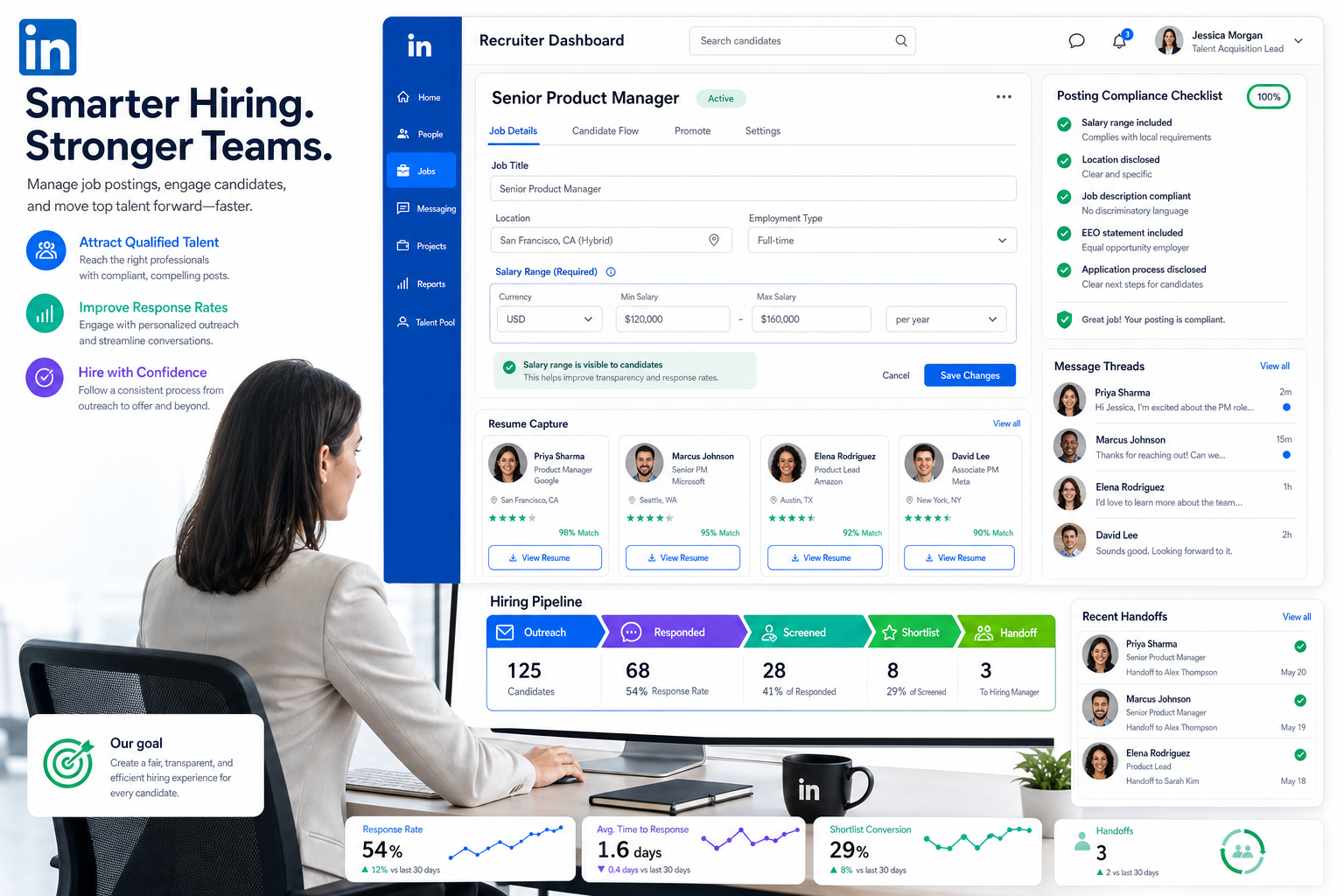
When pay-transparent hiring starts breaking response rates and handoffs, this article helps recruiting leaders judge best recruitment platforms to protect speed, compliance, and candidate trust.
That standard matters more now because recruiting teams are being squeezed from both sides. Candidates increasingly expect salary clarity before they apply, provinces and states are expanding posting requirements, and hiring managers still want faster shortlists. When compensation details, outreach records, screening notes, and job ad versions live in separate places, the damage is familiar: weaker response rates, late-stage drop-off, messy internal handoffs, and avoidable compliance risk.
In my own workflow, StrategyBrain AI Recruiter has been most useful when that pressure starts at the top of funnel. It can handle repetitive candidate outreach on LinkedIn, reply across time zones, and collect resumes or contact details from interested prospects while the recruiter keeps control of final resume review, qualification, and next-step decisions. That matters when compensation questions arrive early and silence costs you applicants.
Picture the actual moment this becomes operational rather than theoretical. A recruiter is updating a publicly advertised role for a Canadian market, checking whether the pay range is shown, confirming that the wording is narrow enough for the posting standard in that location, and removing any question that could stray into salary-history territory. Then replies begin coming in. Some candidates want to know whether the listed range is firm. Others disappear if the ad is vague. The recruiter is not just filling a role anymore; they are trying to protect application volume, candidate trust, and posting compliance at the same time.
That is exactly why the search for the best recruiting software has changed. The best site to hire employees is no longer just about reach, and software for job advertising is no longer just a posting tool. The strongest systems help recruiters publish clear jobs, centralize candidate conversations, document decisions, and move from first outreach to offer without losing the context that now shapes whether people apply at all.
Table of Contents
- Why buyers are rethinking recruiting software
- Quick comparison of best recruitment platforms
- What good recruiting software looks like now
- Best overall setup for most hiring teams
- Best for SMB and growing teams
- Best for staffing and search firms
- Best for enterprise hiring teams
- Why pay transparency changes software requirements
- ATS vs CRM vs all-in-one platform
- What is the best site to hire employees
- Features that matter most
- My experience using AI Recruiter in outreach-heavy hiring
- How to evaluate and buy
- Common buying mistakes
- FAQ
Why Buyers Are Rethinking Recruiting Software
A few years ago, many teams could evaluate recruiting tools mostly on usability, reporting, and whether hiring managers would log in consistently. Those things still matter, but the front end of recruiting has changed. More candidates expect pay information in job ads, more regions are defining job posting rules in detail, and many employers now need to think about whether AI use in screening or outreach should be disclosed or governed internally.
In Canada, for example, the practical landscape is increasingly shaped at the provincial level. British Columbia already requires salary ranges in public job postings and restricts salary-history questions. Prince Edward Island has similar posting and pay-history rules in place. Ontario has moved toward detailed requirements, including expected compensation in public postings for certain employers and disclosure around AI use in candidate screening. Even where rules are still evolving, candidate expectations are already ahead of many employers.
That combination changes software selection. The best recruitment platforms are not just systems of record. They are systems that help you publish cleaner job ads, preserve message history, support consistent recruiter judgment, and avoid losing good candidates because basic information was missing or scattered.
Quick Comparison of Best Recruitment Platforms
| Hiring Scenario | Best Fit | What to Prioritize | Practical Advice |
|---|---|---|---|
| General in-house hiring | All-in-one recruiting platform with ATS core | Job posting, structured review, interview scheduling, offer workflow, reporting | Choose this when you need one operating system for recruiters and hiring managers |
| Small business or startup | Simple ATS with automation | Ease of setup, careers page, posting distribution, collaborative review | Adoption beats feature count for smaller teams |
| Staffing agency or search firm | Recruiting CRM plus ATS controls | Sourcing, relationship tracking, fast search, reusable talent pools | Do not buy an inbound-only system if your desk runs on outbound sourcing |
| Enterprise hiring | Governed platform with analytics and permissions | Approvals, compliance controls, workflow depth, reporting, integrations | Align process design before broad rollout |
| LinkedIn-heavy recruiting motion | ATS or CRM supported by outreach automation | Candidate messaging, resume capture, multilingual follow-up, handoff to recruiter | Use AI-supported outreach to reduce admin, but keep recruiter-led qualification |
If your search began with the phrase best site to hire employees, it helps to separate channel from system. Job boards and networks bring traffic. Recruiting software turns that traffic into an organized hiring process.
What Good Recruiting Software Looks Like Now
Most buyers still use broad terms interchangeably: recruiting software, hiring platform, applicant tracking system, recruiting CRM, and best recruitment platforms. In practice, the best choice is the one that supports the real work recruiters do from ad launch through signed offer.
- Publish jobs clearly with compensation and role details aligned to internal standards
- Distribute openings to relevant channels without duplicating admin work
- Capture applicants and prospects in one searchable workflow
- Support structured review across recruiter and hiring manager
- Keep communication history visible so context is not lost
- Move candidates through interviews and offers with ownership and timing clear
- Provide reporting on pipeline health, time to hire, and bottlenecks
That last point about communication history matters more than many teams admit. Once job seekers ask about pay range, flexibility, remote status, or process timing, the recruiter needs those answers documented somewhere useful. Otherwise the hiring process becomes a chain of disconnected explanations.
Best Overall Setup for Most Teams
For most in-house employers, the best overall answer is an all-in-one recruiting platform built around a strong ATS core. That setup gives enough structure to manage applicants cleanly while still supporting sourcing, internal collaboration, and reporting.
This is usually the safest recommendation because most hiring teams are trying to solve the same set of problems at once: get the role live quickly, keep candidate handling consistent, coordinate interview feedback, and avoid losing information between recruiter, coordinator, and manager.
Why this setup works
- It centralizes hiring context from job ad to final decision
- It reduces admin friction between stakeholders
- It gives leaders visibility into stage movement and conversion
- It supports cleaner compliance habits around what was posted, said, and changed
Practical takeaway: In demos, ask to see how a recruiter edits a live posting, responds to a compensation question, and hands a candidate to the hiring manager. Those moments reveal more than a polished dashboard.
Best for SMB and Growing Teams
Small and mid-sized businesses usually get the most value from a simple ATS that is easy to launch and hard to ignore. In SMB hiring, the biggest risk is not lacking advanced features. It is losing candidates because the process lives in inboxes, spreadsheets, and memory.
That risk grows when salary expectations need to be addressed earlier. A small team may not have dedicated recruiting operations support, but it still needs a careers page, job distribution, interview coordination, and a clean way to track what was shared with candidates.
What SMB teams should prioritize
- Fast posting workflows with easy edits
- A credible careers page that supports employer brand trust
- Simple screening and review for busy hiring managers
- Interview scheduling support that cuts manual back-and-forth
- Basic analytics on source quality and time to hire
If you are hiring only occasionally, the best recruitment platforms are often the least complicated ones. The right system should help the team act with more discipline, not feel like another project to maintain.
Best for Staffing and Search Firms
Agency recruiters and headhunters work differently from most internal teams. They need structured process control, but they also live on sourcing, relationship continuity, and speed. That means the best recruiting software for this group usually combines ATS discipline with recruiting CRM depth.
From a desk perspective, the real value is not just tracking applicants. It is being able to re-open a search, revisit prior conversations, see who already discussed compensation or timing, and restart with context instead of fresh guesswork.
What agency teams should look for
- Sourcing-friendly workflow for outbound and passive talent
- Searchable candidate history across clients and roles
- Pipeline flexibility when multiple openings move at once
- Communication tracking across recruiters
- Reporting that shows activity and conversion, not just headcount
For headhunters especially, a platform earns its keep when it preserves commercial memory. If a prospect asked for pay clarity six months ago, or only wanted to move for a certain range, the next recruiter should be able to see that without rebuilding the conversation from zero.
Best for Enterprise Hiring Teams
Enterprise hiring adds governance pressure to everything above. More stakeholders, more approvals, more locations, and more posting standards mean the best recruitment platforms here need stronger permissions, workflow controls, and reporting.
This is where process design matters as much as software selection. Large organizations often have uneven expectations between TA, HR, legal, compensation, and business leaders. If those groups are not aligned on what belongs in a public posting, who can change it, and how candidate communication should be documented, even good software can feel chaotic after launch.
What enterprise teams should evaluate carefully
- Workflow configuration by business unit or geography
- Permissions and approvals for job postings and offers
- Auditability around changes and communications
- Reporting on hiring velocity and source performance
- Operational consistency across recruiters and managers
Enterprise buyers should also ask a practical question: can the system support policy changes without forcing recruiters into parallel offline workarounds? If the answer is no, adoption will look good in reports and messy in practice.
Why Pay Transparency Changes Software Requirements
The reference point many teams miss is that pay transparency is not just a legal issue. It changes candidate behavior, recruiter workload, and software requirements at the top of funnel.
Research cited in the broader pay-transparency discussion shows a large share of job seekers avoid applying when compensation is missing, and many research market pay before they ever speak to a recruiter. That means every unclear posting creates avoidable friction before screening even begins.
From an operations standpoint, there are at least three workflow consequences:
- Job ad creation needs more control. Recruiters need a reliable way to publish roles with approved compensation language and update them fast.
- Candidate conversations need better documentation. Questions about range, flexibility, and progression should not disappear into private inboxes.
- Recruiting teams need stronger handoffs. When a prospect enters the funnel after outreach, the next person should know what was already discussed.
That is why the best recruitment platforms increasingly sit closer to compliance-adjacent process design than many buyers expect. Even when your team is not subject to a specific local rule today, candidate expectations are already operating as if you are.
ATS vs Recruiting CRM vs All-in-One Platform
| Category | Primary Purpose | Best For | Watch Out For |
|---|---|---|---|
| Applicant Tracking System | Move applicants through defined hiring stages | Teams that need process control and visibility | Can be weak for long-term sourcing and relationship management |
| Recruiting CRM | Source, nurture, and rediscover talent | Agency recruiters and sourcing-led teams | May not provide enough structure for formal hiring workflow alone |
| All-in-One Recruiting Platform | Combine ATS, sourcing, collaboration, and analytics | Companies seeking one operating environment | Can become overbuilt if implementation is undisciplined |
If your main pain is keeping hiring organized, start with ATS requirements. If your pain is rebuilding candidate pipelines every search, CRM capability matters more. If both are true, an all-in-one platform is usually the right category to explore.
What Is the Best Site to Hire Employees?
The phrase best site to hire employees usually mixes up three separate things:
- Job boards where candidates discover roles
- Your careers site where your employer story and application flow live
- Recruiting software that distributes jobs and manages the pipeline
So the best site to hire employees is rarely one site. It is a hiring stack: the right channels supported by software that keeps the process in one place. That is also where broad buyer searches like software for job should be clarified. Most people using that phrase are really looking for software that helps with job advertising, candidate management, and hiring workflow rather than a single posting destination.
Features That Matter Most
1. Job posting and distribution
The platform should make it easy to publish jobs accurately, distribute them widely, and update them without confusion. This is especially important when compensation details and posting language affect conversion.
2. Candidate sourcing and relationship tracking
Many teams need more than inbound applications. Sourcing tools should help you organize prospects, preserve message history, and return to previous candidates with context intact.
3. Structured resume review
Recruiters need fast triage. Hiring managers need a clear review experience. Good systems make those two needs compatible.
4. Interview scheduling
Scheduling remains one of the easiest ways to lose momentum. Strong platforms reduce coordination drag and keep ownership visible.
5. Offer management
Late-stage hiring often breaks down because approvals and communication are fragmented. Offer workflows should make delays obvious early.
6. Reporting and analytics
Even simple reporting can reveal whether unclear ads, slow feedback, or weak sourcing channels are hurting conversion.
7. Communication capture
This is increasingly non-negotiable. If candidate questions about pay, timing, or role scope cannot be referenced later, recruiter consistency suffers.
My Experience Using AI Recruiter in Outreach-Heavy Hiring
Where I have found the most practical value in AI Recruiter is not in replacing recruiter judgment, but in protecting momentum during the repetitive parts of LinkedIn outreach. When a search depends on fast first contact, after-hours replies, or multilingual candidate communication, response handling becomes a bottleneck long before final screening does.
In one outreach-heavy workflow, I used AI Recruiter to keep candidate conversations moving while I stayed focused on shortlist quality. It handled initial messaging, follow-up replies, and resume collection from interested candidates. What I liked most was that it reduced the dead time between a candidate expressing interest and the moment I had enough information to decide whether to review the profile seriously. I still made the call on fit, resume quality, and who advanced.
That division of labor matters. Recruiters should own judgment, stakeholder calibration, and final qualification. AI is most helpful when it absorbs repetitive sourcing activity that would otherwise slow down response time or leave candidate questions sitting overnight.
For teams that do meaningful work on LinkedIn, the useful capabilities are fairly specific:
- Automated initial outreach to candidates within defined search criteria
- 24/7 candidate replies so interest does not go cold after hours
- Resume and contact capture from prospects ready to move forward
If you want to see how those conversations are structured in practice, the published conversation examples are worth reviewing before you build a workflow around them. My main takeaway is simple: used well, AI-supported outreach reduces administrative drag, but it does not remove the need for a recruiter who can judge nuance, compensation alignment, and actual candidate fit.
How to Evaluate and Buy
Any serious shortlist should be based on your hiring motion rather than generic rankings. Here is the process I recommend:
- Map your hiring model. Are you mostly inbound, sourcing-led, agency-style, or approval-heavy?
- Define the posting workflow. Who creates ads, who approves compensation language, and who edits live postings?
- List core recruiter tasks. Usually job distribution, screening, outreach, scheduling, offers, and reporting.
- Test recruiter and hiring manager experience separately. Their friction points are different.
- Review communication capture. Can the team easily track what candidates were told?
- Check category fit. Decide whether you need ATS, CRM, all-in-one software, or a combination with outreach automation.
If you are comparing the best recruiting software seriously, ask not only which system has the most features, but which one helps your team maintain speed, clarity, and trust under real hiring pressure.
Common Buying Mistakes
Confusing channels with systems
Teams searching for the best site to hire employees sometimes buy for reach and forget process. Distribution matters, but it is not the same as workflow control.
Ignoring the top-of-funnel reality
If candidates now expect pay clarity early, your software must support clean posting and message continuity. Buying only for interview workflow misses the point.
Overbuying for edge cases
Many teams choose complexity they never use. Start with the tasks recruiters perform every week.
Skipping hiring manager usability
If managers avoid the system, recruiters end up maintaining parallel processes and the platform loses value fast.
Assuming automation replaces judgment
Automation can speed up outreach, scheduling, or data capture. It should not be mistaken for candidate evaluation, stakeholder alignment, or compensation judgment.
FAQ
What are the best recruitment platforms for most employers?
For most employers, the best recruitment platforms are all-in-one systems with a solid ATS core, easy posting workflows, structured review, and useful analytics. The right choice depends on hiring volume and process complexity.
What is the best site to hire employees?
There is rarely one best site for every employer. The strongest setup combines relevant hiring channels with recruiting software that centralizes applications, communication, and evaluation.
What does software for job usually mean?
In most searches, software for job refers to software used to post openings, attract candidates, manage applications, and run hiring workflows. It is a broad buyer phrase rather than a precise category.
Do pay transparency rules affect recruiting software selection?
Yes. Even where legal requirements vary, candidate expectations are shifting fast. Teams need software that supports accurate posting, communication tracking, and cleaner internal handoffs.
Should staffing firms buy an ATS or a CRM?
Most staffing firms need both structured ATS workflow and CRM-style relationship management. If sourcing and candidate rediscovery drive your desk, CRM depth is essential.
Can AI help with recruiting without replacing recruiters?
Yes. AI can help with repetitive outreach, candidate replies, and resume collection, while recruiters retain responsibility for assessment, fit, and final hiring decisions.
Conclusion
The search for the best recruiting software is no longer just a feature comparison. It is a decision about how your team will publish roles, answer candidate questions, preserve hiring context, and keep momentum from first click to signed offer.
The best recruitment platforms are the ones that fit your actual recruiting motion. For some teams, that means an ATS-first system with strong workflow control. For others, it means CRM depth, better sourcing support, or AI-assisted outreach that keeps candidate communication moving without removing recruiter judgment. If you use that lens, you will make a better decision than any generic top-10 list can make for you.