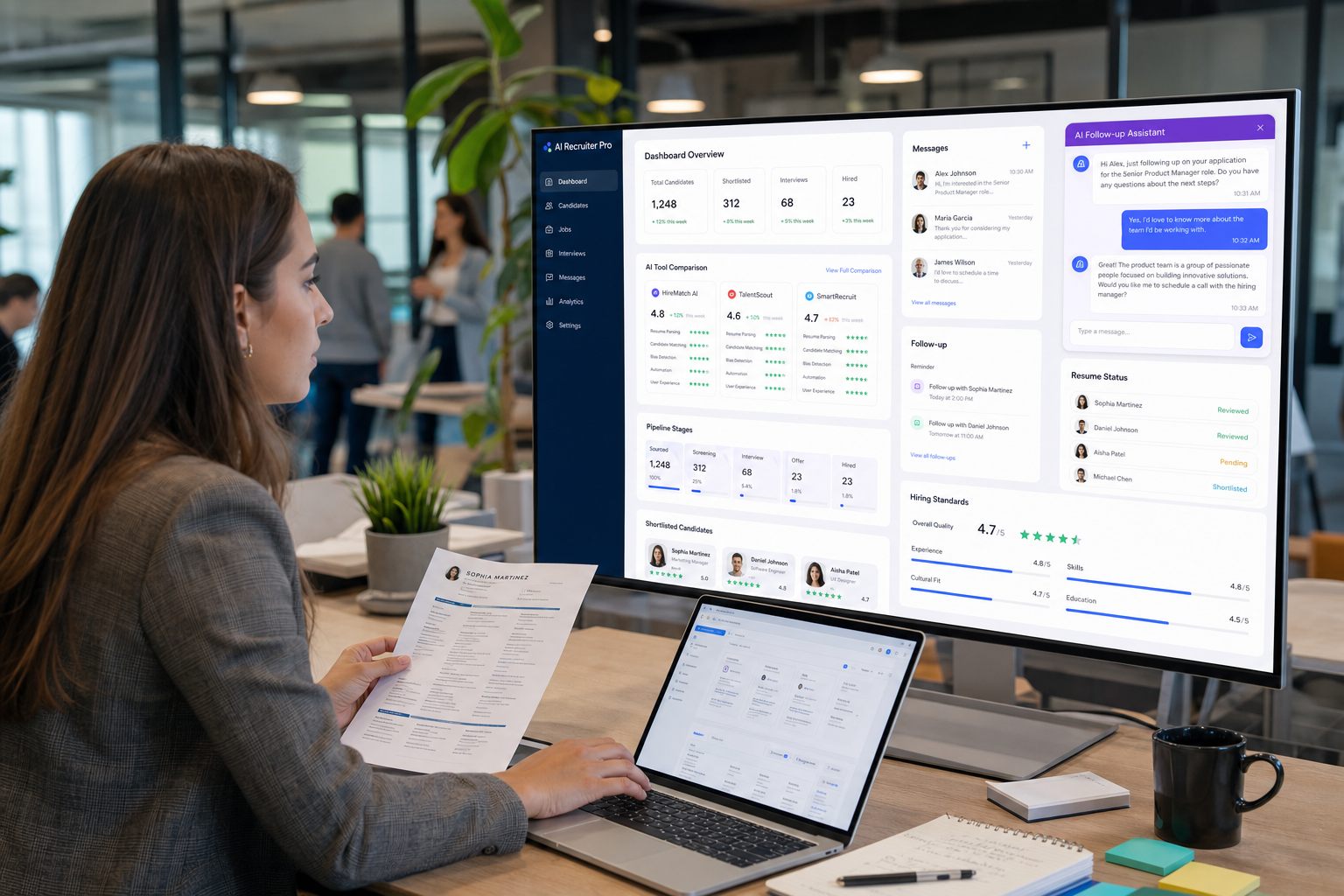
Judge which ai recruiting tool keeps follow-up fast without weakening shortlist quality or hiring standards.
That matters because most recruiting pain does not start with a lack of features. It starts when recruiters are buried in outreach, candidate replies arrive after hours, hiring managers want faster shortlists, and nobody has a clean way to keep standards consistent across busy reqs. For a solo recruiter, that means missed follow-up and weaker candidate experience. For a small agency owner, it means more manual work without more placements. For an in-house talent team, it often means slower coordination, inconsistent screening, and avoidable friction with stakeholders who expect both speed and fairness.
In that gap, tools that automate repetitive sourcing communication can help. I have seen AI Recruiter used most effectively when recruiters need support with LinkedIn outreach, after-hours candidate messaging, and collecting resumes from interested people without losing human control of the process. In practice, the recruiter still reviews the CV, decides whether the profile fits the role, and owns the next step. What the software removes is the repetitive front-end work that usually eats up the day before real assessment even begins.
The pattern is familiar in specialist hiring. When a firm is trying to identify strong finance and accounting leaders, the challenge is rarely just finding someone who can close a month-end process or read a balance sheet. The harder task is judging traits that teams actually depend on after the hire: collaboration with business partners, attention to detail under pressure, ethical judgment, proactive thinking, and the ability to lead by example while still working in the trenches. Recruiters may start by opening a requisition, reviewing old pipeline notes, and sending fresh outreach to controllers or senior accountants, but the real difficulty comes later when responses pile up faster than the team can evaluate them with consistency.
At that point, the workflow problem becomes obvious. One recruiter is replying to LinkedIn messages, another is updating candidate stages, and the hiring manager is asking which applicants show strategic range rather than just technical competence. Without stronger process support, the team spends too much time chasing resumes and too little time comparing the leadership signals that actually matter. That is exactly where modern ai recruiting software becomes useful: not as a replacement for judgment, but as infrastructure that helps recruiters, hiring managers, and even ai job recruiters using automated workflows keep pace without losing standards.
If you are comparing an ai recruiting tool, the real question is not whether AI sounds impressive. It is whether the system helps your team identify, document, and act on meaningful hiring signals the way experienced recruiters already try to do manually. That is why this article evaluates software through a leadership-and-workflow lens: what the tool actually changes in sourcing, screening, communication, ATS handoff, and decision quality, and how to judge an ai recruitment platform without getting distracted by hype.
Table of Contents
- What Good Recruiters Are Really Evaluating
- What Is AI Recruiting Software?
- Where AI Helps Most in the Workflow
- ATS vs AI Recruitment Platform
- Five Standards for Evaluating an AI Recruiting Tool
- LinkedIn Outreach and Front-End Qualification
- Benefits for Recruiters and Hiring Teams
- Trust, Bias, and Compliance
- Implementation and Team Adoption
- Measuring ROI Realistically
- Common Mistakes
- FAQ
What Good Recruiters Are Really Evaluating
Experienced recruiters do not just evaluate candidates against keywords. They evaluate whether a person can succeed inside a team, handle changing demands, and build trust with stakeholders. The accounting leadership framework above is a useful example because it shows how hiring decisions often depend on patterns that are broader than resume matching alone.
When recruiters screen for leadership potential in finance, operations, or other business-critical roles, they often look for five practical signals:
- Collaboration: can the person work constructively across teams and build buy-in?
- Attention to detail: do they handle complexity carefully and reliably?
- Ethical behavior: can they be trusted with decisions that affect the business and other people?
- Proactive thinking: do they look ahead rather than react only after problems appear?
- Leadership by example: will they model the standards they expect from others?
Those same standards are useful when evaluating recruiting software. A platform should support collaboration, improve detail capture, make decisions easier to defend, help teams act proactively, and encourage better recruiter behavior instead of hiding weak process under automation.
What Is AI Recruiting Software?
AI recruiting software is hiring technology that uses automation, pattern recognition, and decision support to help recruiting teams source, screen, communicate with, and move candidates through the funnel more efficiently. A modern ai recruiting tool might assist with sourcing leads, ranking applicants, summarizing resumes, coordinating interviews, or re-engaging older talent pools.
The more important point is scope. Many teams start by asking whether they need AI screening, but the better question is whether they need an ai recruitment platform that supports the actual workflow bottlenecks they live with every day. If your biggest issue is first-touch outreach and response handling, one type of tool will help. If the bigger issue is visibility across sourcing, screening, scheduling, and hiring-manager follow-through, you may need a broader system.
Where AI Helps Most in the Workflow
In day-to-day recruiting operations, AI tends to create the most value in a few predictable places:
- Sourcing: surfacing relevant profiles and reusing past pipeline data
- Outbound communication: sending role introductions, handling replies, and maintaining momentum
- Early screening: organizing incoming applicants or interested prospects for recruiter review
- Scheduling: reducing the back-and-forth that delays interviews
- Candidate rediscovery: helping teams search prior applicants and dormant leads
- CRM follow-up: keeping silver-medalist or future-fit candidates warm
For LinkedIn-heavy teams, this front end matters more than some buyers realize. A recruiter can lose hours each week just managing connection requests, late-night replies, and repetitive qualification messages. That is why some ai job recruiters are not really replacing recruitment judgment at all; they are taking over repetitive communication steps so human recruiters can spend more time reading context, calibrating with managers, and closing candidates.
ATS vs AI Recruitment Platform
One of the most common buying questions is whether an ATS already does enough. In most organizations, the ATS remains the system of record. It stores jobs, applications, stages, and compliance documentation. An ai recruitment platform adds a layer of automation and intelligence across those workflows.
| Category | Typical ATS Role | Typical AI Recruiting Software Role |
|---|---|---|
| Candidate records | Stores applicant and stage data | Enriches, summarizes, or prioritizes records |
| Workflow management | Tracks movement through the funnel | Automates handoffs and suggests next actions |
| Sourcing and outreach | Usually limited | Can support search, outreach, and reply handling |
| Screening | Basic filters or knockout questions | Ranking, matching, summaries, and review support |
| Reporting | Pipeline visibility | Pattern detection and workflow insight |
The practical lesson is usually ATS plus AI, not ATS versus AI. If the intelligence layer cannot work cleanly with your hiring records and recruiter notes, adoption becomes the real problem.
Five Standards for Evaluating an AI Recruiting Tool
The most useful evaluation framework I have used comes back to the same five qualities strong hiring teams look for in people.
1. Collaboration support
Does the system make it easier for recruiters, hiring managers, and coordinators to work from the same information? Good software should reduce handoff friction, not create another silo.
2. Attention to detail in the workflow
Can it capture conversation history, resume receipt, candidate intent, and status updates reliably? In real recruiting operations, tiny data gaps become major delays.
3. Ethical and defensible use
Can your team explain what the tool is doing in plain language? If recommendations influence candidate movement, there should be clear oversight and traceability.
4. Proactive value
Does it help the team think ahead by surfacing stalled candidates, old pipeline matches, or overdue follow-up? Strong tools create momentum before bottlenecks get worse.
5. Leadership by example in process design
Does the tool reinforce disciplined recruiting behavior? A system should encourage timely follow-up, cleaner notes, and better consistency across recruiters.
Key insight: The best ai recruiting tool does not just automate tasks. It makes the recruiter’s standards easier to apply at scale.
LinkedIn Outreach and Front-End Qualification
For teams that rely heavily on direct sourcing, LinkedIn remains one of the biggest time drains and one of the biggest opportunities. Recruiters still need to write outreach, answer candidate questions, confirm interest, and collect resumes or contact details before any serious shortlist can be built.
That is where I have found StrategyBrain AI Recruiter most practical. In my own testing of outreach-heavy workflows, its strongest use was not magic candidate selection. It was the ability to keep initial sourcing conversations moving automatically, respond across time zones, and gather resumes from interested candidates without forcing a recruiter to stay glued to LinkedIn every evening. If a candidate wanted more detail about the role, the system could continue the exchange and collect the next-step information, while I still handled the actual fit decision after reviewing the resume.
That distinction matters. According to the published product description, the tool automates candidate connection, role introduction, ongoing messaging, and resume or contact capture, but the recruiter remains responsible for final qualification. That setup is often healthier than fully opaque scoring because it preserves accountability where it belongs. For firms doing cross-border hiring, the multilingual communication angle can also remove friction that normally slows down early engagement.
If you want to explore the workflow itself, the company also shares a more detailed walkthrough of how recruiters use the system for LinkedIn automation and sourcing support here: AI Recruiter workflow overview. For recruiters who want to see how communication is handled in live conversations, there is also a public conversation library at this example page. The right use case is clear: high-message environments where responsiveness matters, but final screening still belongs with the human recruiter.
Benefits for Recruiters and Hiring Teams
The main benefit of AI recruiting software is leverage. But leverage only matters if it improves the work that experienced recruiters already know needs to happen.
- Faster first-touch engagement: less time lost on repetitive outbound messaging
- More consistent early-stage handling: candidates receive follow-up more reliably
- Cleaner recruiter focus: human time shifts toward shortlist judgment and stakeholder alignment
- Better use of existing talent pools: old candidates become searchable and usable again
- Lower admin burden: less manual effort on coordination and status updates
- Stronger support for skills-based hiring: recruiters can spend more time evaluating substance instead of inbox traffic
For agency teams, that can mean more recruiter capacity without immediately adding headcount. For internal TA leaders, it often means better service to hiring managers because the team can respond faster without rushing final decisions.
Trust, Bias, and Compliance
Any conversation about ai recruiting software has to include trust. Candidates increasingly want to know how technology affects their applications, and hiring teams need to understand whether the software is guiding, ranking, filtering, or only organizing data.
Ask direct questions:
- What data is used?
- Is the tool making recommendations, hard filters, or just workflow automations?
- Can humans override the output?
- Can recruiters explain the process to candidates and hiring managers?
- Does the platform support privacy and recordkeeping expectations?
For tools used in outreach and messaging, privacy and security questions become especially important. The published materials for AI Recruiter state that customer data is not used to train models and that credentials and candidate information are encrypted and isolated. Whether you are evaluating that option or another platform, those are the kinds of details worth verifying early rather than after implementation.
Implementation and Team Adoption
Buying the software is easy compared with getting recruiters to use it well. The teams that adopt AI successfully usually start with one clear problem rather than a broad rollout.
Before implementation, define:
- Which workflow is the pilot: sourcing, screening, rediscovery, or scheduling
- Who owns configuration: recruiting ops, TA leadership, IT, or HR systems
- What the recruiter still decides manually: fit, shortlist, and final movement
- How activity reaches the ATS: notes, resumes, statuses, and compliance records
- How hiring managers will use the output: review support, summaries, or candidate prioritization
In my experience, outreach-heavy roles are often the best place to begin because the time savings are easier to observe. A niche executive search process may still benefit from AI support, but it usually needs more human nuance and stakeholder calibration from the start.
Measuring ROI Realistically
ROI should be measured in workflow terms, not marketing promises. A practical scorecard includes:
- Time spent on outreach and follow-up
- Response speed to interested candidates
- Resume collection rate from qualified conversations
- Time-to-review for new leads or applicants
- Recruiter adoption and consistency of use
- Hiring manager satisfaction with shortlist quality
Notice that none of those metrics require exaggerated claims. The point is to see whether the tool removes enough repetitive work to free better recruiter judgment. If it does not change real workflow behavior, it probably will not justify itself.
Common Mistakes
- Buying for novelty: attractive AI language does not fix a weak recruiting process.
- Confusing communication automation with qualification: interest is not the same as fit.
- Ignoring recruiter judgment: black-box workflows often create resistance.
- Skipping ATS planning: disconnected tools create duplicate work.
- Using one workflow for every role type: high-volume sourcing and leadership hiring need different levels of human review.
- Failing to define standards: if the team cannot agree on what good looks like, software will not solve it.
FAQ
What is an AI recruiting tool?
An ai recruiting tool is software that helps recruiters automate or improve parts of sourcing, screening, communication, scheduling, or candidate management. The best options support human decision-making rather than replacing it.
What is the difference between an ATS and an AI recruitment platform?
An ATS is typically the system of record for jobs, candidates, and hiring stages. An ai recruitment platform adds automation, matching, communication support, or decision assistance around that core process.
Are AI job recruiters replacing human recruiters?
No. AI job recruiters usually refer to tools that automate parts of recruiter workflow, especially repetitive sourcing or communication tasks. Human recruiters still own judgment, candidate context, and final hiring decisions.
Can AI recruiting software help with LinkedIn sourcing?
Yes, especially for outreach-heavy workflows. Some platforms focus on automating candidate connection, messaging, and resume collection so recruiters can spend more time on qualification and stakeholder alignment.
What should I look for before buying AI recruiting software?
Look for workflow fit, ATS integration, clear human oversight, explainable outputs, data security, and measurable value in the parts of recruiting where your team actually loses time.
Conclusion
The right ai recruiting tool should make your recruiting standards easier to apply, not harder to defend. If the software improves collaboration, keeps details from slipping, supports ethical and explainable decisions, and helps the team act proactively, it is doing real work. If it only adds another dashboard, it is not.
That is why the best evaluation process starts with the same qualities strong recruiters and strong business leaders rely on every day. Whether you are assessing broad ai recruiting software, a specialized ai recruitment platform, or outreach-first workflows that support ai job recruiters, judge the system by how well it strengthens the real hiring craft behind the automation.