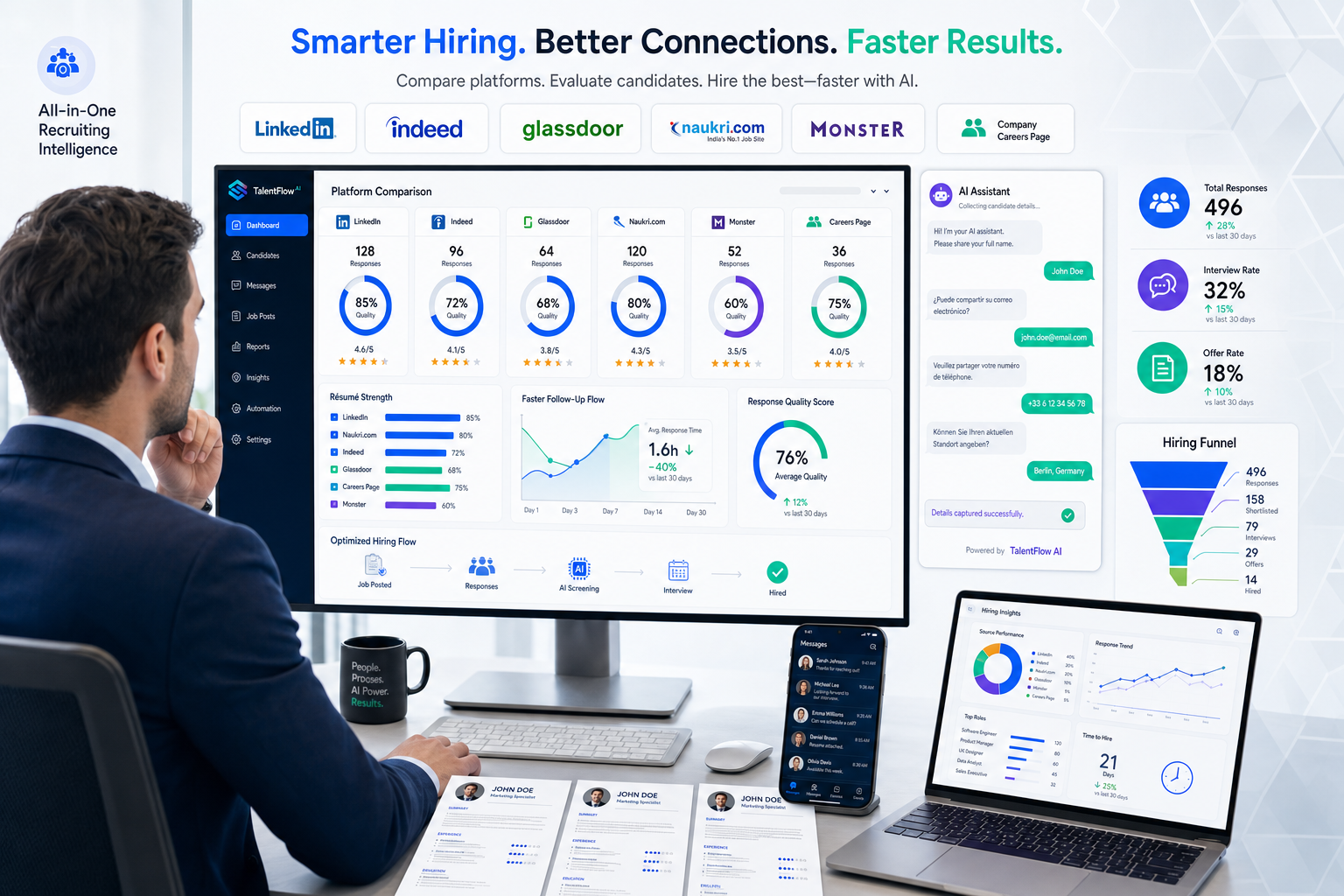
Websites like LinkedIn matter only if recruiters can spot which channels cut review waste and deliver stronger résumés faster.
That distinction matters because most teams do not really struggle with finding more places to post jobs. They struggle with wasted review time, thin applications, duplicate outreach, and long gaps between first contact and a recruiter's actual decision. For a solo headhunter, that means evenings spent chasing replies that never turn into usable résumés. For a small agency owner, it means consultants filling pipelines that look busy but convert poorly. For an in-house recruiter, it means hiring managers questioning source quality because the applications arriving from different channels are inconsistent.
In my own LinkedIn-heavy workflow, StrategyBrain AI Recruiter became useful not as a replacement for recruiter judgment, but as a way to reduce the repetitive front-end work that causes those delays. Its strongest help in this context is straightforward: it can continue candidate conversations around the clock, communicate in the candidate's preferred language when needed, and collect résumés or contact details from people who actually show interest. I still handle final résumé review, fit assessment, and next-step decisions, but the early-stage follow-up stops depending entirely on whether I am online at the right hour.
The underlying problem is easy to see from the candidate side too. A Forbes-cited study of 2,200 hiring managers and HR staff found that 68% spent up to two minutes on a résumé, while 17% spent 30 seconds or less. That is not a lot of room for weak wording or vague outcomes. A finance candidate who writes "responsible for reporting" instead of showing that they improved a process, reduced risk, created a better workflow, mentored a junior teammate, or negotiated a result may never earn a second look. The hiring manager moves on before the value becomes visible.
That same outcome-first filter is exactly why no single platform wins every search. Candidates use websites like LinkedIn because they want visibility, but recruiters and hiring managers still make decisions based on evidence: stronger résumés, clearer outcomes, faster response cycles, and better-fit applications. So when people compare job boards other than LinkedIn or look for linkedin alternatives for job search, the real question is not which site feels most familiar. It is which mix of channels helps the right candidate show measurable value before attention runs out.
Table of Contents
What People Really Mean by Websites Like LinkedIn
When someone searches for websites like LinkedIn, they are usually not asking for a clone. They are looking for one or more of these things: a place to discover jobs, a place to research employers, a place to get noticed by recruiters, or a place to apply with less noise and less competition.
That is why the market naturally breaks into categories. Some options are broad job boards. Some are niche communities. Some are better for startup hiring, some for remote work, and some for direct employer applications. In practice, most recruiters and candidates use several of them together because each solves a different part of the hiring journey.
From an operator's perspective, this is where workflow matters more than category labels. A candidate may discover a role on a broad board, research the employer on another site, and ultimately complete the application on a company career page. The best source is often the one that produces the cleanest handoff into an actual review process.
How Recruiters Evaluate Alternatives
After years of agency and in-house hiring, I do not judge alternatives by traffic alone. I look at four practical signals.
- Response quality: Are candidates actually engaging, or just clicking?
- Résumé substance: Do applicants show outcomes, not just duties?
- Speed to usable information: How quickly can a recruiter move from interest to résumé and contact details?
- Source fit: Does the channel suit the role type, industry, seniority, or work style?
The résumé point is worth stressing because it connects directly to the reference logic above. Hiring managers often review quickly, which means candidates who use outcome-oriented language stand out earlier. Words such as improved, increased, decreased, mentored, created, and negotiated work because they suggest action and results, not passive participation. As a recruiter, I see this every week: the source matters, but the résumé still decides whether a candidate survives the first pass.
That is also where an outreach assistant can help without replacing professional judgment. In my experience using AI Recruiter on LinkedIn workflows, the value was not in magically qualifying talent for me. It was in keeping promising conversations alive, gathering the basic materials faster, and reducing the lag between candidate interest and recruiter review. The final call still belongs to the recruiter.
Quick Comparison Table: Best LinkedIn Alternatives
| Platform | Best For | Main Strength | Networking | How It Differs From LinkedIn |
|---|---|---|---|---|
| Indeed | Broad job search | Large listing volume | Low | Search-first, less relationship-driven |
| ZipRecruiter | Fast applications | Simple apply flow | Low | Built more around matching than networking |
| Glassdoor | Employer research | Reviews and workplace context | Low | Stronger for evaluation than outreach |
| Wellfound | Startup roles | Early-stage company access | Medium | More startup-specific and role-focused |
| Google Jobs | Search-led discovery | Aggregated visibility | None | Discovery layer rather than platform community |
| Monster | Generalist search | Traditional board reach | Low | Classic job-board behavior |
| CareerBuilder | Established employers | Structured search process | Low | Less social, more listing-centric |
| SimplyHired | Easy browsing | Aggregated listings | None | Useful for breadth, not networking |
| Dice | Tech hiring | Niche technical roles | Low | More focused than LinkedIn for tech talent |
| Remote.co | Remote work | Remote-first focus | Low | Better for location-flexible searches |
| FlexJobs | Flexible work | Remote and hybrid filters | Low | Built around work style preferences |
| Company career pages | Direct applications | Employer-source submission | None | Closest route to the employer's process |
| Association job boards | Profession-specific roles | Industry relevance | Medium | Community-driven, narrower audience |
| Alumni portals | Early-career roles | Targeted entry-level access | Medium | Smaller but often more relevant pools |
17 Best Websites Like LinkedIn for Different Goals
1. Indeed
Indeed remains one of the most practical websites like LinkedIn for broad job discovery. If a candidate wants volume and range, it is often one of the first stops. From the recruiter side, it tends to work best as a top-of-funnel source rather than a relationship channel.
2. ZipRecruiter
ZipRecruiter suits active candidates who prefer a straightforward search-and-apply experience. It is one of the more useful linkedin alternatives for job search when speed matters more than public professional visibility.
3. Glassdoor
Glassdoor is less about sourcing reach and more about company judgment. Candidates use it to check whether an opportunity is worth the effort. Recruiters ignore that research layer at their own risk because poor employer perception can hurt application conversion before the first call.
4. Wellfound
For startup hiring, Wellfound is usually more relevant than broad boards. Candidates looking for smaller teams, wider role scope, or earlier-stage environments often get to better-fit roles faster there than on general platforms.
5. Google Jobs
Google Jobs is a discovery engine, not a community. It helps candidates find openings across multiple sources, which makes it useful for anyone trying to avoid dependence on one platform alone.
6. Monster
Monster still plays a role for generalist job searches. It is best treated as one of several job boards other than LinkedIn, especially for candidates who want broader exposure beyond one ecosystem.
7. CareerBuilder
CareerBuilder fits more traditional search behavior. It can still be effective for structured searches across established employers and common role categories.
8. SimplyHired
SimplyHired is useful for discovery breadth. It is not a networking substitute, but it can surface openings candidates might miss elsewhere.
9. Dice
Dice is one of the clearest examples of niche beating scale. For software, infrastructure, cybersecurity, and related technical roles, recruiters often get better relevance there than on broad-market platforms.
10. Remote.co
Remote.co is a practical option when location flexibility is the primary filter. For candidates focused on remote-only opportunities, it can save time compared with broader searches.
11. FlexJobs
FlexJobs works best for candidates looking for remote, hybrid, part-time, or otherwise flexible arrangements. It is better understood as a work-style platform than as a social-professional network substitute.
12. Startup-focused communities
Beyond major startup boards, smaller startup communities can surface roles before they become highly competitive. These are especially useful for candidates who value mission, growth exposure, and cross-functional work.
13. Company career pages
Company career pages are often undervalued in lists of websites like LinkedIn. In reality, many recruiters prefer them because they are usually the clearest, most current source of open requisitions and application instructions.
14. Professional association career centers
Association boards can outperform broad sites when industry relevance matters more than scale. They are especially useful in regulated, credentialed, or specialist professions.
15. University and alumni job portals
These portals can be strong for internships, graduate roles, and career pivots. They may not have the volume of national boards, but the fit can be much higher.
16. Local and regional job boards
When geography matters, local boards often produce more relevant results than national platforms. This is especially true for onsite roles and region-specific labor markets.
17. Referral and networking communities outside LinkedIn
Not every alternative is a classic board. Smaller communities, referral circles, and industry groups can reveal roles before they are crowded. For many experienced professionals, that is the real value of searching beyond LinkedIn.
Why Outcome-Focused Candidates Win Faster
The reference article's strongest lesson is simple: attention is limited, so results language matters. Whether a candidate comes from LinkedIn, Indeed, a startup board, or a company career page, recruiters still react fastest to evidence of impact.
In finance, that might be phrased as improving controls, reducing exposure, creating a reporting process, mentoring analysts, or negotiating vendor or budget outcomes. In other functions, the exact verbs change, but the principle does not. Candidates who describe measurable change outperform candidates who only list responsibilities.
That matters for recruiters too. If you are sourcing through multiple channels, you need a quick way to separate active interest from real quality. One reason I kept using AI Recruiter in a LinkedIn workflow was that it helped me collect actual résumés from interested people faster, so I could evaluate substance instead of guessing from profile headlines and brief message exchanges. It did not decide who was qualified. It gave me cleaner inputs for my own decision.
Practical takeaway: the best platform is the one that gets a recruiter to a credible, outcome-oriented résumé with the least friction.
How to Choose the Right Mix
The right answer is usually a channel mix, not a platform replacement.
- Use broad boards when you need market coverage.
- Use niche boards when relevance matters more than volume.
- Use company career pages when you want the most direct application path.
- Use review and research sites when employer reputation affects candidate intent.
- Use networking communities when referrals and early access matter more than filters.
If you are a recruiter, decide based on actual conversion behavior. Which channel produces replies? Which produces complete résumés? Which produces candidates whose experience is expressed clearly enough for a hiring manager to act? Those questions are more useful than asking for a single best alternative.
A Better Recruiter Workflow Across Channels
- Start wide. Map the market using major boards and search discovery tools.
- Add role-specific channels. Layer in startup, technical, remote, local, or association sources.
- Watch for evidence, not activity. Prioritize candidates who show outcomes in their résumé or profile language.
- Move interested candidates to a usable record quickly. Collect résumé and contact details before momentum fades.
- Keep human judgment at the decision point. Automation can support outreach and follow-up, but recruiters should still assess fit, trajectory, and next steps.
That fourth step is where I found the most practical value in StrategyBrain AI Recruiter. When candidates replied after hours or from different regions, the system kept the conversation moving, answered basic role questions, and captured résumé or contact information when the person wanted to continue. That prevented the all-too-common drop-off between first interest and actual review. But I would not outsource the real recruiting call: the recruiter still has to judge whether the background, trajectory, and communication quality fit the search.
For headhunters especially, that workflow matters because LinkedIn outreach often creates more partial conversations than complete applications. A support layer that keeps those conversations alive can make LinkedIn itself more effective, even while you continue using other channels.
FAQ
What is the best alternative to LinkedIn for job search?
There is no universal best option. For broad search, major job boards are usually strongest. For startup roles, startup-focused platforms often perform better. For direct applications, company career pages are frequently the most practical route.
Which are the best job boards other than LinkedIn?
Common choices include Indeed, ZipRecruiter, Monster, CareerBuilder, Dice, FlexJobs, and niche industry boards. The best choice depends on the role type, industry, and whether the candidate wants scale or specificity.
What are the most useful linkedin alternatives for job search?
The most useful alternatives usually combine a broad board, a niche source, an employer research site, and direct company career pages. That mix gives better coverage than relying on one network alone.
Do recruiters prefer direct applications over social-platform applications?
Often yes, because direct applications usually provide cleaner records and more complete information. But discovery still happens across many channels, including LinkedIn and other boards.
Can candidates find good jobs without LinkedIn?
Absolutely. Many strong hires come through niche boards, referral communities, company career pages, alumni portals, technical job sites, and remote-work platforms.
Why does résumé wording still matter if the sourcing platform is strong?
Because platform visibility only gets the candidate into the review queue. Hiring decisions are still shaped by how quickly a recruiter or hiring manager can see evidence of impact.
Conclusion
The best websites like LinkedIn are not substitutes in a simple one-for-one sense. They are different channels for different hiring moments: discovery, employer research, niche targeting, remote filtering, startup access, and direct application.
The clearest lesson from both recruiting practice and the reference résumé advice is that attention is short and evidence wins. Candidates need to show outcomes fast. Recruiters need channels that surface those candidates with as little friction as possible. That is why the right mix of job boards other than LinkedIn and other linkedin alternatives for job search usually beats dependence on any single platform.
And if your work is especially LinkedIn-dependent, a support tool such as StrategyBrain AI Recruiter can help keep outreach, follow-up, and résumé collection moving without removing recruiter control from the final decision. Used that way, it fits the real workflow: technology handles repetitive front-end motion, and the recruiter still decides who is worth advancing.