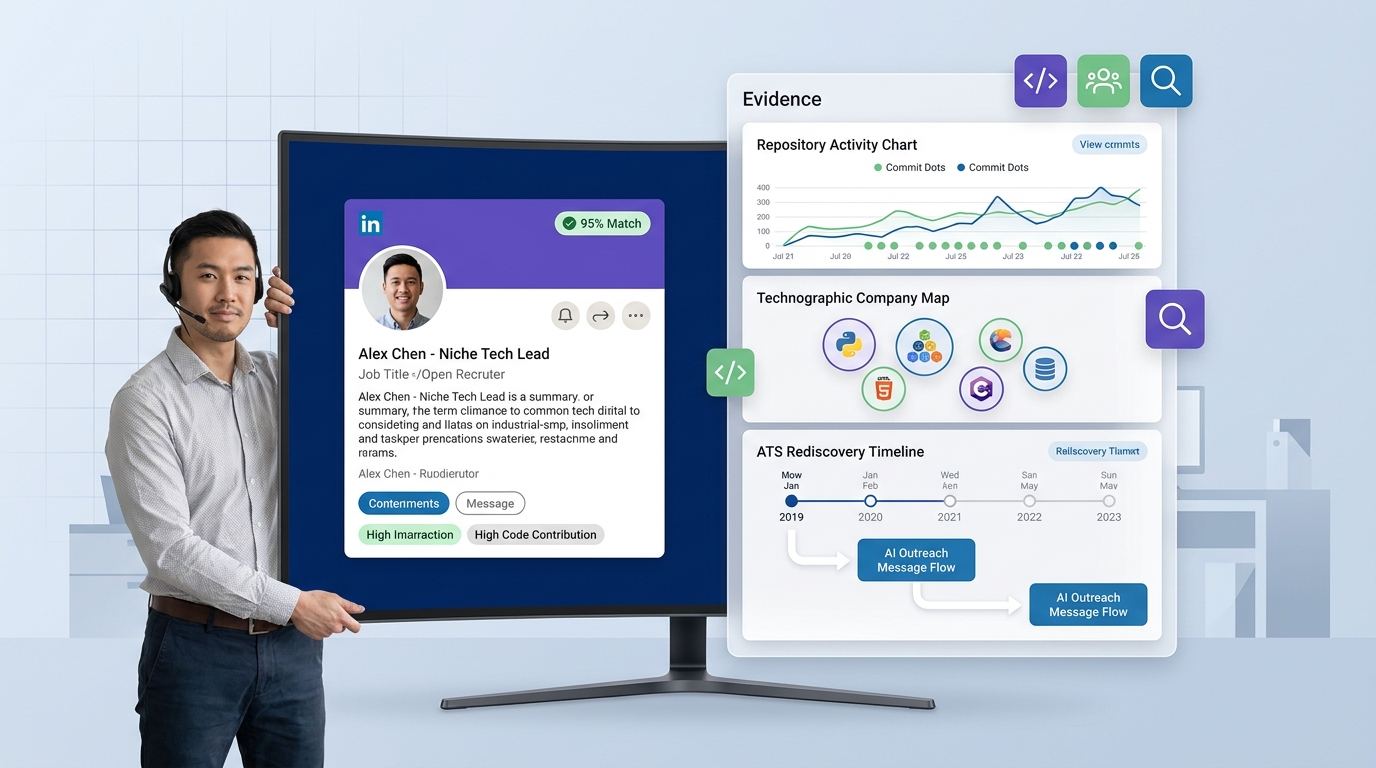
This guide helps recruiters use self-awareness and evidence-based search to spot niche tech talent before weak signals become missed hires.
That matters because hard technical searches rarely fail only on volume. They fail when recruiters cannot tell the difference between a profile that merely mentions a stack and a candidate who has actually grown into it through projects, feedback, and repeated use. For agency owners, that means more researcher hours, slower shortlist delivery, and weaker credibility with clients. For solo headhunters, it means more false positives and more outreach that never earns a reply. For in-house teams, it can damage hiring-manager trust when sourced candidates look plausible on paper but do not hold up in conversation.
In that gap, workflow support matters. Tools such as AI Recruiter can reduce repetitive outreach and after-hours follow-up, keep candidate conversations moving, and capture résumés or contact details when interest appears, so recruiters have more time to judge real fit. In practice, that is where I find automation most useful: not as a replacement for recruiter judgment, but as support for message handling, multilingual follow-up, and handoff discipline while the recruiter still owns final evaluation, résumé review, and next-step decisions.
Think about the familiar interview moment the reference piece centers on: a candidate has handled the technical questions well, then gets asked about a weakness, a failure, or a mistake at work. The real test is not whether they can give a polished answer. It is whether they know what tends to limit them, can explain when it showed up, and can point to what they did to improve. In other words, the interviewer is looking past surface claims and trying to verify self-awareness, growth, and professional evidence.
That same logic shows up in sourcing for narrow engineering stacks. A recruiter who only searches the obvious keyword gets the equivalent of a canned interview answer. A stronger sourcing process looks for the signs behind the label: where the skill was triggered, how often it appears, what adjacent tools support it, and whether the candidate’s recent work shows progression rather than one-off exposure. That is the real frame for how sourcing tools identify candidates for niche tech stacks, especially outside LinkedIn-heavy workflows.
Table of Contents
- Quick answer
- Why exact keywords break down
- Know the signal before you search
- Prepare evidence layers, not one string
- Avoid canned matches and shallow profiles
- How sourcing tools identify candidates for niche tech stacks
- Signal comparison table
- Where social media sourcing tools help
- Boolean search vs conversational search
- Candidate rediscovery and internal talent pools
- How recruiters validate fit before outreach
- What to look for in a non-LinkedIn sourcing tool
- A practical workflow note on AI-supported outreach
- FAQ
- Conclusion
Quick answer
Non-LinkedIn sourcing tools identify niche-stack candidates by combining direct skill evidence with inferred evidence. Direct evidence includes listed tools, repository languages, project descriptions, community tags, and public technical activity. Inferred evidence includes adjacent frameworks, employer technographics, contribution patterns, internal ATS history, and refreshed public data pulled from multiple sources.
The practical lesson is similar to how interviewers assess a weakness answer: a trustworthy conclusion usually comes from multiple signals, not one polished line. If a sourcing tool only searches titles and profile keywords, it will miss many specialists. If it shows why a candidate matched, where the evidence came from, and how recent that evidence is, it is much more useful for hard technical hiring.
Why exact keywords break down
The biggest sourcing mistake in niche technical hiring is assuming the right person will describe themselves with the exact phrase from the requisition. In reality, many specialists describe their work through systems they supported, code they shipped, incidents they solved, or research areas they touched. The stack may be obvious to another engineer, but invisible to a recruiter using exact-match search alone.
This is why how sourcing tools identify candidates for niche tech stacks has become such a practical buying question. Strong tools do not stop at self-reported labels. They examine the surrounding proof: repositories, project context, community participation, employer environment, and internal history. That shift mirrors the lesson from the reference article: when the obvious answer is too polished or too generic, you need better evidence.
Know the signal before you search
Before starting any difficult technical search, define what would count as real evidence of the target stack. The reference article makes a simple but useful point about preparation: know the weakness before you are asked about it. In sourcing terms, know the signal before you open the search bar.
For niche technical hiring, I usually break signal design into three layers:
- Direct stack evidence: the exact tool, framework, or platform appears in code, project text, documentation, issue threads, or public work samples.
- Adjacent evidence: the candidate works with companion tools, related architectures, or neighboring technologies that commonly travel with the target stack.
- Environment evidence: the candidate works in a company, team, or function where the target stack is likely in use, even if it is not written explicitly on a public profile.
This preparation makes the search more resilient. It also helps recruiters explain to hiring managers why a candidate belongs on the shortlist.
Prepare evidence layers, not one string
The reference article recommends preparing a few concrete stories instead of hoping for the best when a hard question appears. The sourcing equivalent is building several evidence paths instead of relying on one Boolean string. For a niche backend, data, infra, or security search, that usually means combining multiple ways to surface candidates.
A strong search plan may include:
- Searching for direct mentions of the stack or its close variants.
- Looking for adjacent frameworks, protocols, or deployment patterns.
- Identifying companies likely to use the stack through technographic clues.
- Reviewing internal ATS or CRM records for past candidates with newly relevant backgrounds.
- Using public community and code signals to confirm whether the match is active and recent.
This layered approach improves recall without making the shortlist too noisy.
Avoid canned matches and shallow profiles
Just as interviewers get tired of hearing "I am a perfectionist," recruiters should be wary of canned matches. A profile with fashionable keywords, shallow endorsements, or old buzzwords can look strong in search results and still fail a serious review. Emerging and specialist stacks are especially vulnerable to this because market language changes quickly and candidates often inherit labels that no longer reflect current hands-on work.
Good sourcing tools help you move beyond those thin matches by attaching evidence to the match: a recent repository, a project description, a technical discussion, a conference mention, or refreshed public data from another source. Transparency matters. If the tool cannot show why it matched someone, the result becomes hard to defend.
How sourcing tools identify candidates for niche tech stacks
At a practical level, modern tools use a multi-signal enrichment model. They gather data from public profiles, code platforms, technical communities, employer context, and internal recruiting systems, then rank likely relevance. That is the clearest answer to how sourcing tools identify candidates for niche tech stacks when the market is searched beyond LinkedIn.
1. Public profile aggregation
Many hard-to-find candidates become visible only when several weak signals are stitched together. A short profile on one site may not say much. Combined with a project page, public portfolio, code account, or conference listing, it becomes much more informative. This cross-source enrichment helps uncover passive talent who would not surface through one network alone.
For recruiting teams, the key question is whether the tool lets you inspect those sources. Explainability matters when you need to defend a shortlist to a skeptical hiring manager.
2. Code and code-adjacent evidence
For engineering roles, hands-on work often tells you more than a profile headline. Tools commonly analyze repository languages, contribution history, readme text, issue participation, and project themes because those signals reveal actual practice. A candidate may never list a niche platform publicly, yet their code history can still show relevant exposure.
That said, recruiters should avoid overvaluing vanity metrics. Stars, followers, or visible popularity can help as secondary context, but they do not prove production depth.
3. Community footprint and verified skill clues
Specialists often leave stronger traces in technical communities than on formal career profiles. Public Q&A participation, research activity, speaking history, forum discussions, and niche communities can all signal real practice. This is where social media sourcing tools become useful when they expand discovery responsibly instead of turning social presence into a proxy for skill.
Used well, community signals strengthen confidence when several independent indicators point to the same conclusion.
4. Technographic sourcing
One of the most effective non-LinkedIn methods is to map the companies likely using the target technology, then identify practitioners inside those environments. This is often called technographic sourcing. It works especially well for hidden candidates whose public profiles are sparse but whose operating environment strongly suggests stack exposure.
A platform engineer may never name a niche observability or data tool online, but if their employer appears to use it and their function aligns with the team responsible for it, that becomes a credible sourcing clue.
5. ATS and CRM rediscovery
Some of the best answers to niche searches are already in your system. Candidate rediscovery means re-searching old applicants, prior finalists, and silver-medalist talent after profiles have been refreshed with newer public signals. A candidate who looked only loosely relevant a year ago may now show strong, recent evidence of the target stack.
This matters because niche hiring markets are small. Teams that ignore their own records often waste time rebuilding a talent pool they already partly own.
Signal comparison table
| Signal type | What it reveals | Best use case | Recruiter caution |
|---|---|---|---|
| Listed skills on public profiles | Self-described expertise | Fast initial filtering | Weak for niche stacks because exact terms may be missing or outdated |
| Repository languages and activity | Hands-on technical work | Developer and engineering searches | Needs context; language use alone does not prove production depth |
| Project descriptions and contribution history | Problem domain and tool context | Emerging or specialized stack searches | Must separate hobby work from role-relevant work |
| Community participation | Public problem-solving and peer engagement | Practitioner and specialist roles | Activity level varies by personality, not only by skill |
| Technographic company mapping | Likely exposure inside target environments | Hidden candidate discovery | Suggests probability, not proof |
| ATS/CRM rediscovery | Previously known talent with updated signals | Reactivating warm candidates | Requires clean records and fresh enrichment |
| Social and community surfaces | Broader public presence and interest areas | Multi-platform sourcing | Must stay role-relevant and privacy-conscious |
The main takeaway is simple: strong sourcing tools help recruiters combine these signals instead of trusting one of them in isolation.
Where social media sourcing tools help
Social media sourcing tools are most useful when they widen discovery across public communities and help recruiters capture relevant evidence into a structured workflow. In technical recruiting, that often means public developer communities, open discussion spaces, code-adjacent platforms, and professional social surfaces that reveal how a person thinks, builds, or collaborates.
For niche-stack roles, this matters because some of the best candidates are much more visible in community participation than in polished career summaries. A recruiter may learn more from project commentary, open discussion threads, or technical identity across platforms than from a conventional résumé headline.
Still, experienced recruiters should use these tools carefully. Social context is a sourcing input, not a hiring standard. Its best use is to expand discovery, sharpen personalization, and improve outreach relevance before formal assessment begins.
Boolean search vs conversational search
Traditional Boolean search still works well when terminology is stable and the recruiter knows the role’s exact naming patterns. It remains useful for exclusion logic, precise filtering, and repeatable searches across similar openings. But for emerging or narrow stacks, Boolean often misses candidates because it depends too heavily on explicit wording.
Conversational or natural-language search is better suited to cases where the recruiter needs the tool to infer likely relevance from surrounding evidence. A prompt such as “find infrastructure engineers likely working on event-driven systems in teams using this environment” can produce stronger discovery when explicit stack names are inconsistent or absent.
The best practice is usually blended:
- Use Boolean for precision when terms are stable.
- Use conversational search for discovery when the signal is buried in context.
- Use both when you want an explainable shortlist that still reaches hidden candidates.
As with the weakness question in an interview, the point is not to reward the neatest wording. It is to uncover the stronger underlying evidence.
Candidate rediscovery and internal talent pools
One of the most underrated answers to how sourcing tools identify candidates for niche tech stacks is that they often start with your own history. If a team has years of applicants, prior finalists, or silver-medalist candidates in the ATS or CRM, that database may already contain relevant people whose profiles simply need fresh context.
A practical sequence looks like this:
- Review rediscovered internal candidates before broad external outreach.
- Check whether former candidates have gained new stack exposure.
- Refresh public signals and rank by recency, depth, and role relevance.
- Merge internal and external sourcing into one working shortlist.
This is especially valuable in specialist hiring because supply is thin and search fatigue builds fast.
How recruiters validate fit before outreach
Good sourcing is not only about finding names. It is about reducing weak matches before the first message goes out. The reference article’s core lesson applies here too: employers are not impressed by generic answers; they look for self-awareness, growth, and credible examples. Recruiters should review sourced candidates the same way.
A practical validation checklist includes:
- Evidence match: Is there direct or adjacent proof tied to the target stack?
- Recency: Is the signal current enough to matter?
- Depth: Does the work suggest repeated exposure rather than one mention?
- Role relevance: Is the evidence connected to the candidate’s actual function?
- Outreach angle: Can you explain in one or two lines why this person was selected?
When recruiters do this well, outreach feels informed instead of speculative. That is usually the difference between a believable message and one that gets ignored.
Key insight: In niche-stack recruiting, better sourcing does not mean collecting more profiles. It means finding candidates with enough evidence that your outreach can be specific, respectful, and defensible.
What to look for in a non-LinkedIn sourcing tool
If your team is evaluating talent sourcing tools for specialist technical hiring, focus on signal quality and workflow support rather than raw volume claims. The strongest non-LinkedIn tools usually help recruiters find hidden candidates, surface evidence from multiple sources, and connect external discovery with internal rediscovery.
Use this checklist when comparing options:
- Multi-source enrichment: Can the tool combine public profiles, code signals, community data, and internal records?
- Evidence visibility: Can recruiters see why a candidate matched?
- Technographic support: Can the team search by likely company stack environment, not just self-reported skills?
- Boolean and conversational flexibility: Can recruiters switch methods based on search difficulty?
- Candidate rediscovery: Can the tool resurface past applicants with updated context?
- Workflow fit: Can discovered candidates be tagged, organized, and handed off cleanly?
- Multi-platform coverage: Does it support public and community surfaces beyond one professional network?
The simplest test is still the best one: run the tool on a genuinely difficult role where explicit keywords are rare and see whether the shortlist is both relevant and explainable.
A practical workflow note on AI-supported outreach
Although this article focuses on talent sourcing tools beyond LinkedIn, there is still a useful place for AI-supported communication once a recruiter has validated likely fit. In my own workflow, I treat automation as a downstream support layer rather than a sourcing brain. After I build a shortlist from evidence, tools like AI Recruiter can help keep outreach moving, handle candidate replies outside working hours, and collect résumés or contact details from interested people without forcing the recruiter to manually chase every thread.
That is most helpful when I already know what signal convinced me. The technology keeps the conversation organized and responsive; I still decide whether the evidence is strong enough, whether the résumé really matches the role, and whether the candidate should move forward. For teams managing international pipelines, the multilingual and always-on communication support can reduce lag, but it does not replace recruiter judgment on technical depth.
FAQ
How do sourcing tools identify niche-stack candidates when the skill is not listed on the profile?
They use inferred signals such as repositories, contribution patterns, project context, community activity, technographic company clues, and refreshed ATS data. The goal is to estimate likely exposure from several sources instead of depending on exact wording alone.
Which non-LinkedIn data sources are most useful for technical sourcing?
Public code platforms, technical communities, research outputs, project portfolios, conference footprints, job-board traces, and internal ATS or CRM records are often more useful than a single career profile source. The best results usually come from combining several signals.
What role do social media sourcing tools play in technical recruiting?
Social media sourcing tools help recruiters discover candidates across public social and community surfaces, then capture that information into a recruiting workflow. Their real value is expanding discovery and adding context, especially for passive talent and hidden specialists.
How is conversational search different from keyword search?
Keyword search looks for exact terms and controlled variations. Conversational search tries to interpret intent and surrounding context, which is useful when a niche skill is implied by projects, environments, or adjacent tools instead of being stated directly.
How should recruiters validate technical fit before outreach?
Check for direct or adjacent evidence, review how recent the signal is, confirm that it relates to the candidate’s actual role, and write outreach around one believable proof point rather than a broad assumption.
Conclusion
The best answer to how sourcing tools identify candidates for niche tech stacks is that strong tools do what strong interviewers do: they look beyond polished labels and search for evidence of real capability, self-awareness, and growth. In sourcing, that means combining profile data, code signals, community participation, technographic context, and candidate rediscovery rather than trusting one keyword or one network.
For recruiters, hiring managers, and talent leaders, the next step is to evaluate non-LinkedIn tools based on evidence transparency, multi-source coverage, and workflow usefulness. If a tool helps your team move from shallow matches to explainable shortlists, it is much more valuable than any system built around titles alone. And when communication support is needed after that shortlist is built, carefully used AI-assisted outreach can help the process move faster without giving up recruiter judgment.