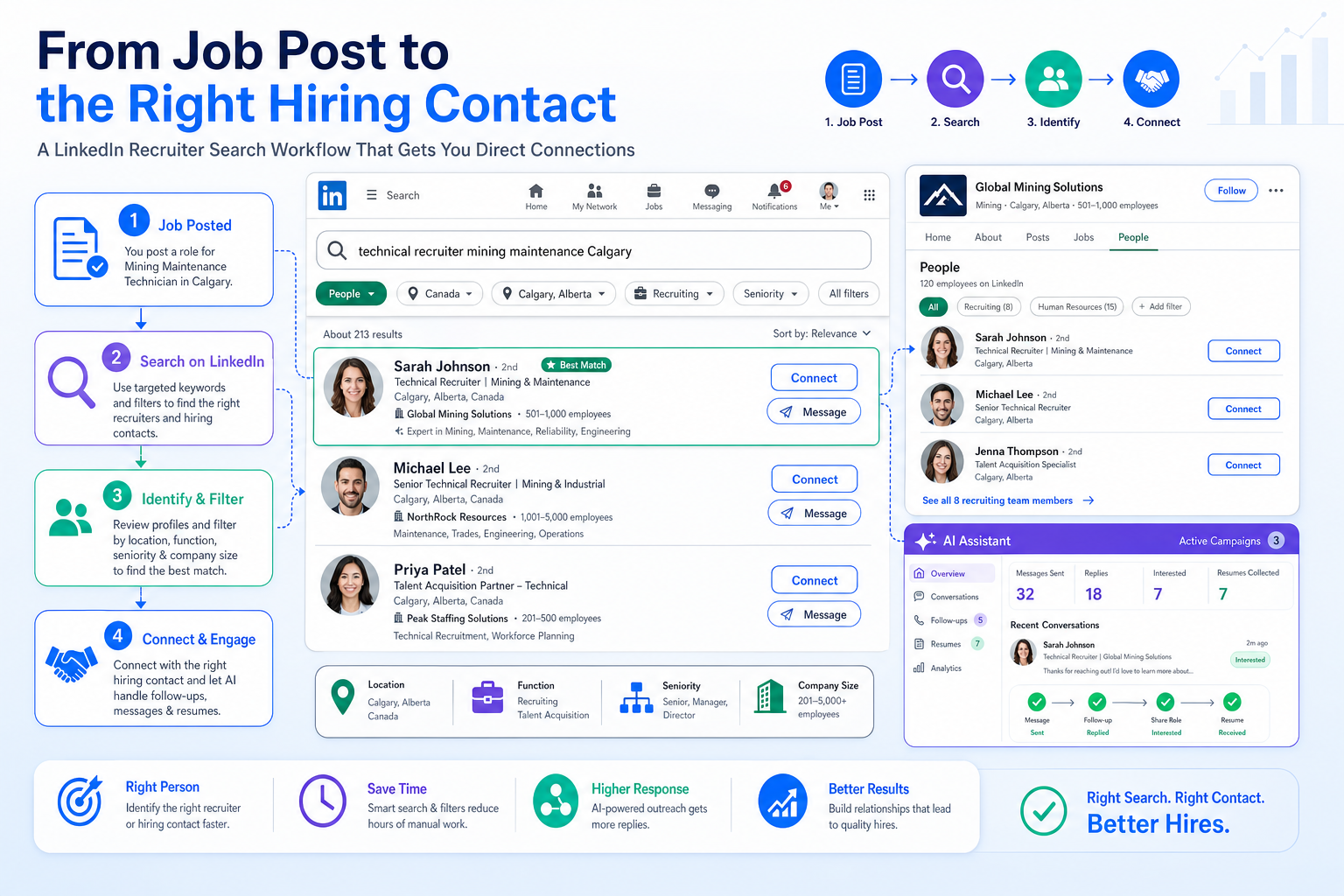
When recruiters need how to find recruiters on LinkedIn, this article shows how to identify the right contact faster and avoid wasted outreach.
Without that discipline, search turns noisy fast. Agency recruiters lose hours chasing the wrong contact, in-house teams send outreach that never reaches the person who owns the role, and small search firms pay the hidden cost in delayed submissions, weaker response rates, and a candidate experience that feels careless rather than informed. The damage is not only time. It affects credibility with hiring managers, candidate trust, and the economics of every search desk.
In my own LinkedIn workflow, tools that reduce repetitive messaging and follow-up have been most useful when they support, rather than replace, recruiter judgment. That is where StrategyBrain AI Recruiter can help: it can automate first-touch communication on LinkedIn, keep candidate replies moving after hours, and collect resumes or contact details from interested people so the recruiter can focus on fit, resume review, and next-step decisions. For teams handling cross-border hiring or high message volume, its multilingual replies and always-on follow-up are especially relevant, but the recruiter still owns qualification and shortlist quality.
That matters in specialized markets. Think about a recruiter trying to fill heavy duty mechanic roles across construction, mining, transportation, or oil and gas. The talent pool spans mobile equipment specialists who handle power, braking, transmission, electronics, and hydraulics; some roles sit in major cities, while others are tied to remote sites where pay can climb well above metro rates because the work is harder to staff. A candidate evaluating one of these jobs is not thinking only about title match. They are weighing location, trade certification path, overtime, allowances, safety, equipment type, and whether the opportunity is worth leaving a stable employer.
Now put that into a LinkedIn sourcing moment. You review a requisition, open candidate replies, and realize that messaging a generic "recruiter" at the target employer will not answer the real question. For a specialized role, you need the recruiter or hiring contact who actually covers that function, geography, and hiring context. That is the transition to this topic: how to search for recruiters on LinkedIn, how to improve recruiter value and ROI, and how to handle the harder scenario of how to find the recruiter for a job on LinkedIn when the job post does not make ownership obvious.
- Why ROI starts with the right recruiter
- How to find recruiters on LinkedIn step by step
- How to find the recruiter for a job on LinkedIn
- What specialized roles teach us about search
- How recruiters actually search on LinkedIn
- Practical search patterns
- Common mistakes that hurt response rates
- Where AI-supported workflows help
- FAQ
Why ROI starts with the right recruiter
When people talk about LinkedIn recruiter ROI, they often jump straight to volume: more searches, more messages, more outreach. In practice, the bigger driver is relevance. If you reach the right recruiting contact faster, you reduce wasted outreach, improve the odds of a useful response, and create cleaner handoffs between candidate, recruiter, and hiring manager.
That is true for both sides of the market. Candidates benefit because they stop sending notes into the void. Recruiting teams benefit because inbound messages become easier to route and evaluate. Headhunters benefit because every search becomes less manual and more defensible to clients. In real recruiting operations, ROI is usually the sum of saved time, higher relevance, and fewer avoidable touchpoints.
Specialized hiring makes this even clearer. In trades and field-service hiring, for example, one recruiter may own remote maintenance roles, another may cover only urban service technicians, and a hiring manager may be more visible than either of them. If you contact the wrong person, your message is not merely delayed; it can miss the actual decision path altogether.
Key insight: Better LinkedIn ROI rarely comes from broader outreach. It usually comes from finding the person who actually owns the search.
How to find recruiters on LinkedIn step by step
If your main question is how to find recruiters on LinkedIn, start with a structured search, not a broad people browse. Recruiters are labeled differently across companies, and LinkedIn search works better when you combine several signals.
Start with title intent. Search recruiter, technical recruiter, talent acquisition partner, talent partner, sourcer, campus recruiter, or staffing specialist.
Add company context. If you want contacts at one employer, combine the title with the company name.
Add geography. For hiring tied to a region, city, province, or country, location dramatically improves relevance.
Add function language. Pair the recruiter title with terms like engineering, healthcare, finance, sales, operations, construction, maintenance, or heavy equipment.
Refine with filters. Current company, location, industry, and connection level help remove noise.
Read the profile, not just the headline. Look for role ownership, hiring posts, business unit references, or wording that signals the functions they cover.
That is the practical answer to how to search for recruiters on LinkedIn. A search for only “recruiter” is usually too broad to be useful. A search like “technical recruiter manufacturing Calgary” or “talent acquisition heavy equipment current company Alberta” is much closer to how experienced recruiters narrow real hiring ownership.
Useful title variations to test
Recruiter
Senior Recruiter
Technical Recruiter
Talent Acquisition Specialist
Talent Acquisition Partner
Talent Partner
Sourcer
Staffing Specialist
University Recruiter
Hiring Manager
In my own searches, widening title variation before widening geography usually produces better results. Companies are inconsistent about titles, but they are often more consistent about where the role sits and what function it supports.
How to find the recruiter for a job on LinkedIn
The harder search problem is how to find the recruiter for a job on LinkedIn. Not every listing shows the recruiter, and even when a visible contact exists, that person may not be the real owner of the requisition.
Inspect the job post first. If a post owner or hiring contact is visible, start there.
Open the company page. Review the People tab for recruiting titles connected to the function or geography.
Search current employees by title and location. Combine recruiter or talent acquisition with the company and the role location.
Match by function. For an engineering role, favor technical recruiters. For field-service or heavy equipment roles, look for recruiters mentioning operations, skilled trades, service, maintenance, construction, or industrial hiring.
Check recent activity. Hiring posts, reposted openings, and team announcements often reveal ownership better than the job listing itself.
Send a short, role-specific note. Mention the job title, location, and one reason you are relevant.
This workflow is especially valuable when the market is fragmented. In skilled trades, for example, a candidate may be considering city-based work at one pay band or remote rotational work at a much higher one. The recruiter who covers remote mining maintenance is not always the same person who covers dealership service roles in a metro area. That is why generic outreach underperforms.
If the recruiter is not visible
Check whether the job owner appears on the listing
Use the company People tab with recruiter and talent acquisition title filters
Try alternatives such as talent partner, sourcer, staffing specialist, or hiring manager
Filter to the relevant location first
Search by function before broadening to general recruiting titles
What specialized roles teach us about search
The heavy duty mechanic example is useful because it exposes how recruiter search actually works in the real world. These are not generic office roles. They can involve different equipment classes, different work environments, and different career decisions for the candidate. One mechanic may work on hydraulic and braking systems for off-road loaders, haul trucks, or bulldozers; another may focus on highway trucks, cranes, or trailers. Safety is central, and the candidate may also be thinking about apprenticeship path, journeyperson status, provincial mobility, or whether a broader credential will open opportunities across regions.
That candidate-side complexity changes recruiter discovery. If the role sits in Vancouver or Toronto, the recruiter might be part of a large urban talent team. If the role is tied to a remote operation with higher hourly pay, overtime, benefits, or allowances, the owner may be a niche recruiter closer to industrial operations. The search problem is no longer “find any recruiter.” It becomes “find the recruiter who understands this exact opportunity structure.”
That is why the opening case matters. The original career context is about evaluating a real work path: what the job involves, what industries need it, what the pay tradeoff looks like by location, and what preparation the person needs before stepping in. On LinkedIn, those same variables become search filters, title clues, and outreach personalization points.
How recruiters actually search on LinkedIn
If you want better outcomes from LinkedIn, it helps to mirror how recruiters think. Experienced recruiters do not usually search one keyword at a time. They layer role, location, specialization, current company, and visible market signals to tighten relevance.
For example, when I have used LinkedIn to find hiring contacts for niche roles, the best results have come from combining the obvious title with one less-obvious business clue. Instead of “recruiter,” I might search “talent acquisition service technician Edmonton,” or “technical recruiter mining maintenance current company.” The second phrase usually does more work than the title alone.
This is also where AI-supported workflow can help without replacing recruiter judgment. I have used AI Recruiter to keep LinkedIn conversations moving while I focused on shortlist review and hiring-manager alignment. Its value was not in making final decisions for me; it was in handling repetitive first-contact, reply continuity, and resume collection so I could spend more time on whether a person actually fit the role, location, and compensation reality. For recruiters working across time zones, the 24/7 multilingual communication piece can keep momentum alive when candidate replies come in after hours.
That division of labor matters. A recruiter still has to evaluate the resume, read between the lines of a career move, and decide whether to advance, reject, or redirect. Automation helps most when it takes pressure off the repetitive surface layer and leaves the judgment layer with the recruiter.
Practical search patterns
Use search patterns that reflect actual recruiting ownership, not just generic labels. Here are some that consistently help.
| Goal | Search Pattern | Why It Helps |
|---|---|---|
| Find recruiters at one employer | Recruiter + company name + location | Removes unrelated profiles quickly |
| Find function-specific recruiters | Technical recruiter + company + city | Improves fit for specialized roles |
| Find industrial or trades recruiters | Talent acquisition + maintenance OR construction + region | Surfaces niche ownership better than generic recruiter |
| Find a recruiter for a specific job | Job function + recruiter + current company | Connects role context to likely owner |
| Catch title variation | Sourcer OR talent partner + company | Useful when recruiter titles differ by employer |
These patterns are especially useful in markets where candidate decisions depend on multiple variables. If a role involves relocation, remote rotation, apprenticeship progression, or a shift from city work to a higher-paid remote site, the recruiter who owns that conversation is often more specialized than the listing suggests.
Common mistakes that hurt response rates
Most people who fail at how to find recruiters on LinkedIn make a few predictable mistakes.
Using only the word recruiter. This creates broad, low-value results.
Ignoring function language. Specialized roles require specialized recruiter signals.
Skipping location filters. In many searches, geography is the clearest ownership clue.
Assuming the visible job post contact is the owner. Sometimes they are; often they are not.
Sending generic outreach. A short, specific note consistently outperforms a broad introduction.
Forgetting title variation. Talent partner, sourcer, staffing specialist, and hiring manager can all matter.
In heavy-duty and field-service hiring, these mistakes become expensive faster because the search itself is already narrower. If the role demands the right certification path, the right equipment background, and willingness to work in a specific setting, irrelevant outreach wastes more than time. It can weaken trust with highly selective candidates.
Where AI-supported workflows help
There is a practical place for automation in this process, especially when LinkedIn messaging volume becomes the bottleneck. The best use case is not final qualification. It is repetitive coordination: first-touch outreach, answering standard role questions, handling late-night replies, and collecting resumes or contact details from interested people.
That is the use case where StrategyBrain AI Recruiter fits naturally into LinkedIn recruiting. It can maintain response continuity, communicate in the candidate's language, and support teams handling more than one search stream at once. If you recruit internationally or run high-volume sourcing, those workflow gains matter. If you want to explore how that operating model works in more depth, the product overview and related tutorials at StrategyBrain and this setup walkthrough show the mechanics clearly.
My own takeaway is straightforward: use automation where the process is repetitive, but keep recruiter judgment where the decision is expensive. In a specialized search, that means the system can help move LinkedIn conversations forward, while the recruiter still interprets compensation tradeoffs, location objections, certification fit, and manager expectations.
Practical takeaway: Automate the reply loop and admin handoff; do not automate the final call on fit.
FAQ
How do you find recruiters on LinkedIn more effectively?
Use layered search criteria: recruiter title, company, location, and function. The more specialized the role, the more important function and geography become.
How to search for recruiters on LinkedIn when titles vary?
Test title alternatives such as talent acquisition partner, talent partner, sourcer, staffing specialist, and sometimes hiring manager. Companies do not use one standard label.
How do I find the recruiter for a job on LinkedIn if no contact is shown?
Start with the company People tab, filter for recruiting titles, and match the role by function and location. Review recent posts to see who is actively hiring for that business unit.
Why does recruiter ROI matter on LinkedIn?
Because the quality of the contact affects speed, relevance, response rate, and handoff quality. Better recruiter discovery reduces wasted outreach and improves workflow efficiency.
Does automation replace recruiter judgment on LinkedIn?
No. Good automation can support first-touch communication, follow-up, and information capture, but recruiters still need to evaluate resumes, interpret fit, and make progression decisions.
What types of roles make recruiter discovery harder?
Specialized roles such as heavy equipment maintenance, field service, industrial operations, or niche technical hiring often have more fragmented ownership by region, business line, or work setting.
Conclusion
Learning how to find recruiters on LinkedIn is ultimately a relevance problem, not a visibility problem. If you search with title variation, function language, company context, and location discipline, you will get closer to the person who actually owns the role. That improves candidate outreach, recruiter productivity, and the real ROI of LinkedIn effort.
The heavy duty mechanic example makes the lesson concrete. When a role involves different industries, equipment types, pay ranges, work settings, and credential paths, generic recruiter discovery breaks down. The same applies across many specialist markets. If you understand how to search for recruiters on LinkedIn in that more precise way, and if you know how to find the recruiter for a job on LinkedIn when ownership is not obvious, your outreach becomes more useful and your workflow more efficient. And when repetitive LinkedIn communication starts consuming the day, an AI-supported workflow such as AI Recruiter can help keep momentum moving while the recruiter stays focused on the decision that still matters most: who is actually right for the job.