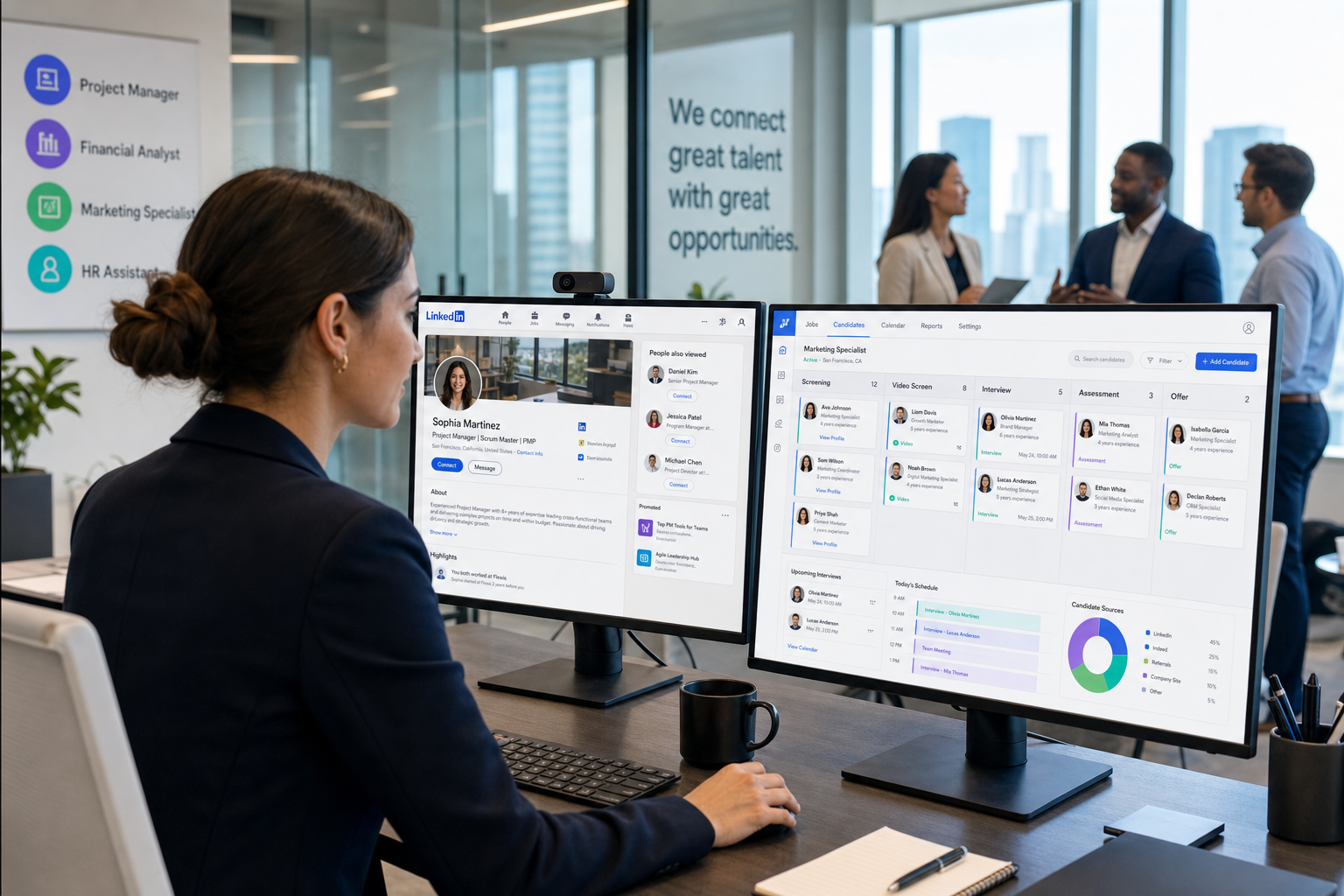
When managing mixed-role searches, this article helps recruiters judge whether a hire platform can cut calendar waste without advancing weak-fit candidates.
That matters most when a desk is handling very different searches at once. One search may be for a junior project manager, another for a junior financial analyst, another for a marketing specialist or HR assistant. The scheduling problem is not just volume. It is the operational cost of deciding who deserves live time, keeping hiring managers aligned, and avoiding the kind of back-and-forth that weakens candidate trust, slows submission speed, and creates preventable revenue leakage for agencies and internal teams alike.
In my own workflow, tools that reduce repetitive outreach before the scheduling stage can make the rest of the funnel far easier to control. Used carefully, StrategyBrain AI Recruiter helps by handling first-touch candidate communication on LinkedIn, replying across time zones, and collecting resumes or contact details from interested people before I move them toward a live interview. What it does not do, and should not do, is replace recruiter judgment. I still review the resume, assess fit, and decide whether the person should advance into the interview workflow inside the hire platform.
A useful way to understand this is to start where many recruiting teams miss opportunity. Fresh finance and business graduates often do not picture themselves entering construction-related roles. They may assume the sector only offers dirty, risky, site-based work, even when employers are actually hiring for junior project management, junior financial analysis, construction marketing, B2B account work, and human resources support. At the same time, the industry still faces real demand pressure, with tens of thousands of additional workers needed and a large wave of experienced workers nearing retirement.
That creates a very specific recruiting challenge. A recruiter has to surface candidates who would not naturally search for the sector, explain why the opportunity is broader than the stereotype, sort early interest from real qualification, and only then coordinate live interviews with the right stakeholders. Once you see that sequence clearly, automated interview scheduling stops looking like a calendar add-on and starts looking like a capability that belongs inside a connected hire platform alongside interview software and video screening software.
Table of Contents
- Why scheduling breaks in cross-functional hiring
- What automated interview scheduling actually covers
- Why a hire platform beats a standalone booking tool
- How early-interest screening reduces calendar noise
- Where interview software and video screening software fit
- Workflow example from outreach to decision
- What to evaluate before you buy
- Common mistakes teams still make
- FAQ
Why Scheduling Breaks in Cross-Functional Hiring
When hiring spans multiple business-facing roles, scheduling friction usually starts before anyone opens a calendar. The real issue is uncertainty at the top of funnel. Recruiters are trying to determine whether a candidate is curious about the industry, open to a role change, able to speak to the work, and worth placing in front of a hiring manager. If those judgments are still unclear, automating interview invitations too early simply moves chaos downstream.
Construction-adjacent hiring is a good example because it regularly includes roles that business graduates do not immediately associate with the sector. A junior project manager needs coordination discipline. A junior financial analyst needs comfort with forecasting and reporting. A construction marketing specialist needs event planning, market research, and channel awareness. A B2B account executive needs relationship management and sales-cycle control. An HR assistant needs process reliability and records accuracy. Those are distinct conversations, so the recruiter needs a workflow that separates initial interest, practical fit, and interview readiness.
Key insight: Automated interview scheduling works best after the recruiting team has clarified who is interested, who is qualified, and which interview stage should happen next.
This is also where I have found StrategyBrain AI Recruiter useful in practice. When I am using LinkedIn to test candidate openness across roles that are not always obvious career targets, automated first-contact messaging can keep conversations moving after hours, in different languages, and without forcing me to monitor every reply live. By the time I personally step in, I am not starting from zero. I am reviewing collected resumes, contact details, and interest signals, then deciding who deserves a scheduled conversation.
What Automated Interview Scheduling Actually Covers
Automated interview scheduling is the set of rules, integrations, and communication steps that move a candidate from approved stage to booked interview with less manual coordination. In a strong hire platform, that usually includes:
- stage-based triggers after recruiter review
- calendar syncing across interviewers
- candidate self-scheduling within approved windows
- reschedule handling and reminders
- meeting instructions and communication history
- feedback capture tied to the interview stage
The distinction that matters is simple. A booking link is not the same thing as scheduling automation. Real automation connects candidate status, interviewer availability, role-specific workflow rules, and documented communication in one place. That is why experienced recruiting teams evaluate this capability inside the broader operating model rather than as a lightweight calendar feature.
For headhunters especially, the benefit is not only speed. It is preserving judgment. Once a candidate is moved into scheduling, everyone on the client or hiring side should know why that person is there, what interview they are entering, and what decision must come out of it.
Why a Hire Platform Beats a Standalone Booking Tool
A standalone scheduling tool can reduce email ping-pong, but it rarely solves the deeper coordination problem. A hire platform can connect sourcing, notes, resumes, stage movement, interview setup, and evaluation. That matters when hiring teams are recruiting for several role types at once and cannot afford fragmented context.
In the earlier construction-style example, imagine one recruiter explaining sector opportunity to a finance graduate, another following up with a B2B sales profile, and a hiring manager waiting for shortlisted candidates for an HR support opening. If scheduling lives outside the hiring record, the team starts copying information by hand, losing communication history, and creating unnecessary ambiguity about who approved what.
A connected platform usually improves:
- Ownership: recruiters know who moved the candidate forward
- Context: hiring managers see why the interview was requested
- Speed: candidates book without long back-and-forth
- Consistency: interviewers use shared scorecards and kits
- Auditability: messages, stage changes, and outcomes stay attached to the record
That is the operational difference between simply booking meetings and actually managing a hiring process.
How Early-Interest Screening Reduces Calendar Noise
One lesson from recruiting into less obvious career paths is that not every positive reply deserves an immediate interview slot. Some candidates are exploring. Some are curious about compensation. Some want to understand whether the role is office-based, client-facing, analytical, or operational. If recruiters schedule all of those conversations live, calendars fill up with calls that should have been filtered earlier.
This is why early-interest screening matters. In outreach-heavy searches, I prefer to separate three questions:
- Is the candidate willing to engage?
- Does the candidate understand the role category well enough to continue?
- After recruiter review, should this person enter a live interview stage?
Tools such as StrategyBrain AI Recruiter can help with the first layer by keeping conversations active on LinkedIn, answering routine role questions, and collecting resumes from interested candidates. That reduces manual chasing, but it still leaves the decisive step with the recruiter: reviewing whether the person actually belongs in the funnel. Once that decision is made, the scheduling workflow in the hire platform becomes cleaner and more defensible.
Where Interview Software and Video Screening Software Fit
Scheduling quality also depends on how the team handles the surrounding stages. This is where interview software and video screening software become part of the same workflow rather than separate purchases.
Interview software supports better live stages
Good interview software helps with more than meeting links. It can support interviewer coordination, structured question sets, role-based interview kits, and scorecards. That matters when one hiring manager is assessing project coordination potential, another is testing analytical capability, and another wants evidence of client communication skills. Scheduling the interview is only half the job; running it consistently is the other half.
Video screening software reduces avoidable live calls
Video screening software is often most useful before the live calendar stage. For roles that attract broad interest but uneven fit, asynchronous responses can help a recruiter compare motivation, communication, and baseline relevance before involving hiring managers. That is especially valuable when the market includes candidates who may not have considered the industry initially and need a clear prompt to explain why they are interested now.
| Stage | Main Decision | Best-Fit Capability |
|---|---|---|
| Initial outreach | Will the candidate engage? | LinkedIn messaging workflow, resume collection |
| Early qualification | Should recruiter review continue? | Video screening software, screening questions |
| Live interview setup | Is the candidate ready for stakeholder time? | Hire platform scheduling, self-booking, reminders |
| Live assessment | How should the team evaluate fit? | Interview software, scorecards, interview kits |
| Decision | Who moves forward? | Recruiter and hiring manager judgment |
When these elements are connected, scheduling supports decision quality instead of creating more admin.
Workflow Example From Outreach to Decision
Here is a practical workflow that fits searches where candidates may not immediately recognize the opportunity category, such as business graduates being considered for project, finance, marketing, sales, or HR roles in construction-related organizations.
- Targeted outreach starts the conversation. The recruiter identifies likely candidates and opens contact through LinkedIn or another sourcing channel.
- Initial interest is captured before live scheduling. If the search involves large outreach volume, a tool such as AI Recruiter can handle routine first-response communication, answer common role questions, and collect resumes or contact details from interested candidates.
- The recruiter reviews actual fit. This remains a human step. The recruiter checks whether the profile makes sense for the role, client, and stage.
- Optional asynchronous screening narrows the field. Video screening software can help if the team needs a more consistent first-pass review before giving up interviewer time.
- Stage-based automation triggers booking. Once approved, the candidate receives scheduling options inside the hire platform.
- The live process is structured. Interview software supports scorecards, interview kits, and feedback capture.
- Decision history stays centralized. Notes, communications, interview outcomes, and scheduling changes remain on the candidate record for recruiter and hiring manager review.
I like this model because it respects where automation genuinely helps and where it does not. It helps with repetitive communication, stage movement, and calendar administration. It does not remove accountability for who gets interviewed or hired.
What to Evaluate Before You Buy
If you are selecting technology for automated interview scheduling, evaluate the workflow in the same way you would evaluate a difficult search: by handoff quality, context retention, and decision discipline.
1. Can the system handle interest before it handles scheduling?
If your searches depend on convincing adjacent candidates to consider a role, you need a process that captures intent before calendars get involved. This is often where sourcing automation and recruiter review must connect cleanly to the hire platform.
2. Does scheduling follow stage logic?
A good platform should trigger interview invitations only after the approved stage has been reached. Recruiters should not need to remember every next step manually.
3. Are different role paths easy to manage?
A junior financial analyst interview should not follow the exact same sequence as a B2B account executive interview. Look for workflow flexibility by role, location, and interviewer group.
4. Does the platform support candidate self-service without losing control?
Self-booking should reduce friction, but recruiters still need buffers, panel controls, and reschedule visibility.
5. How well does it connect to interview software and video screening software?
The best outcomes come from fewer disconnected tools. If early screening and live interviews both happen elsewhere, make sure records and stage history still flow back into the main system.
6. Is the communication record usable?
Recruiters need message history visible in one place, especially when candidates ask follow-up questions or a hiring manager wants context before the interview.
7. Does it preserve human review?
This is non-negotiable. Automation can support messaging, reminders, summaries, and stage triggers. Final evaluation and hiring decisions still belong to recruiters and hiring teams.
Common Mistakes Teams Still Make
Scheduling too early
If a candidate has shown only light curiosity, putting them straight into a live interview creates avoidable calendar waste. This happens often in searches where the role requires education or repositioning, not just availability.
Using a booking tool without a hiring record
When scheduling is detached from candidate notes, resumes, and stage history, interviewers walk into calls with weak context and recruiters spend extra time repairing handoffs.
Ignoring role-specific workflow differences
Project, finance, marketing, sales, and HR openings rarely need identical interview paths. Workflow sameness can feel efficient, but it often creates poor assessment quality.
Forgetting why the candidate was interested in the first place
In adjacent-career recruiting, the initial explanation of the opportunity matters. If that context is not captured, later interviewers may miss what motivated the candidate or what concerns still need to be addressed.
Letting automation outrun accountability
Whether you are using LinkedIn messaging support, video screening software, or interview software, the recruiter still needs to own the decision to advance, schedule, or decline.
FAQ
What is automated interview scheduling in a hire platform?
It is the use of stage triggers, calendar sync, reminders, self-booking, and centralized communication to move approved candidates into interviews with less manual coordination.
Why not just use a scheduling link?
A link can book time, but it does not manage candidate stage, interview context, communication history, or structured evaluation. A full hire platform does.
How does interview software relate to scheduling?
Interview software supports the quality of the live interview through scorecards, interview kits, and feedback workflows. Scheduling gets the meeting on the calendar; interview software helps the team use that time well.
When should video screening software be used?
Video screening software is often most useful before live scheduling, especially when many candidates show interest but only a smaller group should move to stakeholder interviews.
Can LinkedIn automation help before scheduling?
Yes, if used responsibly. In sourcing-heavy workflows, tools like StrategyBrain AI Recruiter can help maintain candidate communication, answer routine questions, and collect resumes before the recruiter decides who should enter the interview funnel.
Should automation make the final hiring decision?
No. Automation can reduce repetitive work and improve consistency, but recruiters and hiring managers should remain responsible for resume review, interview advancement, and final decisions.
Conclusion
Automated interview scheduling delivers the most value when it is treated as a downstream result of good recruiting judgment, not as a shortcut around it. That is especially true in searches where candidates need help seeing the opportunity clearly, as with finance or business graduates considering project, finance, marketing, sales, or HR roles in construction-related organizations.
Inside a strong hire platform, the workflow can connect early interest capture, recruiter review, video screening software, structured interview software, and live scheduling without losing accountability. That is the practical standard I would use when evaluating tools: not whether they automate one task, but whether they help the team move the right people into the right conversations at the right time.