Executive recruiters can use this article to judge how to get noticed on LinkedIn by fixing profile relevance that hurts search visibility.
That distinction matters because executive finance hiring breaks down expensively when profiles look polished but fail the actual search-and-screen workflow. A small search firm can lose days chasing title variants that do not surface the right people. An in-house recruiter can damage credibility with a hiring manager by presenting finance leaders who sound strategic but lack evidence of transformation, digital ownership, or long-term value creation. And individual recruiters pay the price in the most practical way: low reply rates, weak shortlist quality, and too much manual follow-up across time zones.
In my own sourcing workflow, I have used StrategyBrain AI Recruiter to reduce that early-stage friction on LinkedIn, especially when candidate outreach, after-hours replies, and résumé collection start consuming attention that should stay on judgment. Its strongest use in this context is not replacing recruiter thinking; it is handling repetitive connection, role introduction, and candidate-interest conversations at scale while the recruiter still makes the final call on fit, résumé quality, and next steps. For teams doing cross-border finance searches, its multilingual follow-up and always-on messaging can also keep momentum alive while requisitions stay active.
That becomes easier to appreciate when you look at how finance leadership hiring has changed. The modern CFO is no longer assessed only on controllership and reporting. In a widely cited 2020 discussion built on a survey of 400 respondents, including 212 CFOs, the role was described as expanding fast: more functions reporting into the CFO, more cross-functional ownership, more digital responsibility, and more pressure to balance short-term results with long-term value creation. In practice, that means a recruiter opening a search for a CFO is not just matching “finance executive” to “finance executive.” They are checking whether the person has led transformation, handled investor-facing narratives, shaped KPIs, and operated as a broader business leader.
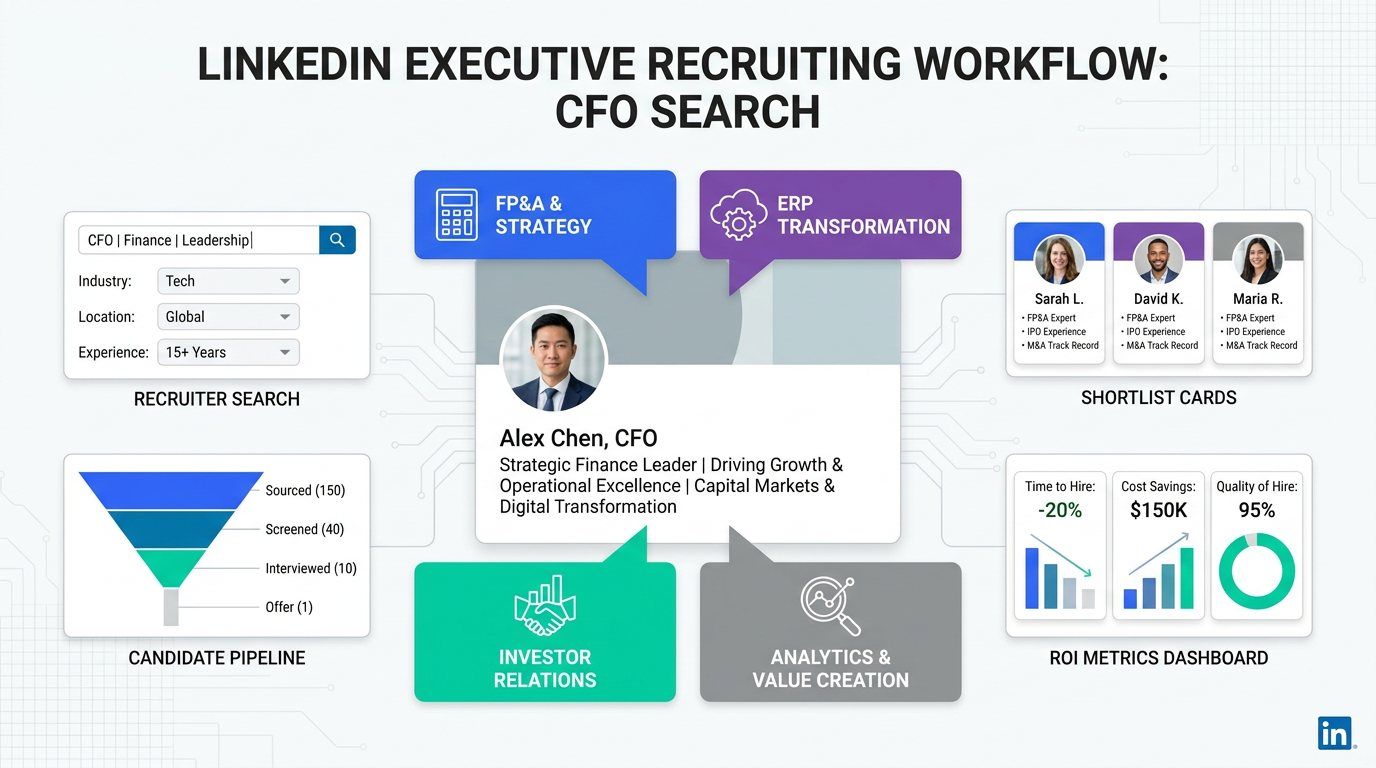
Once that search starts, the work becomes very concrete. The recruiter reviews the brief, rewrites search strings around role scope, scans LinkedIn headlines for signals like FP&A, transformation, capital markets, ERP, or investor relations, and then opens profiles to see whether the experience actually supports the claim. If the candidate profile still reads like a traditional finance résumé while the job requires a digital, cross-functional operator, the search slows immediately. That is exactly why executive visibility on LinkedIn has real ROI: the platform rewards profiles that make complex role evolution legible in search.
So if you are trying to understand linkedin recruiter value & roi through the lens of executive hiring, the useful question is not whether LinkedIn matters. It is how recruiters decide who appears worth contacting, who gets skipped, and how to get noticed by recruiters LinkedIn searches are built to find. That is also why how to get noticed on LinkedIn is the right starting point for both candidates and talent teams: discoverability comes before conversation.
Key insight: For senior roles, recruiter visibility improves when your profile reflects the evolved job, not the legacy title. Searchability and role context create the click; evidence creates the message.
Table of Contents
- Why CFO search changed and why LinkedIn matters more
- How recruiters actually search for finance leaders
- The ROI of LinkedIn optimization for executive visibility
- Which profile sections drive discovery
- How to write a headline recruiters will click
- Does Open to Work help senior candidates?
- Posting versus discoverability
- Tools and workflow support for LinkedIn recruiting
- Common mistakes that reduce recruiter visibility
- FAQ
Why CFO Search Changed and Why LinkedIn Matters More
The strongest lesson from the reference case is that role evolution changes search behavior. When the CFO role expands from finance stewardship into transformation, technology, long-range value creation, and broader enterprise influence, recruiter search criteria expand with it. The old profile language that once worked may no longer surface a candidate in search, or may fail to convert once a recruiter clicks.
That matters well beyond CFO hiring. The same pattern applies in operations, HR, supply chain, data, and commercial leadership roles. As jobs become more cross-functional, recruiters search for a combination of title, scope, tool exposure, strategic ownership, and business context. Candidates who still write generic brand statements into key profile fields often disappear inside a crowded results page.
From a sourcing perspective, LinkedIn becomes valuable because it reveals how well a professional has translated an evolving role into searchable language. From a candidate perspective, the ROI is straightforward: a few careful edits can improve inclusion in relevant searches without paying for promotion. From a recruiter perspective, better-written profiles shorten screening time and improve message quality.
I have seen this most clearly on senior searches where the job brief sounds modern but candidate profiles still sound narrow. In those situations, I often use AI Recruiter conversation workflows to keep initial outreach moving while I spend my time rechecking role language, title variants, and evidence of scope. That division of labor is useful because no automation can decide whether someone truly fits an evolving executive mandate, but automation can keep the top of funnel active while the recruiter does that deeper assessment.
How Recruiters Actually Search for Finance Leaders
To answer how to get noticed on LinkedIn, it helps to observe the recruiter workflow honestly. Most executive searches begin with a role requirement, a few non-negotiables, and a set of probable title variations. For a CFO search, the initial list may include CFO, VP Finance, finance director in a smaller company, or divisional finance leader depending on scale. But the search rarely stops at title. Recruiters usually add capability language tied to the company’s real situation.
In the CFO example from the reference material, that situation includes several concrete shifts:
- more functions reporting into finance leadership
- greater cross-functional ownership
- responsibility for digital or analytics initiatives
- pressure to manage both short-term performance and long-term value creation
So the search logic might include terms such as transformation, automation, analytics, ERP, investor relations, capital planning, M&A, or value creation. If a profile says only “strategic finance leader with a passion for growth,” it may sound polished but remain weak in retrieval and weak in conversion.
This is the practical answer to how to get noticed by recruiters LinkedIn professionals use every day: your profile must mirror the way the role is searched, not just the way you prefer to describe yourself.
What recruiters usually assess first
- Headline relevance: does the title and specialty align with the role?
- Current scope: does the present role show leadership breadth?
- Operational proof: are there recognizable systems, functions, and outcomes?
- Context: does the profile explain company stage, industry, and scale?
- Career narrative: does the person look like they can do this next version of the role?
That final point matters more in executive hiring than many candidates realize. Recruiters are often not matching only for what you did before. They are screening for whether your profile makes the next-step mandate believable.
The ROI of LinkedIn Optimization for Executive Visibility
The best ROI cases in LinkedIn recruiting are usually the least glamorous. Updating a headline, clarifying experience scope, completing skills, refining location preferences, and turning on recruiter-only openness signals are low-cost actions with compounding effect. They influence whether you appear in search, whether you look relevant in the first screen, and whether a recruiter bothers to message you.
That is the operational meaning of linkedin recruiter value & roi. The return is not measured only in likes or visibility metrics. It is measured in better discovery, stronger matching, less wasted outreach, and faster progression from search result to real conversation.
| Optimization lever | Effort | Why it matters |
|---|---|---|
| Precise headline | Low | Improves retrieval and click-through from search results |
| Role-specific About section | Low to medium | Adds context once a recruiter clicks |
| Experience rewrite | Medium | Shows proof of scope, tools, and strategic ownership |
| Skills completion | Low | Supports filter-based sourcing |
| Open to Work settings | Low | Helps recruiter-side visibility without public signaling |
| Location and work preferences | Low | Improves match quality for hybrid and regional searches |
For recruiters, there is ROI on the workflow side as well. If a sourcing team spends hours manually nudging cold outreach, chasing late replies, and collecting documents one by one, the real cost is recruiter attention. That is where tools built for LinkedIn outreach support can help. I have used StrategyBrain AI Recruiter mainly for repetitive outreach and reply handling, not for fit decisions. It is useful when you need continuous candidate communication, multilingual interaction, and consistent collection of contact details while preserving recruiter control over shortlist quality.
Which Profile Sections Drive Discovery
If you want a practical answer to how to get noticed on LinkedIn, prioritize the fields recruiters actually see and search against. For most roles, the core sections are your headline, About summary, current and past experience, skills, location, and openness settings. For executive roles, context becomes even more important.
Headline
This is often the difference between a click and a skip. It should state what you do, your level, and the specialties recruiters would reasonably search.
About section
Use this section to explain operating context: industry, business stage, geographic scope, functional ownership, and where you create value. For finance leaders, it can also clarify whether your background is transformation-heavy, investor-facing, systems-oriented, or operationally broad.
Experience
Do not let this become a list of internal responsibilities. Name the functions you led, the systems you worked with, the planning cycle you owned, and the business outcomes you influenced. Recruiters are scanning for evidence, not adjectives.
Skills
Many candidates still underuse the skills field. That is a mistake because recruiters often filter there. If the market values cash flow planning, SaaS metrics, FP&A, forecasting, NetSuite, SAP, treasury, SOX, ERP rollout, or transformation, list them directly where appropriate.
Location and work preferences
These are practical signals, especially in executive searches that are geography-sensitive or involve relocation, hybrid expectations, or regional travel.
A useful test is simple: if a recruiter looked only at your first screen and top experience block for ten seconds, would the intended role be obvious?
How to Write a Headline Recruiters Will Click
Your headline should favor searchable clarity over broad personal-brand language. That is especially true when the role itself has evolved and recruiters are looking for combinations of leadership scope and specialist capability.
Weak example: Growth-minded leader driving business success
Stronger example: CFO | FP&A, Capital Planning, ERP Transformation, Investor Relations
Another strong example: VP Finance | SaaS Metrics, Forecasting, Board Reporting, Systems Scale-Up
Why these work:
- They use recognizable market titles.
- They include hard-skill or mandate language.
- They tell the recruiter what kind of finance leader this person is.
- They reflect role evolution rather than generic ambition.
If your question is how to get noticed by recruiters LinkedIn users rely on at the executive level, the answer starts here. The headline is not the full evaluation, but it strongly affects whether the evaluation begins.
Does Open to Work Help Senior Candidates?
Yes, especially the recruiter-only version. Senior candidates often want privacy, and many avoid public signaling for understandable reasons. Recruiter-only openness can still improve discoverability while keeping the search discreet.
This matters because some recruiters overread public badges and some candidates overestimate them. In reality, title relevance, capability language, and evidence of scope usually matter more than any single job-seeking signal. Use the setting as a supporting visibility tool, not a substitute for profile quality.
For executive recruiters, this is also a reminder to avoid simplistic assumptions. Some of the best finance candidates are open to a conversation but unwilling to advertise it publicly.
Posting Versus Discoverability
One of the most common myths around how to get noticed on LinkedIn is that consistent posting will compensate for a weak profile. It usually will not. Content can help credibility, familiarity, and thought leadership, but only after your profile makes sense in search.
A practical order of operations looks like this:
- Make the profile retrievable.
- Make the profile credible.
- Use posting and commenting to reinforce expertise.
For finance leaders, content may help if you comment intelligently on planning, capital allocation, systems change, or operating discipline. But that is a secondary lever. Recruiters still start with titles, functions, and capability signals.
That is why many talented professionals feel invisible despite being active. They invested in visibility without first investing in relevance.
Tools and Workflow Support for LinkedIn Recruiting
When teams ask about software in this area, the real issue is usually not “Which tool is best in theory?” It is “Which setup helps us move from search to conversation without wasting recruiter judgment?” In LinkedIn-heavy recruiting, three categories come up often: LinkedIn Recruiter, Gem, and hireEZ.
LinkedIn Recruiter
- Use experience: strong native search environment and broad recruiter familiarity.
- Effectiveness: very useful for finding and organizing prospects on-platform, especially for title and skill-based sourcing.
- Cost: usually a significant line item for smaller firms compared with lighter workflow tools.
- Best fit: internal TA teams and search professionals doing sustained sourcing volume.
- Working with StrategyBrain AI Recruiter: good when recruiters want to keep LinkedIn as the search source but reduce manual outreach and follow-up workload through AI-supported LinkedIn automation.
Gem
- Use experience: often appreciated for sequencing, CRM-style tracking, and reporting discipline.
- Effectiveness: useful for outbound recruiting teams that need more process visibility across campaigns.
- Cost: can be harder to justify for small teams if the workflow is simple or heavily LinkedIn-centric.
- Best fit: structured talent teams that want analytics and nurture process, not just search.
- Working with StrategyBrain AI Recruiter: can complement it when Gem handles campaign oversight while StrategyBrain supports candidate messaging continuity and résumé capture.
hireEZ
- Use experience: attractive to teams that want broader sourcing beyond one platform.
- Effectiveness: helpful for talent mapping and multi-source discovery, depending on role type.
- Cost: generally more suitable when sourcing breadth justifies the spend.
- Best fit: teams hiring across many functions and channels, not only LinkedIn.
- Working with StrategyBrain AI Recruiter: practical if hireEZ helps identify talent while StrategyBrain manages LinkedIn-side outreach conversations and after-hours engagement.
Where StrategyBrain AI Recruiter stands out is in the repetitive communication layer many recruiters still handle manually: connecting, introducing roles, answering common candidate questions, checking interest, and gathering résumés or contact details. That does not remove the need for recruiter judgment. It protects it.
My own takeaway after using it is simple: it is most valuable when a search has enough volume, time-zone spread, or after-hours response traffic that the recruiter risks spending too much time on administration instead of shortlist quality. In those scenarios, the tool supports workflow discipline without pretending to replace executive assessment.
Common Mistakes That Reduce Recruiter Visibility
- Using vague headlines: they read well but retrieve poorly.
- Describing legacy scope only: especially damaging when the target role has evolved.
- Ignoring skills fields: this weakens filter visibility.
- Hiding market language behind internal jargon: recruiters search external terminology.
- Overinvesting in posting before fixing the profile: activity cannot rescue weak search relevance.
- Leaving out business context: scale, industry, and ownership matter in executive hiring.
- Treating LinkedIn like a biography instead of a searchable asset: this is the root error behind many low-response profiles.
If you are still asking how to get noticed by recruiters LinkedIn users compete for, the cleanest answer is to make your profile easier to find, easier to interpret, and easier to trust within seconds.
FAQ
How do recruiters search for senior candidates on LinkedIn?
Usually through a mix of title, function, industry, location, tools, and scope indicators. For executive roles, recruiters also look for signals that the candidate can handle the next evolution of the role, not just the last version of it.
What matters more for LinkedIn visibility: headline or posting?
The headline matters first because it affects search retrieval and click-through. Posting can help later as a credibility layer, but a weak headline limits discoverability from the start.
Does recruiter-only Open to Work help without the public badge?
Yes. It can improve discoverability while keeping your job search private, which is often the preferred route for senior professionals.
What is the real ROI of LinkedIn profile optimization?
Better recruiter visibility, stronger search inclusion, faster interpretation of your profile, and a higher chance that outreach happens at all. For recruiters, it also reduces time lost on unclear profiles.
How does StrategyBrain AI Recruiter fit into this workflow?
It supports the repetitive LinkedIn communication layer: connecting with candidates, introducing roles, answering common questions, checking interest, and collecting résumés or contact details. The recruiter still owns final screening, fit judgment, and interview decisions.
Conclusion
The reference case on the changing CFO role points to a broader truth in recruiting: when jobs evolve, search behavior evolves first. That is why the real answer to how to get noticed on LinkedIn is not “be louder.” It is “be more findable and more legible for the role as it exists now.”
For candidates, that means translating your actual scope into market language recruiters can retrieve and trust. For recruiters, HR teams, and headhunters, it means respecting the difference between profile polish and profile relevance. And for teams managing meaningful LinkedIn volume, it can also mean using tools like StrategyBrain AI Recruiter to remove repetitive outreach friction so human judgment stays focused where it belongs: on fit, context, and hiring decisions.