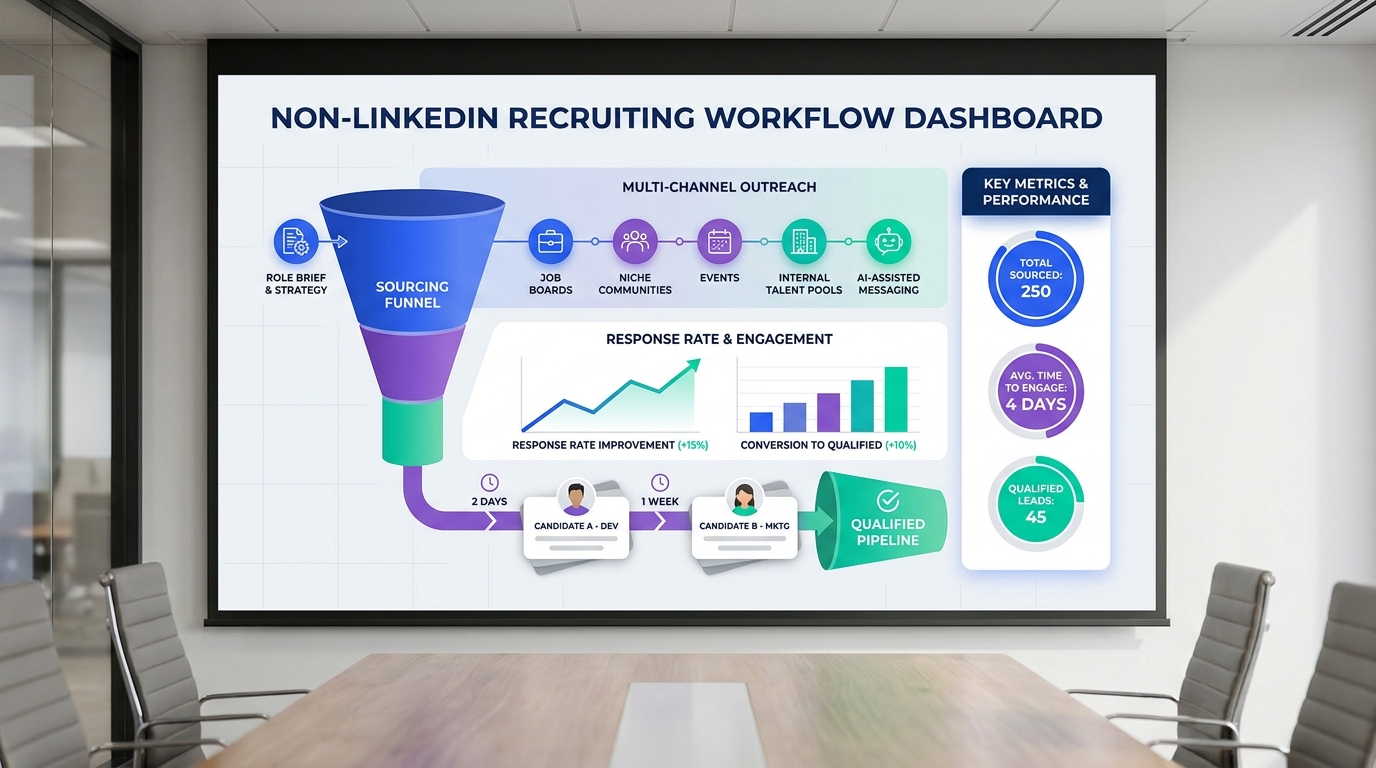
When response rates stall, this hr sourcing guide helps recruiters judge channels and outreach so pipelines gain stronger replies, not just volume.
That sounds simple until a live search gets tight. Agency recruiters end up chasing the same visible profiles, in-house teams send technically accurate but forgettable messages, and hiring managers judge sourcing quality by volume instead of traction. The result is familiar: weak response rates, slower shortlist creation, avoidable friction with stakeholders, and a pipeline that looks busy without getting stronger.
In my own workflow, tools that support consistency matter most when they reduce the repetitive parts without taking judgment away from the recruiter. For teams still working heavily through LinkedIn outreach, StrategyBrain AI Recruiter can help by handling first-touch messaging at scale, replying across time zones, and collecting resumes or contact details from interested candidates. I would still keep final review, fit assessment, and next-step decisions with the recruiter, but for after-hours follow-up and structured first contact, that kind of support can remove a real bottleneck.
The underlying challenge is not new. In interview settings, people are judged on two fast signals: capability and likeability. If competence is not clear early, trust drops immediately. If competence shows up without warmth, the person can still feel risky, distant, or hard to place. That same judgment pattern appears long before the interview, right inside sourcing outreach, where a candidate decides in seconds whether a recruiter sounds credible, relevant, and worth answering.
That is why non-LinkedIn sourcing deserves more than a list of channels. The real question is how recruiters combine discovery tools, outreach timing, and message framing so candidates see both fit and human relevance. The rest of this guide looks at talent sourcing tools (non-LinkedIn), the best sourcing strategies for using them well, and the sourcing methodologies recruitment teams can apply when they want better replies instead of bigger lists.
Table of Contents
- Why Sourcing Breaks Before the Interview Starts
- What to Prepare Before Choosing Tools
- Talent Sourcing Tools Beyond LinkedIn
- Best Sourcing Strategies That Turn Tools Into Results
- Sourcing Methodologies Recruitment Teams Can Use
- Where AI-Assisted Sourcing Actually Helps
- How to Measure Sourcing Success
- Common Mistakes in Non-LinkedIn Sourcing
- FAQ
Why Sourcing Breaks Before the Interview Starts
Experienced recruiters know that candidate sourcing is not only a search problem. It is also a perception problem. The candidate is making a fast judgment: does this recruiter understand my background, is this role relevant, and is this worth my time? In practical hr sourcing, those judgments often happen before a screen is booked.
That is why the interview lesson about warmth and competence translates so well to sourcing. You need enough credibility at the start to show the opportunity is real and considered. You also need enough human connection that the message does not read like a bulk send. When either side is missing, response rates drop for different reasons:
- Low competence signal: outreach feels vague, mismatched, or careless
- Low warmth signal: outreach feels robotic, transactional, or overly aggressive
- Low similarity signal: candidates do not feel the recruiter understands their niche, priorities, or likely motivations
That framing matters because it changes how you evaluate sourcing tools. A useful tool is not just one that finds names. It should help recruiters identify fit, preserve context, support better timing, and make outreach more relevant.
Key insight: The strongest sourcing workflows create early trust the same way strong interviews do: they show capability quickly, then make the interaction feel human.
What to Prepare Before Choosing Tools
One of the most overlooked best sourcing strategies is preparation. Before selecting channels or automation, recruiters need a role brief that goes beyond title matching. Otherwise, even strong tools generate noise.
Start with three essentials: the business outcome of the role, the must-have competencies, and the target-candidate profile. I usually tell hiring teams to define what success looks like in the first 6 to 12 months, which capabilities are non-negotiable, and which adjacent backgrounds could still convert. This becomes especially important when titles vary widely across employers.
Build a sourcing brief before opening any platform
- Core mission of the role: What business problem does this hire solve?
- Required competencies: Skills, tools, scope, and domain exposure
- Context variables: Location, timezone, language, industry, seniority, and compensation boundaries
- Adjacent profiles: Backgrounds that may fit even without a direct title match
- Disqualifiers: Constraints that save time during search and screening
This step improves hr sourcing because it shifts the team from keyword hunting to profile interpretation. It also makes outreach better. If a recruiter cannot explain why the candidate fits, no automation layer will rescue the message.
Use a simple title-and-opening evaluation process
For search performance, I evaluate the article title and first sentence the same way I evaluate outreach copy: by clarity, relevance, and immediate trust. The title should tell the reader what problem is being solved, what boundary matters, and whether the piece sounds written by someone who has actually sourced roles. The first sentence should make a useful claim fast, include a real recruiting signal, and avoid generic blog phrasing.
A practical review process is simple:
- Check whether the title clearly serves the search intent behind hr sourcing.
- Confirm that the opening line makes a specific promise tied to recruiter workflow, not broad career advice.
- Test whether both pieces create curiosity without sounding inflated or vague.
- Remove generic phrases and replace them with practical recruiting language.
- Make sure the first sentence and title match the article that follows.
This may sound like SEO mechanics, but it mirrors candidate psychology. If the first impression is weak, people leave. If it feels credible and relevant, they continue.
Talent Sourcing Tools Beyond LinkedIn
For a non-LinkedIn strategy, the strongest approach is to think in functional categories. That better reflects real recruiter behavior and aligns with real-world sourcing methodologies recruitment teams use across multiple channels.
1. Job boards and resume databases
Job boards are not just posting destinations. Many also operate as searchable databases where recruiters can filter by skills, geography, experience level, and recent activity. These are useful when you need active job seekers quickly, especially for high-volume or location-specific hiring.
Practical advice: Use these sources when speed matters more than perfect specialization. Outreach needs to be sharper because candidates in active databases are often receiving more messages.
2. Professional communities and niche forums
Niche communities often outperform broad networks for specialized roles. They surface genuine practitioner engagement, topic depth, peer recognition, and sometimes better evidence of current expertise than a polished profile does.
Practical advice: Search where professionals learn, share, ask, answer, or collaborate. This supports one of the best sourcing strategies: identify expertise through contribution, not only through headlines.
3. Social platforms outside LinkedIn
Different social platforms reveal different candidate signals. Some are stronger for technical discussion, some for creative work, and some for visible community participation. The value is not just profile data but context: what the person talks about, how they present ideas, and whether their public activity aligns with the role.
Practical advice: Do not duplicate the same message across every channel. Context-based outreach consistently performs better than generic sequencing.
4. Online portfolios and project-based profiles
Portfolio-driven sourcing works especially well for design, content, engineering, research, and other output-visible functions. It lets recruiters evaluate work earlier instead of relying only on titles or self-description.
Practical advice: Hiring managers should define what strong work evidence looks like before sourcing starts. That improves calibration and reduces later disagreement.
5. Event sourcing and conference communities
Events, webinars, workshops, meetups, and attendee communities can be strong sourcing environments because they show active engagement in a field. They also offer a natural reason to start a conversation.
Practical advice: Reach out while the event context is still fresh. Relevance fades quickly when follow-up happens too late.
6. Internal talent databases and silver-medalist pools
Many recruiting teams underuse their own historical pipeline. Past finalists, previous applicants, contractors, referrals, alumni, and talent community subscribers can become some of the highest-converting prospects because trust is already partially built.
Practical advice: Before launching a new search, revisit whether a similar role has already produced quality prospects. This is one of the most efficient best sourcing strategies available.
7. Contact discovery and outreach support tools
These tools help recruiters find professional contact paths, verify data, support sequencing, and monitor engagement. They matter when the challenge is not discovery alone, but disciplined outbound execution.
Practical advice: Use them within clear compliance standards. Better process should not become an excuse for low-quality mass messaging.
8. Talent CRM and pooling systems
CRM-style systems matter once the team moves beyond one-off searches. They help segment prospects, log touchpoints, tag interest, and sustain long-term relationships. For TA leaders, this is where sourcing becomes a repeatable operating model instead of a reactive scramble.
Practical advice: If recruiters keep rediscovering the same candidates every quarter, the issue is usually talent pooling, not search volume.
9. AI-assisted sourcing and semantic matching tools
AI-assisted sourcing tools are useful when they infer related capabilities from full profiles instead of depending only on exact keyword matches. That makes them better for skills-based hiring, adjacent career paths, and role families where titles vary by employer.
Practical advice: Use AI for discovery, prioritization, and outreach support. Keep recruiter judgment in charge of qualification nuance and relationship-building.
Best Sourcing Strategies That Turn Tools Into Results
Tools matter, but execution matters more. The best sourcing strategies usually combine channel choice, role clarity, message relevance, and follow-up discipline.
Use a multi-channel approach, not a single-source habit
When one platform dominates your workflow, you inherit its blind spots. A stronger model blends active databases, passive-candidate channels, niche communities, portfolio sources, and internal pools.
Source for competencies, not only titles
Titles are inconsistent across companies. Strong hr sourcing teams search for evidence of scope, outcomes, tools used, complexity handled, and domain fit. That is how they avoid recycling the same obvious profiles.
Write outreach that shows why the candidate fits
Passive candidates rarely respond because a recruiter says the role is exciting. They respond when the recruiter clearly explains relevance. Mention a capability, project pattern, or industry transition that connects the person to the opportunity.
Balance competence and warmth in the first message
This is where the earlier lesson becomes practical. Your outreach should quickly signal that you understand the candidate's background and the business need. Then it should sound like a conversation, not a script. Accomplishments and role specifics matter, but the message should still be framed as service and fit rather than bragging about the opportunity.
Blend inbound and outbound sourcing
Methodology-focused teams rarely choose only one motion. Inbound applicants create efficiency; outbound sourcing creates reach and precision. Together they produce a healthier comparison set for hiring managers.
Calibrate with hiring managers early
After the first batch of sourced profiles, stop and review patterns. Ask what looks strong, what feels off, and which adjacent backgrounds deserve more attention. This prevents another week of sourcing against the wrong interpretation.
Use automation where response timing matters most
In one of my own LinkedIn-heavy searches, the problem was not finding candidates. It was losing momentum after the initial message because replies came in late, across multiple time zones, and with uneven follow-up. Using AI Recruiter for first-touch communication and resume collection helped keep the conversation moving when I was offline. What I liked was not the idea of replacing the recruiter. It was preserving speed and consistency while I still handled shortlist judgment, resume review, and interview decisions myself.
Sourcing Methodologies Recruitment Teams Can Use
There is no single universal playbook, but most effective sourcing methodologies recruitment teams follow one of a few repeatable models depending on role complexity and urgency.
| Methodology | Best Use Case | How It Works | Main Advice |
|---|---|---|---|
| Volume-first sourcing | High-volume or urgent hiring | Use broad databases, structured filters, and fast outreach to generate top-of-funnel activity | Track quality closely so speed does not flood the funnel with weak fits |
| Precision sourcing | Specialist or leadership roles | Start with a narrow role brief, map target backgrounds, and personalize outreach deeply | Spend more time selecting candidates before messaging |
| Community-led sourcing | Hard-to-reach talent pools | Source through niche groups, events, forums, and peer networks | Lead with relevance and credibility, not a generic pitch |
| Internal-pipeline sourcing | Repeat hiring patterns | Reactivate silver medalists, alumni, referrals, and prior prospects | Refresh data and reframe the opportunity based on timing |
| AI-assisted sourcing | Complex searches with fuzzy titles | Use semantic matching, fit summaries, and outreach support | Validate recommendations with recruiter review before outreach |
For most teams, the best answer is a hybrid model. That is why best sourcing strategies are usually operational, not theoretical. You may start broad, shift to precision once patterns emerge, and then revisit internal pools when the target profile sharpens.
Where AI-Assisted Sourcing Actually Helps
AI is one of the most discussed parts of modern hr sourcing, but its best use is still near the top of the funnel. It can help surface adjacent candidates, summarize fit based on broader profile context, support follow-up, and prioritize who deserves recruiter attention first.
This is especially useful when exact keyword matching misses strong candidates. Someone may have done the work without using the expected title, tool name, or standard terminology. Semantic matching helps uncover those profiles by reading experience patterns rather than literal phrase overlap.
For teams doing heavy outbound on LinkedIn, StrategyBrain AI Recruiter is more relevant as a communication workflow support layer than as a decision-maker. It can keep conversations active around the clock, respond in a candidate's language, and gather resumes or contact details once interest is confirmed. That is helpful in situations where recruiter availability, time-zone lag, or repetitive first-touch tasks slow down the search. But recruiters still need to own the parts that actually determine hiring quality: evaluating resumes, reading motivation, spotting inconsistencies, and deciding who moves forward.
- Best use for AI: discovery, ranking support, message drafting, first-response handling, and structured follow-up
- Use with caution: final qualification, nuanced assessment, and decisions requiring business context
- Recruiter responsibility: validate fit, refine messaging, and protect candidate experience
How to Measure Sourcing Success
If your team only measures how many profiles were found, you do not really know whether sourcing is working. Better sourcing methodologies recruitment teams measure what happens after first contact.
Key metrics to monitor
- Response rate: How many contacted prospects reply
- Prospect-to-screen conversion: How many sourced candidates move into recruiter screen stage
- Pipeline quality: How many sourced candidates are considered viable by recruiters and hiring managers
- Channel efficiency: Which sources create the best mix of speed, relevance, and conversion
- Time-to-qualified-pipeline: How quickly the team produces a credible shortlist
These metrics matter because they reveal whether your workflow is creating early trust. If response rate is low, the issue may be targeting, timing, or message framing. If response is healthy but screen conversion is poor, the problem is often search criteria or recruiter calibration.
A simple operating framework
- Define the role brief and target criteria
- Select 3 to 5 channels based on role type and urgency
- Build a first prospect list using both broad and niche sources
- Send tailored multi-channel outreach
- Review response and conversion patterns after the first wave
- Refine search criteria, messaging, and channel mix
- Recycle strong non-converted prospects into your talent pool
This framework keeps hr sourcing practical. It also gives hiring managers a better way to discuss sourcing quality than simply asking for more resumes.
Common Mistakes in Non-LinkedIn Sourcing
Even experienced teams weaken outcomes with a few common mistakes, most of which connect back to the same early-perception problem described at the start of this article.
- Starting with tools before alignment: If the role brief is vague, the shortlist will be vague too.
- Overusing exact keyword search: This misses adjacent talent and transferable capability.
- Treating all channels the same: Outreach should reflect the context in which the candidate was found.
- Ignoring internal databases: Many teams search outward before checking warm prospects they already have.
- Measuring activity, not conversion: Large lists do not matter if replies and screens stay weak.
- Letting automation flatten recruiter tone: Speed helps, but trust still depends on relevance and human judgment.
If you want stronger best sourcing strategies, fix these process issues first. Tool quality matters, but process discipline usually determines whether a team gets signal or noise.
FAQ
What is candidate sourcing in recruiting?
Candidate sourcing is the proactive process of identifying and engaging potential hires before they apply. In hr sourcing, this includes candidate discovery, passive-candidate outreach, early qualification, and talent pipeline building.
How is sourcing different from recruiting?
Sourcing focuses on top-of-funnel work such as finding prospects, assessing fit signals, and starting conversations. Recruiting usually covers later stages like interviews, coordination, offers, and closing.
What channels work beyond LinkedIn for talent sourcing?
Useful non-LinkedIn channels include job boards, niche professional communities, social platforms, online portfolios, events, alumni networks, referrals, and internal talent databases. The right mix depends on role type, urgency, and how visible candidate work or expertise is.
Why do some sourcing messages get ignored even when the role is strong?
Because candidates often make a quick judgment about both credibility and tone. If the message does not show clear fit, it feels careless. If it shows fit but sounds cold or automated, it still may not earn a reply.
When should recruiters use AI sourcing tools?
AI sourcing tools are most helpful at the top of the funnel for discovery, semantic matching, profile summarization, and outreach support. They are less reliable as stand-alone decision-makers, so recruiter judgment should remain central to qualification and relationship management.
How do you measure sourcing success?
Track response rate, prospect-to-screen conversion, pipeline quality, channel efficiency, and time-to-qualified-pipeline. These metrics show whether your sourcing methodologies recruitment process is creating relevant talent flow instead of just producing long lists.
Conclusion
The best non-LinkedIn sourcing model is not a secret tool stack. It is a disciplined approach to hr sourcing that starts with a clear role brief, uses multiple channels, and treats outreach as an early trust-building moment rather than a volume exercise.
If there is one lesson worth carrying from interview psychology into sourcing, it is this: candidates respond more often when they see both capability and human relevance quickly. The most durable best sourcing strategies reflect that reality. Strong sourcing methodologies recruitment teams do not chase every platform. They choose channels deliberately, personalize for fit, use automation where timing matters, and keep recruiter judgment at the center of the hiring decision.