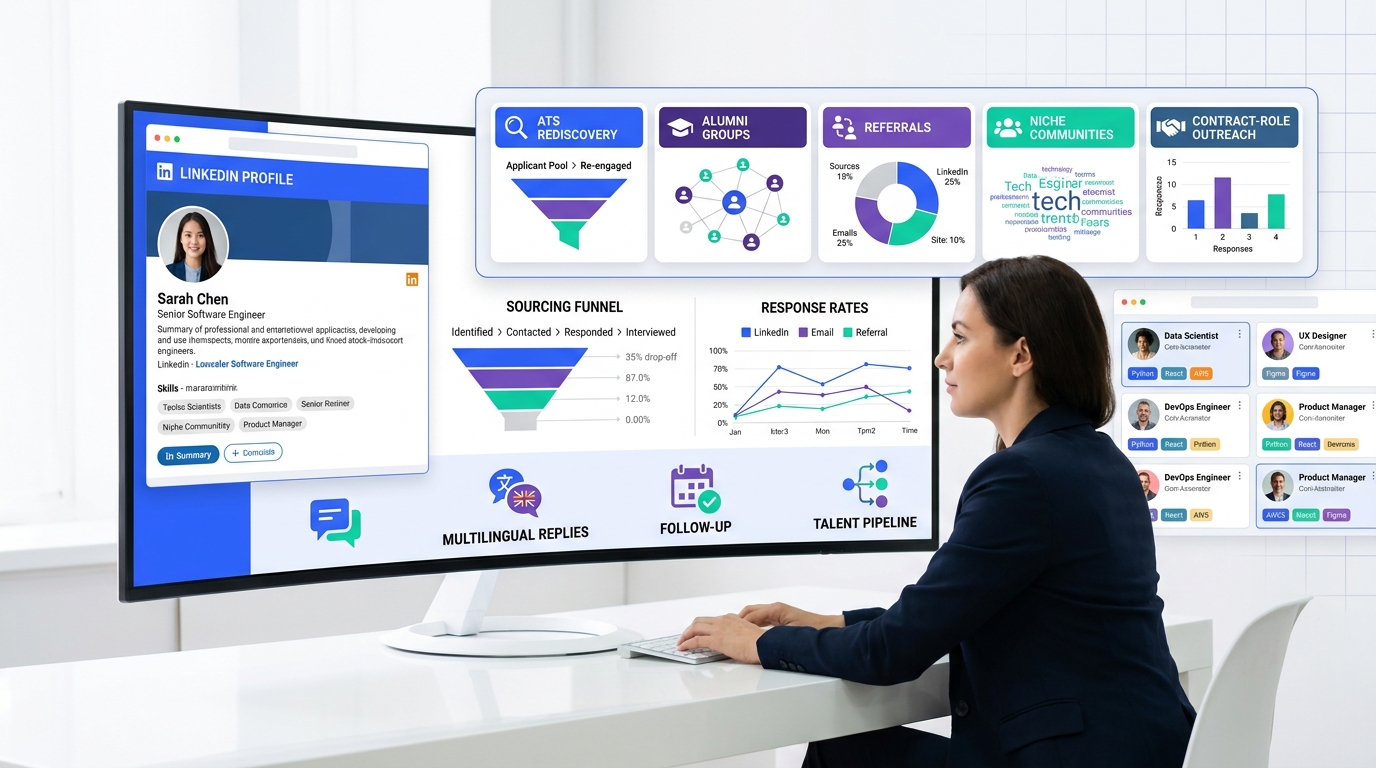
When pipeline quality stalls, this hr sourcing guide helps recruiters judge better channels, avoid vague outreach, and reach overlooked talent.
When teams rely on one network, they miss the same people repeatedly: candidates with relevant skills but different titles, past applicants who were early rather than wrong, and professionals who would consider a contract, project, or step-in role before a permanent move. For agency recruiters, that means slower shortlists and weaker client trust. For in-house teams, it means higher sourcing effort, more ghosting, and hiring managers who think the market is thinner than it really is.
In practice, I have found that workflow support matters most when outreach volume rises and candidate follow-up starts slipping. Tools such as StrategyBrain AI Recruiter can help by handling initial candidate communication, after-hours follow-up, and multilingual replies so no early interest goes cold, while the recruiter still owns final judgment, résumé review, and the decision to advance someone into screening.
That matters in a very familiar scenario: a finance or accounting professional enters a new market, keeps hearing they are overqualified for junior openings, yet cannot land the permanent role they actually want. A contract opening becomes the practical bridge. It offers local experience, access to internal opportunities, and a chance to prove capability in a skills gap the employer urgently needs filled.
But the contract is only useful if both sides can evaluate it properly. The candidate wants to know whether the project is real, whether stakeholders are aligned, whether the information needed to succeed will be available, and what should be delivered by the three-month mark. That candidate-side decision logic is exactly why modern non-LinkedIn sourcing deserves a broader look: the best strategic candidate sourcing is not just about finding names, but about building a talent sourcing process that matches opportunity type, candidate motivation, and sourcing channel.
That is the thread of this article. We are not treating non-LinkedIn tools as a random software list. We are looking at how recruiters build pipeline around real opportunity decisions, especially when contract, project-based, niche, or transitional roles are involved.
Table of Contents
- Why Candidate Context Matters in HR Sourcing
- What HR Sourcing Actually Covers
- A Practical Talent Sourcing Process
- How Good Sourcers Evaluate Opportunity Quality
- Non-LinkedIn Tool Categories That Support Sourcing
- Best Non-LinkedIn Channels for Candidate Discovery
- How to Choose the Right Sourcing Tools
- Implementation Advice for Recruiting Teams
- Common Mistakes to Avoid
- FAQ
- Conclusion
Why Candidate Context Matters in HR Sourcing
One of the easiest mistakes in sourcing is assuming every prospect is evaluating the same kind of move. They are not. Some candidates want a long-term role. Some want a project that lets them demonstrate value quickly. Some need local market credibility before they can compete for a bigger opportunity. Others are open only if the role has clear stakeholder backing and realistic deliverables.
Experienced recruiters learn this quickly. A candidate who ignores a standard permanent pitch may still respond to a well-positioned contract opportunity if it gives them visibility, a brand name on the résumé, access to internal openings, or a cleaner path into a new market. That is not a fringe sourcing issue. It affects where you search, how you write outreach, and which tools actually help.
Key insight: sourcing gets stronger when recruiters understand not just who fits the role, but why that role would make sense for the person receiving the message.
This is where non-LinkedIn thinking helps. A candidate considering a bridge opportunity often appears first in alumni groups, specialist communities, past applicant records, referral chains, or event follow-up rather than a single professional network search.
What HR Sourcing Actually Covers
HR sourcing is the part of hiring focused on identifying, prioritizing, engaging, and nurturing potential candidates before formal evaluation begins. It sits upstream from screening and should create a cleaner, more qualified pipeline for the rest of recruiting.
Many teams still blur sourcing, recruiting, and screening together. In practice, they are related but different activities:
| Hiring Activity | Primary Focus | Typical Output |
|---|---|---|
| Talent acquisition | Workforce planning and hiring strategy | Role priorities and hiring roadmap |
| Candidate sourcing | Finding and engaging people | Qualified talent pipeline |
| Screening | Assessing fit and readiness | Interview shortlist |
The distinction matters because a weak sourcing system creates downstream problems that no interview process can fix. If the top of funnel is narrow, poorly documented, or disconnected from candidate motivation, every later stage gets slower.
A Practical Talent Sourcing Process
A reliable talent sourcing process should help recruiters move from intake to outreach without losing context. The strongest teams do not start by searching everywhere. They start by clarifying the opportunity and the likely talent response.
1. Calibrate the role and the actual business need
Clarify what problem the hire is solving. Is this a permanent growth role, an urgent backfill, a transformation project, or a contract created to close a skills gap? That distinction changes everything from channel strategy to candidate messaging.
For example, contract and project roles often attract candidates who want proof of impact, local experience, or a chance to get inside a company before a permanent move. Sourcers need that context before outreach starts.
2. Build the ideal candidate profile around transferability
Translate the job into search signals: skills, adjacent titles, industry backgrounds, certifications if relevant, visible work samples, and communities where this type of talent gathers. This is where strategic candidate sourcing becomes more than title matching.
- Separate must-have skills from preferences
- Map equivalent titles across company types
- Identify adjacent backgrounds that can transfer well
- Note what would make the opportunity compelling to the candidate
3. Match the role to the right sourcing channels
Not every role belongs in the same sourcing environment. Transitional roles, specialist contracts, and project-based hiring often do better through ATS rediscovery, referrals, alumni networks, niche communities, and event follow-up than through broad-profile search alone.
4. Capture fit notes, not just names
Good sourcers document why someone belongs in the pipeline. Where were they found? What signal suggests likely fit? Why might this opportunity make sense now? That context is especially important when hiring managers are evaluating nontraditional backgrounds or contract-minded talent.
5. Personalize outreach around the actual opportunity
Candidates respond better when the message explains why they were selected and why the role could help them, not just the employer. If the opportunity offers exposure, brand recognition, internal mobility, or a defined deliverable window, say so clearly.
6. Track response and follow-up discipline
Once a candidate shows interest, delay becomes expensive. This is where recruiters often feel the operational pressure. I have used AI Recruiter support most effectively in this stage, especially for after-hours replies and early back-and-forth that would otherwise sit in LinkedIn inboxes or email threads until the next day. It helped keep conversations moving, but I still reviewed the résumé, checked fit against the brief, and decided who was truly worth presenting.
7. Handoff cleanly into screening
When sourcing works, screening begins with context rather than guesswork. The recruiter should pass along source, rationale, outreach history, timing signals, and any candidate concerns about project scope, stakeholder support, or deliverables.
How Good Sourcers Evaluate Opportunity Quality
The most useful lesson from contract hiring is that strong candidates evaluate the role just as hard as recruiters evaluate them. That should shape how you source and how you qualify interest.
When a candidate is considering a contract or transitional opportunity, a sourcer should be prepared to answer questions like these:
- Has the project or role actually been approved?
- Are the key stakeholders aligned?
- Will the hire have access to the information needed to succeed?
- What are the likely challenges in the role?
- What should be accomplished by the first 90 days?
These are not just candidate concerns. They are sourcing quality checks. If a recruiter cannot answer them, outreach will sound vague, response rates will fall, and the eventual handoff to screening will be weaker.
This is also why well-structured requisitions matter. A good posting or intake brief should outline hard skills, soft skills, timing, and likely deliverables. When those basics are missing, recruiters compensate with volume. That is rarely efficient.
Non-LinkedIn Tool Categories That Support Sourcing
Teams evaluating non-LinkedIn sourcing tools should focus on workflow support, not novelty. The question is not which tool looks most advanced. It is which tool helps your team search, re-engage, communicate, and track candidates in the right sequence.
| Tool Category | Best Use | Why It Matters |
|---|---|---|
| ATS and CRM databases | Rediscovering existing talent | Finds former applicants, silver medalists, interns, alumni, and referrals |
| Skills-based search tools | Finding candidates by capability | Widens reach beyond exact-title matching |
| Contact enrichment tools | Enabling outreach | Helps recruiters move from discovery to contact |
| Outreach workflow tools | Sequencing follow-up | Reduces dropped conversations and duplicate messaging |
| Analytics tools | Measuring quality by source | Shows which channels produce real pipeline, not just activity |
| Integration tools | Syncing data across systems | Preserves context between sourcing and screening |
ATS and CRM databases
Your existing database is often the fastest non-LinkedIn source of qualified talent. Candidates who previously applied, interviewed, interned, or nearly made it through another process may be much more responsive than fully cold prospects.
Skills-based search
This matters most when role titles vary or when the right candidate is coming from an adjacent background. It is especially useful in searches where traditional title matching would exclude capable people entering a new market or shifting from project work into permanent roles.
Outreach and follow-up support
Communication support becomes valuable when the team is juggling volume across time zones or languages. In those cases, an automation layer such as StrategyBrain AI Recruiter can keep the first exchange active, answer common role questions, and collect candidate materials from interested prospects. The important operational boundary is simple: the system supports the conversation, but the recruiter remains responsible for fit assessment and shortlist decisions.
Analytics and integration
If source data sits in disconnected notes and inboxes, you cannot tell which channel actually works for contract-friendly candidates, passive specialists, or niche-functional searches. Integration helps teams compare response rates and source-to-screen conversion with less manual cleanup.
Best Non-LinkedIn Channels for Candidate Discovery
The best channels depend on role type and candidate motivation. For recruiters building broader pipeline, these are usually the highest-value non-LinkedIn options:
1. ATS and past applicant databases
This is often the most underused channel in hr sourcing. Revisit candidates who were strong but mistimed, especially for contract, interim, or specialist roles where timing changes everything.
2. Employee referrals
Referrals are especially effective when the opportunity requires trust, context, or a realistic explanation of what success looks like in the first few months.
3. Alumni networks
Former employees and interns are often more open to re-engagement, and they can also connect recruiters to peers with similar backgrounds.
4. Niche communities
Specialist forums, industry groups, and function-based communities reveal intent and expertise in a way generic profile databases often do not.
5. Role-specific job boards
Niche boards remain useful for searches where candidates self-identify through craft or discipline rather than employer brand.
6. Events and conference follow-up
People who attend webinars, conferences, or meetups signal active professional interest. That does not always mean active job search, but it often creates warmer outreach conditions.
7. Public work platforms and technical communities
For technical and portfolio-based roles, visible work can be a stronger signal than title alone. The same principle applies in other functions where output is easier to observe than résumé wording.
How to Choose the Right Sourcing Tools
Most teams do not need more tools. They need tools that solve the actual bottleneck in their talent sourcing process.
Selection criteria that matter
- Search quality: Can the tool support skills-based discovery?
- Rediscovery: Can it surface overlooked talent from your ATS or CRM?
- Outreach support: Can the team move from search to contact without heavy admin?
- Workflow coordination: Can you avoid duplicate outreach and missed follow-up?
- Analytics: Can you compare channel quality and conversion?
- Integration: Does the system preserve sourcing context for screening?
| If your team needs... | Prioritize... |
|---|---|
| Faster early pipeline | ATS rediscovery and outreach workflow support |
| Better fit quality | Skills-based matching and stronger intake calibration |
| More passive candidate reach | Referrals, alumni, niche communities, and enrichment support |
| Better response coverage | Follow-up automation and multilingual communication support |
| Better process visibility | Analytics and ATS/CRM integration |
If the issue is not candidate discovery but candidate response timing, then another search database will not solve the problem. If the issue is unclear role definition, no automation layer will fix the source quality. Tool choice should follow bottleneck diagnosis.
Implementation Advice for Recruiting Teams
The easiest way to improve sourcing maturity is to make role context easier to carry through the workflow.
Build channel playbooks by opportunity type
Create practical rules for when to use ATS rediscovery, alumni outreach, community sourcing, referrals, and contract-focused campaigns. Teams source better when they know which channels fit which role patterns.
Standardize opportunity-quality notes
If a role has a project scope, expected deliverables, or a likely 90-day success window, capture that upfront. It improves outreach quality and candidate trust.
Measure more than activity volume
- Qualified candidates added to pipeline
- Response rate by source
- Time to first interested candidate
- Source-to-screen conversion
- Screen-to-shortlist conversion
Protect the first reply
This is a practical lesson many recruiters learn the hard way. Once a prospect responds, momentum matters. In my own workflow, support from AI Recruiter was most useful not as a replacement for sourcing judgment, but as a way to keep candidate communication alive when I was tied up in client calls or interviews. It reduced the lag between candidate curiosity and recruiter re-engagement, especially in international or after-hours conversations.
Practical takeaway: sourcing performance usually breaks at the handoff points between search, outreach, reply handling, and screening.
Common Mistakes to Avoid
Treating all opportunities the same
Candidates weigh permanent roles, contract assignments, and bridge opportunities differently. Sourcing gets weaker when outreach ignores that.
Over-relying on one platform
Single-channel sourcing hides adjacent talent pools and overexposes the team to the same candidate supply.
Using vague outreach
If the role lacks clarity on stakeholder alignment, success metrics, or deliverables, candidates notice immediately.
Ignoring internal talent pools
Past applicants and alumni often convert faster because familiarity reduces friction.
Buying tools before fixing intake
If the hiring team cannot explain what success looks like in the first few months, the sourcing stack will underperform no matter how many channels you add.
FAQ
What is talent sourcing?
Talent sourcing is the proactive work of finding, engaging, and nurturing potential candidates before formal screening begins.
How is sourcing different from recruiting?
Sourcing focuses on discovery and first engagement. Recruiting usually covers the broader process, including screening, interviews, and offer management.
Why should recruiters use non-LinkedIn sourcing tools?
Because strong candidates are spread across internal databases, referrals, alumni groups, niche communities, events, and role-specific platforms. Non-LinkedIn tools help teams reach those pools more effectively.
How does strategic candidate sourcing work?
Strategic candidate sourcing aligns role context, candidate motivation, channel selection, outreach quality, and pipeline tracking instead of relying on profile search volume alone.
What makes a contract role easier to source well?
Clear stakeholder alignment, realistic deliverables, a defined scope, and a credible explanation of what the candidate gains from taking the role.
How should teams measure sourcing success?
Measure qualified pipeline creation, response rate, source-to-screen conversion, time to first interested candidate, and handoff quality rather than just profiles found or messages sent.
Conclusion
Effective hr sourcing is broader than searching one platform harder. The best teams understand how candidates judge opportunities, especially when the role is contract-based, transitional, or tied to a specific project need. That is why stronger non-LinkedIn sourcing starts with context, not software.
From there, the right tool mix supports a disciplined talent sourcing process: clear intake, realistic candidate profile design, channel selection, tailored outreach, clean follow-up, and informed handoff to screening. That is what turns non-LinkedIn sourcing from extra effort into a repeatable pipeline advantage.