See where hr sourcing breaks down, compare source channels beyond LinkedIn, and build a cleaner system that avoids weak slates.
When that discipline is missing, the cost is not just a slower shortlist. Agency recruiters lose momentum on retained searches, in-house teams keep recycling the same visible profiles, and hiring managers start doubting whether the market is truly thin or whether the search process is. You also feel the hidden damage fast: weak outreach relevance, duplicate records, poor ATS hygiene, missed after-hours replies, and less confidence when you need to explain why a slate is not yet strong enough.
That is where workflow support matters. In my own process, I have found that AI Recruiter is most useful when it handles the repetitive LinkedIn communication layer that usually steals recruiter time: initial candidate contact, follow-up replies, and interest capture across time zones. It can also collect resumes and contact details from interested candidates, while the recruiter still owns the final judgment on fit, resume review, and whether to move someone into screening or client submission.
The management lesson behind that is not new. A practical finance management guide published in 2019 framed the first-time manager problem clearly: once you step into a visible role, everyone is watching, and your job is no longer only about personal output. You have to raise team performance, align reporting and forecasting with business strategy, contribute beyond your own department, and evaluate whether the systems around you are actually helping the work get done.
That same pressure shows up in recruiting. The moment a recruiter or TA lead owns a hard search, the question is not only how to source candidates. It becomes whether your sourcing system improves team productivity, matches the business goal behind the hire, supports other stakeholders, and stands up under scrutiny. That is why this guide looks at talent sourcing tools beyond LinkedIn through a manager-level lens, while still staying practical about how to source candidates as a recruiter.
Table of Contents
- Why HR Sourcing Needs a Systems View
- What Beyond LinkedIn Really Means
- The Main Categories of Talent Sourcing Tools
- Building a Role-Based Source Mix
- How to Source Candidates Step by Step
- How I Use LinkedIn Automation Carefully
- How to Evaluate Sourcing Tools in Real Workflows
- Common HR Sourcing Mistakes
- How to Measure Sourcing Success
- FAQ
Why HR Sourcing Needs a Systems View
One of the most useful ideas from management thinking is that visible roles require more than technical execution. In recruiting, that means good sourcing is not just search syntax or profile discovery. It is the ability to improve output across the whole hiring chain: recruiter productivity, hiring-manager alignment, candidate experience, and clean operating structure.
That is why hr sourcing should be treated as a system. A sourcer or recruiter is not only finding names. They are helping the business answer four questions:
- What kind of talent will actually solve the hiring problem?
- Where does that talent naturally leave credible signals?
- How should outreach and follow-up happen without losing speed or quality?
- Which systems and structures support the search instead of creating more admin?
If you skip that systems view, sourcing becomes reactive. Lists get built, but they do not convert. Messages go out, but they do not reflect role context. Candidates show interest, but records are incomplete or scattered across tabs and inboxes.
Practical takeaway: The best sourcing setup does not simply generate more profiles. It helps recruiters improve performance, align with business goals, support stakeholders, and evaluate whether the workflow itself is strong enough.
What Beyond LinkedIn Really Means
Going beyond LinkedIn does not mean abandoning it. It means refusing to let one platform define your entire market view. LinkedIn is useful, but it does not fully cover every role family, every geography, every passive candidate, or every usable professional signal.
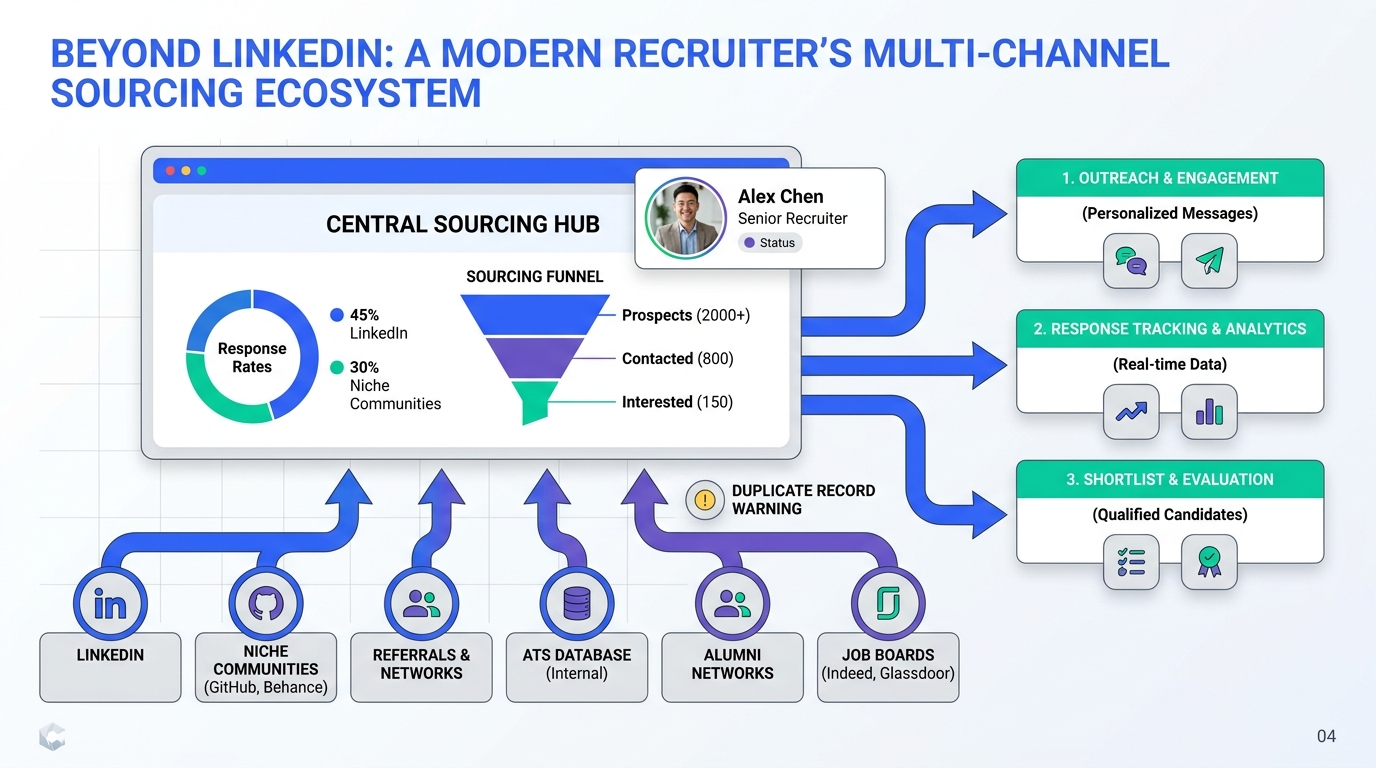
For recruiters asking how to source candidates more effectively, the smarter move is to use LinkedIn as one layer inside a broader sourcing model. That broader model should include external discovery, internal rediscovery, niche communities, referrals, and workflow tools that make outreach and follow-up manageable.
This is especially important when the hiring team expects the sourcing function to do more than fill today’s req. In many organizations, recruiters are also expected to support workforce planning, improve stakeholder confidence, and build talent pools for future demand. That mirrors the management challenge from the finance guide: your department’s activity has to serve the wider strategy, not just produce isolated outputs.
The Main Categories of Talent Sourcing Tools
The easiest way to assess the market is by job to be done. That keeps your hr sourcing stack tied to real workflow gaps instead of feature shopping.
1. Talent search databases
These tools are built for discovery at scale. They are useful when you need broad longlists, company mapping, title adjacency, and search precision across large candidate datasets.
Evaluate them on:
- Search relevance rather than raw profile count
- Boolean and filter flexibility
- Data freshness and duplicate control
- Export and ATS write-back options
2. Contact enrichment tools
These tools help recruiters verify or add contact details so a sourced list can actually move into outreach. Their value is operational: less tab switching and fewer dead ends.
Look for:
- Data confidence signals
- Easy correction of inaccurate records
- Compliance fit
- Clean enrichment into ATS or CRM fields
3. ATS and CRM sourcing layers
Some of the best candidates are already known to you. Previous finalists, alumni, referrals, interns, and silver medalists often outperform fresh external search when the internal database is searchable and well-tagged.
Use these capabilities to:
- Search owned talent before going fully external
- Segment candidates by skill, location, or recency
- Re-engage people with prior context
- Track source-to-stage conversion over time
4. AI-assisted sourcing and outreach tools
These tools can be valuable when they reduce repetitive work without weakening recruiter judgment. Their best use is usually in list support, message drafting, ranking, summarization, or communication handling.
Good use cases include:
- Search expansion for adjacent backgrounds
- Candidate-profile summarization
- Prioritization of outreach queues
- Follow-up support and after-hours communication
The key rule is simple: recruiters should still own the final decision on fit, resume quality, and next-step movement.
5. Niche communities and role-specific sources
These are often the strongest channels for specialist roles because they show actual craft, participation, or proof of work. For technical, operational, regulated, or regional roles, niche sources can beat broad databases on relevance.
Use them when you need:
- Higher confidence in skill evidence
- Passive candidates with visible domain involvement
- Smaller but sharper talent pools
- Personalization material for outreach
Building a Role-Based Source Mix
The best non-LinkedIn sourcing strategy is a balanced source mix, not a favorite tool. Every role family leaves different discoverability signals.
| Source Category | Best For | What to Check |
|---|---|---|
| Technical communities | Engineering, data, product specialists | Visible work quality, activity depth, recency |
| Resume databases | Active candidates, mid-volume hiring | Freshness, search precision, contact quality |
| Employee referrals | Trusted introductions, niche roles | Response speed, referral process clarity |
| Internal ATS pools | Fast shortlist building | Tagging quality, notes, prior-stage context |
| Alumni networks | Boomerang hires, known performers | Recency, location, rehire eligibility |
| Professional associations | Certified and specialized talent | Role fit, membership depth, regional strength |
| Events and communities | Passive talent and relationship-driven hiring | Follow-up discipline, pool capture process |
| Company sites and team pages | Competitor mapping and org clues | Role patterns, growth signs, function structure |
A practical way to choose channels is to ask the same kind of question a manager asks when evaluating systems: does this source genuinely help the work, or does it only create more activity?
- Technical hiring: communities, referrals, internal pools, portfolio signals
- Sales hiring: company mapping, resume databases, referrals, alumni records
- Operations hiring: local job boards, ATS rediscovery, associations, employer channels
- Executive and niche hiring: referrals, events, associations, long-term CRM nurture
How to Source Candidates Step by Step
If you want a practical answer to how to source candidates as a recruiter, this sequence is usually more effective than jumping straight into search.
Step 1: Define the role in business terms, not only job-description terms
Start with the hiring problem, not just the requisition. Clarify what success looks like, what trade-offs are acceptable, which backgrounds are adjacent, and how this hire supports the wider team or business objective.
This mirrors the lesson from the management guide: tactical work improves when it is aligned with larger strategy.
Step 2: Map target companies and adjacent backgrounds
List direct competitors, talent feeder companies, adjacent sectors, and companies that train the right operating habits. This step prevents shallow searching and helps explain the market to hiring managers.
Step 3: Choose channels based on candidate behavior
Do not default to one platform. Use the source mix that matches how the target talent shows expertise, explores opportunities, or responds to outreach.
Step 4: Build a clean and evidence-based list
Capture source, title, employer, fit notes, contact status, and personalization signals. A list is only useful if another recruiter or stakeholder can understand why each person is on it.
Step 5: Personalize outreach using source context
Good outreach reflects why the person was chosen. Mention a relevant project, domain pattern, leadership scope, or prior connection. Generic messages waste brand equity.
Step 6: Track responses and source conversion
If you do not know which channels generate replies, screens, and interviews, you do not really know how to source candidates. You only know how to search.
How I Use LinkedIn Automation Carefully
Although this article is about sourcing beyond LinkedIn, many recruiters still depend on LinkedIn for initial market visibility or first-touch outreach. The operational problem is that LinkedIn work creates a lot of repetitive communication that slows everything else down.
In my own workflow, I have used StrategyBrain AI Recruiter selectively for that layer. What helped most was not replacing sourcing judgment. It was offloading repetitive message handling after I had already set the search criteria, role information, and communication boundaries. The tool can automatically connect with candidates who match the search, introduce the role, answer common questions, and capture resumes or contact details from people who want to continue.
That was especially useful when replies arrived after hours or from candidates in other regions. Instead of losing momentum between initial outreach and real recruiter review, the conversation could continue while I kept ownership of shortlist quality. I still reviewed resumes myself, checked whether the background truly matched the brief, and decided who moved into interview discussions.
For recruiters who want to see how that workflow is framed, the AI Recruiter setup overview and the main StrategyBrain site are the most relevant starting points. Used carefully, this kind of support is best for message continuity and admin reduction, not for outsourcing final qualification.
Key insight: Automation is most helpful when it removes repetitive communication work but leaves sourcing judgment, resume assessment, and shortlist decisions with the recruiter.
How to Evaluate Sourcing Tools in Real Workflows
Most teams overfocus on search filters and underfocus on operating design. A better approach is to ask whether the tool helps you do the four things the opening management lens pointed to: improve performance, align to strategy, support cross-functional work, and assess the systems you rely on.
Use these criteria:
- Dataset fit: does it match the roles you hire most often?
- Search quality: does it reduce manual cleanup?
- Workflow impact: does it shorten time to qualified outreach or shortlist?
- Stakeholder usefulness: does it make market evidence easier to share with hiring managers?
- Contact readiness: can recruiters move quickly from discovery to engagement?
- ATS or CRM integration: does the data return cleanly to your system?
- Communication support: can it help with follow-up, sequencing, or reply handling?
- System health: does it improve structure, or just add another disconnected tab?
A practical test process
- Choose 2 or 3 hard-to-fill role families.
- Document your current source mix and bottlenecks.
- Identify whether the real gap is discovery, enrichment, outreach, or internal rediscovery.
- Trial tools on live reqs, not idealized demos.
- Measure response quality, recruiter time saved, and source-to-stage conversion.
This is the most grounded way to evaluate sourcing technology because it treats the tool as part of an operating structure, not as a standalone promise.
Common HR Sourcing Mistakes
Teams usually struggle with sourcing for the same reason new managers struggle: they focus on visible activity and miss the supporting structure.
- Confusing sourcing with screening: these are different responsibilities and require different measurements
- Using one platform as the default answer: this limits market visibility
- Ignoring strategic role context: shallow briefs create shallow searches
- Underusing internal talent pools: owned candidates often get overlooked
- Overvaluing profile volume: bigger lists are not better lists
- Sending generic outreach: poor personalization weakens replies and brand perception
- Adding tools without evaluating system fit: disconnected software creates more admin than value
If you want to improve hr sourcing, audit your workflow by role family and ask where the real friction appears: role definition, market mapping, list quality, outreach handling, stakeholder alignment, or system write-back.
How to Measure Sourcing Success
Mature sourcing teams measure more than activity. They measure whether the sourcing system is improving outcomes and whether the structure behind it is strong.
Coverage metrics
- Relevant candidates identified per req
- Source diversity by role family
- Internal versus external pipeline share
Outreach metrics
- Contactable candidate rate
- Reply rate
- Positive response rate
- Time from sourcing to first outreach
Conversion metrics
- Sourced to screened
- Screened to interviewed
- Interviewed to offer
- Offer acceptance from sourced candidates
Operational metrics
- Time to shortlist
- Records written back into ATS or CRM
- Duplicate rate across tools
- Recruiter time spent on research versus engagement
These measures matter because they tell you whether your sourcing function is only busy or actually improving hiring performance.
FAQ
How do you source passive candidates without LinkedIn?
Use channels where passive talent leaves credible professional signals, such as industry communities, technical forums, professional associations, referrals, alumni networks, events, and previous ATS finalists. The source should guide the outreach angle.
Where can recruiters find candidates without LinkedIn?
Recruiters can find candidates through resume databases, portfolio sites, job boards, referrals, professional associations, internal ATS pools, company alumni networks, events, niche communities, and competitor company pages.
What is the best approach to how to source candidates as a recruiter?
Start with role clarity and business context, then map target companies, choose channels based on candidate behavior, build a structured list, personalize outreach, and track source conversion. The process works best when it is repeatable and measurable.
Are AI tools useful in hr sourcing?
Yes, when they support workflow efficiency rather than replace recruiter judgment. They are most helpful for search expansion, communication handling, follow-up, summarization, and admin reduction. Final qualification should still sit with the recruiter.
Why should sourcing be evaluated like a management system?
Because sourcing affects more than candidate discovery. It influences team productivity, stakeholder trust, hiring speed, and whether recruiting systems support the business strategy behind the role.
Conclusion
Strong hr sourcing is not about finding a single replacement for LinkedIn. It is about building a sourcing system that performs under scrutiny: one that improves team output, aligns with hiring goals, supports other stakeholders, and uses the right mix of tools and channels for each role.
If you want a practical answer to how to source candidates, start by widening your source mix, strengthening your operating structure, and treating tooling decisions as workflow decisions. That is also the most reliable answer to how to source candidates as a recruiter without getting trapped in one dataset or one repetitive communication pattern.