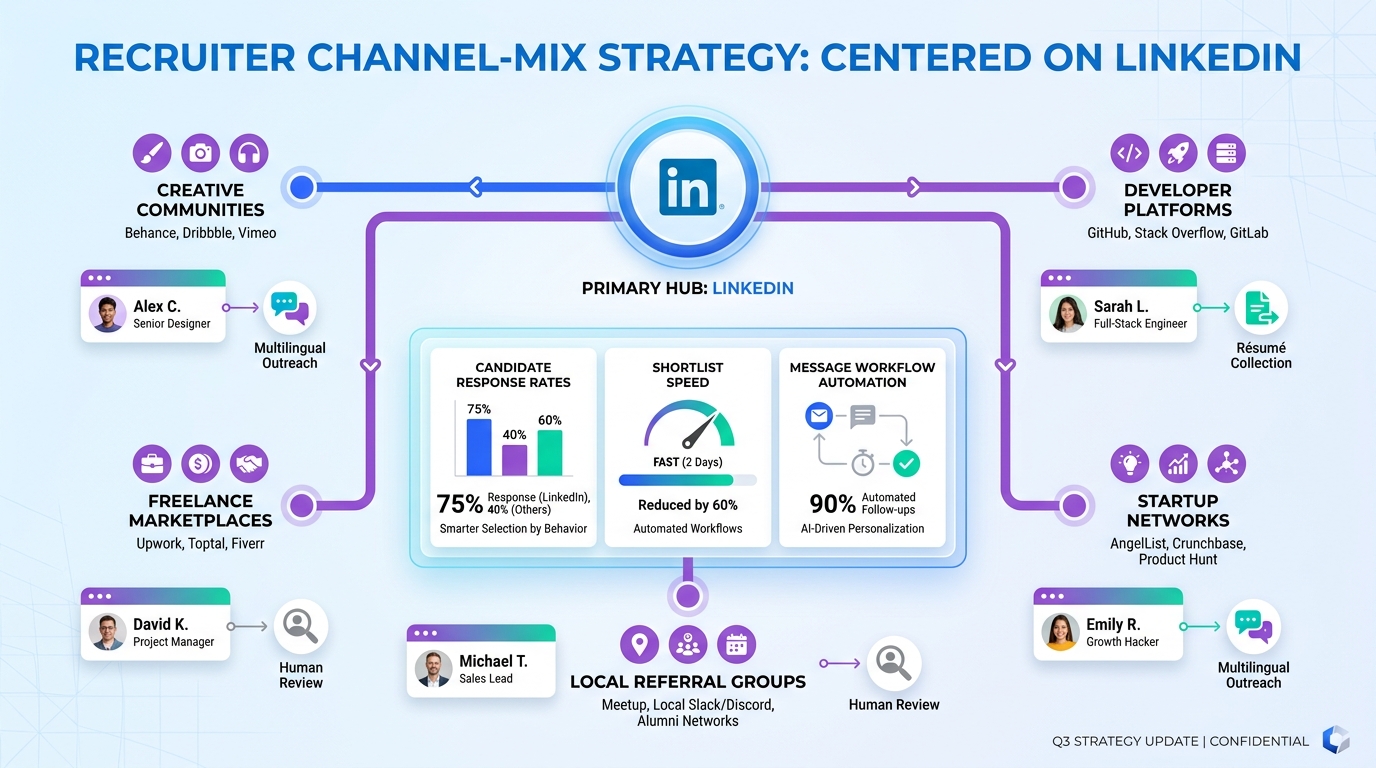
Choosing professional networking social media sites by talent behavior helps recruiters avoid low-response outreach and shortlist faster.
The costly mistake is treating every network like a giant directory and every professional the same way. In practice, recruiters lose time when outreach lands in the wrong environment, agencies miss revenue when contract or niche candidates never reply, and in-house teams damage employer brand when they send generic messages into communities that expect real participation. The platform choice is not cosmetic. It shapes response rates, referral quality, speed to shortlist, and whether your team is building relationships or just adding noise.
That is also why I have become more deliberate about where automation belongs in the workflow. Used well, StrategyBrain AI Recruiter can reduce repetitive LinkedIn work such as first-touch outreach, follow-up, and after-hours candidate replies, especially when you are balancing high message volume across time zones. Its multilingual communication and résumé collection are useful when candidates respond late or from different markets, but the recruiter still has to decide whether the person actually fits the role, review the résumé, and handle the next step with judgment.
You see this most clearly in consultant-style hiring. Someone who has spent years in a defined finance role may start considering contract or advisory work because the upside looks attractive: more flexibility, stronger rates, more control. But the tradeoff is immediate. The person is no longer stepping into a stable internal path. They have to define what makes them marketable, explain the specific skill they are being hired for, and keep sourcing the next opportunity before the current one ends.
That candidate does not usually rely on one network alone. They talk to specialist recruiters, reconnect with former colleagues, ask for introductions from trusted peers, and focus on the industries where their expertise is already credible. For recruiters, that scene exposes the real issue behind general LinkedIn alternatives: if professionals build opportunity through targeted relationships, niche visibility, and repeated introductions, then the best professional platforms are the ones that support that behavior. LinkedIn may still be the default answer to which social media platform is primarily used for professionalnetworking, but it is not always the best place to start or finish the conversation.
Table of Contents
- Why LinkedIn Alternatives Matter
- How Professionals Actually Build Opportunity
- Quick Comparison of Alternative Platform Types
- Best General LinkedIn Alternatives
- Best for Creative and Portfolio-Led Hiring
- Best for Developers and Technical Communities
- Best for Freelancers and Contract Recruiting
- Best for Startups and Early-Stage Teams
- Best for Local Networking and Referrals
- Where LinkedIn Still Fits and How I Use AI Recruiter
- How to Choose the Right Platform
- FAQ
Why LinkedIn Alternatives Matter
When people search for general LinkedIn alternatives, they are rarely asking for a perfect clone. Most are trying to solve a practical recruiting or career problem. They need better response quality, stronger niche access, more visible work samples, faster project hiring, or warmer introductions than a broad professional feed tends to provide.
That is why I usually frame this topic around behavior rather than logos. A platform becomes useful when it matches how the target audience actually finds work. Contract consultants depend on repeat networking because each engagement ends. Developers often prefer skill-first communities. Creatives want visible portfolios. Founders care about mission, stage, and ownership. Different groups use different professional networking social media sites because they are solving different risks.
Key insight: The strongest LinkedIn alternative is usually the platform that mirrors how a specific talent segment earns trust and opportunities.
How Professionals Actually Build Opportunity
The reference point I keep coming back to is simple: professionals who work in consulting, contract, or specialist roles cannot assume the next opportunity will arrive automatically. They have to be certain the independent path fits them, define what makes them marketable, and network consistently enough to keep future work flowing. That logic applies far beyond accounting consultants. It maps directly to how many modern candidates build careers across full-time work, freelance projects, interim assignments, and industry communities.
For recruiters, that offers a more useful lens than asking whether one site can replace LinkedIn. Start with three questions instead:
- Does this audience need ongoing relationship-building? If yes, discussion-led communities and referral-rich spaces matter more.
- Is the talent hired for a specific visible skill? If yes, niche or portfolio-based professional platforms may outperform broad profiles.
- Will the person need another project soon? If yes, contract, freelance, and specialist networks become more important.
Once you look at platform choice this way, alternatives stop feeling secondary. They become part of the sourcing strategy.
Quick Comparison of Alternative Platform Types
| Platform Type | Best For | Main Strength | Main Risk | Recruiting Advice |
|---|---|---|---|---|
| General social communities | Broad awareness and industry conversation | Large reach and active discussion | Mixed intent and uneven professionalism | Build presence before pitching roles |
| Creative communities | Design, content, brand, media | Work samples are visible upfront | Portfolio quality may not reflect delivery habits | Reference actual work in outreach |
| Developer communities | Engineering and technical talent | Skills are demonstrated through contribution | Recruiting can be unwelcome if tone is generic | Lead with role context and technical relevance |
| Freelancer marketplaces | Contract and project work | High availability and clear work intent | Weak briefs create mismatches fast | Define scope, timeline, and output clearly |
| Startup ecosystems | Founders, operators, early hires | Mission and ownership alignment | Hype can outpace reality | Be candid about stage and ambiguity |
| Local event and community platforms | Regional hiring and referrals | Trust through repeated interaction | Lower scale | Show up consistently and follow up quickly |
Best General LinkedIn Alternatives
General alternatives tend to work best when your goal is not just profile search but participation. Discussion-heavy communities, founder circles, trade groups, and social platforms with professional subcommunities can all help you stay visible among people who may ignore direct cold outreach elsewhere.
If someone asks, which social media platform is primarily used for professionalnetworking, the honest answer is still LinkedIn. But if the next question is where actual relationships form, the answer becomes broader. In many fields, people trust peers they have seen contribute repeatedly more than people with polished job histories.
- Best use: broad networking, topical visibility, passive candidate discovery
- Watch out for: treating these channels like résumé databases
- Takeaway: General alternatives reward credibility built in public
Best for Creative and Portfolio-Led Hiring
Creative hiring works differently because the evidence is often visual, narrative, or style-based. Designers, content specialists, brand creatives, and marketers may be easier to assess in communities where output is visible before a conversation even starts.
That is why some of the best professional platforms for creative recruiting are not traditional networking feeds at all. They are spaces where you can review consistency, presentation, taste, and craft. A title-only profile cannot always do that. If your role depends on aesthetic judgment or communication quality, the platform should make those signals easy to see.
- Best use: design sourcing, content partnerships, brand hiring
- Watch out for: polished personal brands that hide collaboration gaps
- Takeaway: Hire creatives where the work is easiest to inspect
Best for Developers and Technical Communities
Technical communities remain some of the most useful LinkedIn alternatives because they let professionals demonstrate thinking rather than simply claim it. Engineers often build reputation through code, discussion, problem-solving, and community contribution. For recruiters, that changes the sourcing playbook.
Among all professional networking social media sites, developer-focused communities are one of the clearest reminders that niche beats broad when the role is skill-sensitive. Recruiters who show technical understanding, reference relevant tools, and respect community norms usually get better engagement than those who copy their LinkedIn template into every channel.
- Best use: engineering, developer relations, technical product roles
- Watch out for: outreach that reads like bulk recruiting
- Takeaway: Technical communities respond to relevance more than reach
Best for Freelancers and Contract Recruiting
This is the category that most closely reflects the logic from consulting-oriented career advice. Contract professionals know every engagement has an end date, so they stay alert to their next assignment. They define the core skill that makes them marketable, build relationships with specialist recruiters, and keep introductions moving. In that environment, freelancer marketplaces and contract-oriented communities can outperform a broad social network.
For recruiters, these channels are especially useful when you need speed and specificity. You are not trying to persuade someone to consider a vague future move. You are discussing deliverables, availability, rates, review cycles, and working style now. The more precise the brief, the better the outcome.
- Best use: interim roles, consultants, project hiring, specialist contract work
- Watch out for: unclear scopes and rushed requirements
- Takeaway: Contract talent responds best when the ask is concrete
Best for Startups and Early-Stage Teams
Startup-focused communities can be stronger alternatives than LinkedIn when the role itself is fluid. Early-stage hires often evaluate opportunities like consultants do: not just by title, but by what problem they will solve, how much ownership they will have, and whether the operating environment matches their appetite for ambiguity.
That is why startup ecosystems deserve a separate category. They attract people who are comfortable with incomplete structure, shifting priorities, and mission-led career choices. A polished corporate presence matters less here than honesty about the stage, constraints, and upside.
- Best use: founding teams, operators, startup recruiting
- Watch out for: overpromising and underexplaining reality
- Takeaway: Startup candidates want clarity about the actual challenge
Best for Local Networking and Referrals
Local communities still matter more than many digital-first recruiters expect. Regional business groups, event platforms, trade associations, and recurring meetups can create stronger trust than mass online outreach, especially for leadership, sales, operations, and relationship-heavy roles.
This also connects back to the consultant mindset from the reference material. Many professionals source work through introductions, former colleagues, designation peers, and industry circles. They do not wait passively on one platform. Recruiters who understand that pattern use local and industry-led communities to create referral momentum instead of relying only on search filters.
- Best use: local hiring, partnerships, trust-based recruitment
- Watch out for: expecting scale from relationship channels
- Takeaway: Repeated presence often beats one-time outreach
Where LinkedIn Still Fits and How I Use AI Recruiter
None of this means LinkedIn stops mattering. It still anchors most professional identity online, and it remains the easiest answer to the broad question of which social media platform is primarily used for professionalnetworking. The mistake is expecting it to do every job equally well.
In my own workflow, I use LinkedIn for reach, credibility checks, and first-pass market visibility. Then I layer in narrower channels depending on the role. For volume-heavy sourcing, I have found that AI Recruiter helps most with the repetitive pieces that drain recruiter time: connecting with candidates, sending initial job introductions, handling after-hours replies, and collecting contact details or résumés from people who want to move forward. For cross-border search, its multilingual communication is particularly helpful because candidates often respond outside local working hours.
I would still not outsource judgment. The final fit decision, résumé review, and interview choice stay with the recruiter. That division of labor matters. The software can keep the top of funnel moving, but it should not pretend to replace the judgment required when a consultant-style candidate is weighing role clarity, marketability, and next-step risk.
If you want to see how the workflow is positioned, the LinkedIn recruiting comparison page and the broader usage notes for headhunters are useful references for understanding where automation supports, rather than replaces, a recruiter-led process.
How to Choose the Right Platform
If you are comparing general LinkedIn alternatives, use the same logic a consultant would use when evaluating whether self-employment fits: be certain about the environment, define the skill or outcome being purchased, and build your network accordingly.
- Start with the audience. Are they full-time candidates, consultants, freelancers, creators, founders, or local operators?
- Define what makes them marketable. Is it visible work, technical proof, reputation, responsiveness, or industry credibility?
- Match the platform to the next action. Do you need discussion, referral, immediate project availability, or broad awareness?
- Adjust your message style. Every network has its own expectations around tone, value, and trust.
- Keep LinkedIn in the mix without forcing it to carry everything. Use it as part of a channel mix, not the entire strategy.
That framework works because it mirrors how professionals actually move through the market. The people you want to hire are not standing still on one platform. They are evaluating risk, visibility, and fit across multiple environments.
FAQ
What is the best alternative to LinkedIn?
There is no universal best alternative. The strongest option depends on whether you need broad networking, niche expertise, visible work samples, contract availability, startup alignment, or local trust-based relationships.
Which platform is mainly used for professional networking?
LinkedIn is still the platform mainly used for professional networking. If you are asking which social media platform is primarily used for professionalnetworking, that remains the direct answer. Alternatives matter when you need different kinds of engagement or better audience fit.
Are niche communities better than broad professional platforms?
Often, yes. Niche communities can be better professional platforms when the role depends on specialized skills, demonstrated expertise, or industry-specific conversation. Broad networks offer reach, but niche spaces often offer stronger relevance.
How should recruiters use LinkedIn and alternatives together?
Use LinkedIn for visibility, profile checks, and broad outreach. Then use niche communities, freelancer ecosystems, local groups, or startup networks based on the role. Many recruiters also use tools like StrategyBrain AI Recruiter to handle repetitive LinkedIn messaging while keeping candidate judgment and hiring decisions human-led.
How do professionals network effectively without relying only on LinkedIn?
They define what makes them marketable, focus on the industries where their skills are relevant, reconnect with former colleagues, seek introductions, and stay active in communities where opportunities naturally circulate. That is true for consultants, contractors, and many specialist candidates.
Conclusion
The best way to think about general LinkedIn alternatives is not replacement, but fit. Professionals do not all build careers the same way, so they do not all use the same channels with the same intent. Some need portfolios. Some need code communities. Some need local trust. Some need a steady stream of contract opportunities.
For recruiters, that means the strongest professional networking social media sites are the ones that align with how your target talent becomes discoverable, credible, and ready to respond. LinkedIn is still central, but the highest-quality recruiting often happens when you combine it with the right niche environments and use tools selectively to reduce repetitive work without giving up recruiter judgment.