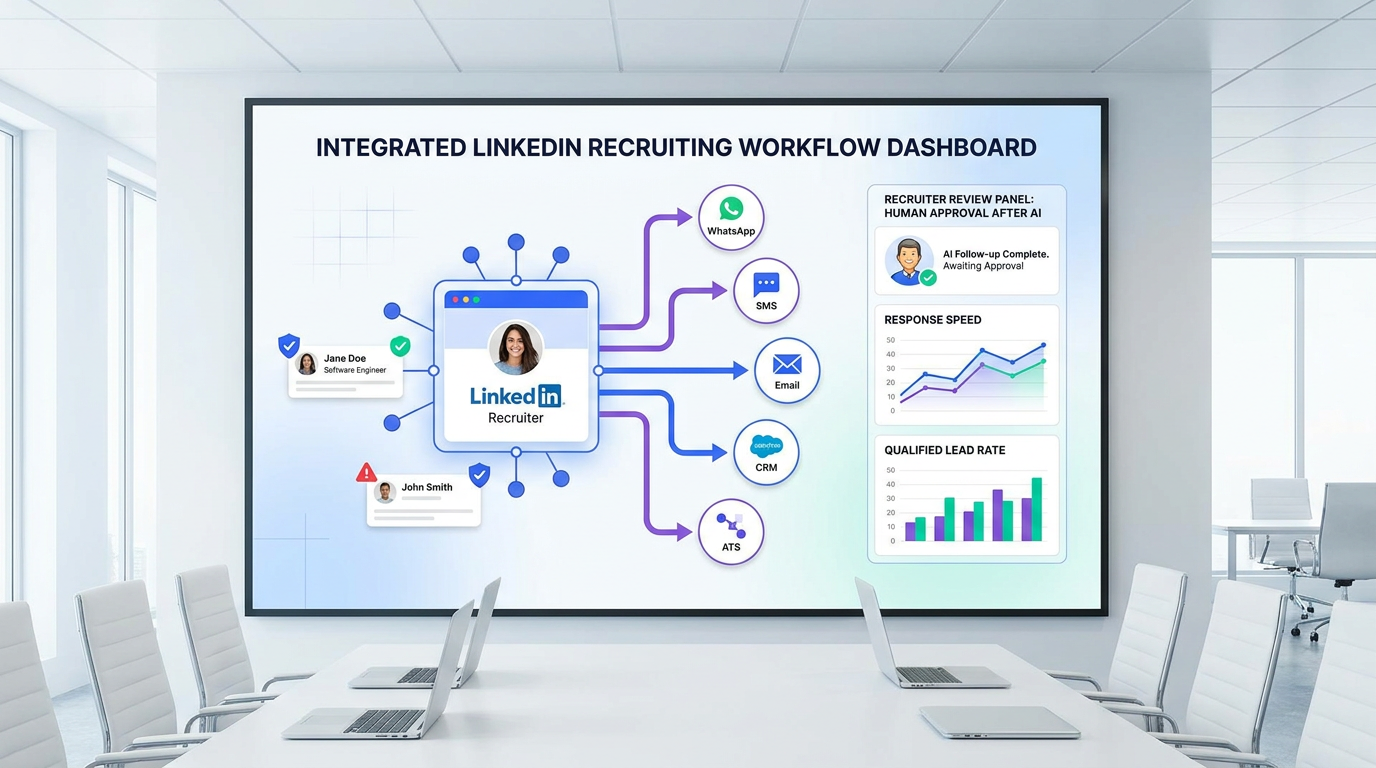
This article helps recruiting leaders evaluate linkedin marketing software to prevent trust-breaking outreach, bad handoffs, and stalled leads.
That matters because modern recruiting teams are not only chasing response rates. They are also protecting candidate trust, recruiter credibility, and the handoff between first contact and real screening. When outreach comes through LinkedIn, WhatsApp, SMS, email, and lead forms at the same time, weak process shows up fast: duplicate records, slow replies, unclear ownership, and in the worst cases, candidates who cannot tell the difference between a real recruiter and a fake one.
In my own LinkedIn-heavy workflows, I have found that StrategyBrain AI Recruiter is most useful when the problem is not just volume but consistency. Its automated LinkedIn conversations, after-hours response coverage, and multilingual follow-up can reduce the dead time between first interest and recruiter action, while the recruiter still owns final judgment, CV review, and whether a person should move into interview or client submission. Used carefully, it supports process discipline rather than replacing recruiting judgment.
The candidate-side warning signs are familiar. Someone receives an unsolicited job message on WhatsApp from a company they barely know. The logo looks real, the promise sounds attractive, and the sender claims to be part of a legitimate firm, yet the phone number does not match the geography of the business. The candidate starts checking the company website, team page, and LinkedIn presence, trying to confirm whether the recruiter is an actual employee before sharing anything sensitive.
Then the pressure point appears: the message asks for personal details too early, or pushes a role that feels unusually generous, or hints at fees that no legitimate recruiter should request. That single moment is not only a fraud risk for the candidate. It also exposes a recruiting operations problem for genuine teams. If your outbound and inbound systems do not preserve identity, source context, and timely follow-up, real recruiter outreach becomes easier to doubt, and trust becomes harder to earn.
That is why recruitment automation tools now need to be evaluated through both efficiency and credibility. Linkedin marketing software is no longer just about capturing names through Lead Gen Forms or sequencing outreach. It sits inside a wider chain that includes verification signals, lead generation automation, recruiter ownership, ATS or CRM handoff, and the practical rules that make marketing automation lead generation feel professional instead of suspicious.
In this guide, you will learn:
- How linkedin marketing software fits real recruiting workflows
- Why candidate trust and identity verification now matter in automation design
- How lead generation automation should move from first contact to recruiter action
- What to review in ATS, CRM, routing, and reporting workflows
- Which metrics and process checks help teams protect quality as they scale
Table of Contents
- Why Trust Now Belongs in Recruitment Automation
- What LinkedIn Marketing Software Means in Recruiting
- How Lead Capture and Follow-Up Should Work
- Verification Checks Before Data Moves Downstream
- Where CRM and ATS Handoffs Usually Break
- Inbound, Outreach, and Post-Capture Automation Compared
- Best Practices for Lead Generation Automation
- Metrics That Show Both Speed and Credibility
- Common Mistakes to Avoid
- FAQ
Why Trust Now Belongs in Recruitment Automation
Most articles about recruitment automation tools start with speed. Speed matters, but trust is now part of the same conversation. Candidates are increasingly used to receiving unsolicited messages across multiple channels, and many of them have also seen scam attempts dressed up as recruiter outreach. That changes how they read your first message, your follow-up timing, and the information you ask them to share.
From an operator's perspective, that means the top of funnel has changed. A candidate is no longer deciding only whether a role is relevant. They are also deciding whether the sender is real, whether the company can be verified, and whether the request feels proportionate to the stage of the conversation. Good recruitment automation does not ignore that hesitation; it is designed around it.
Key insight: In recruiting, automation that improves response speed but weakens identity clarity can damage conversion quality instead of improving it.
That is one reason I increasingly look at LinkedIn-led workflows before I look at feature depth. Professional profile context, visible company connection, and cleaner role relevance often make LinkedIn a stronger first-touch environment than cold messaging channels where authenticity is easier to question.
What LinkedIn Marketing Software Means in Recruiting
Linkedin marketing software in a recruitment context covers the systems and processes that help teams attract, capture, route, and nurture professional interest through LinkedIn. That can include ads, Lead Gen Forms, recruiter outreach workflows, CRM sync, ATS handoff, segmentation rules, and reporting.
But in practice, the category is broader than demand generation. A strong setup also signals legitimacy. It gives candidates a clearer path from a recognizable LinkedIn touchpoint to a recruiter-owned next step, instead of asking them to trust an isolated message with no context.
For agency recruiters, internal talent teams, and recruitment operations leads, the real question is not whether a platform can automate contact. It is whether the workflow preserves enough context for the next decision. Can the candidate see who is contacting them? Can the recruiter see where the person came from? Can operations verify that the request for data matched the stage of the conversation?
That is where software evaluation becomes more practical. The best setup is usually not the one with the most automation. It is the one that keeps identity, intent, and ownership clear while still reducing admin work.
How Lead Capture and Follow-Up Should Work
Whether you are running LinkedIn ads or direct recruiter outreach, the workflow should feel simple to the candidate and disciplined behind the scenes.
- A professional sees a credible entry point. That may be a LinkedIn ad, a recruiter profile, or a company-backed message with enough context to feel legitimate.
- Interest is captured with low friction. This can happen through Lead Gen Forms, direct conversation, or a secure handoff to a form or application page.
- Data moves into connected systems. CRM, routing tools, and ATS processes should receive the right record without forcing manual re-entry.
- Lead generation automation applies rules. Geography, function, seniority, and source can be used to assign ownership or trigger nurture steps.
- The recruiter responds at the right depth. Early-stage questions can be handled quickly, but qualification, CV review, and next-step judgment remain human decisions.
- Reporting stays attached to the original source. That allows teams to compare message quality, response speed, and qualified progression.
This is why lead generation automation is so valuable in recruiting. It reduces manual lag, but it also creates a consistent chain of evidence. When a candidate later wonders who contacted them and why, your team can trace the source, the message path, and the owner of the conversation.
I have seen this difference most clearly when using StrategyBrain AI Recruiter for LinkedIn outreach support. The practical benefit was not just automated introductions. It was the ability to keep conversations moving overnight, answer basic role questions in the candidate's language, and gather contact details or CVs from interested people without making the initial exchange feel abandoned. Recruiters still had to review the resume and decide whether the fit was real, but the front end stopped stalling.
Verification Checks Before Data Moves Downstream
The reference scenario at the start of this article points to a useful recruiting discipline: before asking for deeper information, make it easy for the other person to verify who you are.
That sounds obvious, but many automation workflows miss it. They optimize for message send volume, not for message believability. In today's market, a candidate often does a fast credibility check before replying. They may review:
- The company website and whether it looks complete and current
- The recruiter's LinkedIn profile and connection to the employer or agency
- Whether the role is visible on an official careers page or business channel
- Whether the geography, phone number, and business identity make sense together
- Whether the outreach asks for reasonable information at the current stage
These checks mirror how genuine recruiting teams should design outreach. A workflow that immediately asks for sensitive personal data, bank details, passport information, or any payment should fail review. Legitimate recruiting processes do not need that material in a first contact sequence, and no candidate should be asked to pay for access to a job.
That candidate logic can also sharpen internal process design. If your outreach cannot survive a simple credibility check, the problem may not be the market. It may be the workflow.
Where CRM and ATS Handoffs Usually Break
In most recruitment automation stacks, the weakest point is not capture. It is the handoff. One system collects interest, another stores contacts, a third handles pipeline stages, and suddenly no one can tell whether the person was an ad lead, a sourced candidate, a returning applicant, or a duplicate record from six months ago.
This is where ATS and CRM roles need to be separated clearly:
- CRM or marketing automation logic is often better for early-stage nurturing, segmentation, and source tracking.
- ATS workflows are stronger once the person becomes an active candidate tied to a role, recruiter owner, and interview or submission path.
That distinction matters because not every LinkedIn response is interview-ready. Some people are only open to hearing more. Others want to verify the company first. Others may be suitable for future roles but not current requisitions. If every contact is pushed straight into ATS status too early, recruiters lose clarity and the candidate experience becomes mechanical.
My rule is simple: move records into structured hiring workflow only when there is enough intent and enough verification to justify recruiter time. Until then, preserve source data, keep communication professional, and avoid asking for more than the stage requires.
Inbound, Outreach, and Post-Capture Automation Compared
Teams often use linkedin marketing software as a catch-all phrase, but the recruiting use cases are different enough that they should be reviewed separately.
1. Inbound LinkedIn capture
This includes ads, Lead Gen Forms, and employer-brand campaigns. The goal is to reduce friction and attract qualified interest inside a trusted platform context.
Strength: Stronger legitimacy signals and easier attribution.
Risk: Good volume can still produce weak handoff discipline if follow-up ownership is unclear.
2. LinkedIn outreach automation
This focuses on connection requests, first-touch messaging, candidate engagement, and early interest checks. It is where candidate trust is most exposed, because unsolicited contact can feel useful or suspicious depending on execution.
Strength: Useful for proactive sourcing and after-hours response continuity.
Risk: Poorly designed messaging can sound generic or trigger credibility concerns.
3. Post-capture workflow automation
This is where marketing automation lead generation becomes operationally valuable. Once a person responds, the system routes, tags, notifies, nurtures, and preserves attribution.
Strength: Improves speed and reporting.
Risk: If source context drops during sync, recruiters lose the story behind the lead.
Most hiring teams do not need to solve all three at once. They need to identify the real bottleneck first:
- Low inbound volume
- Weak candidate trust in outreach
- Delayed recruiter response
- Bad CRM or ATS sync
- Duplicate records and missing source data
- Poor visibility into qualified progression
That diagnosis is more useful than another feature checklist.
Best Practices for Lead Generation Automation
Start with a believable first touch
Before optimizing forms or routing, make sure the first message or ad gives the candidate enough context to trust the interaction. Name the company clearly, connect the role to a visible business identity, and avoid making the first exchange feel like a data collection exercise.
Ask only for stage-appropriate information
One lesson from scam-prevention logic is that timing matters. Early conversations should not ask for sensitive personal data. Good recruiters know that credibility is built step by step.
Keep a human decision point
Lead generation automation should accelerate contact and organization, not eliminate recruiter judgment. Qualification still depends on reading the CV, understanding the requirement, and deciding whether there is enough fit for interview or submission.
Use LinkedIn for context, not just volume
LinkedIn works well because profile data and company visibility make the interaction easier to validate. That context is often as important as the message itself.
Build nurture tracks for hesitant but relevant leads
Not everyone replies with immediate intent. Some people need time, more role detail, or confidence that the opportunity is real. This is where marketing automation lead generation helps recruiting: follow-up can stay active without forcing the recruiter to manually chase every soft signal.
Protect source integrity during sync
If campaign source, conversation origin, or recruiter identity disappears after sync, trust and reporting both suffer. Recruitment ops should treat source preservation as a core requirement, not a nice-to-have.
Metrics That Show Both Speed and Credibility
Recruiting teams often measure top-of-funnel output and ignore whether the process felt trustworthy enough to convert the right people. A stronger dashboard should combine performance and confidence signals.
- Lead form fill rate: reveals whether the value exchange and friction level are right
- Reply rate by channel: helps compare LinkedIn with lower-trust channels
- Response speed: shows whether inbound or outreach interest receives timely follow-up
- Qualified lead rate: shows whether conversations become real recruiter opportunities
- Duplicate or failed sync rate: surfaces process breakage after capture
- Source retention accuracy: confirms whether downstream records still show where and how the contact originated
- Candidate drop-off before CV share: can indicate trust friction or poor sequencing
If your team can see high message activity but weak progression to qualified conversations, review the credibility layer. Sometimes the issue is not the audience. It is the fact that the process asks too much too soon or fails to show a trustworthy path forward.
Common Mistakes to Avoid
Treating automation as a substitute for legitimacy
Faster messaging does not automatically create better recruiting. If the outreach looks unverified, candidates may ignore it or doubt it.
Asking for too much information too early
This is one of the fastest ways to make legitimate outreach resemble a scam pattern. Keep the first step proportional.
Using disconnected channels with no identity continuity
When LinkedIn, SMS, email, and messaging apps are used without shared ownership or recordkeeping, trust drops and duplicates rise.
Letting the ATS become a dumping ground
Not every contact belongs in active candidate workflow on day one. Poor staging creates clutter and hides stronger prospects.
Measuring submissions instead of qualified outcomes
Raw lead totals can look healthy while recruiter confidence and candidate trust are both declining.
FAQ
How does linkedin marketing software help recruiters?
It helps recruiters attract or engage professionals through LinkedIn, capture interest with less friction, route data into CRM or ATS workflows, and track what happens after the first touch. In recruiting, its value comes from combining speed with clearer professional context.
What is lead generation automation in recruiting?
Lead generation automation is the use of rules and connected systems to capture interest, assign ownership, trigger follow-up, and preserve source data. In recruiting, it reduces manual lag and helps teams respond while candidate interest is still fresh.
Why does candidate trust matter in automation?
Because many candidates have seen fake recruiter outreach, especially through messaging channels. If real outreach feels vague, asks for sensitive information too soon, or cannot be verified, conversion quality suffers.
How should teams handle personal information in early outreach?
They should avoid requesting sensitive personal or financial information in first-touch conversations. Early stages should focus on relevance, legitimacy, and next-step interest, with secure data collection used only when appropriate.
Where does marketing automation lead generation fit in hiring?
It is most useful after first contact, when teams need to route, segment, nurture, and report on leads without losing source context. It supports recruiting well when paired with clear recruiter ownership and ATS staging rules.
Can AI-supported LinkedIn workflows replace recruiters?
No. They can support message continuity, early engagement, and admin-heavy follow-up, but recruiters still need to assess fit, review resumes, and decide on interviews or submissions.
Conclusion
The most useful way to evaluate recruitment automation tools today is to ask two questions at the same time: does the workflow move faster, and does it make legitimate recruiter contact easier to trust? That is the real overlap between candidate-side scam awareness and recruiter-side process design.
When linkedin marketing software is connected to disciplined routing, human review, and sensible data requests, it supports both scale and credibility. When it is not, the process may still generate activity, but candidates hesitate, recruiters lose context, and good leads stall before they become real conversations.