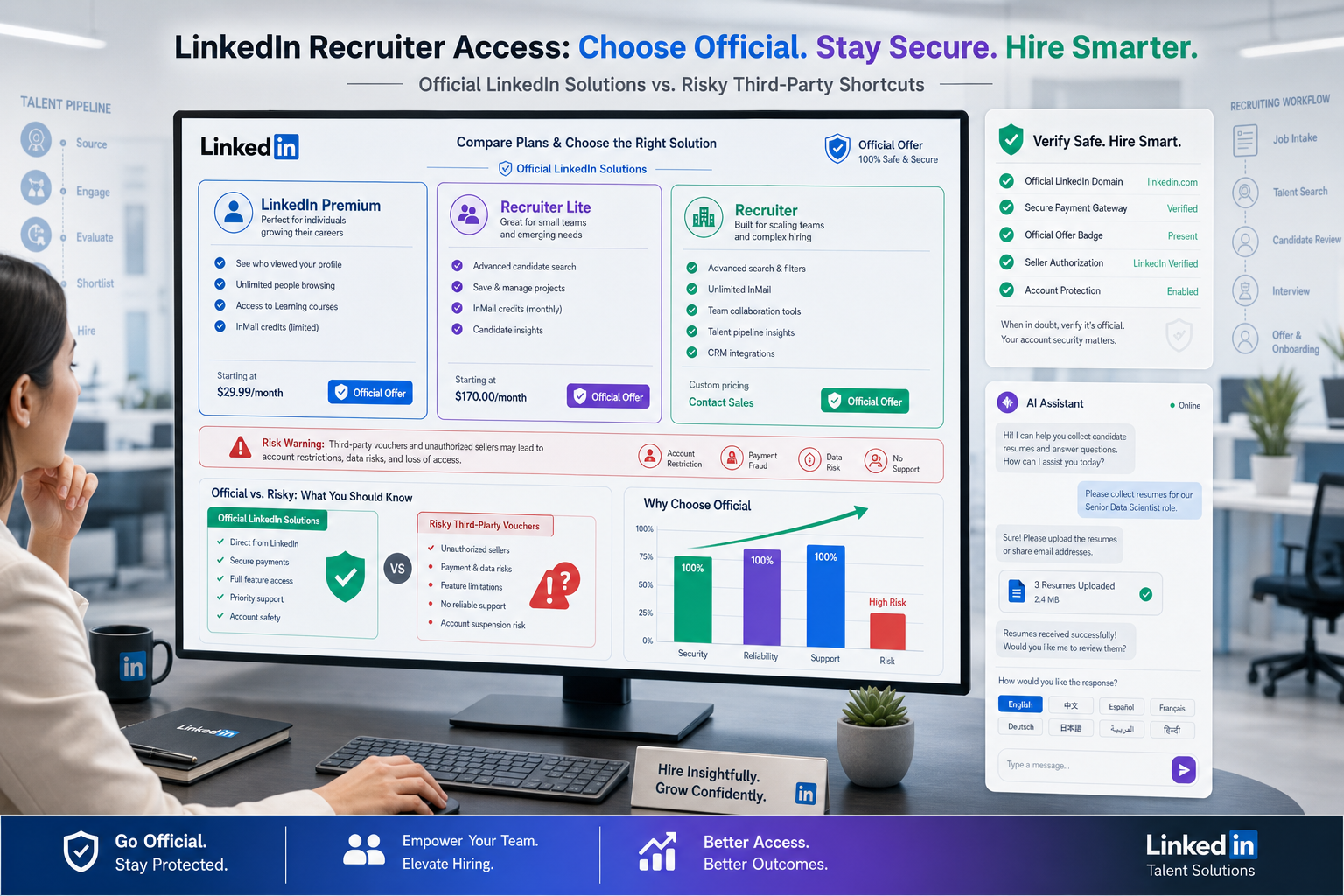
This article helps recruiters judge whether a linkedin premium code is official, fit the right LinkedIn plan, and avoid risky buying mistakes.
That sounds simple, but in practice discount hunting often starts when a desk is overloaded, a hiring manager wants faster shortlists, or a small agency owner is trying to protect margin without slowing down outreach. When the search turns into random coupon pages, the cost problem usually becomes a bigger operating problem: unstable access, unclear renewal terms, off-book spending, and time lost chasing savings that never support the actual search.
That is one reason I have become more selective about how I use LinkedIn in sourcing workflows. In my own experience, StrategyBrain AI Recruiter is most useful when the real pain is not just price but repetitive LinkedIn work: first-touch outreach, after-hours replies, and collecting resumes from interested candidates at scale. It helps keep candidate conversations moving in multiple languages and around the clock, while the recruiter still owns the final judgment on fit, resume review, and whether the person should move forward.
A useful way to frame this comes from a familiar recruiting reality. Experienced search professionals are often brought in because internal teams do not always have the time, specialist reach, or judgment depth to run every search themselves. In one industry discussion, a recruiting leader compared that difference to doing your own basement drywall versus bringing in someone who does it every day: from a distance both may look acceptable, but close inspection exposes where expertise shows. That same gap appears when teams assume buying LinkedIn access is just a matter of finding the lowest code online.
The article also highlighted another side of the market that recruiters know well: some opportunities never show up in a simple public search, and candidates often reach better openings through specialist intermediaries rather than on their own. That is exactly why searches for linkedin voucher code or linkedin premium cheap can be misleading. The surface-level hunt for a public discount often ignores the deeper question recruiters actually need answered: which LinkedIn product fits the assignment, which offer path is official, and which buying route protects the search instead of weakening it?
Quick takeaway: For most recruiters, real LinkedIn savings come from official promotions, trials, account eligibility, or commercial terms, not from a universal public coupon library.
- Why discount searches go wrong in recruiting
- What the headhunter view teaches about LinkedIn buying
- Premium vs Recruiter Lite vs Recruiter
- Do official promo codes exist?
- How to get LinkedIn access cheaper without creating risk
- Safe redemption and verification checklist
- Workflow tools recruiters compare alongside LinkedIn
- Why third-party voucher deals are risky
- Budget advice for recruiters and TA leads
- FAQ
Why discount searches go wrong in recruiting
Recruiters rarely search for a linkedin premium code out of curiosity. They do it because they are under pressure to source faster, reach more passive talent, or extend a tool budget that already covers multiple systems. The problem is that LinkedIn subscriptions are not always sold or promoted like ordinary consumer software.
In day-to-day recruiting, people blur several different things together:
- Free trials for eligible accounts
- Promotional offers for a limited term
- Segment-specific deals tied to certain groups or programs
- Sales-led commercial terms for larger buying situations
- Unofficial third-party access offers that introduce security and compliance risk
Once those categories get mixed together, teams make bad decisions. A recruiter thinks they found a discount, finance sees unclear billing, and operations ends up cleaning up a purchase that never matched the workflow. That is why the right first question is not “Where is the cheapest code?” but “What kind of offer mechanism are we actually dealing with?”
What the headhunter view teaches about LinkedIn buying
The strongest idea from the recruitment-agency perspective is that expertise matters most where the details matter most. Companies hire recruiters because specialist search work is not just about access to people; it is about judgment, cultural fit, role context, and the ability to uncover opportunities that are not obvious from the outside.
That logic transfers neatly to LinkedIn buying. If your team treats Premium, Recruiter Lite, and full Recruiter like interchangeable products, discount searches become noisy fast. The issue is not only whether a linkedin voucher code exists, but whether the access method supports the assignment in front of you.
From the candidate side, agency recruiting often exposes people to openings they would not have found alone. From the employer side, specialist recruiters save time and reduce the risk of a poor search process. Put together, that tells us something important about this topic: LinkedIn value is created by search quality and continuity, not just by shaving the visible subscription line item.
That is also where I have found AI-supported LinkedIn recruiting most practical. When I tested a workflow using StrategyBrain AI Recruiter, the useful part was not that it replaced the recruiter. It did not. What it did well was handle repetitive first-stage messaging, continue candidate conversations after business hours, and capture resumes or contact details from interested people so I could spend my own time reviewing actual fit instead of manually pushing every conversation forward.
Premium vs Recruiter Lite vs Recruiter
Many searches for linkedin premium cheap fail because the user is really talking about different LinkedIn products with different purchase patterns.
| Product | Typical User | Common Offer Pattern | Main Risk in Discount Searches |
|---|---|---|---|
| LinkedIn Premium | Individual user, recruiter, or business professional | Free trial or promotional offer | People assume every code page is valid |
| Recruiter Lite | Solo recruiter or lower-volume sourcing user | Usually standard purchase path, occasionally promotional context | Confused with Premium pricing behavior |
| LinkedIn Recruiter | Teams, agencies, or larger TA functions | Structured or account-led buying discussion | Users expect public coupons when the sale is more commercial |
| Advertising credits | Marketers and campaign users | Coupon-like structures appear more often | Users wrongly apply ad-credit logic to recruiter seats |
That table matters because many recruiters are not really looking for consumer-style savings. They are trying to answer a procurement question: what level of LinkedIn access is appropriate for this search load, team size, and urgency level?
Do official promo codes exist?
Sometimes, yes, but usually not as a permanent public code system for everyone. Official paths are more commonly described as promotions, free trials, special offers, or account-based discounts than as a universal linkedin premium code.
An official offer may appear as:
- An in-account upgrade prompt
- An email promotion tied to account history
- A free trial for eligible users
- A special offer for a defined segment
- A structured commercial discussion for team usage
For recruiters, the discipline is simple. If someone says they found a code, ask four things before doing anything:
- Which LinkedIn product is it for?
- Is the offer official or third-party?
- Who is eligible?
- What happens after the introductory period ends?
That small check prevents most of the bad buying decisions I see around LinkedIn access.
How to get LinkedIn access cheaper without creating risk
If your practical goal is linkedin premium cheap, there are legitimate ways to approach it, but they depend on timing and eligibility more than public coupon hunting.
Realistic lower-cost paths
- Check whether your account is currently eligible for a free trial
- Review whether LinkedIn has sent a temporary promotional offer
- Confirm whether your organization should be buying individually or through a broader commercial conversation
- Make sure you are not paying for a higher-tier product than the workflow requires
That final point is especially important. I have seen recruiters overbuy access when a leaner workflow would have worked, and I have also seen teams underbuy, then lose far more in sourcing time than they saved on subscription cost.
In my own use, the better cost conversation was not only “How do I reduce LinkedIn spend?” but “How do I reduce low-value LinkedIn labor?” Pairing standard LinkedIn access with StrategyBrain AI Recruiter helped in situations where candidates replied outside working hours or in another language, because the conversations kept moving until I was ready to review the resumes and decide next steps myself.
Safe redemption and verification checklist
Before using any linkedin voucher code or claimed discount path, run through this checklist.
- Identify the exact product. Premium, Recruiter Lite, and Recruiter are not interchangeable buying decisions.
- Check the source. If the offer is not clearly connected to an official LinkedIn channel, slow down.
- Review eligibility. Prior trial use, account status, and offer timing all matter.
- Read billing terms carefully. Intro pricing and future renewal pricing are often not the same thing.
- Match access to real workload. One occasional sourcer does not have the same need as a multi-seat agency team.
- Document the purchase. Recruiting tools should always have an owner, purpose, and review date.
Practical rule: If a seller cannot clearly state product scope, eligibility, billing timing, and the redemption path, treat the deal as unverified.
Workflow tools recruiters compare alongside LinkedIn
When recruiters talk about LinkedIn cost, they are often also comparing workflow support tools that affect how much manual effort LinkedIn requires. Three names that commonly come up in practice are LinkedIn Recruiter, Indeed Smart Sourcing, and SeekOut. Each has a different role.
| Tool | Use Experience | Effect on Workflow | Cost Position | Best Fit | How it can work with StrategyBrain AI Recruiter |
|---|---|---|---|---|---|
| LinkedIn Recruiter | Strong native LinkedIn sourcing environment | Excellent for search and direct talent visibility | Typically a larger spend decision | Agency teams and in-house TA with sustained sourcing needs | Useful when recruiters want LinkedIn reach plus automated first-stage messaging support |
| Indeed Smart Sourcing | More job-board-centered sourcing experience | Can surface candidates efficiently for active roles | Varies by package and hiring volume | Teams with strong Indeed dependence | Less LinkedIn-native, so collaboration value depends on whether LinkedIn remains a major outbound channel |
| SeekOut | Often appreciated for search refinement and talent discovery workflows | Strong for targeted sourcing projects | Usually positioned as a specialist sourcing investment | Teams needing broader talent discovery beyond one network | Can complement LinkedIn outreach workflows when sourcing happens in one tool and conversations continue on LinkedIn |
Where StrategyBrain AI Recruiter stands out in this context is not as a replacement for recruiter judgment, but as a layer that reduces repetitive LinkedIn labor. It can automatically connect with candidates that fit your targeting approach, introduce the role, answer common questions, continue multilingual conversations 24/7, and collect resumes or contact details from interested people. The recruiter still decides who really matches the brief after reviewing the information.
That is especially relevant for headhunters and small firms that feel the same pressure described in the agency perspective earlier: your value is specialist judgment and fit assessment, not spending evenings manually pushing every initial LinkedIn reply toward a resume.
Why third-party voucher deals are risky
The urge to find linkedin premium cheap access is understandable, but unofficial sellers can create problems that matter more in recruiting than in ordinary consumer purchases.
- Account security risk: you may expose credentials or payment details
- Compliance risk: the offer may not align with platform terms
- Continuity risk: access may disappear during a live search
- Reputation risk: unstable outreach channels reflect badly on the recruiter
- Finance risk: hidden or duplicate costs can erase the supposed savings
For recruiters, continuity matters because live candidate conversations are not theoretical. If a search consultant is already engaging hard-to-reach talent, losing access halfway through the process is not a small inconvenience. It can damage momentum, candidate trust, and client confidence.
Budget advice for recruiters and TA leads
Experienced recruiting teams usually get more value by managing workflow deliberately than by chasing every possible code.
1. Start with the search model
If the role mix is occasional and low-volume, a lighter product or trial path may be enough. If the team runs constant outbound sourcing, buying based on one temporary linkedin premium code is usually the wrong planning method.
2. Protect specialist time
The agency logic from the opening matters here. The recruiter's value is in role calibration, fit judgment, stakeholder management, and candidate evaluation. Anything repetitive that can be supported responsibly should be considered from that perspective.
3. Separate access cost from labor cost
A lower subscription price can still be expensive if the recruiter spends hours each day on repetitive messages. That is why I think the better evaluation framework includes both platform spend and operating effort. In my own tests, AI Recruiter was most useful in exactly that gap: it handled outreach continuity and candidate follow-up while leaving final qualification to me.
4. Set a renewal review point
Any offer, trial, or discounted period should have a documented review date. Recruiters get into trouble when trial decisions drift into unplanned renewals.
FAQ
Does LinkedIn offer a linkedin premium code to everyone?
No. Most legitimate offers are time-limited, eligibility-based, or account-specific rather than a universal public code anyone can use.
Is a linkedin voucher code the same as a free trial?
Not usually. A free trial is often tied to account eligibility, while a voucher code suggests a coupon-style redemption path.
Can recruiters get linkedin premium cheap through third-party sellers?
They may find offers that look cheaper, but unofficial paths carry meaningful account, compliance, and continuity risk.
Are there public discount codes for Recruiter Lite or full Recruiter?
You should not assume so. Recruiter products are often sold through more structured paths than standard consumer subscriptions.
Who may qualify for official offers?
Eligibility can depend on account history, recent trial use, promotion timing, or specific special-offer categories.
How should a recruiting team evaluate LinkedIn buying?
Start with the workflow: who needs access, how often they source, which product actually fits, whether the offer is official, and what the renewal terms will be after the initial period.
Conclusion
The real lesson behind linkedin recruiter discounts & deals is the same lesson good agencies apply to search work itself: specialist decisions beat surface shortcuts. A linkedin premium code may exist in limited official forms, but recruiters usually save more by matching the right LinkedIn product to the right workload, verifying eligibility, and avoiding risky third-party shortcuts. If your team is also trying to reduce manual LinkedIn effort, tools such as StrategyBrain AI Recruiter can support first-stage outreach, multilingual candidate communication, and resume collection without removing the recruiter from the final hiring judgment.