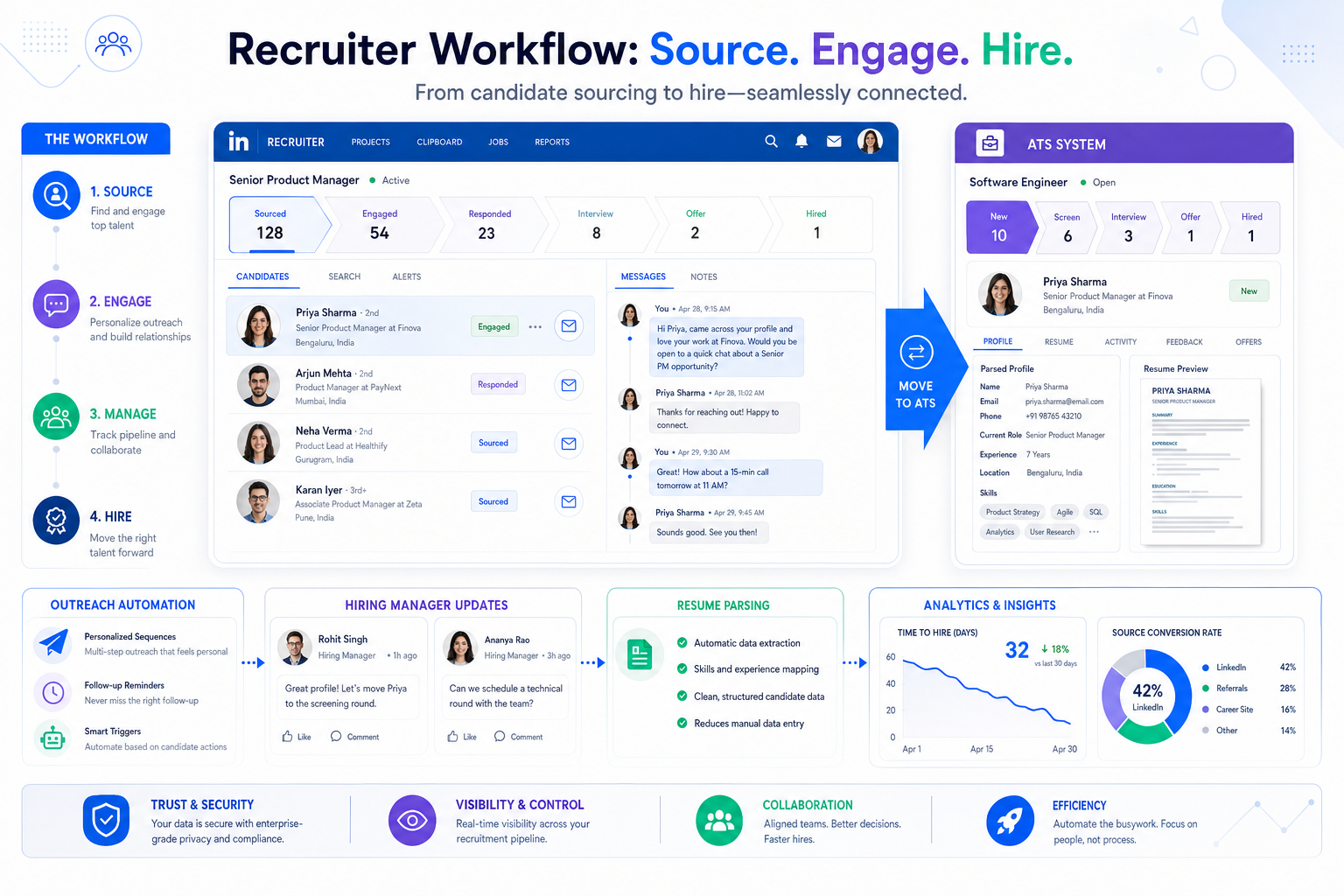
When candidate updates scatter and trust slips, this article helps recruiting leaders judge which applicant tracking system for recruiters prevents delays.
That matters because recruiting breaks down long before a placement is lost on paper. A busy agency recruiter feels it when candidate replies sit in scattered inboxes, when hiring managers get vague updates, when a consultant cannot tell a candidate the truth about timing, and when a small firm starts operating like every desk is its own island. For in-house teams, the cost shows up as slower hires, weaker candidate experience, and less confidence from business leaders who want clear progress, not another spreadsheet.
In that gap between speed and clarity, I have found that tools only help when they remove very specific friction. When I tested StrategyBrain AI Recruiter in sourcing-heavy work, the useful part was not hype. It was the practical support: automated LinkedIn outreach and follow-up, around-the-clock candidate replies across time zones, and structured collection of resumes and contact details so conversations did not vanish into message threads. The recruiter still has to review the resume, decide whether the profile really fits, and own the next move, but the admin drag becomes lighter.
That same lesson shows up in team leadership. A recruiter does not want to work on a desk where nobody says what is really happening, where updates change depending on the audience, and where the team acts like people are workflow units instead of human beings. In recruiting operations, you can see the problem in small actions: a consultant opens a requisition list, checks a candidate's last LinkedIn reply, tries to remember what was promised to the client, then realizes the note is in a private inbox and the hiring manager has a different version of the timeline.
Strong recruiting teams usually become attractive places to work for the same reasons strong hiring systems work: straight communication, consistency, personal accountability, and support that matches what the team actually needs. That is why choosing the best recruiting software is really about choosing an applicant tracking system for recruiters that keeps the process honest, visible, and usable. The advantages of applicant tracking system adoption and the most important ATS benefits are easiest to see when a team is trying to protect trust while still moving fast.
- What Best Recruiting Software Really Means
- Why Team Leadership Principles Matter in ATS Selection
- Quick Comparison: What Recruiters Should Evaluate
- Advantages of Applicant Tracking System Adoption
- Core Features Modern Recruiting Teams Need
- Which Type of ATS Fits Your Recruiting Model?
- How to Choose the Best Recruiting Software
- Common Buying Mistakes
- FAQ
- Conclusion
What Best Recruiting Software Really Means
When recruiters search for the best recruiting software, they are usually not looking for the longest feature sheet. They are looking for a system that makes daily recruiting easier to run under pressure. In practice, that usually means an applicant tracking system for recruiters that supports job posting, candidate tracking, communication, interview coordination, feedback collection, pipeline visibility, and reporting without forcing the team back into side spreadsheets.
From an operator's point of view, the word best should mean three things. First, the software helps recruiters tell candidates and hiring managers what is actually happening. Second, it creates one consistent record instead of several partial truths across inboxes and notes. Third, it supports the team in the way the team actually needs, whether that means more structure, more speed, or better sourcing follow-up.
That is also why many software evaluations fail. Teams compare features in isolation instead of asking a harder question: does this system help recruiters lead a cleaner hiring process that people trust?
Why Team Leadership Principles Matter in ATS Selection
The leadership angle is not a detour. It is a practical buying lens. Teams want to work with leaders who communicate plainly, act consistently, treat people like people, create room for real collaboration, and step in with the support the moment requires. Recruiters want software for the same reasons.
- Straight talk becomes process visibility. Recruiters and hiring managers need accurate statuses, clear ownership, and communication history they can trust.
- Being real becomes workflow consistency. The process should not change completely depending on who touched the role last.
- Working with people, not robots, becomes candidate-centered design. Communication, responsiveness, and mobile access matter because candidates experience the process in real time.
- Taking work seriously while keeping friction low becomes better adoption. If the system is too heavy, people route around it.
- Being the leader your team needs becomes software fit. A lean search firm, a corporate TA team, and a high-volume employer do not need the same setup.
This framework is useful because it moves the conversation beyond generic feature comparisons. It helps you judge whether the system strengthens how your team actually works together.
Quick Comparison: What Recruiters Should Evaluate
If you are shortlisting recruiting software, evaluate it through the daily work of a recruiter rather than through broad marketing claims.
| Evaluation Area | What to Look For | Why It Matters |
|---|---|---|
| Job distribution | Easy publishing to multiple channels and simple requisition management | Reduces repetitive admin and helps roles go live faster |
| Candidate records | Searchable profiles, resume parsing, complete communication history | Supports fast screening and cleaner rediscovery |
| Pipeline control | Custom stages, visible ownership, aging alerts, status clarity | Keeps the process honest and prevents silent bottlenecks |
| Communication workflows | Email templates, reminders, interview coordination, stakeholder updates | Improves consistency with candidates and hiring managers |
| Sourcing support | Talent pools, proactive outreach tracking, LinkedIn workflow support | Helps recruiters go beyond inbound applicants |
| Automation | Task triggers, scheduling support, reminders, workflow nudges | Creates real ATS benefits through time savings |
| Reporting | Dashboards for source quality, stage conversion, time-to-hire | Turns recruiting activity into operational insight |
| Compliance and auditability | Permissions, activity logs, consistent workflow records | Supports governance and more defensible hiring |
| Candidate experience | Clear apply flow, timely updates, mobile accessibility | Protects conversion and employer reputation |
My own rule is simple: if the demo cannot show how the tool helps a recruiter answer a candidate, update a hiring manager, and move a stage without confusion, it is probably not the best recruiting software for a real team.
Advantages of Applicant Tracking System Adoption
The most credible advantages of applicant tracking system adoption are operational, not theoretical. They appear in fewer dropped threads, faster decisions, and a more trustworthy process.
1. Less manual work across the pipeline
One of the clearest ats benefits is reducing repetitive work. Posting jobs, updating stages, requesting interview feedback, sending reminders, and maintaining candidate records should not depend on memory alone. Good systems remove low-value repetition so recruiters can spend more time screening, calibrating, and advising.
In sourcing-heavy environments, this is also where AI-assisted workflows can help. I have seen the value of pairing an ATS with AI Recruiter for LinkedIn conversations that would otherwise require late-night follow-up, especially when candidate responses come in after hours or across regions. The recruiter still makes the fit call, but the message handling burden can become much more manageable.
2. Faster screening without losing judgment
A strong applicant tracking system for recruiters should speed up first review while preserving recruiter judgment. Searchable candidate records, knockout questions, parsing, and structured profiles help teams move quickly, but they should support decision-making rather than replace it.
This is one of the biggest advantages of applicant tracking system use because speed affects hiring outcomes. The longer a qualified candidate waits for clarity, the greater the chance the process loses momentum.
3. Better trust through centralized records
Recruiting gets messy when every stakeholder has a different version of the story. Centralized notes, message history, stage movement, source data, and interview feedback create one shared reality. That is a major ats benefit for both agencies and internal teams.
It also reflects the leadership principle of straight talk. You cannot give reliable updates if the information lives in five places.
4. Stronger collaboration with hiring managers
The best recruiting software should make it easier for hiring managers to participate well. That includes reviewing profiles, giving timely feedback, seeing where candidates sit, and understanding what happens next. If managers avoid the system, recruiters end up acting as human middleware.
Good ATS design reduces that friction. It creates a more consistent process and helps recruiters spend less time chasing and more time advising.
5. More consistent candidate experience
Candidates notice disorganization quickly. Delayed replies, repeated questions, confusing timelines, and disconnected scheduling all signal a weak process. A modern ATS supports cleaner communication and clearer handoffs, which is one of the most practical applicant tracking system benefits for teams that care about conversion and reputation.
6. Better reporting and process learning
Leadership teams want to know more than how many requisitions are open. They want to know where candidates stall, which sources convert, how long decisions take, and where recruiter capacity is being spent. Reporting is one of the strongest advantages of applicant tracking system adoption because it turns recruiting from a black box into a measurable operating function.
7. Governance without extra chaos
Permissions, activity logs, and standardized workflows support process discipline. For larger organizations, regulated environments, and multi-user agency teams, this is one of the quieter but more important ats benefits. It helps protect consistency even when ownership shifts between coordinators, recruiters, and hiring managers.
Core Features Modern Recruiting Teams Need
Once the leadership and workflow lens is clear, the feature conversation becomes easier. The best recruiting software should include the capabilities that protect communication, visibility, and team coordination.
Resume parsing and structured candidate profiles
This is basic but essential. If records are not searchable and consistent, every later workflow becomes slower.
Multi-channel job distribution
Recruiters need to publish roles efficiently and track where applications come from. This is especially important for lean teams handling many concurrent searches.
Pipeline management with custom stages
No two teams run exactly the same process. Your ATS should reflect your hiring reality without becoming so customized that nobody can use it consistently.
Interview scheduling and feedback workflows
Scheduling is where momentum often dies. Look for a system that reduces calendar chasing and makes feedback collection easier for busy stakeholders.
Talent pools and sourcing support
The best recruiting software should not only process applicants after they apply. It should also help recruiters organize silver medalists, passive candidates, and future-fit profiles.
Practical automation
Useful automation is concrete. It triggers reminders, helps with follow-up, and removes administrative repetition. It does not replace recruiter evaluation.
LinkedIn workflow support and AI-assisted outreach
For recruiters who live in outbound search, an ATS alone may not be enough. This is where I found value in using StrategyBrain AI Recruiter alongside the core system. It handled repetitive LinkedIn introduction and follow-up tasks, captured candidate resumes and contact details once interest was confirmed, and kept outreach moving while I focused on shortlist quality and client calibration. That combination is especially helpful for agency recruiters, independent headhunters, and in-house sourcing teams working across time zones.
Reporting dashboards
If the system cannot show source performance, time in stage, and conversion points clearly, it will be much harder to improve your process with confidence.
Which Type of ATS Fits Your Recruiting Model?
Not every team needs the same architecture. Good software choice starts with matching the tool to the operating model.
SMB and boutique agency teams
Smaller teams usually need speed, usability, and fast adoption. A simpler ATS with strong sourcing support and clear reporting often works better than a highly layered platform.
Enterprise talent acquisition teams
Larger organizations usually need stronger controls, permissions, approvals, and reporting depth. Workflow consistency matters more because more people touch each process.
Standalone ATS platforms
A standalone ATS often fits teams that want recruiting depth, especially around sourcing, pipeline management, and recruiter workflow design.
HCM-embedded recruiting modules
These can work when HR platform alignment matters most, but recruiters should verify that speed, usability, and sourcing depth are strong enough for real talent acquisition work.
The practical test is simple: what does your team need right now? More structure, more outreach capacity, better reporting, or cleaner manager participation? Buy for that reality.
How to Choose the Best Recruiting Software
Choosing the best recruiting software is easier when you evaluate it the same way you would evaluate a team environment: honesty, consistency, usability, and fit.
- Map the current workflow. Document how a role moves from opening to offer, including where information gets lost.
- Identify trust failures. Where do candidates, recruiters, and hiring managers see different versions of the process?
- Define your real must-haves. Examples include better source tracking, less admin, stronger outreach follow-up, or clearer feedback loops.
- Run live scenarios. Ask to see a hard-to-fill role, a high-volume role, and a delayed manager feedback situation.
- Review reporting early. Weak analytics rarely become strong later.
- Test hiring manager usability. Recruiter efficiency means little if manager participation is still clumsy.
- Check compliance and data handling. This matters for governance and operational confidence.
- Evaluate AI features with discipline. Ask what specific tasks are assisted and where the recruiter remains the decision-maker.
Practical takeaway: The best software does not just track candidates. It helps recruiters communicate clearly, work consistently, and give the team the kind of support the process actually needs.
Common Buying Mistakes
Even experienced recruiting leaders miss the mark when they buy for presentation value instead of workflow truth.
- Choosing feature quantity over day-to-day fit. More features can mean more friction.
- Ignoring team behavior. If recruiters and managers avoid the system, side processes will return.
- Confusing automation with judgment. Recruiters still need to assess fit, risk, and nuance.
- Skipping sourcing workflow evaluation. Teams that rely on LinkedIn or outbound search need support beyond inbound applicant tracking.
- Underestimating communication design. Process trust often depends on simple, clear updates.
- Treating candidate experience as secondary. It is part of conversion, not just branding.
I would add one more mistake from experience: some teams buy an ATS and assume the outreach problem is solved. It usually is not. If your recruiters spend major time in proactive search, an ATS may need to be paired with workflow support such as AI Recruiter for LinkedIn-based sourcing, while keeping human control over qualification and final movement.
FAQ
What is an applicant tracking system for recruiters?
An applicant tracking system for recruiters is software that manages recruiting workflows in one place, including jobs, applicants, communication, interviews, feedback, offers, and reporting.
What are the main advantages of applicant tracking system adoption?
The main advantages of applicant tracking system adoption include lower admin burden, better pipeline visibility, centralized candidate records, stronger collaboration, cleaner reporting, and a more consistent candidate experience.
Which ATS benefits matter most to agency recruiters?
Agency recruiters usually care most about faster screening, searchable talent pools, clean client updates, sourcing support, and less time spent on repetitive coordination.
Can AI tools replace recruiter judgment?
No. AI can help with outreach, follow-up, drafting, and administrative support, but recruiters still need to evaluate resumes, assess fit, and decide what happens next.
Should small recruiting teams use an ATS?
Yes. Small teams often feel the benefits quickly because even modest process discipline can save time, reduce confusion, and improve candidate communication.
How should recruiters evaluate LinkedIn-related workflow support?
They should look at whether the system or supporting tools can track outreach, handle follow-up efficiently, capture resumes and contact details, and keep records visible without forcing recruiters to manage everything manually.
Conclusion
The best recruiting software is not the one with the broadest promise. It is the one that helps your team work in a way people actually trust and want to be part of. In most cases, that means choosing an applicant tracking system for recruiters that keeps communication clear, records centralized, stages visible, and recruiters focused on judgment instead of busywork.
The deeper lesson is simple. Teams want leaders who are direct, consistent, human, and responsive to what the group really needs. Recruiters want software for the same reasons. If your evaluation process keeps that standard in view, the advantages of applicant tracking system adoption and the most meaningful ats benefits become much easier to recognize before you buy.