When sourcing leaders compare alternatives to LinkedIn for talent sourcing, this article helps them avoid follow-up chaos and choose a workflow that preserves context, judgment, and control.
That distinction matters because sourcing failure rarely starts with search alone. It starts when a recruiter finds people but cannot keep context straight across outreach, résumé collection, stakeholder updates, compliance notes, and next steps. For a solo headhunter, that means wasted evening follow-up and lost replies. For a small agency owner, it means inconsistent delivery and candidate duplication. For an in-house team, it can damage hiring-manager trust, candidate experience, and budget efficiency.
In my own LinkedIn-heavy workflows, I have found that StrategyBrain AI Recruiter helps most when the real bottleneck is repetitive first-touch communication, after-hours reply handling, and résumé capture from interested candidates. Its automated LinkedIn messaging, multilingual follow-up, and contact collection reduce manual chasing, while the recruiter still makes the final call on fit, résumé review, and whether a candidate should move forward.
You can see why this matters in HR and administration hiring, where the search is not just about filling a seat. These roles often sit at the center of onboarding, policy execution, compliance, employee communication, and cross-department coordination. When a company needs an HR manager who can handle union realities, seasonal workforce swings, or a field-based operating environment, the recruiter has to do more than pull names. They have to surface people who can work inside that exact culture and operating model.
The real pressure shows up once outreach begins. A recruiter is comparing background signals, replying to candidate questions about the role, logging sensitive conversations, checking whether someone has the discretion and communication style the client needs, and deciding who deserves a real review. That is exactly why the market for LinkedIn recruiter alternatives has changed: the best alternatives to LinkedIn for recruiting 2025 are not just search databases, but systems that support targeted search, soft-skill judgment, confidentiality, and disciplined follow-up across the whole recruiting flow.
Table of Contents
- Why Teams Look Beyond LinkedIn Recruiter
- What Good Alternatives Actually Need to Do
- A Four-Part Evaluation Framework
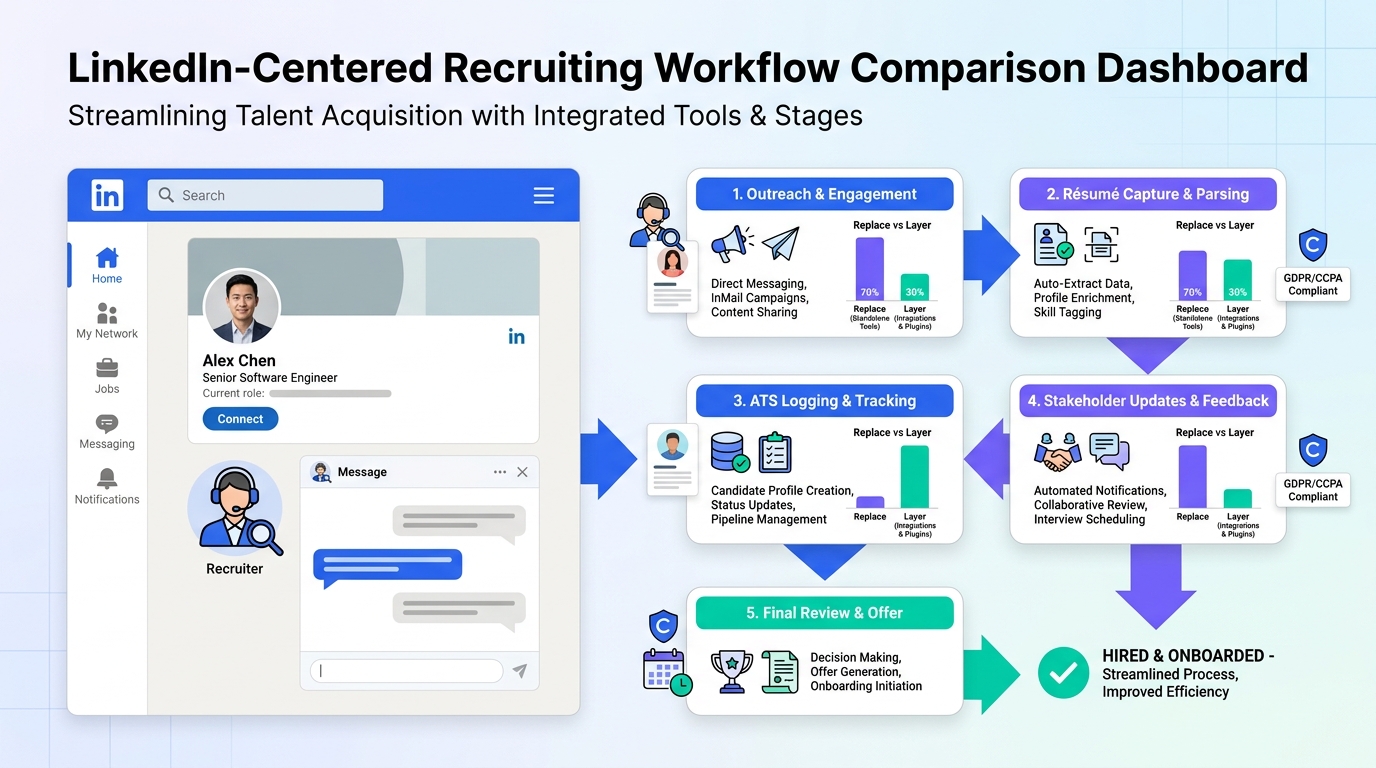
- Replace LinkedIn or Layer Around It?
- Comparison of Alternative Categories
- Best Alternatives to LinkedIn for Recruiting 2025 by Use Case
- My Workflow Experience Using AI Recruiter
- Why ATS Discipline Still Decides ROI
- How to Choose the Right Stack
- Common Mistakes
- FAQ
Why Teams Look Beyond LinkedIn Recruiter
If your team is researching alternatives to LinkedIn for talent sourcing, the need is usually practical rather than ideological. Most recruiters still recognize LinkedIn's value. The problem is that many searches now require broader discovery, more reliable outreach execution, better documentation, and cleaner handoff into a structured hiring process.
In experienced recruiting teams, the usual friction points are familiar:
- Overdependence on one ecosystem: recruiters become too reliant on a single profile source
- Manual outreach overhead: replies arrive after hours and require constant chasing
- Weak candidate rediscovery: good past prospects vanish into notes, inboxes, or spreadsheets
- Inconsistent context capture: candidate questions, concerns, and next steps are not logged well enough
- Gaps between sourcing and process control: teams can find names, but cannot run a repeatable workflow around them
That last point is especially important in HR, admin, operations, and other trust-heavy roles. These searches often require judgment around discretion, communication, and environment fit, not just title matching. A tool that only helps you search is often not enough.
What Good Alternatives Actually Need to Do
One useful lesson from HR and administrative recruiting is that the right person has to match both the formal job and the real operating environment. The same principle applies when evaluating sourcing platforms. You are not just buying profile access. You are choosing whether the tool can support the way your recruiting work actually happens.
The strongest LinkedIn recruiter alternatives usually help with at least five jobs:
- Strategic intake support: helping recruiters translate a vague brief into a usable search thesis
- Targeted search: finding candidates across active and passive channels, not just one familiar network
- Soft-skill screening support: capturing enough interaction context to assess communication, responsiveness, and professionalism
- Efficiency and confidentiality: moving quickly without losing control of sensitive searches
- Pipeline continuity: keeping prospects searchable and reusable later
That framing is more useful than asking which tool has the biggest database. A large database may still fail if the workflow around it breaks down.
Key insight: The best recruiting stack does not just find people; it preserves context, supports judgment, and keeps the process consistent when searches become sensitive or high-touch.
A Four-Part Evaluation Framework
The reference point I come back to is simple: good recruiting tools should help you align talent with operating reality. In practical sourcing terms, that means evaluating alternatives through four lenses.
1. Strategic fit
Can the tool support the actual hiring context? If you are filling HR, operations, executive support, or administrative leadership roles, context matters. You may need people comfortable with multi-site teams, regulated environments, labour relations, confidential information, or fast-changing internal processes.
2. Search quality
Can you reliably surface candidates beyond the same obvious pool? This includes search breadth, enrichment quality, filtering depth, and whether the system helps you find passive talent instead of recycling active applicants.
3. Communication and soft-signal capture
Once outreach starts, can the tool help you manage candidate replies, store contact details, and keep the interaction history visible? For recruiters, this is where the gap between raw sourcing and real recruiting becomes obvious.
4. Process control and confidentiality
Can your team move quickly without creating compliance or reputation risk? Sensitive searches often require discretion, auditability, and clear ownership of next steps.
This framework is more grounded than vendor hype because it mirrors how serious recruiting work actually succeeds or fails.
Replace LinkedIn or Layer Around It?
This is the first decision I would settle before comparing anything else. Some teams truly want a replacement. Others need a tool that makes LinkedIn sourcing less manual and more scalable.
When replacement makes sense
A replacement path is more realistic when your team needs strong multi-source discovery, reliable contact enrichment, outreach workflow support, and talent pipeline visibility outside LinkedIn itself. This is common in agency recruiting, technical sourcing, and multi-market hiring.
When layering makes more sense
For many teams, LinkedIn still remains useful for network visibility and credibility, but the painful part is everything around it: repetitive messaging, follow-up lag, résumé collection, multilingual communication, and keeping candidate interest organized. In those cases, augmentation is the better model.
That is where I have seen AI Recruiter fit more naturally than a simplistic replacement narrative. If your recruiting work still begins on LinkedIn, but execution stalls because recruiters cannot keep up with connection requests, initial conversations, and late-night responses, automation can remove the repetitive layer while preserving human review where it matters most.
Comparison of Alternative Categories
The most useful comparison is by category, not by trying to force one universal winner.
| Category | Best For | Core Strengths | Typical Limits | Best Fit |
|---|---|---|---|---|
| AI sourcing and outreach tools | Teams with heavy outbound volume | Automated first-touch, follow-up support, contact capture, speed | Still needs recruiter judgment on fit and résumé quality | Agencies, headhunters, fast-growth in-house teams |
| Talent CRM platforms | Long-cycle relationship building | Segmentation, nurture workflows, candidate history | May need separate ATS or sourcing layer | Enterprise TA and executive search |
| Sourcing databases with enrichment | Broad market mapping | Multi-source search, contact data, niche discovery | Can be weak on messaging workflow and collaboration | Technical sourcers and research-heavy teams |
| ATS-led recruiting suites | Process control first | Stage tracking, compliance support, collaboration, reporting | Often less specialized in proactive sourcing | SMBs and structured internal teams |
| Agency recruiting systems | Desk-based delivery and client work | Ownership tracking, submissions, CRM discipline | May feel heavy for lean internal recruiting teams | Staffing firms and search practices |
If you are evaluating the best alternatives to LinkedIn for recruiting 2025, start by deciding which category matches your operating model before you worry about feature lists.
Best Alternatives to LinkedIn for Recruiting 2025 by Use Case
For technical sourcing
Technical recruiting usually needs broader signals than a profile-centric network alone can provide. Search flexibility, enrichment quality, and candidate rediscovery matter more than polished profile presentation.
What to prioritize: multi-source search, niche skill discovery, contact enrichment, and a way to preserve prior outreach history for future openings.
For HR and administrative leadership hiring
This is where the reference article offers a useful recruiting lens. These searches often involve cultural alignment, trustworthiness, policy fluency, and environment fit. A recruiter may need to judge whether someone can handle sensitive information, support a hybrid or field workforce, or act as a coordination hub across departments.
What to prioritize: targeted search, strong interaction records, confidentiality, and enough workflow discipline to compare candidates beyond résumé keywords.
For executive search
Executive searches depend less on volume and more on market mapping, discretion, note quality, and relationship continuity. Talent CRM depth matters here as much as search.
What to prioritize: stakeholder visibility, confidential outreach, structured notes, and strong rediscovery of prior conversations.
For agency recruiting
Agencies need the full desk to work: sourcing, outreach, candidate ownership, résumé handling, submissions, and repeatable client updates. A tool can look impressive in demo search results and still fail badly in daily desk use.
What to prioritize: outreach support, fast contact capture, pipeline visibility, and strong CRM or ATS handoff.
For SMB in-house teams
Smaller companies often need fewer tools, not more. The right answer is usually the one that reduces manual effort without creating another disconnected system.
What to prioritize: ease of adoption, basic automation, ATS compatibility, and hiring-manager visibility.
My Workflow Experience Using AI Recruiter
In practice, I have found that StrategyBrain AI Recruiter is most useful when a recruiting team already believes in LinkedIn as a sourcing channel but is frustrated by how much recruiter time disappears into repetitive message handling. In one recurring pattern, I would identify target candidates, launch outreach, and then spend too much time returning to scattered replies, clarifying interest, and asking again for résumés or contact details. The search itself was not the bottleneck; the communication loop was.
Using AI Recruiter, the immediate benefit was workflow continuity. It could handle initial LinkedIn communication, continue replying after hours, and request résumés from genuinely interested candidates, including in multilingual situations where response timing and language comfort would otherwise slow momentum. What mattered to me was not replacing recruiter judgment, but clearing out the repetitive front-end work so I could spend more time reviewing actual candidate quality and preparing better conversations with shortlisted people.
I would still make the final decision on fit, compensation alignment, and whether a résumé matched the role. That boundary is important. Automation can help you maintain speed and responsiveness, but the recruiter still owns the quality bar, stakeholder advice, and movement into the formal process. For teams trying to improve LinkedIn execution rather than abandon LinkedIn entirely, that is a more realistic model than pretending every platform should be a total substitute.
Why ATS Discipline Still Decides ROI
Many discussions about alternatives to LinkedIn for talent sourcing stop at discovery. That is only half the problem. Once a candidate responds, the real operational questions begin: where does the record live, who owns follow-up, how is interest logged, and how do you stop strong prospects from disappearing between sourcing and hiring?
This is why ATS discipline still matters. The recruiter who fills HR, admin, operations, and leadership roles well usually has a system for preserving context, not just finding names.
The main benefits of connecting sourcing activity to an ATS or structured recruiting workflow include:
- Pipeline visibility: the team can see status and ownership clearly
- Candidate rediscovery: silver medalists remain usable for future roles
- Confidentiality control: sensitive searches are easier to manage consistently
- Collaboration: hiring leaders and recruiters review the same record, not competing notes
- Reporting: sourcing channels can be measured by actual conversion, not guesswork
Without this layer, even the strongest sourcing tool can produce operational clutter.
How to Choose the Right Stack
If you are comparing LinkedIn recruiter alternatives, a workflow-first scorecard will usually give you a better answer than a feature-first demo.
- Define the real pain. Is the issue search reach, manual outreach, context capture, confidentiality, or process control?
- Identify the role type. HR leadership, technical sourcing, executive search, and agency recruiting all need different strengths.
- Decide whether you are replacing or augmenting LinkedIn. This prevents bad-fit buying decisions.
- Test communication flow. Can the tool support candidate replies, résumé collection, and follow-up ownership?
- Check culture and environment fit support. Especially for people-facing internal roles, can your workflow preserve soft-signal evidence?
- Audit ATS or CRM connection. If candidate history disappears after first contact, the value leaks out quickly.
- Review recruiter adoption risk. The best tool on paper still fails if the team avoids using it.
A simple scorecard can rate each option on search quality, automation, candidate context, confidentiality, ATS compatibility, multilingual support, and recruiter usability.
Common Mistakes Teams Make
Choosing on database size alone
A large pool does not solve follow-up chaos, poor handoff, or weak recruiter adoption.
Ignoring culture and operating context
Some roles, especially in HR and administration, require more than surface qualifications. If your workflow cannot retain nuance around communication style, discretion, or environment fit, your sourcing stack is incomplete.
Confusing automation with final qualification
Automation can accelerate outreach and response handling, but recruiters still need to assess the résumé, the role match, and the stakeholder implications.
Underestimating confidentiality needs
Sensitive searches require cleaner records, clearer ownership, and better process controls than ad hoc inbox management can provide.
Overbuying complexity
SMB teams often benefit more from focused workflow improvement than from an oversized enterprise stack.
FAQ
What are the best alternatives to LinkedIn for recruiting 2025?
The best alternatives depend on your workflow. Agencies often need outreach automation and CRM discipline, technical teams need broader discovery and enrichment, and internal teams may need stronger ATS control. In many cases, the best answer is a stack rather than a single tool.
Are there good alternatives to LinkedIn for talent sourcing if I still want to use LinkedIn?
Yes. Many teams do better by keeping LinkedIn as one sourcing channel and adding tools that improve messaging, follow-up, résumé capture, and pipeline organization.
Can automation help without replacing the recruiter?
Absolutely. Tools can support repetitive first-touch communication, multilingual replies, and contact collection, while the recruiter still handles résumé review, candidate judgment, and hiring decisions.
Why do HR and admin searches need a different sourcing approach?
Because these roles often require strong communication, discretion, compliance awareness, and cultural fit. Search quality matters, but workflow context and recruiter judgment matter just as much.
Should I replace LinkedIn Recruiter completely?
Not always. If LinkedIn is still productive for your market, layering automation or adding better workflow tools may deliver more value than trying to force a total replacement.
Conclusion
The search for alternatives to LinkedIn for talent sourcing is really a search for better recruiting control. The teams that choose well are not looking for a magical profile database. They are looking for a workflow that can support targeted search, nuanced judgment, responsive communication, and reliable process follow-through.
That is why the best alternatives to LinkedIn for recruiting 2025 should be judged the same way good recruiters judge candidates in sensitive roles: not just on surface credentials, but on fit with the real work, the real environment, and the real risks. If your current setup still depends on manual LinkedIn effort, scattered replies, and weak candidate tracking, the best next step may be to improve the workflow around LinkedIn before trying to escape it entirely.