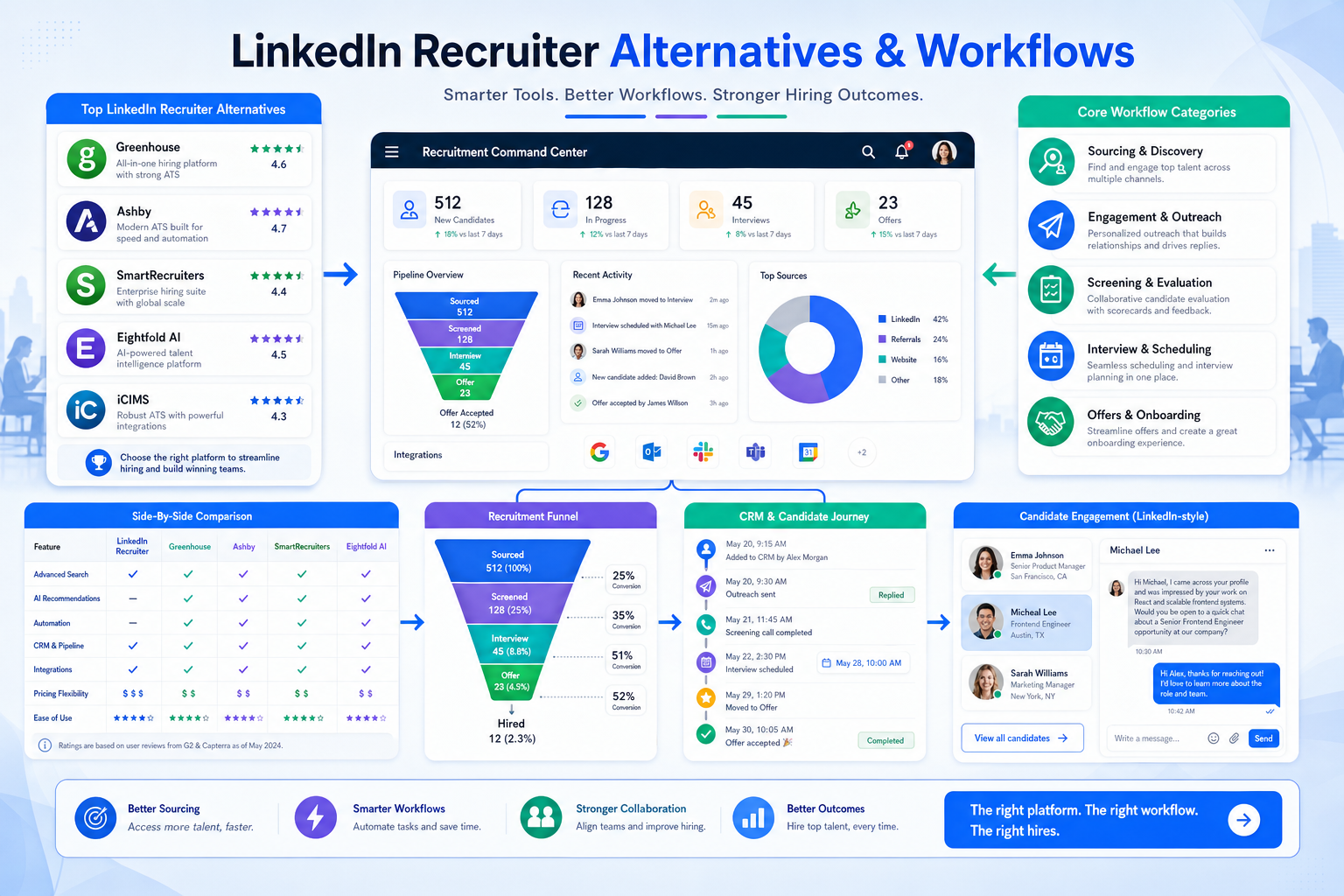
When evaluating LinkedIn Recruiter competitors, recruiters can identify the right fit to improve follow-up discipline, seat ROI, and team workflow.
That distinction matters because most teams do not start shopping for linkedin recruiter alternatives out of curiosity. They start when good prospects slip through uneven follow-up, when recruiters spend too much time inside one channel, or when expensive seats are spread across a team that uses them very differently. For agency owners, that becomes a margin problem. For solo recruiters, it becomes a time problem. For in-house talent teams, it becomes a hiring manager confidence problem.
In my own workflow, I have found that automation helps most when it removes repetitive LinkedIn tasks without taking final judgment away from the recruiter. Tools like StrategyBrain AI Recruiter are useful in that narrow but important layer: keeping candidate outreach moving, replying after hours, and collecting resumes or contact details from interested prospects while the recruiter still reviews fit, evaluates the CV, and decides whether to move forward. That is very different from pretending software should make the hiring decision for you.
A while ago, I spoke with a senior candidate who was weighing a job offer and trying to decide whether the move was actually right. The questions were not superficial. Could they work well with the future manager and team? Would the role stretch them enough to stay engaged? Was the company moving in the right direction, or joining it would mean walking into drift instead of momentum?
That conversation is a useful mirror for recruiters comparing software. Buyers asking what are good alternatives for LinkedIn Recruiter are not really choosing a list of features; they are judging fit, growth, and working style. Can the tool work with your team and process? Will it make recruiters better, not busier? And is it aligned with where your hiring model is heading? That is the right frame for evaluating linkedin competitors.
Table of Contents
- Quick Answer
- The 3 Questions That Actually Matter
- Why Teams Look for LinkedIn Recruiter Alternatives
- Quick Comparison of LinkedIn Recruiter Competitors
- Best Alternatives by Recruiting Use Case
- Where StrategyBrain AI Recruiter Fits
- Replace It or Run a Hybrid Stack?
- A Practical Evaluation Process
- Common Buying Mistakes
- FAQ
- Conclusion
Quick Answer
What are good alternatives for LinkedIn Recruiter? Good alternatives depend on the recruiting job you need done. Some teams need broader candidate discovery. Others need better outbound discipline, recruiter CRM visibility, or lower-friction LinkedIn execution. And some do not need a full replacement at all; they need a better operating model around LinkedIn.
That is why the market for LinkedIn Recruiter competitors is best understood by workflow category, not by brand name alone. Broadly, buyers compare sourcing platforms, recruiter CRM tools, ATS-led systems, and LinkedIn automation layers. Each solves a different bottleneck.
The 3 Questions That Actually Matter
The strongest insight from candidate career decisions also applies to recruiter software selection: the best choice is rarely the loudest option. It is the one that fits the working relationship, develops the team, and matches the direction of the business.
1. Will your team actually work well with it?
When candidates evaluate a job, the first serious question is whether they can work effectively with the new boss and team. In recruiting software, the equivalent question is whether the platform fits recruiter habits, hiring manager expectations, and operating cadence.
If a tool looks powerful in a demo but clashes with how your team searches, messages, tracks, and hands off candidates, adoption drops fast. In practical terms, this means testing whether recruiters can search naturally, whether activity is visible to managers, and whether records stay usable across the team rather than trapped in personal inboxes or browser tabs.
2. Will it make the team better or just busier?
A strong next job usually has some stretch. The same is true of recruiting systems. The right tool should raise the quality of sourcing and follow-up without demanding heroic admin work just to keep it running.
When I assess linkedin recruiter alternatives, I look for tools that improve one of three things: the reach of candidate discovery, the consistency of recruiter follow-up, or the speed of initial response to interested talent. If a platform adds complexity without improving one of those outcomes, it is not a meaningful upgrade.
3. Does it fit your growth trajectory?
Good candidates look at whether a company is growing, stagnant, or shrinking. Recruiting leaders should ask the same about their hiring model. Are you building a high-volume outbound motion? Scaling across languages or time zones? Tightening seat costs? Centralizing process visibility? The right answer for a two-person search firm will not be the right answer for a global in-house team.
This question matters because many linkedin competitors are designed for different stages of recruiting maturity. Buying ahead of your needs creates waste. Buying behind them creates friction.
Why Teams Look for LinkedIn Recruiter Alternatives
In practice, most searches for LinkedIn Recruiter competitors begin with one of five triggers.
- Seat cost pressure: a premium license is hard to defend when usage is uneven across the team.
- Coverage limits: recruiters want sourcing beyond one familiar network.
- Follow-up inconsistency: prospects are found, but outreach rhythm breaks down.
- Operational gaps: candidate records, notes, and handoffs are too fragmented.
- Need for speed: recruiters want conversations to continue after hours or across regions.
Notice that only one of those is purely about search. The rest are process problems. That is why so many buyers asking what are good alternatives for LinkedIn Recruiter are really trying to redesign a workflow, not just swap one database for another.
Quick Comparison of LinkedIn Recruiter Competitors
| Category | Best For | What Teams Like | Watch-Out |
|---|---|---|---|
| Broad sourcing platforms | Passive candidate discovery across more sources | Useful when recruiters need reach beyond LinkedIn | May not match LinkedIn's native network behavior |
| Recruiter CRM tools | Nurture, outreach history, team visibility | Helpful when follow-up discipline is the real issue | Less useful if search quality is still weak |
| ATS-led recruiting suites | Process control, reporting, compliance | Stronger workflow governance for larger teams | Not a direct sourcing replacement |
| LinkedIn automation layers | Speeding repetitive LinkedIn outreach tasks | Good for response handling, follow-up continuity, and resume capture | Recruiters still need to own judgment and screening |
The point of this table is not ranking. It is to stop buyers from comparing unlike-for-like tools as if they solve the same problem.
Best Alternatives by Recruiting Use Case
1. Best for recruiters who need more candidate discovery
If your desk depends on finding people outside the same visible LinkedIn pool, then sourcing-first alternatives make sense. This is the most obvious reason people search for linkedin recruiter alternatives.
In technical search, executive mapping, or hard-to-fill niche roles, broader discovery can matter a lot. But the test should be grounded in live searches. Run ten real reqs, not demo examples, and compare whether the longlist is actually more useful.
2. Best for teams with weak outreach follow-up
Many firms do not have a search problem. They have a consistency problem. Good prospects are identified, then contacted late, replied to slowly, or lost because nobody owns the next step.
That is where recruiter CRM workflows or LinkedIn messaging support can outperform another pure sourcing seat. If your recruiters repeatedly lose momentum after the first touch, this category deserves serious attention.
3. Best for agency recruiters balancing speed and utilization
Agencies feel software waste quickly. Some consultants use their tools heavily; others do not. Some desks need deep search; others need fast outreach and fast qualification. That mix is why agencies often compare linkedin competitors more aggressively than in-house teams do.
For agency owners, the right setup often combines targeted premium sourcing access for power users with lighter workflow support for the rest of the team. That can be more efficient than giving everyone the same expensive seat.
4. Best for in-house teams that care about process quality
Corporate recruiting teams often need cleaner handoffs, clearer stage visibility, and stronger manager collaboration. In that case, the buying question shifts from “Which sourcing tool is biggest?” to “Which workflow helps us move from first contact to interview without chaos?”
This is also where the candidate-side lesson from the opening case matters. Just as a candidate evaluates a future boss, team, and growth path before accepting an offer, recruiting teams should evaluate whether a tool will improve working relationships inside the hiring process rather than just increasing message volume.
Where StrategyBrain AI Recruiter Fits
Because this topic is about LinkedIn usage in real recruiting work, it is worth separating database alternatives from workflow assistance inside LinkedIn itself. In my experience, StrategyBrain AI Recruiter fits best when the problem is not “we cannot find profiles” but “we cannot keep LinkedIn activity moving at the pace the desk requires.”
I tested that kind of workflow support most seriously in situations where candidate replies arrived outside office hours or across geographies. The practical win was not magical sourcing; it was continuity. A tool like AI Recruiter can keep conversations moving, answer common role questions in the candidate's language, and collect resumes or contact details from interested people while I still make the real call on relevance, shortlist quality, and whether to advance the person.
That distinction matters. Recruiters still need to read the CV, assess the match, and decide the next step. But if your bottleneck is repetitive first-touch messaging, slow follow-up, or after-hours response handling, this type of support can be a better complement than buying another full sourcing product.
It is particularly relevant for:
- agency recruiters handling many live LinkedIn conversations at once
- in-house teams hiring across time zones
- headhunters who need outreach continuity without constant manual monitoring
- teams that want to capture resumes and interest signals faster from LinkedIn conversations
If you want to see how that positioning is explained in more detail, the vendor's own comparison page and conversation examples are useful to review critically alongside your own test scenarios.
Replace It or Run a Hybrid Stack?
One of the most useful conclusions from reviewing LinkedIn Recruiter competitors is that a full replacement is not always the smartest goal. Many teams perform better with a hybrid stack.
A full replacement makes sense when your team gets limited value from LinkedIn's native environment relative to cost, or when your recruiting motion depends more on broader sourcing or stronger CRM process than on LinkedIn messaging itself.
A hybrid approach makes sense when LinkedIn still works well for profile visibility and credibility, but the surrounding workflow is weak. In that case, a team may keep some premium LinkedIn capability for heavy users while adding support around automation, follow-up, or downstream process management.
Practical takeaway: the right comparison is often not tool versus tool, but stack versus workflow. Ask whether your current model breaks at search, outreach, response handling, qualification, or handoff.
A Practical Evaluation Process
If you are comparing linkedin recruiter alternatives, use the same discipline that a strong candidate uses when evaluating a job move.
- Check team fit. Can recruiters, managers, and coordinators work effectively with the tool?
- Check developmental value. Will it improve recruiter quality or just add process overhead?
- Check trajectory fit. Does it match where your hiring model is going over the next 12 to 24 months?
- Run live scenarios. Test real reqs, real outreach, real reply handling, and real handoffs.
- Measure seat logic honestly. Separate power-user needs from light-user needs.
- Decide whether hybrid is acceptable. Do not force a one-system answer if the workflow says otherwise.
When I run these reviews, I also ask three operating questions: how fast can the recruiter start a search, how reliably can the team maintain outreach follow-up, and how cleanly can candidate interest turn into a documented next step? Those questions reveal more than most feature lists.
Common Buying Mistakes
- Comparing categories as if they are identical. Search tools, CRM tools, ATS tools, and LinkedIn automation tools serve different jobs.
- Buying for demo polish. A smooth demo does not prove recruiter adoption.
- Ignoring team fit. If recruiters cannot work naturally with it, it will not stick.
- Confusing automation with judgment. Messaging support can help, but recruiters still need to qualify and decide.
- Over-licensing the whole team. Not every recruiter needs the same seat type.
- Forgetting growth direction. The best current answer may be wrong for next year's hiring model.
These mistakes happen when buyers treat software like a generic procurement exercise. In recruiting, tool choice is closer to role fit: success depends on working style, stretch, and future direction.
FAQ
What is the best LinkedIn Recruiter alternative?
The best option depends on the bottleneck. If you need broader discovery, look at sourcing-first alternatives. If your issue is outreach consistency, recruiter CRM or LinkedIn workflow automation may be more valuable. If the problem is end-to-end process quality, your ATS setup may matter more than another sourcing license.
Can anything fully replace LinkedIn Recruiter?
Sometimes, but not always. Many tools compete well on sourcing breadth, process support, or automation. But native LinkedIn network familiarity still matters for many recruiters, which is why hybrid setups are common.
What are good alternatives for LinkedIn Recruiter for agency recruiters?
Agency teams usually need a mix of sourcing reach, follow-up speed, and seat efficiency. In many cases, the best setup is not one direct replacement but a combination of selective premium sourcing access and lighter workflow tooling for daily LinkedIn activity.
Are linkedin competitors mainly about cost?
No. Cost is often the trigger, but the real issue is usually workflow fit. Teams start reviewing options because they want better reach, cleaner follow-up, faster response handling, or more efficient seat usage.
Where does StrategyBrain AI Recruiter fit in this comparison?
It fits best as LinkedIn workflow support rather than as a broad sourcing database replacement. Its value is in helping recruiters keep conversations moving, handle candidate replies, and capture resumes or contact details while the recruiter retains final screening and decision control.
Conclusion
The market for linkedin recruiter alternatives makes more sense when you stop asking for a single winner and start asking a better question: which system fits your team, improves your work, and matches your direction?
That is the same logic strong candidates use when choosing a job. They do not decide on salary alone. They evaluate the manager and team, the learning curve, and the organization's trajectory. Recruiting leaders should evaluate software the same way.
So if you are reviewing LinkedIn Recruiter competitors, focus less on feature theater and more on operating reality. If your issue is discovery, compare sourcing depth. If your issue is follow-up discipline, compare CRM or automation support. If your issue is LinkedIn execution speed, a workflow tool such as StrategyBrain AI Recruiter may be the missing layer. And if LinkedIn still works for part of your desk, do not be afraid of a hybrid stack.