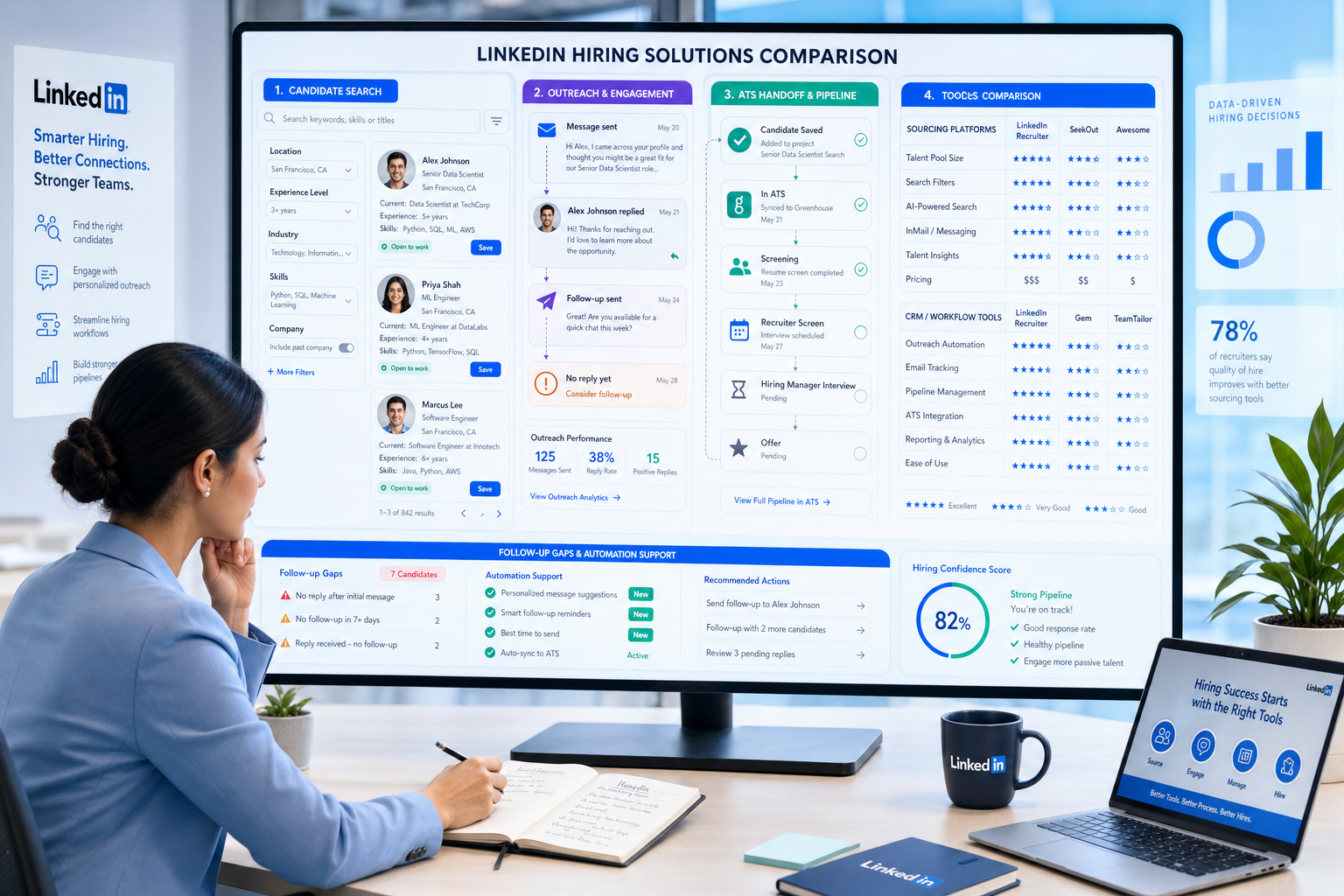
This framework helps headhunters compare linkedin recruiter competitors, fix follow-up gaps, and avoid expensive workflow mismatches.
That distinction matters more than most comparison pages admit. Agency recruiters lose time when replies come in after hours and no one answers. In-house talent teams lose momentum when passive prospects sit untouched while hiring managers keep asking for updates. Small firms feel it in seat cost, duplicated notes, missed callbacks, and the quiet damage that happens when candidates experience fragmented outreach instead of a coherent conversation.
That is why I now think about LinkedIn workflow in layers, not as one giant software swap. In my own testing, StrategyBrain AI Recruiter was most useful when the real problem was repetitive first-touch work: connecting with the right people, handling routine back-and-forth in different time zones, and collecting resumes or contact details from interested candidates before I stepped in for the real evaluation. It did not replace recruiter judgment, and that is exactly the point. The recruiter still decides fit, reviews resumes, and owns the next move.
A useful way to frame this comes from a leadership idea that has become very relevant to recruiting operations: capable teams do better work when people feel supported, trusted, and able to act. In the original context, the argument was about modern leadership under economic pressure and technological change. But the same pattern shows up in hiring. A recruiting lead pairs junior recruiters with senior mentors, asks them to run a market map, shadow outreach, and own a short search sprint, then expects them to respond confidently to prospects, update stakeholders, and keep momentum moving.
The crack appears when entry-level learning has disappeared, communication happens across channels, and nobody has the capacity to coach through every message thread. A recruiter checks one LinkedIn reply, moves to another req, forgets to log a contact detail, then scrambles before a stakeholder check-in because the search pipeline is only half documented. That is the real transition point into evaluating linkedin recruiter alternatives: not just who has more profiles, but which tools help your team build capability, maintain candidate trust, and support a repeatable workflow. That is also where the best alternatives to LinkedIn Recruiter need to be compared by search depth, outreach execution, automation support, and ATS handoff.
Table of Contents
- What makes a credible LinkedIn Recruiter alternative?
- Why capability-building matters in recruiting tech
- Quick comparison table
- The replacement jobs buyers actually care about
- The four categories of linkedin recruiter competitors
- 1. Sourcing platforms
- 2. Talent intelligence tools
- 3. Recruiting CRM and workflow tools
- 4. ATS-connected hiring suites
- Where AI Recruiter fits in a real LinkedIn workflow
- How to evaluate pricing and recruiter seat cost
- Buyer’s guide for recruiting teams
- Common mistakes when comparing competitors
- FAQ
What makes a credible LinkedIn Recruiter alternative?
A credible alternative should be judged against the real reasons teams buy LinkedIn Recruiter in the first place: advanced search filters, access to passive candidates, reliable outreach, some form of prioritization, and a clean path into ATS or CRM workflow. If a platform cannot support those jobs, it is not a true substitute just because it sits somewhere in the recruiting software category.
That is where many comparison pages fail experienced recruiters. They mix sourcing tools, applicant tracking systems, and recruitment workflow platforms as if they replace the same thing. They do not. The useful buying question is simpler and tougher: which system removes the bottleneck without weakening execution quality?
In practice, the best alternatives to LinkedIn Recruiter are often stronger in one narrow area than in broad, all-purpose recruiting. Some improve top-of-funnel search. Others reduce manual follow-up. Others are really better at process control than outbound discovery. Knowing the difference is what separates a smart software decision from another expensive workaround.
Why capability-building matters in recruiting tech
The leadership reference behind this article offers a useful principle: when uncertainty rises, strong performance comes less from command and more from enabling people to act well. In recruiting, that means workflows should help recruiters become more capable, not more dependent on admin recovery.
Three ideas transfer especially well into software evaluation.
- Empowerment: tools should reduce hesitation and make it easy for recruiters to respond, track, and progress candidates with confidence.
- Mentorship structures: systems should make good recruiter behavior visible enough for newer team members to learn from it.
- Closing the capability gap: if entry-level learning has been compressed by automation and remote work, your workflow must create new learning rungs rather than remove them completely.
This is one reason I am cautious with software that promises total replacement thinking. The best recruiting tech usually handles repetitive tasks, preserves communication continuity, and leaves room for human judgment. That is especially true on LinkedIn, where the first message is easy to automate badly and difficult to recover once candidate trust drops.
Practical takeaway: when you compare linkedin recruiter competitors, ask whether the tool merely accelerates output or actually helps recruiters operate more consistently, safely, and capably under pressure.
Quick comparison table: types of LinkedIn Recruiter competitors
| Category | Best For | Search Depth | Outreach Capability | Automation Support | ATS/CRM Fit | Best Team Type |
|---|---|---|---|---|---|---|
| Sourcing platforms | Passive candidate discovery | High | Strong | Moderate | Varies | Agency, executive search, technical sourcing |
| Talent intelligence tools | Market mapping and targeting | High | Moderate | High | Moderate | Enterprise TA, strategic search teams |
| Recruiting CRM/workflow tools | Pipeline control and follow-up | Moderate | Strong | High | Strong | Scaling internal teams, coordinated agency desks |
| ATS-connected hiring suites | End-to-end hiring operations | Moderate | Moderate | High | Core strength | HR-led, inbound-heavy organizations |
The table reflects how most talent teams should compare linkedin recruiter competitors. A sourcing-led team usually cares most about search precision and outreach speed. A talent operations leader often cares more about workflow continuity, stakeholder visibility, and reliable handoff to the system of record.
The replacement jobs buyers actually care about
When recruiting teams evaluate linkedin recruiter alternatives, the conversation usually comes down to four operational tests.
- Can we still find passive candidates efficiently?
- Can we handle outreach and replies without dropping candidate trust?
- Can the workflow sync into our existing process cleanly?
- Can we justify cost against actual recruiter usage?
These are better questions than asking for a universal winner. A tool can have excellent search and still fail because follow-up is messy. Another can have average sourcing reach but win because outreach, reminders, and documentation actually happen. That is why the best alternatives to LinkedIn Recruiter are not always clones. Sometimes the better substitute is the one that repairs execution, not the one that looks most similar in screenshots.
The four categories of linkedin recruiter competitors
Grouping the market by use case is the most honest way to review linkedin recruiter competitors. It avoids the usual mistake of pretending one platform should dominate sourcing, process management, reporting, and recruiter coaching at the same time.
It also mirrors what happens inside real teams. One recruiter is trying to build a shortlist for a difficult role. Another is managing follow-up and candidate nurture. A recruiting manager is trying to coach a junior sourcer while also preparing for a stakeholder update. Those are connected jobs, but they are not identical software needs.
1. Sourcing platforms: best for passive candidate sourcing and outbound outreach
Sourcing platforms are the closest match when your main goal is replacing LinkedIn Recruiter’s search and outreach workflow. These are often the strongest linkedin recruiter alternatives for agency recruiters, startup talent leads, and specialist sourcers who spend most of their week in outbound search.
In this category, experienced buyers usually compare:
- Profile and contact coverage
- Filtering depth
- Outreach tools
- Contact verification or enrichment
- Export and sync options
- How much manual tracking still falls back on the recruiter
The last point matters more than many demos suggest. A sourcing tool can look powerful but still leave the recruiter doing all the repetitive conversational work. If that creates inconsistent follow-up, it also weakens coaching, because managers cannot easily see what happened between first touch and candidate interest.
For headhunters and search consultants, sourcing platforms are often the right first layer. But they are usually strongest at discovery, not downstream process discipline. If your problem is scattered handoff, incomplete notes, or candidates slipping between touchpoints, discovery alone will not fix it.
When a sourcing platform is the right choice
- You fill hard-to-find roles with a high passive candidate mix.
- Your current ATS is usable, but top-of-funnel search is weak.
- You want deeper filters and better shortlist building.
- You measure success primarily by sourced pipeline quality.
2. Talent intelligence tools: best for market mapping, targeting, and strategic search
Talent intelligence tools sit slightly upstream from the classic recruiter seat. They are useful when the challenge is less about opening a messaging window and more about understanding where talent sits, how markets are shifting, and where effort should go first.
These tools can be strong linkedin recruiter competitors for enterprise teams because they add targeting context. They help answer questions like:
- Which companies employ the talent we need?
- Where is the market concentrated by location or function?
- Which segments should recruiters approach first?
- Where are we wasting outreach on low-probability targets?
This category connects well to the capability-gap theme from the reference material. When newer recruiters lack years of market pattern recognition, structured intelligence can shorten the ramp. It does not replace mentorship, but it can make coaching more concrete by showing why one target list is stronger than another.
What it usually does not do by itself is create complete workflow discipline. So if your larger issue is candidate progression, stakeholder alignment, or documentation, talent intelligence may need to sit alongside a workflow system rather than replace one.
When talent intelligence tools are the right choice
- You hire repeatedly into the same specialist markets.
- You need better company targeting and talent mapping.
- You want more strategic search planning before outreach starts.
- Your bottleneck is prioritization, not applicant processing.
3. Recruiting CRM and workflow tools: best for pipeline control and team coordination
Recruiting CRM and workflow tools become valuable when the core issue is not only finding people but keeping the process coherent once they engage. In many organizations, this is where linkedin recruiter alternatives start to overlap with day-to-day execution reality.
These tools often help with:
- Candidate relationship history
- Outreach sequences and reminders
- Ownership visibility across recruiters
- Pipeline progression
- Clean handoff into ATS stages
This category is often underrated because buyers think they are shopping for search. But if the real loss sits in inconsistent follow-up, duplicated notes, or missed stakeholder updates, a workflow-centered platform can produce more practical value than a slightly larger profile database.
It also supports better mentorship. One of the strongest lessons from the reference article is that growth should not be left to chance. The same is true in recruiting operations. If good recruiter habits are invisible, junior staff cannot learn them. Workflow systems make behavior more coachable because activity, timing, and progression are easier to review.
When a recruiting CRM or workflow tool is the right choice
- You have candidate flow, but the pipeline feels messy.
- You need cleaner recruiter collaboration.
- You want reminders and communication history in one place.
- Your ATS works, but recruiter execution around it is inconsistent.
4. ATS-connected hiring suites: best for inbound applicants and end-to-end hiring infrastructure
ATS-connected suites show up in search results for linkedin recruiter competitors because many buyers are not seeking a feature-for-feature copy of LinkedIn Recruiter. They are trying to simplify the broader hiring stack.
If your organization needs requisition control, interview workflow, scorecards, approvals, and reporting, this category deserves serious attention. It is usually best for HR-led or high-volume internal hiring teams where consistency matters as much as search reach.
Still, an ATS rarely replaces outbound sourcing well on its own. If your recruiters rely on direct outreach to passive candidates, you may still need a sourcing or LinkedIn engagement layer. In other words, some ATS products replace the process around Recruiter, not the search experience itself.
When an ATS-connected suite is the right choice
- You need one shared system for recruiters, hiring managers, and HR.
- Your inbound applicant volume is high.
- You care about reporting, approvals, and process consistency.
- You want to reduce fragmented tools across the hiring team.
Where AI Recruiter fits in a real LinkedIn workflow
Because this topic is specifically about LinkedIn usage, it is worth separating sourcing software from LinkedIn conversation execution. In my own workflow, AI Recruiter was most useful when the problem was not who to search for, but how to keep first-touch momentum moving without asking recruiters to be online every time a candidate replied.
I used it as a support layer for repetitive communication rather than as a replacement for recruiting judgment. It could automatically connect with candidates inside a defined search scope, continue the initial exchange, answer routine role questions, and collect resumes or contact details from genuinely interested people. That was especially helpful when responses came in after hours or from candidates who preferred communication in their native language. The handoff stayed clear: once someone showed interest, I reviewed the resume, checked fit, and decided whether to move them into interview consideration.
What I liked most was not the promise of automation by itself. It was the operational relief. Junior recruiters did not need to manually babysit every low-complexity exchange, and senior recruiters could spend more time on calibration, client updates, and final assessment. That maps neatly to the capability-building theme from the reference piece: better systems should create more room for coaching and higher-value work, not eliminate human accountability.
If you want to understand the setup logic, the product walkthrough on how AI Recruiter works on LinkedIn is the most relevant starting point. If your issue is after-hours engagement or scaling initial outreach across multiple searches, that is where I see the clearest fit.
How to evaluate pricing and recruiter seat cost
Pricing transparency is one of the biggest reasons buyers start looking for linkedin recruiter alternatives. But low subscription cost is not the same as low operating cost.
A practical evaluation should cover:
- Which workflow is being replaced? Search only, or search plus outreach and admin?
- How many seats will truly be active?
- How much manual logging still remains?
- Does the tool reduce after-hours follow-up burden?
- Can a recruiter manager coach from the data the system captures?
That last point rarely appears in pricing pages, but it matters. If a tool makes activity more visible and consistent, it can reduce the hidden cost of supervision and recovery. For small recruiting firms and lean in-house teams, that operational effect can matter as much as the software invoice.
| Pricing Question | Why It Matters | Who Cares Most |
|---|---|---|
| Is cost seat-based? | Affects scale economics | Agency owners, TA leaders |
| Are outreach tools included? | Changes total replacement value | Sourcers, recruiters |
| Is automation part of the package? | Reduces repetitive manual work | Lean teams |
| Is ATS sync standard? | Prevents duplicate entry | Recruiting ops |
| Can recruiters share visibility without full heavy-use seats? | Prevents overbuying | Managers, coordinators |
Buyer’s guide: how recruiting teams should choose the best fit
The safest way to choose among linkedin recruiter alternatives is to evaluate by hiring model and team maturity.
For outbound-heavy search teams
Prioritize search depth, contact reach, and outreach support. If follow-up consistency is also a problem, add a communication or workflow layer rather than expecting search alone to solve it.
For small agencies and solo headhunters
Look hard at the time drain between connection and qualification. If you are losing evenings to repetitive candidate messaging, an AI-supported LinkedIn communication layer can be more valuable than another analytics dashboard.
For enterprise TA teams
Balance market intelligence with process visibility. Strategic mapping matters, but so does making recruiter behavior coachable across a team.
For HR-led or operations-led groups
Choose systems that improve process discipline and stakeholder clarity. Strong reporting and structured handoffs usually matter more than pure sourcing volume.
For teams training newer recruiters
Use the same test I would borrow from the leadership article: does the system help people become more capable? If it removes every learning step without improving visibility, you may gain speed but lose team development.
Common mistakes when comparing LinkedIn Recruiter competitors
- Comparing tools without naming the job to be replaced.
- Overvaluing profile count and undervaluing follow-up quality.
- Ignoring whether the workflow helps train newer recruiters.
- Assuming automation should replace judgment.
- Choosing an ATS when the real gap is passive sourcing.
- Choosing a sourcing tool when the real gap is team execution.
These mistakes usually happen when software is treated as a feature checklist instead of an operating model. The better test is whether the system helps your team search, communicate, decide, and learn with less friction.
FAQ
What is the best alternative to LinkedIn Recruiter?
It depends on the workflow you are trying to replace. For passive sourcing, sourcing platforms and talent intelligence tools are often strongest. For follow-up and coordination, CRM-style workflow tools can be better. For end-to-end hiring operations, an ATS-connected suite may fit best.
Are there cheaper linkedin recruiter competitors?
Often yes, but the smart comparison is total workflow value, not headline price. A cheaper tool that creates more admin can still cost more in recruiter time.
Can LinkedIn automation help without replacing the recruiter?
Yes. Used carefully, automation can handle repetitive first-touch communication, after-hours replies, and resume collection, while the recruiter keeps control of qualification, judgment, and next steps.
When should I look at linkedin recruiter alternatives instead of just adding seats?
When your issue is no longer only access. If recruiters are struggling with follow-up load, inconsistent documentation, or weak workflow handoff, adding seats may increase cost without fixing execution.
What should recruiters compare first when reviewing the best alternatives to LinkedIn Recruiter?
Start with search depth, outreach support, automation for repetitive work, integration fit, and actual team usage. Then ask which option improves not just output, but operating consistency.
Final thoughts
The market for linkedin recruiter alternatives is broad because the search term hides different buying motives. Some teams want cheaper access to passive candidates. Others want stronger workflow. Others want help closing the gap between outreach volume and thoughtful recruiter follow-through.
The most useful lesson from the reference leadership piece is that capability compounds when people are supported by the right structure. Recruiting software should do the same. The strongest linkedin recruiter competitors are not the ones that promise to do everything. They are the ones that help your recruiters search well, communicate consistently, and keep enough judgment in the loop to make better hiring decisions over time.