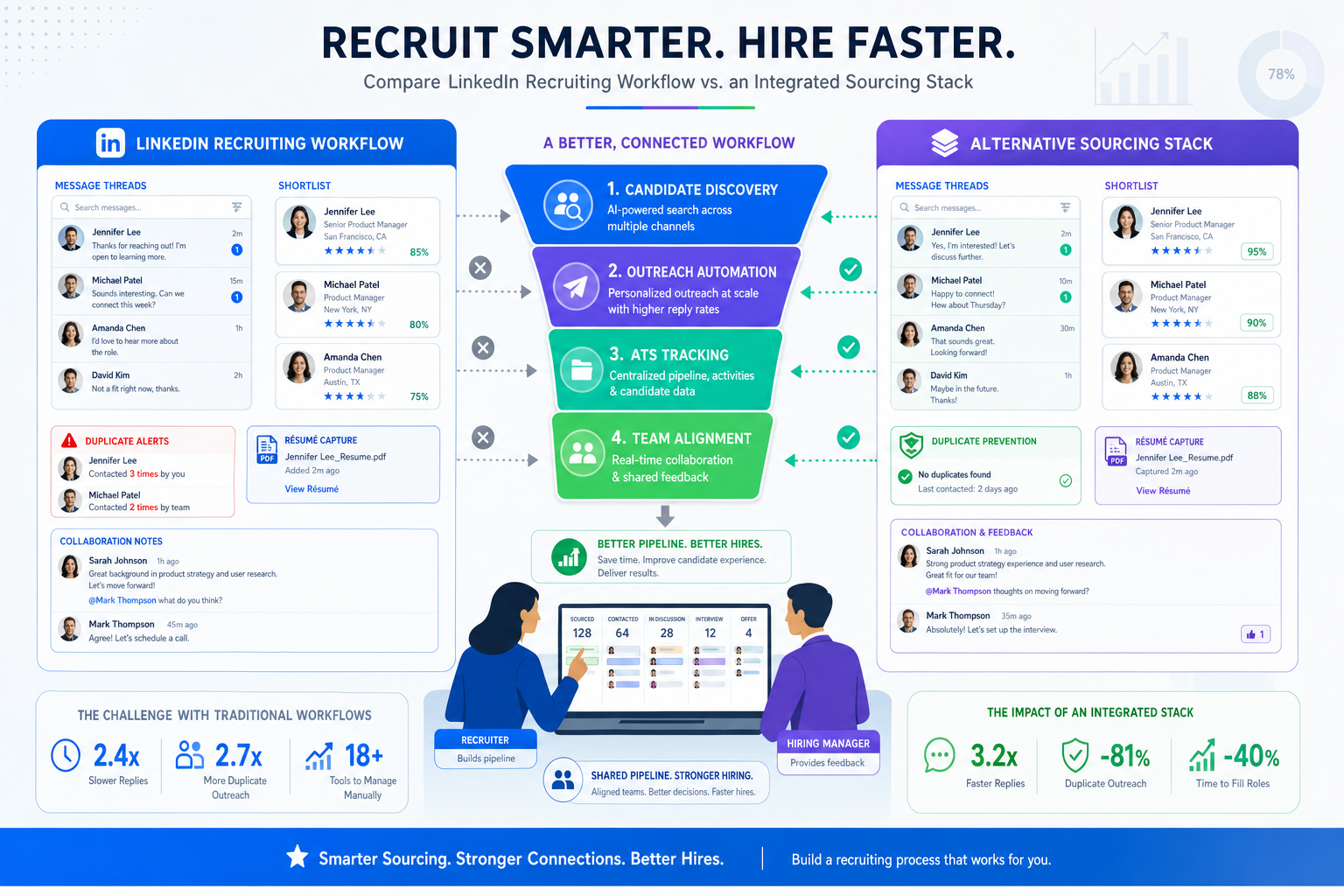
When sourcing gets messy, this article helps headhunters judge alternatives to LinkedIn for talent sourcing to avoid duplicate outreach, slow feedback, and re-sourcing known talent.
That sounds simple until a live search turns messy. A boutique agency owner wants faster shortlist delivery, an individual recruiter is chasing replies after hours, and an in-house talent lead is trying to keep hiring managers aligned on priorities. When sourcing, outreach, and candidate tracking sit in different places, the losses are not only time-based. You get duplicate outreach, slower feedback, weaker recruiter credibility with clients or hiring managers, and expensive re-sourcing of people your team already touched.
In my own workflow, I have used StrategyBrain AI Recruiter to handle the repetitive part of LinkedIn outreach when response timing and message continuity were the real bottleneck. What helped most was not some fantasy of full automation, but the practical support: automated candidate introductions, always-on multilingual replies, and résumé/contact collection for interested prospects. The recruiter still has to review the résumé, judge fit, and decide whether to move someone forward, but the tool can remove a lot of the low-value chasing that slows a desk down.
The better framing came to me from a management lesson that has nothing to do with software demos. Strong teams do not start with a giant database; they start with a clear vision, the right people in the right roles, and accountability tied to outcomes. In recruiting, that same logic shows up when a hiring team stops asking, “What tool gives us more profiles?” and starts asking, “What are we actually trying to build, who owns each part of the workflow, and where does the process break?”
Once you see sourcing through that lens, the search for the best alternatives to LinkedIn recruiter becomes much more practical. You are not shopping for a clone. You are deciding how candidate discovery, recruiter outreach, stakeholder alignment, and internal mobility or promotion pathways should work together. That is why the best alternatives to LinkedIn for recruiting 2025 often come from different categories, and why a sourcing decision can fail if the broader team structure is wrong.
Start with Team Design, Not Tool Shopping
One of the most useful ideas in recruiting operations is that sourcing tools only work well when the hiring team already knows what success should look like. In other words, before you compare vendors, define the mission.
That means four things.
1. Set the hiring vision
Your recruiters need to know what they are ultimately trying to deliver. Is the priority faster pipeline creation, stronger passive candidate engagement, more accurate mapping of a niche market, or cleaner collaboration with hiring managers? If the team does not agree on that, even strong tools will look disappointing because each user is solving a different problem.
2. Put the right people in the right recruiting roles
Some teams need a true sourcer-recruiter split. Others need full-desk recruiters who can search, contact, qualify, and move candidates through a process themselves. A platform that works for a sourcing pod may be a poor fit for a lean internal TA team. This is a big reason many evaluations of alternatives to LinkedIn for talent sourcing go wrong: buyers compare software before they clarify who is doing what.
3. Build mentorship and communication into the workflow
The original management principle is simple: people perform better in a supportive environment where ideas and concerns can be raised early. In recruiting terms, that means shared candidate notes, visible stage history, cleaner handoffs, and a way for junior recruiters to learn what “good” looks like. If a platform improves search but weakens team communication, it may lower output over time.
4. Reward internal wins and candidate rediscovery
Promotion from within matters in team building, and there is a close hiring-tech equivalent: rediscover talent you already know before paying to source from scratch again. The best stacks make past applicants, silver medalists, and previously engaged passive candidates easier to find and reactivate.
Key insight: A sourcing platform does not rescue an unclear recruiting model. It performs best when your hiring vision, ownership, feedback loops, and rediscovery process are already defined.
What Makes a Real LinkedIn Recruiter Alternative
A credible alternative needs to solve a workflow problem that materially affects recruiter output. In practice, I evaluate tools against five criteria.
- Clarity of data value: Is the advantage broader coverage, stronger enrichment, niche specialization, or better matching logic?
- Search precision: Can a recruiter move from intake notes to a workable shortlist without endless filtering?
- Outreach execution: Can the team consistently contact passive candidates, manage replies, and avoid dropped conversations?
- Team coordination: Does the system support shared accountability across recruiters, sourcers, and hiring managers?
- Process fit: Does it work cleanly with your CRM or ATS so the team can actually act on what it finds?
This is why the market for the best alternatives to LinkedIn recruiter is so fragmented. Some buyers need better discovery. Some need messaging support. Others mainly need team-level process control.
Best LinkedIn Recruiter Alternatives by Category
When recruiters search for the best alternatives to LinkedIn for recruiting 2025, they are usually comparing tools from several categories at once. That creates confusion, because these categories solve different parts of the job.
1. Talent sourcing and talent intelligence platforms
These are the closest substitutes when your real issue is candidate discovery. They tend to focus on search depth, matching logic, labor-market signals, and shortlist creation.
- Best for: sourcing-heavy teams, technical hiring, executive mapping
- Watch for: relevance quality, profile overlap, market coverage, and recruiter learning curve
- Operator tip: run the same three live roles in every trial, not vendor-prepared examples
2. Recruiting CRM and engagement workflow platforms
These are often better when recruiters can already find people but struggle to engage them consistently. The value is in sequences, nurture logic, visibility into outreach, and handoff continuity.
- Best for: outbound-heavy teams and agencies
- Watch for: reply tracking, recruiter adoption, campaign control, and duplicate prevention
- Operator tip: judge whether your average recruiter actually becomes more disciplined, not whether the feature list looks advanced
3. ATS-led recruiting suites
These matter when sourcing is only one piece of a broader execution problem. They are less about replacing profile search directly and more about keeping the whole team aligned from source to offer.
- Best for: lean TA teams, process-heavy organizations, multi-stakeholder hiring
- Watch for: candidate history, reporting, approvals, hiring manager visibility, and searchability of prior talent
- Operator tip: separate sourcing power from workflow control during evaluation
4. LinkedIn-focused automation support
Some teams do not want to abandon LinkedIn at all. They want to reduce the manual labor around it. That is where AI Recruiter fits operationally. It is not a database alternative in the classic sense; it is a workflow support layer for repetitive LinkedIn activity, especially outreach, multilingual candidate messaging, and resume capture from interested candidates. For headhunters working across time zones or trying to maintain response speed without being online all night, that can be highly practical.
I would still stress the same boundary I mentioned earlier: automation can surface and organize interest, but recruiters remain responsible for final qualification, résumé review, and next-step decisions. That division of labor is exactly what makes this type of tool useful rather than risky.
Comparison Table
| Category | Best For | Main Strength | Main Trade-Off | Best Fit |
|---|---|---|---|---|
| Talent sourcing | New candidate discovery | Search depth and shortlist building | May need separate outreach workflow | In-house sourcing teams, exec search |
| Talent intelligence | Precision hiring and market mapping | Signal-based targeting | Can require more enablement | Technical and strategic hiring teams |
| Recruiting CRM | Passive candidate engagement | Outreach consistency | Discovery may be secondary | Agencies and outbound-heavy teams |
| ATS suite | Process consolidation | Shared pipeline visibility | Not always strongest at sourcing | Lean TA teams, enterprise operations |
| LinkedIn automation support | Manual outreach reduction | Reply handling and interest capture | Still depends on recruiter judgment | Headhunters, global sourcing, after-hours workflows |
This is usually the moment where stakeholder conversations improve. Once each option is tied to a role, a process, and an expected outcome, the list of best alternatives to LinkedIn recruiter becomes easier to narrow.
How I Use AI Recruiter in Practice
My own experience with StrategyBrain AI Recruiter has been most useful in high-friction LinkedIn workflows, especially when candidate replies arrive late, international prospects want to communicate in their own language, or the desk is losing time to repetitive first-touch conversations. I did not use it as a replacement for recruiter judgment. I used it to keep momentum going when human follow-up would otherwise stall.
A typical scenario is this: I define the role, candidate search criteria, and the key facts the recruiter would normally repeat in early outreach. The system then handles connection attempts, introduces the opportunity, answers routine questions, and checks whether the person wants to continue. If the candidate is interested, it can collect a résumé and contact details. I then step in to evaluate the profile, assess fit, and decide whether to schedule screening or move on.
That division matters. It protects quality while still removing a lot of the repetitive work that makes LinkedIn sourcing feel heavier than it should. If you want to explore how the workflow is set up, the vendor’s setup overview and conversation examples are useful for understanding the practical handoff between automation and recruiter review.
For agency recruiters and independent headhunters, the most relevant value is usually consistency and coverage. For corporate teams, it is often response continuity without increasing headcount. Either way, this kind of support tends to help when your problem is not discovering names, but keeping outreach active and organized long enough to convert interest into real conversations.
How to Evaluate by Use Case
For small recruiting teams
Small teams usually need fewer tabs, faster rediscovery, and less admin overhead. A platform that combines reasonable sourcing support with workable tracking often beats a more sophisticated point solution that creates extra handoffs.
Use the team-building lens here: if one recruiter has to carry the vision, execute sourcing, keep notes clean, and maintain hiring-manager trust, simplicity matters more than a flashy demo.
For staffing agencies and headhunters
Agency desks care about speed, ownership, and contactability. The right choice often depends on whether your bottleneck is discovery or response management. If outreach volume is high, verified contact data and disciplined messaging workflows may matter more than another search interface.
This is also where LinkedIn automation support can make sense as a complement. If your recruiters already know how to source but are wasting hours on repetitive first-touch messaging, AI Recruiter can sit beside the desk workflow rather than replacing the recruiter’s core judgment.
For enterprise hiring teams
Larger organizations need governance, consistency, permissions, reporting, and shared visibility. Their strongest alternative is often a layered stack rather than a single replacement. In that environment, the real question becomes whether each tool strengthens the larger hiring vision or fragments it.
That ties directly back to the opening management principle: a team performs better when people understand the goal, their role, and the accountability attached to it. Your software stack should reinforce that, not fight it.
Where an ATS Fits
Many teams think they have a sourcing problem when they really have a rediscovery and handoff problem. That is why ATS design belongs in this discussion.
An ATS matters because it helps with:
- Candidate rediscovery: search your existing applicants and prior finalists before sourcing from zero again
- Team accountability: make ownership visible across recruiters, coordinators, and hiring managers
- Feedback loops: capture stage movement and decision history in one place
- Internal progression: support mobility and promotion from within, not just external sourcing
The last point is easy to overlook. In the same way a strong leader promotes internal talent to reinforce team goals, a strong recruiting system should make internal candidates and known talent visible. Otherwise, the organization keeps paying to look outside while missing people already connected to the business.
Common Selection Mistakes
Confusing a bigger database with a better recruiting system
More profiles do not automatically improve recruiter output. Without good targeting and execution, they just create more review work.
Ignoring team structure
If your roles are unclear, no platform will fix that. Decide whether your model relies on dedicated sourcers, full-desk recruiters, or shared pods before you buy.
Overlooking mentoring and adoption
A system that only power users can navigate usually underperforms. The best stack should help average recruiters improve, not only impress senior operators.
Separating outreach from decision-making
Automation can help with repetitive communication, but final qualification still needs human judgment. Teams that forget this either underuse automation or trust it too far.
Forgetting internal talent and prior pipeline history
If your process does not support rediscovery, you will keep rebuilding candidate lists instead of compounding your team’s recruiting knowledge.
FAQ
What is the best LinkedIn Recruiter alternative?
The best answer depends on your main bottleneck. If you need better discovery, look at talent sourcing or intelligence platforms. If you need stronger outreach execution, a CRM or LinkedIn automation support layer may fit better. If your team loses momentum after sourcing, the better answer may include your ATS.
Is there a true one-for-one replacement for LinkedIn Recruiter?
Usually not. Most teams either complement LinkedIn with another tool or replace only part of the workflow. That is why alternatives to LinkedIn for talent sourcing are best evaluated by use case, not by clone logic.
What are the best alternatives to LinkedIn for recruiting 2025 for agencies?
Agencies typically benefit most from combinations that support fast search, reliable outreach, and candidate ownership. If your desk is reply-heavy and time-zone stretched, workflow support around LinkedIn can be just as valuable as an entirely separate sourcing database.
What are the best alternatives to LinkedIn recruiter for small teams?
Small teams usually need tools that reduce switching, support rediscovery, and keep recruiter accountability visible. The right stack is often simpler than the market suggests.
Can AI-assisted LinkedIn workflow tools help without replacing recruiters?
Yes. Used well, they can automate repetitive first-touch communication, keep candidate replies moving, and collect key information, while recruiters retain responsibility for qualification and hiring decisions.
Conclusion
The market for alternatives to LinkedIn for talent sourcing makes more sense when you stop treating it as a search for a clone and start treating it as a team design question. Define the hiring vision, clarify who owns each part of the work, support communication and mentorship, and make sure known talent can be rediscovered.
From there, the best alternatives to LinkedIn recruiter become easier to evaluate. Some teams need better search. Others need better engagement. Others need LinkedIn workflow support such as StrategyBrain AI Recruiter to reduce repetitive outreach without giving up recruiter control. The right decision is the one that helps your recruiting team operate like a real team, not just a collection of disconnected tools.