When evaluating linkedin recruiter costs, recruiters can avoid overbuying and candidate-experience damage by judging workflow fit, follow-up load, and true team needs.
That sounds obvious until a live search turns messy. A solo headhunter can waste hours chasing late LinkedIn replies, an agency owner can burn margin on licenses that do not match actual desk activity, and an in-house TA lead can damage employer brand when outreach, follow-up, and handoff break down. In recruiting, cost mistakes are rarely just financial. They show up in missed responses, thin pipelines, duplicate work, and candidates who feel processed rather than served.
That is one reason I have become more practical about where LinkedIn time really goes. In my own sourcing workflow, StrategyBrain AI Recruiter has been useful for the repetitive parts that usually create those gaps: first-contact outreach, after-hours candidate replies, and collecting résumés or contact details from interested prospects. What matters is that the recruiter still owns the final judgment on fit, résumé review, and next-step decisions. Used that way, AI Recruiter supports the process instead of pretending to replace recruiter judgment.
A useful way to frame the pricing question comes from a truth many recruiters forget once they get buried in seats, InMails, and dashboards: the person on the other side is also your client. That candidate did not show up to admire your sourcing stack or your agency story. They showed up for a role, a response, and a fair process. When recruiters lose sight of that, they drift into broad, volume-heavy outreach, pile up too many résumés, and end up replying only to the few profiles they can move fastest.
That candidate-first lens is exactly why direct pricing inquiries need more than a number. If you are asking how much does LinkedIn Recruiter cost or comparing the linkedin recruiter lite cost, the real issue is whether the subscription helps you run a tighter, more human search without creating more admin drag. The sections below break down the public pricing signals, the quote-based reality of full Recruiter, and the operating criteria experienced recruiters actually use before they buy.
- Direct answer: how much does LinkedIn Recruiter cost?
- Why candidate experience belongs in the cost discussion
- LinkedIn Recruiter Lite cost vs full Recruiter
- How recruiters manage LinkedIn workload in practice
- What affects actual LinkedIn Recruiter costs?
- Which option fits your hiring team?
- How to evaluate cost beyond the subscription price
- FAQ
Direct answer: how much does LinkedIn Recruiter cost?
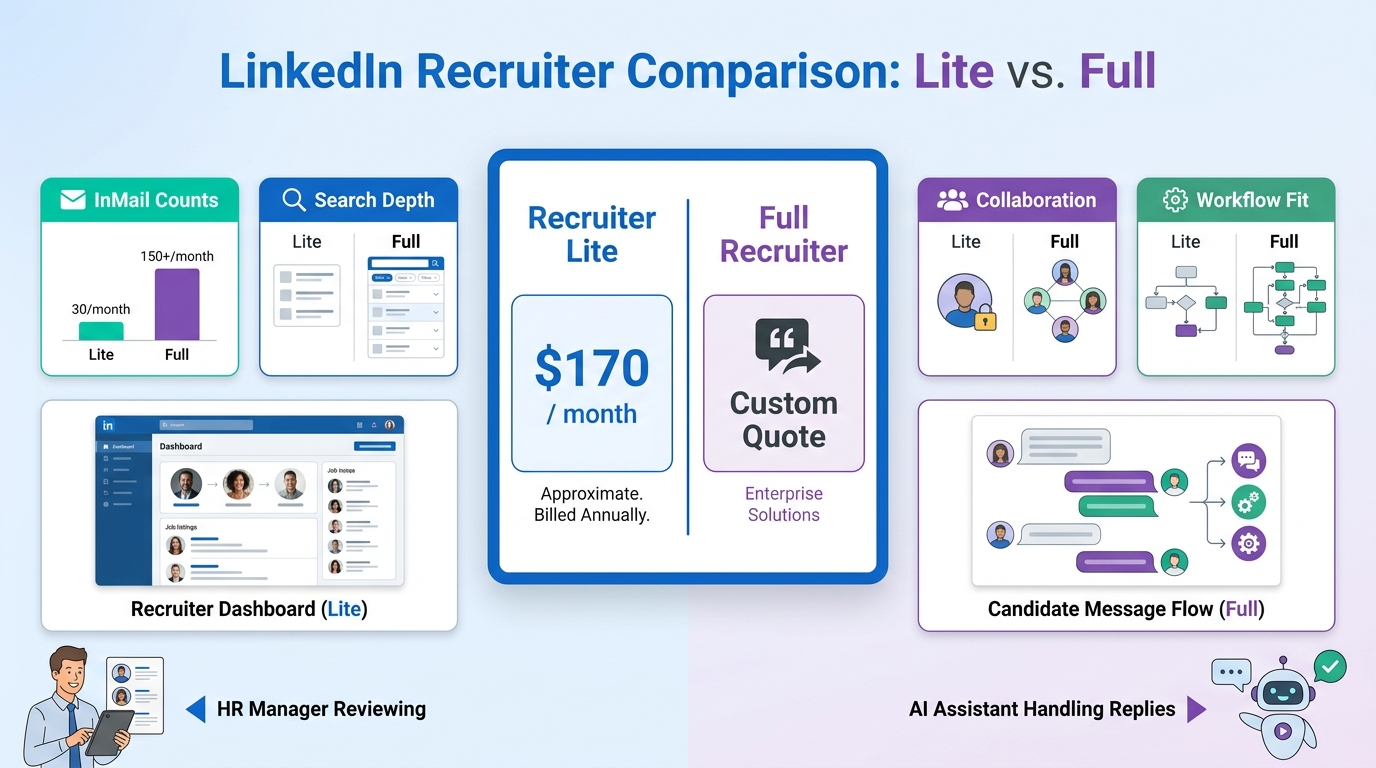
If you want the clearest public answer, Recruiter Lite is the easiest plan to benchmark. Publicly cited figures commonly place the linkedin recruiter lite cost at about $170 per month for one seat, or roughly $1,680 to $2,040 per year depending on billing structure and source framing.
Full LinkedIn Recruiter is a different purchase. Public-facing materials usually emphasize capabilities rather than a hard list price, so teams asking how much does LinkedIn Recruiter cost often end up in a quote process. You will see third-party estimates online, but they should be treated as directional only, not as confirmed list pricing.
- Recruiter Lite is the most visible public price point.
- Full Recruiter is usually sold through a custom quote.
- Actual value depends on hiring volume, workflow needs, and how cleanly recruiters can move from sourcing to follow-up.
Practical takeaway: For occasional sourcing, Lite gives you a public benchmark. For active recruiting teams, the meaningful question is not only price but whether the tool supports candidate response quality, recruiter follow-through, and team coordination.
Why candidate experience belongs in the cost discussion
The reference point many pricing articles miss is that recruiting software is not only bought for recruiters. It affects the experience of candidates who trust your process. When a team takes a broad, shotgun approach to outreach, the hidden cost appears fast: too many conversations to manage, too little specific follow-up, and too many people left without a useful response.
In my experience, this is where operators misread linkedin recruiter costs. A cheaper or lighter license can still become expensive if it encourages disorganized outreach or leaves recruiters drowning in manual follow-up. A more robust setup can also become wasteful if the team never needed that scale in the first place. The right pricing decision sits in the middle: enough capability to run a focused search, but not so much complexity that the tool outgrows the real work.
That is also why disciplined recruiters keep the search tight. The more specific the brief, the easier it is to target the right people, avoid stringing candidates along, and protect the credibility of the recruiter behind the message. Cost, in other words, is tied to precision.
LinkedIn Recruiter Lite cost vs full Recruiter
The most practical comparison is not just features on a sales grid. It is public pricing visibility versus operational depth. Lite is generally the easier starting point for solo or occasional use. Full Recruiter is more often suited to teams that need scale, collaboration, and a heavier outbound motion.
| Area | Recruiter Lite | Full Recruiter |
|---|---|---|
| Pricing visibility | Publicly cited more often | Usually quote-based |
| Typical public cost references | About $170/month or about $1,680 to $2,040/year | Varies; third-party estimates exist but are not official list prices |
| Best fit | Occasional hiring, solo recruiters, lighter sourcing needs | Larger-scale recruiting, team workflows, higher sourcing volume |
| Monthly InMail signal | 30 InMails per month | 150 InMails per month |
| Search capability | More limited than full Recruiter | Broader search filters and access scope |
| Collaboration | More limited | Stronger team collaboration support |
| Integrations | More limited | Better fit for broader recruiting workflows |
If someone asks what really separates the linkedin recruiter lite cost from full Recruiter pricing, the answer is usually this: Lite supports individual sourcing; full Recruiter is better positioned for coordinated recruiting operations. That difference matters once multiple recruiters, hiring managers, or offices need visibility into the same talent activity.
When Lite usually makes sense
- A solo recruiter managing a modest number of searches
- An agency desk testing LinkedIn-heavy outreach before scaling
- An HR lead who hires periodically rather than continuously
- A hiring manager doing occasional direct sourcing
When full Recruiter usually makes more sense
- A talent acquisition team running multiple open roles at once
- A recruiting function with regular outbound sourcing requirements
- A business that needs collaboration across recruiters or stakeholders
- A team that needs more search depth and higher outreach capacity
How recruiters manage LinkedIn workload in practice
Once the cost discussion gets real, most recruiters are no longer comparing only LinkedIn plan tiers. They are comparing how the work actually gets done. In practice, that usually means some mix of LinkedIn’s own products, outreach automation tools, and candidate relationship workflows.
Three names regularly come up in U.S. recruiting teams: LinkedIn Recruiter, LinkedIn Recruiter Lite, and Gem. The first two are the obvious platform-native options. Gem is widely used as a sourcing and CRM layer for outreach tracking and follow-up discipline. Each has a different strength, and each creates a different cost pattern.
| Tool | Use experience | Likely value | Cost pattern | Best fit | Works with StrategyBrain AI Recruiter? |
|---|---|---|---|---|---|
| LinkedIn Recruiter Lite | Simple starting point for one user | Good for lighter direct sourcing | Publicly benchmarked around $170/month | Solo recruiters, small teams | Yes, for handling repetitive message flow around LinkedIn activity |
| LinkedIn Recruiter | Broader search and team workflow depth | Stronger for scale and collaboration | Usually quote-based | Active TA teams, larger recruiting functions | Yes, where recruiters want support with first-touch and response handling |
| Gem | Useful for outreach organization and follow-up tracking | Helpful for process discipline | Custom pricing in most cases | Teams building structured outbound motion | Can complement AI-assisted LinkedIn messaging if the team separates sourcing and workflow layers |
I would not treat those as interchangeable. LinkedIn Recruiter gives access and search power. Gem is often about orchestration and follow-up structure. In my own testing, StrategyBrain AI Recruiter has been most relevant in the part of the process recruiters routinely underestimate: maintaining timely, personalized, ongoing LinkedIn conversations without forcing a human recruiter to be online at every reply window. It can connect with candidates in defined search criteria, respond in real time, and gather résumés or contact details from interested people, while the recruiter still decides who actually moves forward.
That matters in the exact scenario raised earlier: when a recruiter wants to keep the search narrow and respectful rather than blasting a market and then neglecting half the responses. I have found that when outreach volume rises after business hours or across time zones, AI Recruiter is especially helpful because it keeps the conversation moving without turning the recruiter into a 24/7 message desk. It is not a substitute for search judgment or candidate assessment. It is a support layer for the repetitive LinkedIn work that otherwise creates candidate experience problems.
What affects actual LinkedIn Recruiter costs?
When people search linkedin recruiter costs, they often expect a universal number. In reality, final spend depends on commercial variables and on how your team recruits.
1. Number of seats
Seat count is the first obvious factor. One license may be enough for a founder or one recruiter. Once multiple recruiters need access, the cost equation changes quickly, and collaboration needs become harder to ignore.
2. Monthly vs annual structure
Billing format matters, especially when you compare public references for Lite. A monthly number may look straightforward, while annual commitments can shift the effective per-seat math. That is why price comparisons online can look inconsistent even when they are talking about the same product family.
3. Geography and hiring footprint
A local hiring team may evaluate the tool very differently from a cross-border recruiting function. Market coverage, talent scarcity, and time-zone realities can all influence how much value the team gets from LinkedIn sourcing access.
4. Product scope and commercial packaging
Full Recruiter discussions are rarely just about a base subscription. Once the conversation includes multiple users, broader access, or team workflow requirements, the purchase behaves more like a scoped commercial deal than a self-serve subscription.
5. Hiring volume and message management
This is the factor too many buyers underweight. If your team fills only a few roles each quarter, the public Lite benchmark may be enough. If your recruiters run a steady outbound pipeline, then response handling, follow-up consistency, and recruiter availability start to matter as much as access itself. That is where support tools can change the economics of a LinkedIn seat.
For example, if a recruiter spends hours every evening replying to candidate messages, clarifying role basics, and asking interested people for résumés, the subscription cost is only one part of the picture. In that kind of workflow, support from StrategyBrain AI Recruiter can reduce the repetitive LinkedIn burden while keeping the recruiter in charge of final selection. That does not change the LinkedIn invoice itself, but it can change whether the license is being used efficiently.
Which option fits your hiring team?
The better buying question is not only how much does LinkedIn Recruiter cost. It is what kind of recruiting motion are you actually running?
Solo recruiter or occasional hiring team
If your workload is lighter or more periodic, Recruiter Lite is usually the first plan to evaluate. The public linkedin recruiter lite cost is easier to benchmark, and the lower complexity often fits a smaller operating reality.
This is also the group most likely to overbuy. If you are not running a high-volume outbound desk, paying for enterprise-style capacity may not improve your results. In many cases, a disciplined search brief plus tighter follow-up habits matter more than more seats or more complexity.
Growing TA team with active sourcing needs
If recruiters are filling multiple roles at once, Lite-only thinking can become shortsighted. Full Recruiter may justify a quote conversation because the value sits in broader search scope, team collaboration, and heavier sourcing support.
At this stage, candidate experience usually becomes a leadership issue. A team that sources aggressively but responds poorly creates friction with both candidates and hiring managers. If that is happening, review not only the LinkedIn plan but the workflow around it.
Agency or search environment
Agency recruiters often care about speed, outreach volume, and the ability to keep conversations warm across many open searches. Lite may work for niche or low-volume desks, but high-activity agency teams usually need to look harder at process capacity. In these environments, keeping outreach specific and follow-up timely protects both brand and billings.
How to evaluate cost beyond the subscription price
Experienced recruiting leaders rarely approve a sourcing tool on invoice amount alone. They ask whether the tool helps the team stay focused, specific, and responsive.
- Start with role volume. Map how many active searches each recruiter actually runs.
- Define the search style. If your process depends on narrow, high-fit sourcing, prioritize workflow discipline over raw reach.
- Check follow-up capacity. Do recruiters have enough time to answer replies, clarify role details, and collect candidate information consistently?
- Separate access from execution. A LinkedIn seat gives search access; it does not automatically solve message management or candidate care.
- Treat third-party estimates carefully. For full Recruiter, validate through a direct quote process rather than relying on unofficial pricing pages.
- Protect the candidate side of the process. If the workflow encourages broad outreach but weak follow-up, the true cost is higher than the subscription suggests.
Working rule: Buy the smallest LinkedIn setup that still lets your team run a focused, responsive process. Upgrade when workflow demands prove the need, not when feature grids make more capacity look tempting.
FAQ
Is LinkedIn Recruiter worth the cost?
It can be, but only when the subscription matches your hiring volume and process. For occasional sourcing, Lite may be enough. For active teams, the value comes from search depth, outreach capacity, and whether the workflow around the tool is strong enough to protect candidate experience.
Is there a monthly option for LinkedIn Recruiter?
Public discussions most commonly reference a monthly framing for Recruiter Lite at about $170 per month for one seat. Full Recruiter pricing is generally handled through a quote process, so the commercial structure may vary.
How many InMails are included?
Common public comparison signals often reference about 30 InMails per month for Recruiter Lite and about 150 InMails per month for full Recruiter. Buyers should confirm current packaging directly during evaluation.
What is the difference between Recruiter and Recruiter Lite?
Recruiter Lite is generally aimed at lighter or occasional hiring. Full Recruiter is more suited to larger-scale recruiting, with stronger search capability, higher InMail volume, and better support for team-based sourcing operations.
Why is full LinkedIn Recruiter pricing usually not public?
Because it is often sold through a quote-based commercial process rather than a simple self-serve subscription. Final pricing may depend on seats, contract structure, geography, and product scope.
What hidden costs should recruiters consider?
The biggest hidden cost is usually workflow friction. If recruiters cannot keep up with replies, if outreach is too broad, or if promising candidates wait too long for a real answer, the operational cost rises even when the listed subscription seems manageable.
When should a team request a custom quote?
A custom quote makes sense when recruiting is ongoing, multiple seats are needed, or the team wants broader search depth and collaboration support. That is usually the point where a simple linkedin recruiter lite cost comparison no longer reflects the real buying decision.
Final thoughts
If your direct question is how much does LinkedIn Recruiter cost, the clearest public number remains Recruiter Lite at about $170 per month, or roughly $1,680 to $2,040 per year depending on plan framing. Full linkedin recruiter costs are usually quote-based, so any estimate should be treated carefully until you validate it directly.
But experienced recruiters know the stronger question is whether the tool helps you run the kind of search candidates deserve: specific, timely, and well managed. That is why pricing should be judged alongside workflow reality. If your LinkedIn process is already strained by repetitive outreach and message handling, adding support such as StrategyBrain AI Recruiter can help absorb the repetitive communication layer while leaving final fit decisions where they belong: with the recruiter.