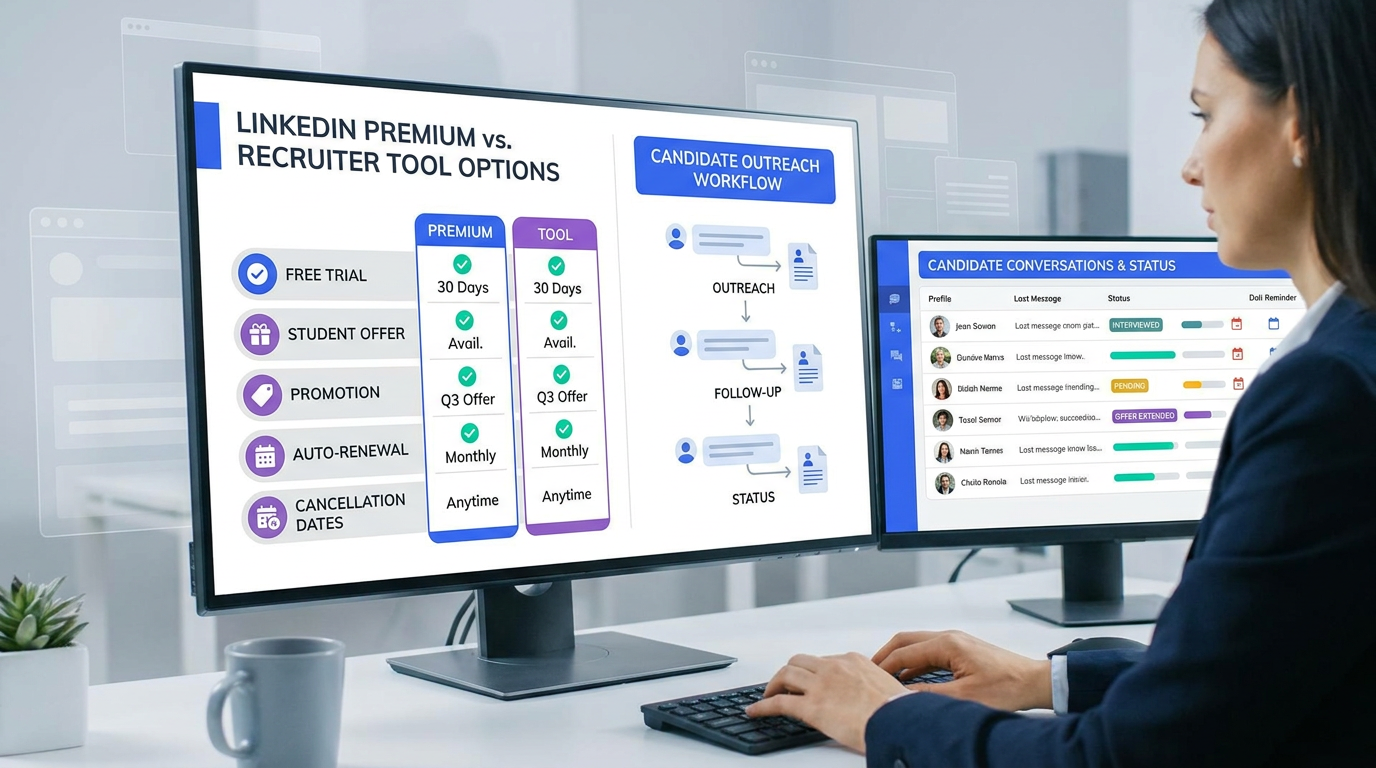
Before redeeming a linkedin premium code, recruiters can use this guide to avoid wrong-plan and renewal mistakes that waste budget.
That distinction matters more than most teams expect. When recruiters, agency owners, or in-house talent leads treat every deal claim as interchangeable, they create avoidable problems: someone activates the wrong subscription, a trial rolls into paid billing, a student promotion gets mistaken for recruiter access, or a sourcing process is built around savings that disappear at renewal. The operational damage is small at first, then expensive in time, trust, and budget.
In my own LinkedIn-heavy workflow, I have found that StrategyBrain AI Recruiter helps most when the real issue is not the discount itself but the mess around outreach follow-up, after-hours replies, and resume collection. Its always-on messaging, multilingual communication, and automated first-touch conversations reduce the scramble that happens when recruiters chase candidates manually across too many threads. The recruiter still makes the final call on fit, reviews the resume, and decides who moves forward, but the front end becomes far easier to control.
That control matters because the real recruiting pressure usually starts somewhere else. As older leadership cohorts retire and companies try to replace experience with younger talent, recruiting teams are pushed to attract candidates who care about work-life balance, growth, values, and mentoring more than shiny tools or executive prestige. In that setting, recruiters are not just filling seats. They are trying to keep candidate conversations aligned with what the opportunity actually offers, while also managing response speed, follow-up quality, and the employer story across LinkedIn.
Picture the moment a recruiter is working a campus or early-career search: they review a requisition, reply to a student who wants to know whether the role offers development, then jump back into LinkedIn to sort unread messages from candidates asking about flexibility, team culture, and advancement. That is where the opening problem shows up. The offer itself may be attractive, but without a reliable workflow, the team loses momentum in communication, confuses Premium with recruiter tools, and starts searching for a linkedin premium code or student deal as if access alone will solve a messaging and process problem.
If you are searching for LinkedIn recruiter discounts, recruiter-related savings, or a linkedin premium code, the first practical truth is simple: official savings usually appear as a free trial, a limited promotion, or a partner-based offer, not as a permanent public coupon library. That is especially important for recruiters, staffing teams, hiring managers, and student users, because low-trust pages often blur the line between LinkedIn Premium, recruiter-focused products, and unverifiable third-party code claims.
The better way to approach this topic is the same way experienced recruiting teams approach candidate attraction for younger talent: start with what the audience actually values, understand the real use case, and do not get distracted by surface-level claims. In the same way millennials are more likely to evaluate opportunity quality through balance, advancement, values, and mentoring, recruiters should evaluate LinkedIn deals through fit, terms, and practical workflow impact rather than through “coupon” language alone.
- Why offer context matters before you chase a deal
- What actually counts as a LinkedIn discount or deal
- Offer types at a glance
- LinkedIn Premium vs recruiter products
- The reality behind linkedin premium code searches
- How to get LinkedIn Premium for free for students
- What to know about linkedin premium discount for students
- What recruiting teams can learn from millennial attraction strategy
- My workflow experience using StrategyBrain AI Recruiter
- How to avoid risky or misleading deal claims
- Checklist before you redeem any offer
- FAQ
Why offer context matters before you chase a deal
In recruiting, access only matters when it supports the right hiring objective. A recruiter running experienced search, campus hiring, or early-career pipeline work is dealing with different candidate expectations, different message volume, and different urgency. That is why a search for a linkedin premium code often starts in the wrong place. The real question is not “Where is the coupon?” but “Which type of access matches the job to be done, and what does it become after the offer period ends?”
The reference point from millennial recruiting is useful here. Younger candidates often compare opportunities based on work-life balance, advancement paths, values alignment, and mentoring. In practice, recruiters need the time and consistency to answer those concerns well. If your team is buried in repetitive outreach, delayed replies, or poor handoff between messages and resume review, a discount by itself will not fix the process. It only lowers the entry cost to the same confusion.
What actually counts as a LinkedIn discount or deal
In practice, official LinkedIn savings tend to fall into a few buckets: a one-month free trial for eligible users, a time-limited promotional price, and a partner offer tied to specific eligibility rules. That is useful language because many people search for a linkedin premium code expecting a standing coupon page, when the more accurate terms are usually trial, promotion, or partner redemption.
For recruiters and HR operators, that is not just semantics. A trial is not the same thing as an ongoing discount, and a student partner offer is not the same thing as recruiter team access. If someone on the hiring side assumes otherwise, they can build a workflow around the wrong subscription type and create renewal headaches later.
Offer types at a glance
| Offer Type | Who It Usually Fits | Typical Duration | Main Limitation | What Recruiters Should Check |
|---|---|---|---|---|
| Free trial | New or eligible individual users | Usually 1 month | May be unavailable if a trial was used recently | Billing start date, cancellation deadline, payment method requirement |
| Promotional offer | Selected users during limited campaigns | Varies | Not consistently available | Eligibility wording, renewal at standard pricing, refund terms |
| Student partner offer | Eligible students | Can extend up to 12 months in qualifying programs | Eligibility and redemption rules matter | Auto-renewal, proof of eligibility, cancellation timing |
| Third-party code claim | Anyone searching for quick savings | Unclear | Often unverifiable or low trust | Avoid unless the source is clearly official |
The main takeaway is straightforward: not every “deal” creates the same business outcome. Some reduce cost briefly. Some simply delay billing. Some are designed for students, not recruiters. Strong recruiting operations teams document the offer type before they activate anything.
LinkedIn Premium vs recruiter products
One of the most common mistakes in this topic is mixing up LinkedIn Premium with recruiter-oriented products. Searchers often use recruiter language broadly, but the actual offer path can differ depending on whether someone needs career features, outreach support, sourcing capability, or team-level hiring access.
That distinction matters because campus hiring, early-career engagement, and millennial recruiting are communication-heavy workflows. A solo recruiter may be able to test certain individual features through Premium, but a team managing multiple open roles, follow-up sequences, and candidate questions about growth and flexibility is dealing with a very different problem. Do not assume that a student promotion, a one-month trial, or a consumer-style promotional route will apply to every recruiter-facing use case.
The reality behind linkedin premium code searches
The phrase linkedin premium code is popular because it sounds like a direct unlock. In reality, official messaging is much more likely to refer to a promotional offer, a free trial, or a partner route. That does not mean deals never exist. It means they are usually conditional, time-sensitive, and tied to account status or eligibility.
From a recruiter’s perspective, the safest filter is simple. If the claim does not clearly explain who qualifies, how long the offer lasts, what price applies afterward, and how cancellation works, it is not solid enough to build around. I have seen too many teams waste time chasing “special links” that either do not validate or solve the wrong subscription problem.
- Is the offer described as a free trial, promotional offer, or partner offer?
- Does it explain who is eligible?
- Does it mention whether prior trial use affects access?
- Does it disclose what happens after the free period ends?
- Does it explain cancellation and refund expectations?
If those answers are missing, treat the deal claim cautiously.
How to get LinkedIn Premium for free for students
For users asking how to get linkedin premium for free for students, the most credible path in the material reviewed here is the student promotional route tied to Microsoft 365 + LinkedIn Premium Career for eligible students. That matters because it gives a more trustworthy answer than the usual expired coupon pages or generic code lists.
What makes this route credible is not hype but structure: eligibility rules, a documented redemption path, and terms showing that the subscription can move to standard pricing after the no-cost period unless the user cancels in time. Those are the same practical details experienced recruiting operators look for in any subscription decision.
If you advise interns, student workers, or campus candidates, tell them to verify three things before they activate anything:
- Whether they meet the current student eligibility requirements.
- How long the free period lasts.
- When they need to cancel if they do not want standard pricing to begin.
That advice is especially relevant in early-career recruiting, where candidates often care about advancement, mentoring, and career visibility but may not pay close attention to subscription renewal mechanics.
What to know about linkedin premium discount for students
The phrase linkedin premium discount for students can mean different things depending on search intent. Some users are looking for a reduced monthly rate. Others are really looking for free temporary access through a student promotion. Based on the available reference material, the stronger student answer is an eligibility-based promotional offer that can provide extended no-cost access, not an always-on public coupon for every student account.
That distinction should be stated clearly. A free trial and a student offer are not identical. A trial is usually shorter and may be blocked if the user redeemed one recently. A student offer may last longer, but it still depends on qualification rules and still requires close attention to auto-renewal terms.
For recruiters involved in university hiring, precision matters. If your team is talking to students about career tools, avoid telling them to “just find a linkedin premium code.” Point them toward official offer paths, remind them to read the renewal terms, and encourage them to set a cancellation reminder if they do not plan to keep the subscription.
What recruiting teams can learn from millennial attraction strategy
The most useful insight from millennial recruiting is that attraction works best when the message reflects what candidates actually value. The old assumption that brand prestige, leadership pedigree, or impressive technology alone will carry the conversation is often weak. Candidates, especially younger ones, tend to respond more to clear evidence of balance, growth opportunity, values alignment, and manager support.
That has a direct connection to this topic. Recruiters often chase subscription discounts because they want better LinkedIn results at lower cost, but the bigger performance variable is usually message quality and follow-up discipline. If a candidate asks about advancement, mentoring, flexibility, or culture and your team responds slowly or inconsistently, a cheaper subscription does not improve conversion. The operational system around the subscription matters more.
Here are the practical recruiting lessons that transfer well:
- Make the value proposition candidate-friendly: benefits, flexibility, and development opportunities need to be easy to communicate in outreach.
- Show a path forward: candidates want to understand progression, not just job duties.
- Do not over-index on tools: technology alone rarely wins the decision if the conversation quality is poor.
- Research values before outreach: candidate fit is often about belief and work style, not just title match.
- Support managers and mentoring: retention risk often starts with weak manager relationships, which recruiters should surface early.
These are not abstract branding ideas. They shape what your recruiters need to say, how quickly they need to respond, and what kind of subscription or workflow support is actually worth paying for.
My workflow experience using StrategyBrain AI Recruiter
In my own testing of LinkedIn-heavy recruiting workflows, the most useful place for AI Recruiter has been in the repetitive layer that slows good recruiters down. When candidates reply after hours, ask similar first-round questions, or need a quick explanation of the role before they will share a resume, the delay is rarely about recruiter knowledge. It is about bandwidth.
Using StrategyBrain AI Recruiter, I found the strongest fit in three scenarios. First, it handled initial LinkedIn conversations and kept outreach moving when I could not reply immediately. Second, it supported multilingual communication, which matters when candidate pools stretch across regions. Third, it helped collect resumes and contact details from interested candidates without forcing me to manage every back-and-forth manually. I still reviewed every resume myself and made the final screening decision, but the front-end communication gap became much smaller.
That matters in the kind of recruiting scene described earlier. If you are talking to students, early-career talent, or millennial candidates who want to understand growth path, work-life fit, or leadership support, speed and consistency matter. A recruiter cannot credibly sell mentoring and development while responding two days late to simple questions. For teams that rely heavily on LinkedIn, this kind of workflow support can be more valuable than spending time hunting unreliable discount pages.
If your team is considering whether process support is worth more than a temporary deal, it helps to review how LinkedIn recruiting workflows differ when automation handles repetitive messaging. The key operational point remains the same: automation can support speed, coverage, and consistency, but the recruiter still owns judgment, fit assessment, and next-step decisions.
How to avoid risky or misleading deal claims
Unreliable deal pages usually follow the same pattern. They promise permanent codes, skip eligibility rules, ignore renewal pricing, or push urgency without clear support documentation. In recruiting terms, that is the same kind of low-signal messaging you would reject from a candidate source that cannot show quality controls.
Use this filter before trusting a claim:
- Transparent wording: Does it say free trial, promotional offer, or eligible student offer?
- Eligibility clarity: Can you tell exactly who qualifies?
- Duration clarity: Is the timeline stated plainly?
- Renewal clarity: Does it explain standard pricing after the offer?
- Exit clarity: Does it explain cancellation and refund expectations?
If not, pause. Chasing weak claims usually costs more staff time than it saves.
Checklist before you redeem any offer
Quick check: Before activating any linkedin premium code, free trial, or student promotion, confirm eligibility, duration, auto-renewal terms, cancellation timing, and whether prior trial use affects access.
Here is the short version I would give any recruiter, HR generalist, or student assistant:
- Identify the offer type correctly.
- Read the eligibility language closely.
- Check whether a payment method is required at sign-up.
- Note whether previous free-trial use affects eligibility.
- Save the renewal date on your calendar.
- Review cancellation steps before the final day of the offer period.
- Check refund expectations instead of assuming charges can always be reversed.
This may feel administrative, but it is exactly the kind of detail that protects recruiting budgets and prevents avoidable support work.
FAQ
Is there an official linkedin premium code that always works?
No reliable evidence here suggests a permanent public coupon system. Official savings are more consistently presented as a free trial, a promotion, or a partner offer.
How long is the LinkedIn Premium free trial usually available for?
The reviewed material indicates that LinkedIn Premium is commonly available as a one-month free trial for eligible users. Prior trial use may affect access.
How to get LinkedIn Premium for free for students?
The most credible current path in this material is the eligible student promotional offer linked to Microsoft 365 + LinkedIn Premium Career. Students should verify eligibility and review renewal terms before redeeming it.
Is there a linkedin premium discount for students?
There can be a student-specific promotional route, but it should not be treated as a guaranteed always-on coupon for every student account.
Will the subscription renew automatically after a free student period or trial?
It can move to standard pricing after the offer period unless the user cancels in time. Always check the specific terms during activation.
Do recruiters need the same type of subscription as students or job seekers?
No. Individual Premium access, student promotions, and recruiter-oriented tools should not be treated as interchangeable.
Where does StrategyBrain AI Recruiter fit into this discussion?
It fits on the workflow side rather than the discount side. If your problem is slow outreach, missed after-hours replies, or manual resume collection on LinkedIn, StrategyBrain AI Recruiter can support those front-end tasks while the recruiter keeps final screening control.
Conclusion
If your search started with linkedin premium code, the main takeaway is that official savings are usually presented as a free trial, promotional offer, or student partner offer, not as a permanent public coupon system. For students, the most credible route is the eligibility-based promotion tied to Microsoft 365 + LinkedIn Premium Career. For recruiters, the smarter move is to evaluate offer type, renewal terms, and use case fit before activating anything.
The deeper lesson is the same one good recruiters already know from attracting millennial talent: outcomes improve when you focus on what actually drives decisions. In this case, that means understanding whether you need temporary savings, clearer subscription governance, or better LinkedIn workflow support. Discounts matter, but process clarity matters more.