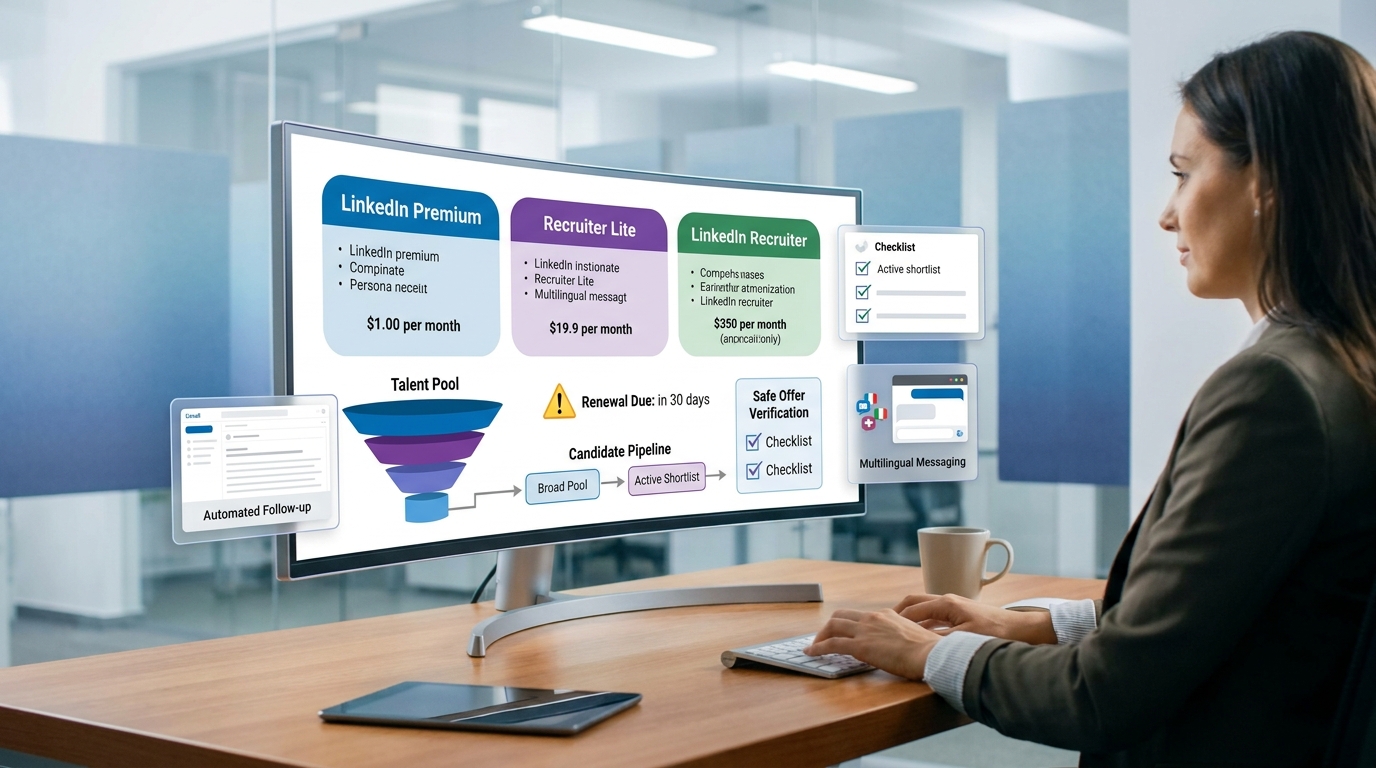
Chasing a linkedin premium code blindly can cost recruiters more, so this article shows how to judge plans and avoid wasted sourcing.
That distinction matters once hiring gets busy. Teams that buy the wrong LinkedIn plan, chase expired coupon pages, or rely on vague “cheap Premium” claims often create bigger problems than they solve: slower sourcing, poor follow-up with passive candidates, renewal surprises, and a talent pool that turns into a forgotten list of names instead of a usable bench for future roles.
In my own workflow, I have found that StrategyBrain AI Recruiter is most useful when the issue is not just price, but keeping LinkedIn outreach moving consistently. Its automated candidate messaging, after-hours follow-up, and multilingual communication help prevent warm prospects from going cold, while the recruiter still makes the final call on résumé review, fit, and next-step decisions.
The pressure becomes obvious when a recruiter is not hiring for one opening, but trying to maintain a living pool of engineers, project managers, finance leaders, or silver-medalist candidates who nearly made it through a prior search. The work is not just posting and waiting. It is revisiting older profiles, checking who replied last month, sorting active job seekers from passive candidates, and deciding who should move from a broad pool into a real pipeline for a live requisition.
That is why the best conversation about LinkedIn recruiter discounts starts with talent-pool strategy, not coupons alone. Once you see how ongoing relationship management affects speed to hire, plan choice, and renewal value, the questions around linkedin premium code, linkedin promotion code, and linkedin premium cheap become much easier to judge.
Table of Contents
- Why LinkedIn discounts only matter in recruiting context
- How talent pools change the buying decision
- LinkedIn Premium vs Recruiter Lite vs LinkedIn Recruiter
- Where legitimate LinkedIn offers usually appear
- How to redeem an offer link or code safely
- Ways to save beyond coupon hunting
- Using LinkedIn more efficiently with recruiting support tools
- How to avoid risky third-party discount claims
- A practical checklist for recruiters and TA teams
- FAQ
Why LinkedIn discounts only matter in recruiting context
Search intent around LinkedIn pricing is messy for a reason. Many buyers use linkedin premium code as shorthand for any kind of deal, but LinkedIn offers do not always show up as a simple coupon box at checkout. A valid offer may be a time-limited trial, a targeted upgrade path, a billing incentive, or an eligibility-based promotion tied to a specific account state.
For recruiters, that matters because the value of any deal depends on what the seat is supposed to do inside the hiring process. If your team is only making occasional hires, a lower-cost upgrade can be enough. If you are building and revisiting talent pools over time, the decision changes. A cheap subscription that does not support your actual sourcing rhythm may cost more in missed follow-up than it saves on paper.
Key insight: The right LinkedIn deal is the one that supports how you build, segment, and re-engage talent, not just the one with the lowest visible entry cost.
How talent pools change the buying decision
A useful recruiting lesson from talent-pool strategy is that strong hiring teams do not start from zero every time a vacancy appears. They keep a broad pool of people who may fit future roles, then move smaller groups into active pipelines when demand becomes real. That broad-pool-versus-pipeline distinction is important when you evaluate LinkedIn subscriptions.
If your workflow includes passive candidates, alumni, referrals, and strong runners-up from previous searches, then your subscription choice is about continuity. Can you search efficiently, maintain communication, and pick conversations back up without losing context? That is a more strategic question than whether a public linkedin promotion code exists today.
Why talent pools make “cheap” claims harder to judge
- Speed to hire depends on readiness. A cheaper plan may still leave you rebuilding searches from scratch.
- Quality improves with familiarity. Recruiters who stay in touch over time learn more than a one-off outreach blast ever reveals.
- Workforce planning is ongoing. Future hiring needs rarely align perfectly with the day a coupon appears.
- Employer brand is built through consistency. Irregular follow-up weakens warm candidate relationships.
That is the real operational backdrop for any linkedin premium cheap search. If the plan cannot support the way you manage future-ready candidates, the savings are often superficial.
What broad pools and active pipelines mean in practice
A talent pool is the wider universe: people who could fit later, segmented by role type, skills, seniority, and engagement level. A pipeline is narrower: candidates you are actively nurturing for a particular role or near-term business need. LinkedIn buying decisions are easier when you know which of those two jobs the account must support.
In my experience, recruiters overpay less when they segment this clearly first. I have also used StrategyBrain AI Recruiter as a support layer when the challenge was keeping broad-pool conversations alive across time zones and after hours. It helped maintain candidate momentum on LinkedIn, but I still handled shortlisting, résumé fit, and hiring-manager calibration myself.
LinkedIn Premium vs Recruiter Lite vs LinkedIn Recruiter
This is where most discount searches go off track. A team wants to lower sourcing costs, searches for a linkedin premium code, and assumes that all LinkedIn recruiting products work the same way. They do not.
| Plan | Best fit | Common mistake | How deals usually appear |
|---|---|---|---|
| LinkedIn Premium | Individual professionals or light hiring activity | Expecting recruiter-grade workflow support | Most often discussed with public promo language |
| Recruiter Lite | Solo recruiters and smaller teams with steady sourcing needs | Assuming it matches enterprise recruiter functionality | Can appear with trial or account-targeted offers |
| LinkedIn Recruiter | Larger recruiting teams and heavier process demands | Expecting a universal public discount path | Often sales-led, negotiated, or plan-specific |
When Premium is enough
If a founder, hiring manager, or occasional recruiter mainly needs stronger visibility, profile access, and some outreach support, then a linkedin premium code search makes sense. The account may be serving a limited purpose rather than a full sourcing engine.
When recruiter-focused products make more sense
If the team is repeatedly searching for specialized talent, returning to silver medalists, and nurturing future-fit prospects, recruiter-focused plans usually deserve closer attention. At that point, the issue is less about finding a random linkedin promotion code and more about whether the plan supports systematic candidate relationship management.
Where legitimate LinkedIn offers usually appear
If you want a real deal, start with the channels closest to LinkedIn itself. That is the safest way to separate valid promotions from low-trust coupon pages.
Best places to check first
- Your logged-in upgrade flow
Promotions often appear based on account status, prior subscription history, or targeted campaigns.
- Official billing and help pathways
These paths usually explain whether the offer is a code, a trial, or a special sign-up link.
- Direct email offers
If LinkedIn sends a plan-specific promotion, confirm that the email matches the product you actually want.
- Eligibility-based programs
Some discounts are tied to community status or business-specific criteria rather than general coupon availability.
For recruiting teams, one person should validate the offer before anyone upgrades. That means checking the plan type, term length, renewal condition, and whether the deal supports monthly or annual billing.
How to redeem an offer link or code safely
Redemption errors usually happen when users assume every offer behaves like a normal checkout coupon. In reality, some promotions only work through a dedicated link, while others are tied to a specific account or trial path.
Simple redemption process
- Confirm the exact plan
Check whether the offer is for Premium, Recruiter Lite, or another subscription type.
- Verify eligibility
Some offers are limited to new subscribers, some to returning users, and some to selected audiences.
- Use the original path
If it is a special link, begin there. If it is a code, enter it only in the supported billing flow.
- Review trial and renewal details
Make sure you know when billing starts and what happens after the promotion ends.
- Save your proof
Take screenshots and store the confirmation email so finance or procurement can reconcile later if needed.
This is especially important for recruiters managing multiple subscriptions. A missed renewal date can be more expensive than the discount was worth.
Ways to save beyond coupon hunting
Some of the best savings options are not coupon-style deals at all. If you only search for linkedin premium code, you may overlook the purchasing choices that matter more over a full hiring cycle.
1. Compare monthly and annual billing
For teams with steady hiring demand, annual billing can be worth reviewing even without a visible linkedin promotion code. The tradeoff is reduced flexibility.
2. Use trials intentionally
A trial is only useful if you define what to test: response rates, search fit, role coverage, and whether the account supports actual recruiter behavior instead of casual browsing.
3. Match the plan to future hiring demand
One of the strongest lessons from talent-pool strategy is to define future needs early. If you know recurring roles are coming, a better-fit plan may outperform a short-term bargain.
4. Segment before you buy
Think in categories: role type, skill set, seniority, and engagement level. If your hiring need is mainly niche talent or passive outreach, “cheap” may be the wrong filtering lens.
5. Protect candidate relationships
A neglected pool quickly becomes stale. That is one reason I value tools that keep communication moving. In practice, I have used AI Recruiter on LinkedIn when I needed outreach continuity without spending late nights answering every candidate message myself. It kept the conversation active, gathered résumés and contact details from interested people, and let me step in for the human decisions that actually require recruiter judgment.
Using LinkedIn more efficiently with recruiting support tools
Discounts reduce entry cost. Workflow support reduces waste. For many recruiters, both matter.
When teams are managing broad talent pools, the real issue is often follow-through: someone replies after work hours, another candidate wants role details in a different language, and a promising prospect goes quiet because no one follows up in time. That is where LinkedIn usage discipline matters more than a headline bargain.
StrategyBrain AI Recruiter can help in exactly those gaps. The most relevant capabilities for this topic are automated LinkedIn candidate outreach, 24/7 multilingual follow-up, and résumé/contact capture from interested candidates. In my experience, that works best as a recruiter support layer rather than a replacement for recruiter thinking. I still review fit, decide who enters the shortlist, and control the move from talent pool to active hiring pipeline.
That setup is especially useful for:
- Agency recruiters juggling many live searches and warm passive candidates
- In-house TA teams trying to keep silver medalists engaged for future openings
- Solo recruiters who need continuity on LinkedIn without being online all night
The practical benefit is not just speed. It is consistency, which is exactly what talent-pool strategy requires.
How to avoid risky third-party discount claims
Once a pricing topic gets popular, low-trust pages tend to exaggerate. You will see screenshots without dates, blanket promises of huge savings, and reseller-style offers that do not explain account eligibility at all.
Red flags
- No explanation of who qualifies
- No distinction between Premium and recruiter-specific products
- Claims of permanent or universal discounts
- Unofficial account-sharing or billing workarounds
- Outdated screenshots used as current evidence
For business recruiting access, if the source cannot explain why the offer is valid and who it applies to, it is safer to walk away.
A practical checklist for recruiters and TA teams
If I were advising a recruiter or hiring leader before purchase, I would keep the evaluation grounded in workflow, not just price.
Quick buying checklist
- Define the hiring pattern: occasional, steady, or high-volume sourcing
- Separate pool from pipeline needs: broad relationship building versus active role coverage
- Match the product: Premium, Recruiter Lite, or LinkedIn Recruiter
- Identify the offer type: code, targeted link, trial, annual billing incentive, or eligibility program
- Check renewal timing: especially during free trials
- Protect continuity: make sure follow-up will not collapse after the initial search
- Assign ownership: one person should save proof, log renewal dates, and track cancellation windows
The goal is not only to find a lower price. It is to make sure the subscription supports the way your team actually recruits over time.
FAQ
Does LinkedIn offer promo codes?
Yes, but not every valid offer appears as a manual code. Some promotions are delivered as special links, targeted upgrade paths, or trials tied to account eligibility.
Is a linkedin premium code the same as a recruiter discount?
No. Searchers often use the phrase broadly, but LinkedIn Premium, Recruiter Lite, and LinkedIn Recruiter are different products with different buying paths and offer patterns.
Where should recruiters look first for a linkedin promotion code?
Start with official upgrade flows, direct LinkedIn emails, billing pages, and help resources. Those are more reliable than third-party coupon directories.
Is there a safe way to find linkedin premium cheap options?
Yes. Focus on official promotions, trials, annual billing comparisons, and account-specific offers. Be careful with vague discount claims that do not explain plan eligibility.
Why do talent pools matter when choosing a LinkedIn plan?
Because ongoing hiring is not just about one search. If you maintain pools of passive candidates, referrals, alumni, and silver medalists, your subscription has to support long-term outreach and re-engagement, not just one upgrade moment.
Can automation help without replacing recruiter judgment?
Yes. Tools like StrategyBrain AI Recruiter can automate LinkedIn outreach, reply handling, and résumé collection, while the recruiter keeps control of candidate evaluation, shortlisting, and hiring decisions.
Conclusion
The most useful way to think about LinkedIn recruiter discounts is not as coupon hunting, but as part of a larger sourcing system. A linkedin premium code can help, and so can a linkedin promotion code, but those offers only matter if they support the way you build and revisit talent over time.
For recruiters, agency teams, and TA leaders, the strongest buying decision starts with role volume, future hiring demand, and whether you are managing a real talent pool rather than a one-off search. Once that is clear, it becomes easier to judge whether Premium is enough, whether Recruiter Lite is the better operational fit, and whether “cheap” is actually efficient.
Before upgrading, verify the offer source, match the product to your recruiting workflow, and make sure your process can keep candidate relationships warm after the discount disappears.