If you're wondering how to get in touch with recruiters on LinkedIn, this article shows candidates how to target the right recruiter, improve profile visibility, and avoid messages that get ignored.
When that discipline is missing, the damage shows up fast: wasted InMail credits, missed passive candidates, duplicated follow-up, weak hiring-manager trust, and slower fills on roles that already demand narrow skill sets. For solo recruiters and smaller search firms, the cost is not abstract. It is lost time, diluted relationships, and too many conversations with people who were never aligned to the brief in the first place.
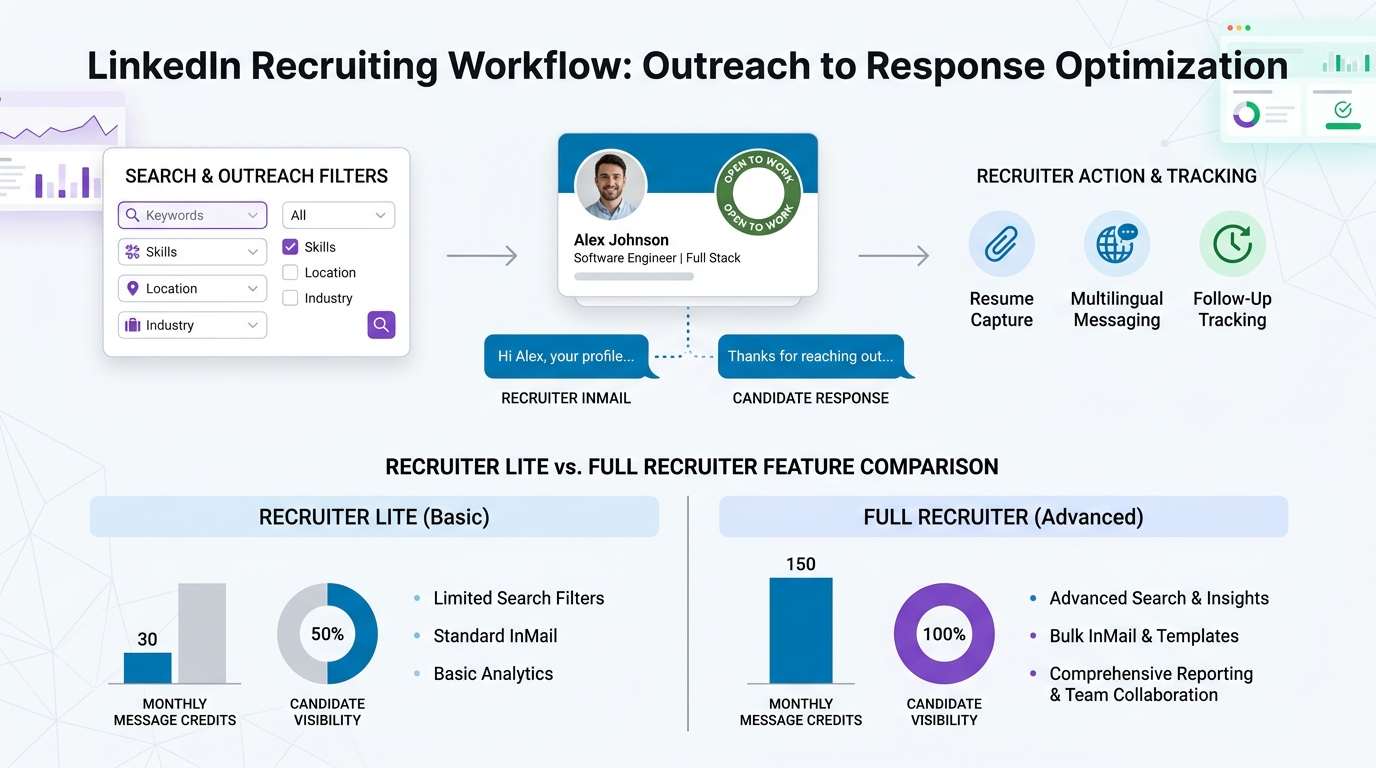
In my own LinkedIn sourcing work, StrategyBrain AI Recruiter has been most useful when the problem is not finding names but keeping outreach, replies, and qualification moving across time zones and after hours. Its LinkedIn automation, multilingual messaging, and resume/contact capture reduce repetitive front-end work, while the recruiter still makes the final call on fit, resume review, and whether a candidate should move to interview.
That matters because recruitment is never just about sending messages. Employers still have to define the role, decide whether the search belongs in-house or with an external recruiter, and reach candidates who may not be actively applying. In specialized searches, especially where passive talent matters, the recruiter’s real job is to translate business need into a workable search, then keep sourcing, screening, and communication aligned well enough that the process does not stall.
The same logic explains why LinkedIn recruiter subscription details matter more than most job seekers assume. If one recruiter has broader search access, pooled messaging capacity, or a more organized workflow than another, contact patterns change. So if you want to understand both how to get in touch with recruiters on LinkedIn and how to get recruiters to contact you on LinkedIn, you need to look at the full recruitment process behind the message, not just the message itself.
Table of Contents
- Quick Answer
- Why LinkedIn Recruiter Subscriptions Matter in the Hiring Process
- LinkedIn Recruiter Subscription Details Explained
- How to Get in Touch With Recruiters on LinkedIn
- How to Get Recruiters to Contact You on LinkedIn
- In-House Recruiters vs External Recruiters on LinkedIn
- How I Use AI Recruiter to Support LinkedIn Outreach
- Candidate Actions vs Recruiter Capabilities
- Important InMail and Messaging Rules to Know
- FAQ
Quick Answer
If you want practical LinkedIn recruiter subscription details, the key point is that recruiters and candidates are operating with different tools and limits. Recruiters may contact candidates through InMail without being connected first, but their ability to do that depends on the type of recruiter subscription, seat access, message rules, and team workflow.
For candidates, the best answer to how to get in touch with recruiters on LinkedIn is to target the right recruiter with a brief, role-specific message backed by a strong profile. The best answer to how to get recruiters to contact you on LinkedIn is to improve discoverability through Open to Work, accurate titles, relevant locations, and profile language that matches recruiter searches.
| Goal | Best Move | Why It Helps |
|---|---|---|
| Reach a recruiter directly | Send a concise note tied to a real role or function | Shows relevance and respects recruiter workflow |
| Get found more often | Turn on Open to Work and refine searchable profile keywords | Improves appearance in recruiter search and spotlight views |
| Understand outreach differences | Learn how Recruiter, Recruiter Lite, and seat access differ | Explains why recruiters do not all message candidates the same way |
Why LinkedIn Recruiter Subscriptions Matter in the Hiring Process
Recruitment is an end-to-end process, not a messaging trick. A recruiter first needs a clear role brief, hiring-manager alignment, and a sourcing strategy that fits the market. Then comes candidate identification, screening, outreach, feedback, negotiation, and handoff. LinkedIn sits inside that process, but it does not replace it.
That broader view is useful because many questions about LinkedIn messaging are really questions about hiring structure. Is the search being run by an in-house talent team or an external recruiter? Is the role high volume and straightforward, or niche and difficult to fill? Is the recruiter trying to attract active applicants, or reach passive talent who are not applying anywhere? Those choices affect how aggressively recruiters search, message, follow up, and prioritize candidates.
In practice, subscription details matter because they shape the recruiter's working reality. A recruiter handling a confidential, specialized search usually behaves differently from a recruiter filling a common role with a large applicant pool. Access to search filters, InMail capacity, visibility features, and internal process discipline all influence whether the candidate ever sees a message.
LinkedIn Recruiter Subscription Details Explained
From a recruiting-operations standpoint, the most important terms are Recruiter, Recruiter Lite, InMail, Open Profile, Open to Work, Spotlights, and seat-based usage. These explain why one recruiter can reach out quickly while another seems restricted.
Recruiter Lite generally starts with 30 InMail credits per month per user. Full Recruiter access works differently. Credits may vary by contract, some usage may be pooled, and admin-level controls can affect how teams manage messaging. So there is no single universal number that explains every recruiter's outreach behavior.
For candidates, that means silence is not always about fit. It can also reflect seat allocation, sending limits, team policy, or workflow priorities. For recruiting teams, it is a reminder that better hiring outcomes do not come from credits alone. They come from search quality, message discipline, and follow-up consistency.
What usually sits behind the LinkedIn seat
- Role intake: agreeing on title, responsibilities, and must-have skills
- Sourcing method: deciding whether to rely on applicants, passive outreach, or both
- Search execution: using titles, locations, seniority, and availability signals well
- Outreach control: managing credit usage and follow-up windows carefully
- Pipeline handling: recording replies, resumes, and next steps consistently
That is one reason external recruiters and in-house teams often use LinkedIn differently. The subscription is only the visible layer; the real differentiator is the process around it.
How to Get in Touch With Recruiters on LinkedIn
If your goal is how to get in touch with recruiters on LinkedIn, start with search logic and role relevance. Recruiters respond best when your message is clearly connected to their hiring scope.
- Find the recruiter attached to your function or market. Look for recruiters handling your job family, industry, geography, or seniority range.
- Prioritize live roles. If they are connected to an active vacancy, mention the role directly.
- Keep the message short. State who you are, what kind of role you fit, and one reason you may be relevant.
- Make sure your profile supports the claim. If your headline and experience do not match the note, the message usually dies on first glance.
- Follow up once, not repeatedly. One respectful nudge is enough.
Recruiters usually scan for a handful of fit signals first: title match, function, sector, location, and level. If those are unclear, even a well-written message struggles.
A message framework that tends to work
- Opening: mention the role, team, or hiring area
- Fit marker: summarize your most relevant recent experience
- Reason for reaching out: explain why this recruiter specifically
- Close: ask for a simple next step or clarification
Practical takeaway: Good recruiter outreach is less about persuasion and more about making fit obvious in under 20 seconds.
How to Get Recruiters to Contact You on LinkedIn
If you want to know how to get recruiters to contact you on LinkedIn, think like someone building a searchable talent pool. Recruiters often use LinkedIn the same way agencies maintain segmented databases: by title, industry, location, specialization, and readiness to move.
- Enable Open to Work. This can improve visibility in recruiter search and spotlight-style filters.
- Use recognizable target titles. Recruiters search standard market titles, not creative internal labels.
- Set a realistic location. Even remote roles often start with location filters.
- Sharpen your headline and About section. Put your specialty and target direction near the top.
- Make recent experience easy to skim. Your last two or three roles should quickly signal fit.
- Add role-relevant keywords naturally. Use the language recruiters actually search for.
This works for the same reason talent pools work in agency recruiting: the easier it is to classify and retrieve your profile, the more likely it is to be surfaced when a search opens. Candidates who wait to be discovered without making themselves legible to search usually stay invisible.
In-House Recruiters vs External Recruiters on LinkedIn
One of the most useful ways to understand recruiter behavior on LinkedIn is to compare in-house and external recruiting models.
In-house recruiters
These recruiters work inside the employer's HR or talent function. They usually understand internal teams, culture, and approval chains better than anyone outside the company.
- Strengths: direct access to hiring managers, better knowledge of culture, strong internal alignment
- Constraints: heavy req loads, broader responsibilities, less time for deep niche searches
External recruiters and headhunters
These recruiters are often brought in for hard-to-fill, specialist, senior, or confidential searches. They may have broader industry networks and stronger access to passive candidates.
- Strengths: focused search effort, niche market knowledge, deeper passive-candidate relationships
- Constraints: success depends on brief quality, client alignment, and information flow
For candidates, this matters because the same LinkedIn profile may attract different reactions from each group. An internal recruiter may care most about direct relevance to one open role. An external recruiter may look at long-term marketability, transferability, or confidential fit for a search not yet publicly visible.
How I Use AI Recruiter to Support LinkedIn Outreach
In specialized hiring, the hardest part is often not the search itself but the handoff between sourcing activity and real recruiter judgment. I have found that AI Recruiter is most useful when LinkedIn replies start arriving across different hours, languages, and candidate intent levels. It can continue the initial conversation, introduce the role, answer common job questions, and collect resumes or contact details from interested people.
What I like most is that it helps with the repetitive front end without pretending to replace recruiter accountability. I still review whether the resume actually matches the brief, whether the candidate's background aligns with the market, and whether it makes sense to move to interview. That separation matters. Early outreach can be systematized; final qualification should not be guessed.
In practical terms, the strongest use cases are:
- After-hours response handling: candidates often reply when recruiters are offline
- Multilingual outreach: useful when the candidate pool crosses regions or language barriers
- Resume and contact capture: keeps interested replies from disappearing in message threads
If you want to explore how it works in more detail, the setup overview and these conversation examples give a clearer picture of where AI-supported LinkedIn workflows can save time without removing recruiter judgment.
Candidate Actions vs Recruiter Capabilities
A lot of confusion comes from mixing up what candidates can do with what recruiters can do. These are not the same experience.
| Feature | Candidate View | Recruiter View |
|---|---|---|
| InMail | You may receive it without being connected | Can be used to contact candidates outside the network, subject to credits and platform rules |
| Open Profile | May affect who can message you in certain contexts | Not a substitute for recruiter messaging capacity |
| Open to Work | Signals availability and can improve discoverability | Can support search filters and spotlight visibility |
| Recruiter Lite | Mostly invisible from the candidate side | Typically starts with 30 InMail credits per month per user |
| Recruiter | Explains why some recruiters have broader reach | May involve different contract-based credit structures and admin controls |
| Seat-based usage | Helps explain uneven outreach behavior | Access and limits can vary by user and team setup |
If you are a candidate, the right takeaway is simple: make your profile easy to find and easy to evaluate. If you are a recruiter, train your team so they understand that access level changes search behavior, response strategy, and throughput expectations.
Important InMail and Messaging Rules to Know
Subscription details are only part of the story. Platform rules also shape recruiter behavior. Recruiters may face daily sending caps, first-week limitations on new seats, and a 24-hour wait before sending another InMail to the same person unless that person replies sooner.
That means a delayed follow-up is not always low interest. It may be a sending rule, a credit decision, or a sequencing choice inside a high-volume workflow. Candidates should not overread silence. Recruiters should not waste first messages on vague outreach that burns scarce credits.
Key insight: InMail capacity matters, but the bigger advantage comes from using each message on a well-defined search rather than a broad guess.
FAQ
Can recruiters contact you on LinkedIn without being connected?
Yes. Recruiters using recruiter-focused subscriptions can often contact candidates through InMail even without a first-degree connection.
What is the best way to get in touch with recruiters on LinkedIn?
The best method is targeted outreach to the right recruiter with a short message tied to a specific role, function, or market. That is the most practical answer to how to get in touch with recruiters on LinkedIn.
What is the best way to get recruiters to contact you on LinkedIn?
Use Open to Work, accurate market-facing job titles, clear locations, and profile language that reflects the roles you actually want. That is the strongest answer to how to get recruiters to contact you on LinkedIn.
Does Recruiter Lite have the same outreach power as full Recruiter?
No. Recruiter Lite and full Recruiter do not work exactly the same way. Messaging capacity, workflow controls, and contract structure can differ.
Why do some recruiters never reply?
Common reasons include poor fit, message overload, seat restrictions, credit prioritization, and timing. In many cases, it is a workflow issue rather than a personal rejection.
How does Open to Work help?
It can improve your visibility in recruiter searches and make it easier for recruiters to identify candidates who may be open to opportunities.
Where does AI support help in LinkedIn recruiting?
It helps most with repetitive early-stage communication, after-hours replies, multilingual conversations, and collecting resumes or contact details. Recruiters should still make the final decision on quality and next steps.
Conclusion
If you are evaluating LinkedIn recruiter subscription details, the important lesson is that outreach mechanics make more sense when viewed through the full recruitment process. Role clarity, sourcing strategy, passive-candidate access, search discipline, and follow-up quality all shape who gets contacted and who gets ignored.
For candidates, that means success comes from both sides of the equation: knowing how to get in touch with recruiters on LinkedIn and making your profile strong enough to support how to get recruiters to contact you on LinkedIn. For recruiters, it means subscriptions help, but process still wins. The best LinkedIn results come from clear briefs, smart search logic, disciplined messaging, and a workflow that does not lose momentum once candidates start replying.