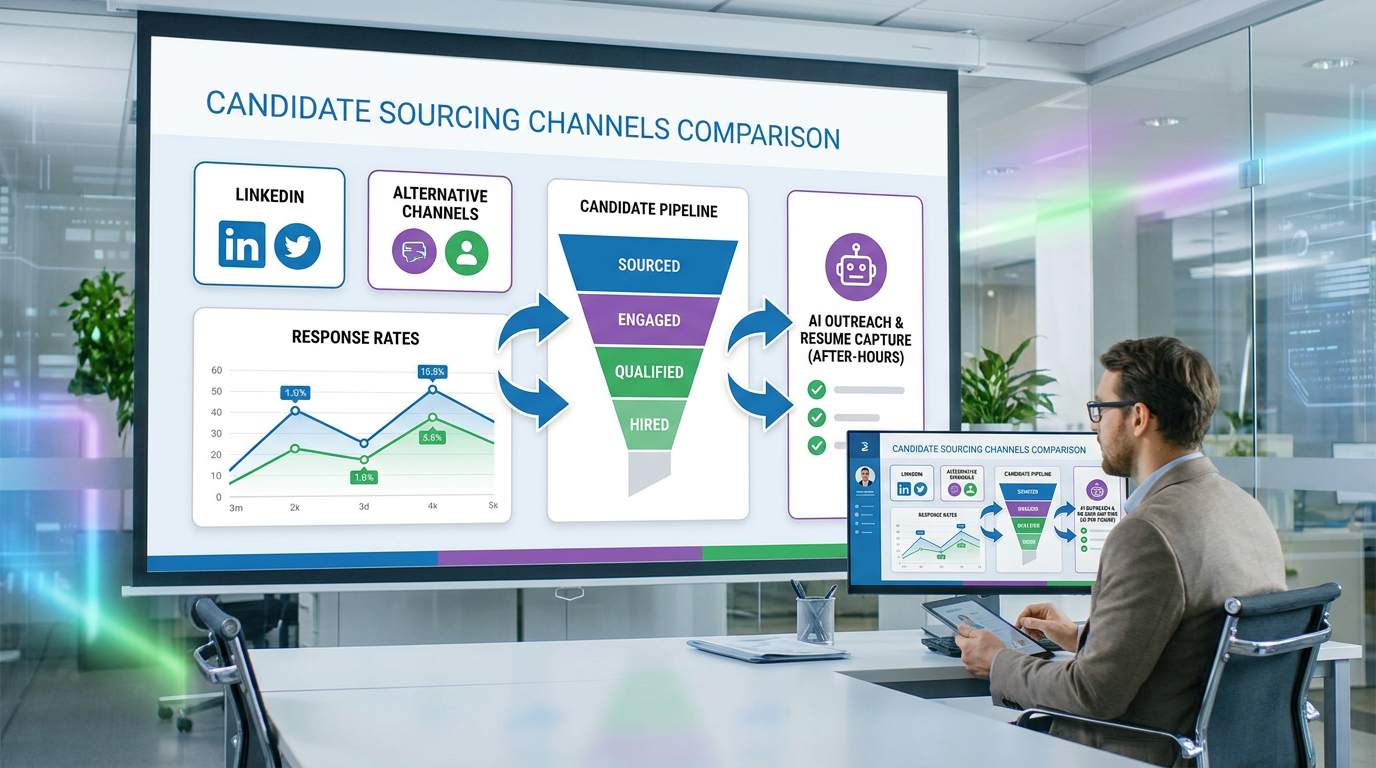
When response quality slips, this article helps recruiters judge which websites like LinkedIn fit each search and avoid weak channel choices.
That matters because recruiting teams usually feel the pain long before they name it. A search starts on the wrong platform, passive candidates reply after hours, notes live in scattered inboxes, and a recruiter keeps using the same sourcing playbook even after response quality drops. For a solo recruiter, that means wasted time and slower placements. For a small agency owner, it means lower consultant output and shaky client confidence. For an in-house team, it often shows up as poor source quality, inconsistent follow-up, and hiring managers who think the market is the problem when the workflow is.
In my own LinkedIn-heavy searches, I have used StrategyBrain AI Recruiter to take pressure off the repetitive part of that cycle: candidate connection requests, first-message outreach, after-hours follow-up, and basic interest checking. What makes it useful in this context is not that it replaces recruiter judgment. It does not. The recruiter still reviews the resume, decides whether the background fits, and chooses the next step. But for teams testing apps like LinkedIn alongside LinkedIn itself, always-on multilingual messaging and automated resume collection can prevent good conversations from dying in the gap between outreach and human review.
A useful way to frame the problem comes from executive search, where some replacement searches stay confidential because the person in seat has not kept up with what the business now needs. In high-growth environments, the issue is often not one dramatic failure. It is a pattern: relying on the same old bag of tricks, shutting down new ideas too early, not understanding how the business really makes money, getting pulled into too many side projects, or staying so tactical that strategic support never arrives. That logic applies to recruiting channels too. A platform that worked two years ago may no longer be the best place to build the next pipeline.
Picture the recruiting version of that moment. A consultant is reviewing an open search, checking the requisition list, reopening old LinkedIn threads, and trying to work out why a once-reliable sourcing channel now produces slow replies and weak alignment. Then they update candidate stages, chase a hiring manager for priority clarification, and realize the real issue is not just volume. It is context. Different roles need different environments, and the cost of staying stuck in one platform is the same cost leaders face when they fail to adapt: missed timing, weaker decisions, and a growing performance gap.
That is why any serious comparison of linkedin alternatives should start with fit, not familiarity. The rest of this article looks at which websites like LinkedIn and which apps like LinkedIn work best by use case, what warning signs tell you a channel is no longer serving the search, and how to combine specialized platforms with a disciplined recruiting workflow.
- Why Recruiters Look Beyond LinkedIn
- 7 Signs Your Current Channel Mix Needs to Change
- Quick Comparison Table
- Best Types of LinkedIn Alternatives by Use Case
- Where AI Recruiter Fits Into a LinkedIn-First Workflow
- How to Choose the Right Platform
- Common Mistakes When Comparing Apps Like LinkedIn
- Final Recommendation Matrix
- FAQ
Why Recruiters Look Beyond LinkedIn
People searching for websites like LinkedIn are rarely asking for a perfect one-to-one replacement. Most are trying to solve a narrower problem:
- finding startup talent faster
- getting more candid market insight
- reaching early-career candidates
- reviewing real portfolio work
- improving response rates on outreach
- reducing dependence on one sourcing habit
From a recruiting operations perspective, LinkedIn is broad, but broad does not always mean best. It combines profiles, networking, messaging, jobs, and employer visibility in one place. That makes it powerful, but it can also make teams lazy. The same search patterns, the same outreach assumptions, and the same candidate pool get reused long after the market has shifted.
Key insight: the best alternative is usually not the platform that looks most like LinkedIn. It is the platform that best matches the candidate behavior required for the role.
7 Signs Your Current Channel Mix Needs to Change
The strongest lesson from executive replacement work is that performance gaps rarely appear all at once. They build. The same is true in sourcing. If you recognize several of the signals below, it is probably time to expand beyond LinkedIn or rethink how you use it.
1. You rely on the same sourcing tricks
If every search begins and ends with the same LinkedIn filters, your pipeline quality will eventually flatten. Good recruiters adapt their channels as role mix, geography, and candidate expectations change.
2. You shut down new channels too early
Some teams dismiss niche communities or startup networks before they understand what those environments are actually good at. Early critique can kill experimentation before you gather enough evidence.
3. You do not understand the hiring context deeply enough
A channel only works when it reflects how a candidate group thinks about work. If you do not understand how startup engineers, freelance designers, finance leaders, or new graduates discover opportunities, the platform choice will be weak from the start.
4. You spread effort across too many side channels
The opposite problem also shows up often. Teams sign up for multiple linkedin alternatives but never define which one is for which search. That creates fragmented outreach and muddled reporting.
5. You stay too tactical
If the team is only chasing message volume, they miss the bigger question: which environments actually support long-term candidate relationships, better positioning, and stronger conversion?
6. Your follow-up is slow or inconsistent
Good candidates often reply outside business hours. If no one responds until the next day or later, momentum disappears. This is one reason many recruiters now add automation support to a LinkedIn-led process instead of abandoning LinkedIn entirely.
7. Your process breaks once a channel starts working
A new source that suddenly increases replies can expose weak internal systems. Without central tracking, resume capture, and clear ownership, channel success creates operational chaos instead of hires.
Quick Comparison Table
| Platform Type | Best For | Main Advantage | Main Limitation |
|---|---|---|---|
| Professional networking platforms | General recruiters, passive candidate sourcing, career visibility | Closest experience to LinkedIn | Usually smaller overall reach |
| Startup talent networks | Founders, startup recruiters, startup candidates | Higher relevance for early-stage roles | Less useful for broad corporate hiring |
| Anonymous career communities | Professionals seeking honest peer insight | More candid discussion than polished profiles | Weak as a full sourcing system |
| Job search platforms | Active applicants, high-volume hiring | Strong search and application flow | Limited networking layer |
| Early-career recruiting networks | Students, graduates, campus hiring teams | Built around limited experience candidates | Less effective for senior roles |
| Portfolio platforms | Creative, product, and design talent | Shows actual work quality fast | Role coverage is narrow |
| Freelance marketplaces | Contract and project hiring | Useful for availability and proof of delivery | Not ideal for long-term networking |
Best Types of LinkedIn Alternatives by Use Case
This is where most searches for apps like LinkedIn become more practical. Instead of asking which site replaces everything, ask which category solves your immediate problem better.
1. Broad professional networking platforms
These are the closest match for people who specifically want websites like LinkedIn. They usually support professional profiles, some degree of networking, employer presence, and job visibility.
Best for: passive candidate discovery, general professional branding, and recruiters who still need a profile-first environment.
Pros
- Closest to familiar LinkedIn behavior
- Useful for maintaining weak-tie professional relationships
- Better than job boards when reputation and visibility matter
Cons
- Often smaller communities
- May not outperform niche platforms in specialized searches
2. Startup talent networks
These are some of the strongest linkedin alternatives for founder hiring, early-stage leadership searches, and candidates who actively want startup work.
Why they work: intent is clearer. Candidates are there for startup-style environments, which means less filtering and stronger fit for ambiguity, speed, and lean teams.
Watch-out: they are highly useful by segment, not universal. If the search is for broad enterprise hiring, they may be too narrow.
3. Anonymous career communities
These communities are less about polished networking and more about honest workplace signal. They can be excellent for understanding sentiment, compensation concerns, manager reputation, and what candidates actually care about.
Best for: market listening, message testing, and employer perception checks.
Not best for: full-cycle sourcing or formal candidate management.
4. Job search platforms
Dedicated job platforms are often better than LinkedIn when the goal is simple and immediate: active applications, search filters, and broad vacancy access.
Best for: active job seekers and hiring teams needing application flow.
Risk: more applications can mean more noise, so quality review has to stay disciplined.
5. Student and early-career networks
Students usually do not need the same profile depth expected of experienced professionals. Early-career platforms can create a better entry point for internships, graduate roles, and campus pipelines.
Best for: intern programs, graduate hiring, and candidates with potential but limited formal history.
6. Portfolio-led platforms
For designers, creatives, and some product talent, proof of work beats profile polish. In those cases, portfolio-first discovery can outperform more general websites like LinkedIn.
Best for: evaluating craft, visual communication, and practical range quickly.
7. Freelancer marketplaces
Not everyone looking for LinkedIn substitutes wants a long-term network. Some need immediate work discovery, fast availability checks, and reputation signals tied to deliverables.
Best for: freelance, contract, and project-based hiring.
8. Industry-specific communities
In some markets, niche language and shared standards matter more than scale. An industry-specific space can generate better trust and more relevant engagement than general professional platforms.
Best for: specialist searches where domain fluency matters more than broad reach.
Where AI Recruiter Fits Into a LinkedIn-First Workflow
One practical reality behind searches for linkedin alternatives is that many teams do not actually want to leave LinkedIn. They want to use it better, with less manual drag. That is where I have found AI Recruiter useful as a workflow layer rather than a sourcing strategy by itself.
In my own tests, the strongest use cases were straightforward:
- keeping candidate conversations moving after business hours
- sending first-touch outreach at scale without turning every message into a template dump
- collecting resumes and contact details from interested candidates before momentum fades
- supporting multilingual communication for cross-border hiring
What I would not outsource is final fit judgment. The recruiter still has to read the resume, understand the brief, evaluate the business context, and decide who moves forward. That mirrors a broader lesson from executive performance: tools help, but they do not replace knowing the business, staying strategic, or making sound decisions.
For recruiters who live in LinkedIn but are trying to improve throughput, StrategyBrain AI Recruiter can help with the repetitive front end of outreach while the recruiter keeps ownership of shortlist quality and stakeholder alignment. If you want to understand how the conversation flow works in practice, the public conversation examples are useful because they show the sort of handoff point where human judgment still matters most.
How to Choose the Right Platform
The best way to compare apps like LinkedIn is by use case, candidate behavior, and workflow readiness.
For job seekers
- Use a networking platform if visibility and recruiter discovery matter.
- Use a job platform if you are actively applying and need speed.
- Use a startup network if startup intent is central to your search.
- Use a portfolio platform if your work speaks louder than your summary.
- Use a career community if you want unfiltered peer insight before engaging.
For recruiters and hiring managers
- Start with the role type, not the platform brand.
- Map channel choice to candidate behavior.
- Track source quality, not just source activity.
- Separate sourcing from judgment; tools can support outreach, but fit decisions stay human.
- Review whether your channel mix still matches business stage. What worked at one growth point may not be enough for the next one.
If you remember only one framework, use this one: understand the business need, avoid shutting down experimentation too early, stay focused on the few channels that actually fit the search, and keep enough strategic distance to know when a familiar source is no longer carrying the load.
Common Mistakes When Comparing Apps Like LinkedIn
Expecting one platform to replace every LinkedIn function
That is rarely realistic. Most alternatives are strong because they do one thing especially well.
Confusing volume with relevance
A high-traffic platform can still be a weak fit if the wrong candidates dominate it.
Ignoring business context
A startup engineering search, a campus pipeline, and a confidential finance leadership search do not need the same environment.
Staying trapped in old habits
Recruiters can become operationally stale just like any other business function. The same sourcing routine that got you here may not get you where the next set of searches needs to go.
Automating without decision discipline
Automation can move conversations forward, but it should not replace human review, contextual judgment, or stakeholder management.
Final Recommendation Matrix
| If You Are... | Best Place to Start | Why |
|---|---|---|
| General job seeker | Professional networking platform | Best blend of visibility and recruiter discovery |
| Active applicant | Job search platform | Stronger for direct application flow |
| Startup candidate | Startup talent network | Higher relevance for early-stage roles |
| Founder or startup recruiter | Startup network + LinkedIn support tools | Targeted audience with scalable outreach support |
| Student or graduate | Early-career recruiting network | Built for limited experience and entry-level discovery |
| Creative professional | Portfolio-first platform | Work samples carry more weight than profile polish |
| Freelancer or contractor | Freelance marketplace | Faster matching around deliverables and availability |
| Recruiter needing more LinkedIn throughput | LinkedIn + AI Recruiter | Keeps outreach and follow-up moving while the recruiter owns selection |
The bottom line is simple: the best websites like LinkedIn depend on the job to be done. Some are better for networks, some for jobs, some for truth, and some for proof of work. Recruiters get the best results when they stop asking for a universal replacement and start matching each channel to the search.
And if your team still depends heavily on LinkedIn, the smarter move may not be replacement at all. It may be adapting the workflow around it. That is where a tool like StrategyBrain AI Recruiter can help keep outreach, replies, and resume capture moving, while the recruiter focuses on the part no platform should fully own: judgment.
FAQ
What is the best LinkedIn alternative?
The best option depends on use case. A broad networking platform is closest to LinkedIn, but startup networks, job platforms, portfolio sites, and career communities may be better for specific goals.
Are there free websites like LinkedIn?
Yes. Many platforms offer free browsing, profile creation, or community participation. The tradeoff is that most free options specialize in one function rather than providing LinkedIn's full range.
Which apps like LinkedIn are best for recruiters?
Recruiters usually do best with a mix: a broad professional platform for visibility, niche channels for role-specific sourcing, and workflow support tools if LinkedIn remains a primary outreach channel.
Can any platform fully replace LinkedIn?
Usually not. LinkedIn bundles networking, profiles, jobs, messaging, and employer presence. Most alternatives replace only part of that stack.
Should recruiters replace LinkedIn or improve how they use it?
Often the better answer is to improve the workflow first. If LinkedIn still has the right audience for your searches, adding process discipline and tools that support follow-up can be more effective than switching platforms entirely.