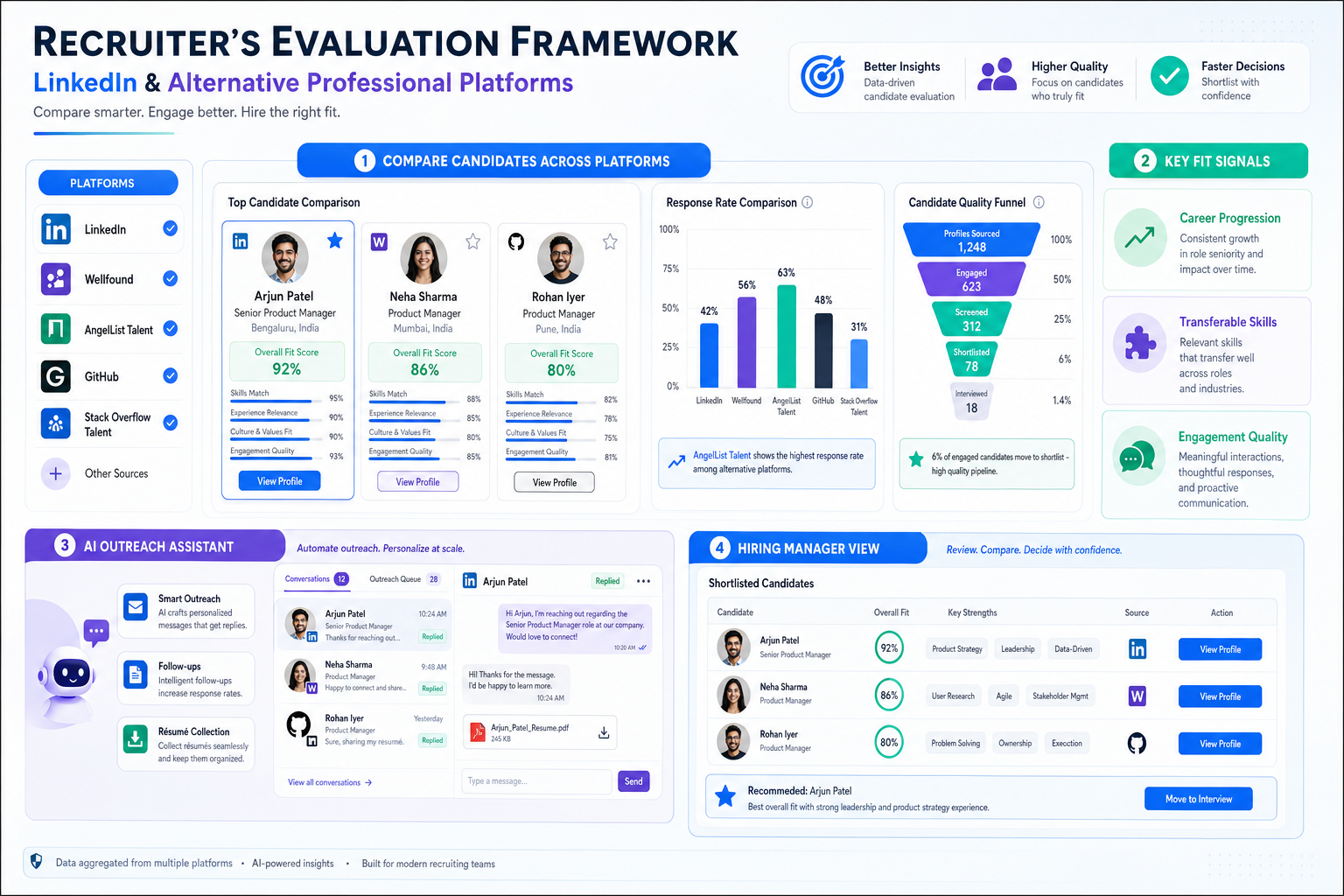
When recruiter response drops, this article helps hiring teams judge websites like LinkedIn by fit signals to avoid low-quality pipelines.
That matters because most channel decisions fail for the same reason many hires fail: teams confuse profile volume with candidate quality. In practice, that leads to weak outreach response, too many unqualified applicants, poor handoffs to hiring managers, and wasted recruiter hours spent chasing people who were never a realistic fit for the role or the working environment.
When I need to reduce that noise on LinkedIn itself, I have used StrategyBrain AI Recruiter to handle the repetitive front end of outreach, candidate replies, and résumé collection while I keep control of the real judgment calls. Its value is not that it replaces recruiter evaluation; it helps cover after-hours messaging, multilingual follow-up, and first-contact consistency so I can spend more time reviewing whether someone actually shows progression, transferable skills, and genuine interest in the work.
That screening logic is familiar to anyone who has hired finance talent. A strong finance candidate rarely stands out just because the profile looks polished. What usually matters first is whether the résumé shows real progression, whether the person can explain how prior experience transfers into the new seat, and whether their questions reveal that they understand the company’s challenges rather than just the title. When I review alternative professional platforms, I use the same lens.
If a network makes it easy to spot career progression, verify transferable strengths, and see whether candidates ask smart, role-specific questions, it is useful. If it mainly produces static profiles and generic messages, it is not much help. That is the real bridge into similar to LinkedIn platforms and apps similar to LinkedIn: the best alternatives are not the ones that look the same, but the ones that make better hiring judgment easier.
Table of Contents
Why LinkedIn Alternatives Matter Now
People usually search for websites like LinkedIn because something in the current workflow is underperforming. For job seekers, that may be low visibility or too much competition. For recruiters, it is often slower response rates, more templated outreach in the market, and less certainty about whether a profile reflects real capability.
From a recruiting operations perspective, that is the wrong moment to chase lookalike platforms based on popularity alone. A better approach is to ask what kind of proof the platform gives you. Can you see progression? Can you assess transferable skills? Can you tell whether the person is engaged enough to ask thoughtful questions or join the right conversations? Those are the same signals that separate a quality hire from a merely available one.
Practical takeaway: The strongest alternatives to LinkedIn are usually better at one hiring signal than LinkedIn itself—regional relevance, portfolio proof, technical contribution, startup intent, or community trust.
How to Evaluate Platforms Like a Recruiter
Borrowing from how experienced recruiters assess candidates, I suggest scoring any platform similar to LinkedIn against three core evidence areas first, then expanding into workflow fit.
1. Look for visible progression
In candidate review, progression tells you whether someone is developing, taking on complexity, and building credibility over time. Platforms that surface this well help recruiters make faster, better decisions. That might mean clear project history, strong endorsements from a real peer community, contribution records, event participation, or portfolio growth over time.
If a site only gives you a headline and a contact button, it is weak for serious hiring even if the user base is large.
2. Check how transferable skills show up
No recruiter gets a perfect candidate every time. Strong channels let people show why their past work will carry into a new function, industry, or team. That is especially important on startup platforms, remote communities, and career-change channels where experience is often adjacent rather than identical.
Good alternatives make that translation easier through project summaries, work samples, discussion threads, or specialist profiles that explain context rather than just job titles.
3. Watch for quality questions and real engagement
In interviews, good candidates ask specific questions about near-term deliverables, team needs, and business conditions. On professional platforms, the equivalent signal is thoughtful participation. Do users join relevant discussions, attend events, contribute useful material, or ask informed questions in niche communities? That often predicts response quality far better than profile polish does.
4. Then assess the workflow fit
Once those candidate-quality signals are clear, evaluate the channel itself:
- Professional identity: Can users present experience and credibility clearly?
- Network quality: Are members active, relevant, and reachable?
- Hiring utility: Can recruiters actually source, contact, and organize prospects there?
- Job visibility: Are current opportunities easy to find and filter?
- Community depth: Is there meaningful interaction or just profile storage?
- Signal-to-noise ratio: Does it reduce spam, irrelevant applications, and generic outreach?
This is also where many recruiters decide whether to keep leaning on LinkedIn or improve how they use it. In my own workflow, I still use LinkedIn as a broad discovery layer, but I pair it with AI Recruiter when volume becomes the bottleneck. It can manage first-touch messaging, continue conversations outside my working hours, and collect résumé details from interested candidates, but I still make the final call on fit after reviewing the evidence myself.
Quick Comparison Table: Best Websites Like LinkedIn
| Platform Type | Best For | Primary Use Case | Audience | Best Signal | Main Limitation | Free Access | Networking-First or Jobs-First |
|---|---|---|---|---|---|---|---|
| Startup career networks | Founders, startup candidates | Startup hiring and discovery | Early-stage talent | Transferable skills and mission fit | Narrow market coverage | Usually yes | Jobs-first |
| DACH professional networks | German-speaking markets | Regional hiring and networking | DACH professionals | Local progression and language fit | Less global reach | Often mixed | Networking-first |
| Event-led communities | Relationship-led networking | In-person and local connections | Professionals by city or sector | Quality questions and engagement | Weak direct application flow | Usually yes | Networking-first |
| Remote job platforms | Distributed teams | Remote work discovery | Remote candidates | Work-style alignment | Limited networking depth | Often yes | Jobs-first |
| Freelance marketplaces | Independent professionals | Project-based hiring | Freelancers and buyers | Commercial readiness | Less long-term brand building | Usually yes | Jobs-first |
| Portfolio communities | Creatives | Work showcase and discovery | Designers and creators | Proof of output | Weak general hiring workflow | Usually yes | Networking-first |
| Developer communities | Technical talent | Skill signaling and peer discovery | Engineers and technical recruiters | Contribution-based credibility | Not broad for all roles | Usually yes | Mixed |
| Associations and niche directories | Specialist sectors | Trusted industry networking | Credentialed professionals | Professional standing | Lower scale | Mixed | Networking-first |
12 Best Websites Like LinkedIn
The list below is ranked by recruiting usefulness, not by raw popularity. If your actual goal is better hiring judgment, that matters more than total user count.
1. Startup-focused professional platforms
These are among the most practical websites like LinkedIn if you hire for early-stage companies or want startup jobs. What they do well is give context: company stage, mission, team shape, and the kinds of transferable skills that matter when roles are fluid.
Best for: founders, startup recruiters, product talent, engineers.
Strengths: high intent, transparent role context, strong fit signaling.
Weaknesses: less useful for mature corporate hiring.
Recruiting advice: use these when adaptability and problem ownership matter as much as exact title match.
2. Regional professional networks for the DACH market
When the hiring market is local, region-specific networks often outperform global ones. Language, norms, and local progression signals are easier to read there than on broad international platforms.
Best for: DACH employers, local recruiters, bilingual professionals.
Strengths: regional concentration, local credibility, language fit.
Weaknesses: weaker reach outside the region.
Recruiting advice: for geography-bound roles, regional relevance beats global scale.
3. Event-led networking platforms
These are some of the most underrated apps similar to LinkedIn. They create context before outreach. Instead of cold messages, you can evaluate people by what they ask, what they discuss, and how they show up in a professional setting.
Best for: consultants, business development teams, community recruiters.
Strengths: trust-building, stronger engagement signals, local visibility.
Weaknesses: limited direct sourcing workflow.
Recruiting advice: ideal for relationship-led pipeline building, not just urgent requisitions.
4. Remote-first job platforms
Remote candidates behave differently, and remote employers need different filters. These channels help remove location friction and attract people with genuine distributed-work intent.
Best for: global recruiters, remote employers, distributed candidates.
Strengths: strong role filtering, remote alignment, clear work preferences.
Weaknesses: less networking depth.
Recruiting advice: pair them with clear screening around timezone fit, communication habits, and autonomy.
5. Freelance and contract marketplaces
For project work, these can be better than traditional networks. They are not full replacements, but they often produce faster commercial matching when the need is execution rather than permanent employment.
Best for: hiring managers with urgent project work, freelancers, agencies.
Strengths: quick matching, visible work history, clear commercial intent.
Weaknesses: limited employer-brand value.
Recruiting advice: define scope and deliverables up front; clarity drives better outcomes here than reputation alone.
6. Portfolio-first communities for creatives
Creative hiring is one of the clearest cases where a profile-first network underperforms. Output matters more than headlines, so portfolio communities often work better than general platforms similar to LinkedIn.
Best for: creative recruiters, agencies, designers, writers.
Strengths: immediate skill proof, visual differentiation, stronger quality signals.
Weaknesses: less structured for broad networking.
Recruiting advice: review the work before the résumé.
7. Developer communities and code-centered networks
For engineering hiring, contribution-based communities often reveal far more than polished professional profiles. They surface technical depth, peer respect, and specialization through real activity.
Best for: software engineers, technical sourcers, engineering leaders.
Strengths: strong skill signaling, credible contribution history, specialist depth.
Weaknesses: harder for non-technical teams to read.
Recruiting advice: lead with relevant technical context, not a generic recruiter script.
8. Professional associations and member directories
These are particularly valuable in regulated or credential-driven fields. They often provide better trust signals than public networks.
Best for: healthcare, legal, finance, engineering, education.
Strengths: credibility, credential relevance, trusted environment.
Weaknesses: slower growth, lower scale.
Recruiting advice: if certification or standing matters, start here before broad networks.
9. Alumni networks and university communities
For early-career recruitment and referral-led hiring, alumni spaces still perform well because they combine identity with trust.
Best for: graduate recruiters, emerging talent teams, career switchers.
Strengths: warm access, shared background, good response quality.
Weaknesses: limited breadth by institution.
Recruiting advice: strong for quality conversations, not necessarily volume.
10. Industry forums and niche online communities
Some of the best alternatives are not classic networks at all. They are specialist discussion spaces where credibility is earned through relevance.
Best for: hard-to-fill roles, niche recruiters, specialist contractors.
Strengths: concentration, insider trust, highly relevant engagement.
Weaknesses: slower discovery, requires authentic participation.
Recruiting advice: contribute before you recruit.
11. Local business communities and chambers
For local hiring, these groups can be more useful than global digital-first platforms because proximity and reputation drive referrals.
Best for: SMB hiring, local operations, sales roles, partnerships.
Strengths: geographic trust, local referrals, practical introductions.
Weaknesses: limited scalability.
Recruiting advice: where community trust matters, local visibility often wins.
12. Curated talent communities
Curated networks trade scale for quality control. That makes them useful when the cost of a bad fit is high.
Best for: specialist searches, premium hiring, high-trust project work.
Strengths: stronger qualification signals, cleaner candidate pools.
Weaknesses: smaller volume, possible access limits.
Recruiting advice: use them when pre-screening quality matters more than reach.
How I Use LinkedIn Better Before Replacing It
In most searches, I do not start by abandoning LinkedIn. I start by tightening the workflow around it. The biggest waste usually happens between first outreach and actual recruiter review: delayed replies, inconsistent follow-up, missed after-hours messages, and scattered résumé collection.
That is where StrategyBrain AI Recruiter on LinkedIn has been useful in my own process. I can set the search criteria, role context, and communication boundaries, then let it handle repetitive candidate contact and early interest checks. If someone wants to move forward, the system can collect résumé and contact details, including through LinkedIn file sharing or email routes, and I step in to assess the actual résumé against the brief.
What I like most is not “automation” as a slogan. It is the operational benefit of not losing candidate momentum while I am in client meetings or asleep in another time zone. For recruiters handling international searches, the multilingual support also matters because a lot of friction in early-stage outreach is simply avoidable miscommunication. You can review more about the workflow on the product overview and the free trial page.
The important boundary is this: I still own judgment. Just as a strong finance hire cannot be identified by profile polish alone, no tool should make the final quality call for you. The recruiter still has to decide whether the candidate shows progression, whether their skills transfer to the mandate, and whether their questions suggest real understanding of the job.
Best LinkedIn Alternatives by User Type
For job seekers
Use remote-first platforms for distributed work, startup networks for early-stage roles, and alumni or specialist communities when trust and referrals matter. If you are comparing apps similar to LinkedIn, choose the one that matches how your strengths are best demonstrated.
For freelancers
Freelance marketplaces are best for immediate work flow, while portfolio communities are better for long-term credibility. If your work is visual or project-based, proof matters more than contact count.
For founders
Startup communities usually work best because they make transferable skills and mission fit easier to evaluate. Broad channels tend to create more noise for early-stage teams.
For creatives
Portfolio-first communities usually outperform profile-first networks. Review output, range, and problem-solving before you weigh profile polish.
For developers
Developer communities tend to provide the strongest evidence because they show practice, contribution, and specialization directly.
For recruiters and HR teams
Use a channel mix. Keep one broad platform for visibility, one specialist source for high-signal candidates, and one relationship-led community for better engagement quality.
Should You Replace LinkedIn Entirely or Use Alternatives Alongside It?
Most teams should use alternatives alongside it. LinkedIn is still useful for baseline discoverability and professional identity. The gap is that it does not always provide enough concentrated signal for niche, regional, portfolio-led, or community-trust hiring.
Replacement makes more sense when:
- Your roles are highly niche and broad networks create too much noise.
- Your market is region-specific and local platforms have stronger adoption.
- Your hiring depends on portfolios, code, or other real-work proof.
- Your target audience avoids broad professional networks because of fatigue or privacy concerns.
Otherwise, the practical setup is simple: keep LinkedIn as the visibility layer, improve its workflow, and add one or two focused alternatives where the hiring signal is stronger.
FAQ
What is the best alternative to LinkedIn?
There is no universal winner. The best option depends on what proof you need: startup intent, regional credibility, portfolio evidence, technical contribution, or community trust.
Are there free sites similar to LinkedIn?
Yes. Many websites like LinkedIn offer free profile creation, browsing, or participation. The difference is usually in audience quality and workflow features rather than basic access.
Which apps similar to LinkedIn are best for job seekers?
Remote-first platforms are best for distributed roles, startup platforms for early-stage work, and portfolio communities for creatives. The right choice depends on how your strengths are best evaluated.
Which sites like LinkedIn are best for recruiters?
Recruiters usually do best with a mix: a broad network for visibility, a niche channel for sourcing, and a community-led platform for stronger response quality.
Can you replace LinkedIn completely?
Sometimes, but not usually. Most teams get better results by improving how they use LinkedIn and adding focused alternatives where they can see clearer progression, transferable skills, and engagement signals.
Final Verdict
If you are researching websites like LinkedIn, do not start with the question of which platform looks most familiar. Start with the same judgment criteria you would use to identify a quality hire: progression, transferable value, and evidence of real engagement.
That framework makes it easier to decide which platforms are truly similar to LinkedIn in a useful way and which apps similar to LinkedIn fit your actual hiring goals. For most recruiters, the winning setup is not one replacement. It is a better evaluation lens, a cleaner workflow on LinkedIn, and a small number of high-signal alternatives matched to the role.