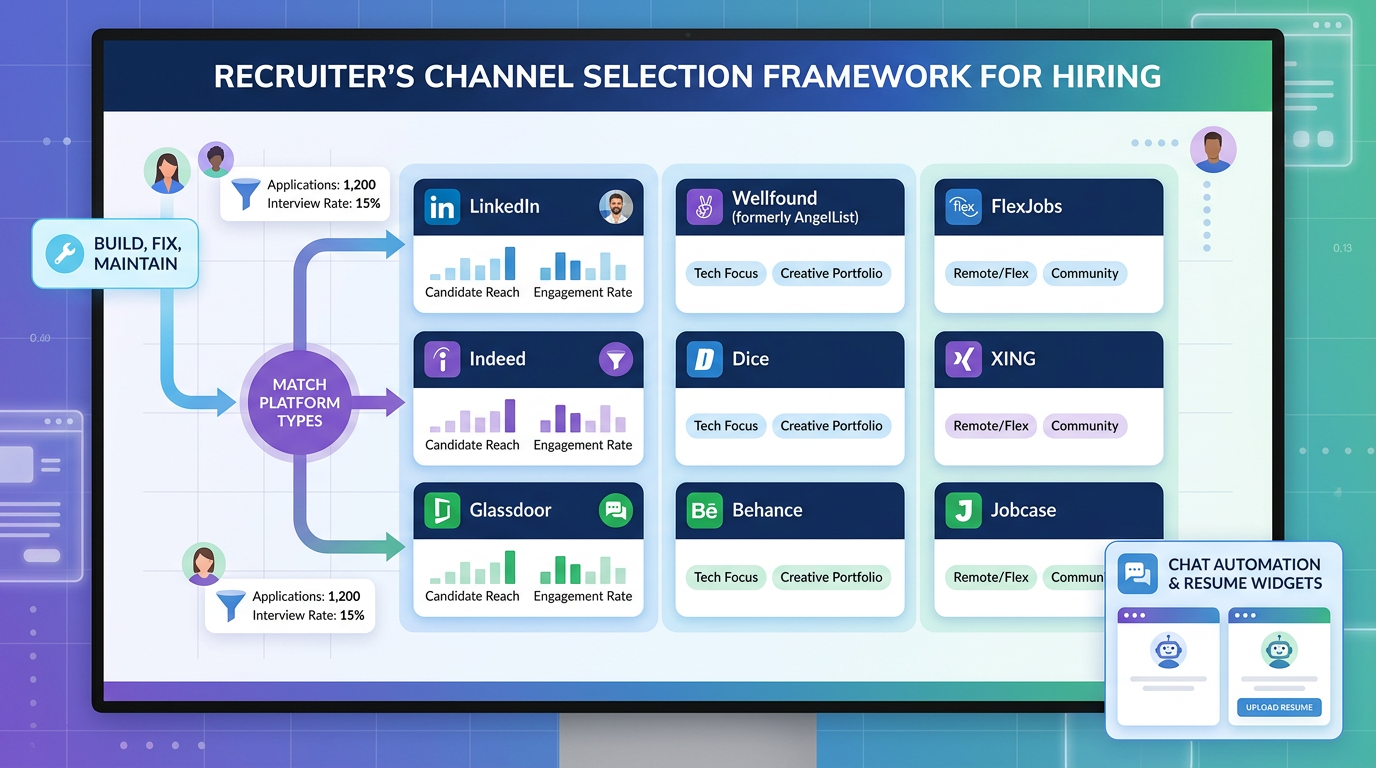
Choosing websites like LinkedIn by hiring goal helps recruiters avoid channel mismatch, cut screening waste, and reach better-fit talent faster.
That matters more than most teams admit. When recruiters use the wrong channel, they do not just get fewer replies. They lose time screening the wrong applicants, miss niche talent that never uses LinkedIn heavily, slow down hiring manager feedback, and create avoidable cost in outreach, coordination, and follow-up. Agency recruiters feel it in productivity and placements; in-house teams feel it in backlog, candidate drop-off, and weaker stakeholder trust.
In my own sourcing work, I have found that an AI-supported workflow helps most when the issue is not effort but channel-to-task mismatch. StrategyBrain AI Recruiter is useful in that specific gap because it can automate initial LinkedIn outreach, keep candidate conversations moving across time zones, and collect resumes from interested prospects while the recruiter still makes the final judgment on fit, resume quality, and next-step decisions. If a team is staying on LinkedIn for part of the process, this kind of support reduces the drag that comes from repetitive outreach while you test whether LinkedIn should remain your main source at all.
The underlying problem shows up clearly in growth-stage hiring. Once a company passes an inflection point such as roughly $5M in revenue, closes a major funding round, or starts preparing for a more mature operating structure, leadership can no longer hire reactively. A founder, CEO, or finance leader is not simply asking for "more candidates." They are deciding whether the next hire is meant to build a capability, fix a process weakness, or maintain day-to-day operations while the business scales.
That is where channel choice becomes a real recruiting decision, not a posting habit. If the immediate pain is month-end reporting, the search may need a dependable accountant now. If the bigger milestone is a financing round a few months away, the stronger move may be a finance analyst or strategic finance profile instead. The same hiring brief can fail on LinkedIn if the wrong audience behavior is assumed. That is why recruiters comparing apps similar to LinkedIn and job boards better than LinkedIn should start with decision criteria first, then pick the platform that matches the work, timing, and complexity.
Most articles on LinkedIn alternatives flatten everything into one big platform list. In practice, recruiters need a more useful framework: what are you hiring for, what stage is the business in, how complex is the role, and do you need networking, active applicants, or a specialized talent pool? That is the lens I use below.
Table of Contents
- Why LinkedIn Is Not Always the Best Default
- Four Factors to Use Before Choosing an Alternative
- Quick Comparison: Best Websites Like LinkedIn
- Networking Platforms vs. Job Boards
- Best Platforms by Hiring Context
- Where AI Recruiter Fits in a LinkedIn-Heavy Workflow
- How to Choose the Right Option
- Common Mistakes Recruiters Make
- FAQ
Why LinkedIn Is Not Always the Best Default
LinkedIn is still useful, especially for white-collar visibility, passive outreach, employer branding, and profile-based sourcing. But many searches for websites like LinkedIn come from a practical frustration: too much noise, too much competition, too little specialization, or too much manual follow-up.
In recruiting, that usually means one of three things:
- You need active applicants, not passive networking signals
- You need a narrower talent market, not the biggest audience possible
- You need a workflow that fits a specific business stage or hiring event
That last point is the one most often missed. A company hiring its first serious finance leader after a funding event is solving a different problem than a company hiring repeatable high-volume talent. The source strategy should reflect that distinction.
Four Factors to Use Before Choosing an Alternative
The strongest insight from growth-stage hiring is that hiring channels should be selected with the same discipline as the role itself. Before comparing apps similar to LinkedIn, I suggest using four filters.
1. Are you hiring to build, fix, or maintain?
This is the most useful first question. Sometimes the business has a breakdown to fix. Sometimes it needs a builder who can create process and structure. Sometimes it simply needs someone to keep operations stable during growth.
For recruiters, this changes where you search:
- Build: better served by niche networks, specialized communities, or targeted outbound
- Fix: often requires experienced operators who may be easier to find through curated or role-specific channels
- Maintain: may perform well on broader job boards with active applicants
If you skip this step, you end up measuring platforms by applicant volume rather than by whether they match the business problem.
2. How complex is the company’s revenue model or operating structure?
A role can look small on paper and still demand a more sophisticated hiring source. A company under $10M in revenue may still have multiple geographies, cross-border compliance issues, product-line complexity, or uneven transaction volume. That usually means the recruiter needs more precision, not more exposure.
In those cases, niche platforms often outperform general networks because the role requires a candidate who understands that complexity immediately.
3. What hiring traps are shaping the brief?
One common mistake is hiring in the image of the current leader. A finance executive from an accounting-heavy background may overvalue controllership experience. Another may hire too far ahead of real need and overlook the current pain point.
Recruiters should treat platform choice the same way. If the brief is biased, the wrong channel amplifies that bias. A broad professional network can flood the search with adjacent profiles that look familiar but are not right for the actual mandate.
4. Should you invest in more people effort or better technology support?
High-growth teams often cannot do everything at once. They may need to choose between adding recruiter effort, refining process, or using automation in the part of the workflow that is repetitive but necessary.
That is where LinkedIn-specific automation can help. If the talent market really is on LinkedIn, then the problem may not be the platform itself but the amount of manual work needed to reach and qualify interest consistently. If the audience is not there, though, no amount of automation fixes a channel mismatch.
Quick Comparison: Best Websites Like LinkedIn
| Platform | Category | Best For | Where It Beats LinkedIn |
|---|---|---|---|
| Indeed | General job board | Broad reach, active applicants, high-volume hiring | Simpler job discovery and stronger active-search intent |
| Glassdoor | Job board + employer research | Candidates who want company context | Better when employer transparency influences apply rates |
| ZipRecruiter | General hiring marketplace | Fast posting and distribution | Useful when speed matters more than networking |
| Wellfound | Startup talent marketplace | Startup and early-stage hiring | Stronger audience match for venture-backed roles |
| Professional network | DACH-region hiring and networking | More relevant than LinkedIn in specific regional markets | |
| FlexJobs | Specialized job board | Remote and flexible work | Better intent match for work-style-driven searches |
| Dice | Niche tech board | Technology recruiting | Higher specialization for technical roles |
| Jobcase | Community/job platform | Frontline and hourly hiring | Reaches worker segments LinkedIn often misses |
| Behance | Portfolio community | Creative and design hiring | Shows proof of work more clearly than profile summaries |
Networking Platforms vs. Job Boards
Not everyone looking for websites like LinkedIn actually wants another network. Many just want a faster route to relevant talent or relevant openings.
When networking platforms make sense
- You need passive talent outreach
- You are hiring leadership, specialist, or relationship-driven roles
- Regional professional credibility matters
- The search benefits from visibility and reputation over immediate applications
When job boards better than LinkedIn make more sense
- You need active job seekers now
- You want less dependence on profile-building behavior
- The role is high-volume or urgency-driven
- You are hiring in a niche where search intent matters more than social presence
Practical takeaway: LinkedIn is usually strongest as a relationship platform. It is not automatically the strongest transaction platform for every hiring need.
Best Platforms by Hiring Context
Indeed for broad hiring volume
If your main issue is reach, Indeed is one of the clearest job boards better than LinkedIn. Candidates there are generally in application mode already, which reduces some of the persuasion work recruiters have to do on LinkedIn.
- Best for: High-volume roles, broad location coverage, and active job search
- Watch-out: Volume can become noise without strong screening criteria
- Recruiter note: Use clear titles and hard requirements to reduce weak applications
Glassdoor for informed applicants
Glassdoor is useful when candidates need context before they apply. In my experience, that matters for roles where expectations about management style, culture, or stability affect conversion.
- Best for: Employer brand-sensitive hiring
- Watch-out: Mixed employer reputation can suppress conversion
- Recruiter note: Align the job description with the reality candidates will research
ZipRecruiter for speed
ZipRecruiter is more operational than relational. If the need is quick visibility rather than long-term networking, it can be more direct than LinkedIn.
- Best for: Fast posting and wide exposure
- Watch-out: Quick distribution needs quick recruiter response
- Recruiter note: Pair speed with knockout questions and disciplined follow-up
Wellfound for startup roles
For startup hiring, Wellfound often feels closer to how candidates actually evaluate those roles. Company stage, mission, and scope matter more there than on a broad professional profile site.
- Best for: Early-stage, venture-backed, and startup-minded talent
- Watch-out: Less useful outside startup hiring contexts
- Recruiter note: Be explicit about ambiguity, pace, and role breadth
Dice for technical hiring
Dice remains relevant when role specificity matters more than social reach. Engineering and infrastructure candidates often respond better to detail than to generic employer messaging.
- Best for: Technical and specialist tech recruiting
- Watch-out: Weak briefs get exposed quickly on specialist platforms
- Recruiter note: Use realistic stack requirements and avoid inflated wish lists
Behance for creative recruiting
Creative recruiting is often portfolio-first. Behance can outperform LinkedIn because the work itself is visible, not just summarized.
- Best for: Design, branding, and visual creative roles
- Watch-out: Strong portfolios still need role relevance review
- Recruiter note: Evaluate fit by project type, not just polish
FlexJobs for remote hiring
When candidate intent centers on flexibility, remote-first platforms are often better than broad networks. People searching there are filtering by work arrangement first.
- Best for: Remote and flexible roles
- Watch-out: Ambiguous location rules create drop-off and frustration
- Recruiter note: State geography, time zone, and schedule expectations clearly
XING for regional relevance
XING is not a global LinkedIn replacement, but it is useful when recruiting in German-speaking markets where local habits and market concentration matter more than global scale.
- Best for: DACH-region recruitment and networking
- Watch-out: Limited value for globally distributed hiring outside that context
- Recruiter note: Use it when local market fit is a stronger predictor than universal reach
Jobcase for frontline and hourly audiences
Jobcase reaches worker communities that many LinkedIn-centered recruiters underserve. For frontline and hourly recruiting, that distinction matters.
- Best for: Essential, frontline, and hourly hiring
- Watch-out: Corporate-style messaging can miss the audience
- Recruiter note: Lead with practical details like schedule, pay structure, and location clarity
Where AI Recruiter Fits in a LinkedIn-Heavy Workflow
If you are still doing significant sourcing on LinkedIn, the question is not only whether there are apps similar to LinkedIn or job boards better than LinkedIn. It is also whether your current LinkedIn process is too manual.
I tested that question from a workflow angle rather than a hype angle. What helped most was not replacing recruiter judgment, but offloading repetitive top-of-funnel tasks. AI Recruiter can handle initial outreach, maintain candidate conversations around the clock, and gather resumes and contact details from people who actually want to continue. That was most useful on searches where response timing mattered and where I did not want good leads to stall overnight or across regions.
What I liked in practice was the division of labor. The system keeps the conversation moving and captures interest, while I still review the resume, assess whether the profile really matches the brief, and decide who moves forward. That matters because a candidate can be willing to talk without being the right hire. Automation helps with motion; the recruiter still owns evaluation.
For recruiters working across markets, the multilingual communication angle is also practical rather than flashy. A candidate who replies after work hours or in another language does not have to wait for a human recruiter to wake up and restart the thread. If your team relies heavily on LinkedIn, that can reduce a lot of preventable leakage. More details are in the usage notes here and the conversation examples here.
The important caveat is simple: this improves a LinkedIn workflow; it does not make LinkedIn the right source for every search. If your real issue is audience mismatch, use a different platform. If your issue is LinkedIn workload, support the workflow better.
How to Choose the Right Option
1. Start with the business milestone
Is the company approaching a funding event, geographic expansion, compliance shift, or leadership transition? That milestone often tells you more about the right channel than the job title alone.
2. Define the hire’s true mandate
Ask whether the person is expected to build, fix, or maintain. This helps you separate broad applicant needs from specialist search needs.
3. Match the source to candidate behavior
- Active search behavior: general job boards
- Passive relationship-driven behavior: professional networks
- Role-specific behavior: niche communities and specialist boards
- Portfolio-led behavior: creative platforms
- Regional behavior: local networks
4. Decide whether LinkedIn is wrong or just inefficient
If the right audience is on LinkedIn but your team is overloaded, workflow support can help. If the audience is not there, switch channels instead of optimizing the wrong one.
5. Measure quality after the click
The right source is not the one with the most applicants. It is the one producing better conversations, better interviews, and better alignment with the hiring need.
Common Mistakes Recruiters Make
Treating every alternative as a full LinkedIn replacement
Most platforms do one thing better, not everything better. That is fine if you know what job the platform is supposed to do.
Hiring for visible pain only
The original growth-stage lesson matters here: current pain is not the only signal. If a business milestone is coming, the next hire may need to support what is ahead, not just what is hurting now.
Choosing scale when complexity is the real issue
A role with global operations, multiple product lines, or specialized finance or technical demands usually needs precision, not a bigger funnel.
Using LinkedIn because it is familiar
Familiarity creates lazy source strategy. Recruiters often stay on LinkedIn even when candidate behavior clearly belongs somewhere else.
Confusing automation with qualification
Workflow tools can speed up outreach, replies, and resume collection. They do not replace recruiter judgment about actual fit, timing, or hiring risk.
FAQ
What are the best websites like LinkedIn?
The best websites like LinkedIn depend on your goal. Indeed, Glassdoor, and ZipRecruiter are strong for active job search. Wellfound, Dice, Behance, FlexJobs, XING, and Jobcase are better when role type, region, or work style matters more than general networking.
Are there apps similar to LinkedIn for recruiters?
Yes, but most do not replicate LinkedIn exactly. Some focus on networking, some on job discovery, and some on a niche talent pool. Recruiters should compare them based on audience behavior rather than feature similarity alone.
What are job boards better than LinkedIn?
Job boards can be better than LinkedIn when you need active applicants, less social-network noise, stronger employer research, or better role specialization. Indeed, Glassdoor, ZipRecruiter, and several niche boards often outperform LinkedIn for those use cases.
Is LinkedIn still worth using for recruiting?
Yes, especially for passive outreach, white-collar visibility, and relationship-based sourcing. But it is not always the best primary channel for every role. The right question is whether LinkedIn fits the hiring goal.
When should recruiters use AI support with LinkedIn?
Use AI support when LinkedIn remains a valid sourcing channel but the workflow is too manual. It is most helpful for outreach, follow-up, multilingual messaging, and collecting resumes from interested candidates while recruiters retain final evaluation control.
Conclusion
The best websites like LinkedIn are not the ones that look most similar on a feature list. They are the ones that match the hiring event, the candidate behavior, and the complexity of the role.
That is why the most useful sequence is simple: define whether the hire is meant to build, fix, or maintain; understand the operating complexity behind the role; watch for bias in the brief; and decide whether your problem is channel selection or channel execution. Once you do that, apps similar to LinkedIn and job boards better than LinkedIn become easier to evaluate honestly.
And if LinkedIn is still part of your sourcing mix, support it properly. A tool like StrategyBrain AI Recruiter can reduce repetitive outreach work and keep conversations moving, but the recruiter still owns the decision that matters most: who is actually right for the job.