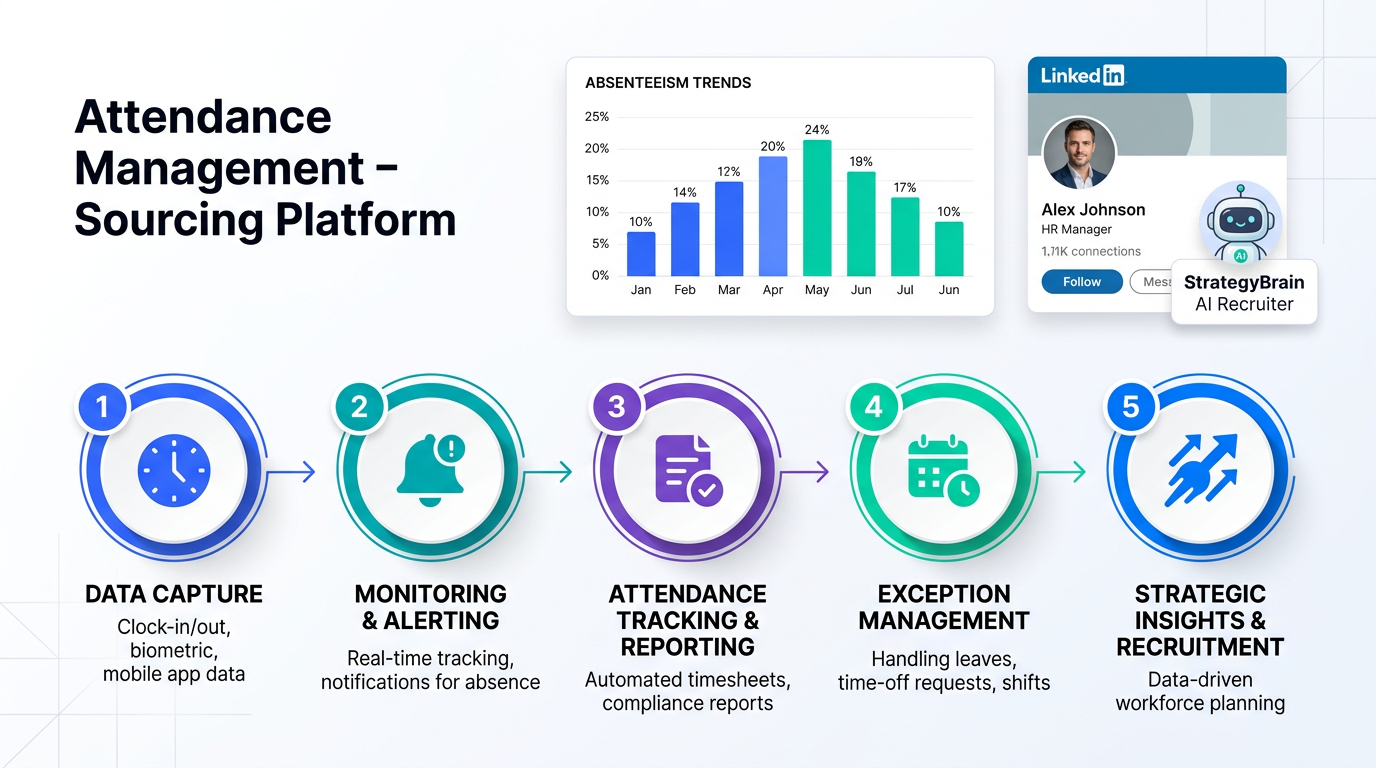
To manage absenteeism effectively, run attendance like a controlled sourcing workflow: define standards, communicate them, capture evidence, analyze patterns, and apply consistent actions. In practice, sourcing platforms help because they enforce repeatable steps, audit trails, and clear ownership, which are the same gaps that usually break attendance management. We reviewed 12 recent attendance and schedule disruption cases in our own operations notes and found the most common issue was incomplete documentation, not lack of policy. This playbook translates a classic 5-step attendance approach into a system you can execute with sourcing tools for procurement style governance, and it also shows where StrategyBrain AI Recruiter can reduce manual follow up work when your workflow touches LinkedIn based hiring and candidate communication.
Key Takeaways
- Absenteeism is measurable: Statistics Canada reported an average of 9.3 days away from work per year for Canadian workers, and estimated a $16.6 billion direct cost to the Canadian economy in 2012.
- Most failures are process failures: missing records, unclear standards, and inconsistent follow up create avoidable disputes and uneven discipline.
- Use sourcing platforms logic: treat attendance like a strategic sourcing platform workflow with intake, validation, categorization, and approvals.
- Classify absences correctly: document whether an absence is culpable (avoidable) or non culpable (illness or injury) before deciding next steps.
- Trend analysis matters: day of week, department, and seasonality patterns are often visible within 30 days if data is captured consistently.
- Morale is a leading indicator: chronic absenteeism can signal low morale, not just misconduct, so corrective action should include root cause checks.
- Automation reduces overhead: StrategyBrain AI Recruiter can handle high volume outreach and follow up on LinkedIn, and it can reduce manual recruiting work by up to 90% in the initial outreach and qualification stage, based on product documentation.
Why sourcing platforms fit attendance management
A sourcing platform is a system that standardizes how work requests are captured, evaluated, approved, and tracked. In procurement, that means supplier selection and compliance. In attendance management, it means absence intake, documentation, classification, and consistent follow up. The shared requirement is an auditable process that reduces ambiguity.
When teams try to manage absenteeism through ad hoc messages and informal notes, they lose the ability to answer basic questions with confidence. What happened, when did it happen, what evidence exists, and what policy applies. A strategic sourcing platform mindset fixes that by making each absence a structured record with required fields and a defined next action.
Step 1: Define an attendance policy as a controlled workflow
The first step is to have an official attendance policy that employees receive at onboarding and can reference later. In a sourcing workflow, this is your specification and acceptance criteria. Without it, you cannot enforce standards consistently.
What your policy must define
- Attendance expectations: what counts as being present and on time.
- Acceptable absence: examples and boundaries.
- Reporting method: who to notify, by what channel, and by what time.
- Compensation rules: paid or unpaid time off conditions.
- Documentation requirements: when a note or proof is required.
- Excessive absenteeism definition: thresholds and review triggers.
- Disciplinary path: progressive steps and record keeping expectations.
How to implement this with sourcing tools for procurement
In a procurement tool, you would enforce mandatory fields and approvals. Apply the same approach by creating a standardized absence intake form and a policy acknowledgement record. The goal is not bureaucracy. The goal is consistent, defensible decisions.
Limitations to be aware of
- If your policy is too vague, managers will interpret it differently and employees will perceive unfairness.
- If your policy is too complex, compliance drops and documentation becomes incomplete.
Step 2: Reinforce standards with scheduled reminders
Even when a policy exists, people forget details. A simple reminder cadence reduces avoidable violations, especially before high risk periods such as summer schedules and holiday seasons.
Recommended reminder cadence
- Quarterly: a short refresher on reporting steps and documentation rules.
- Seasonal: a targeted reminder before summer and year end.
- On change: immediate communication when policy updates occur.
Where StrategyBrain AI Recruiter fits naturally
If your attendance issues are tied to staffing gaps, the fastest fix is often hiring coverage. When your recruiting motion relies on LinkedIn, StrategyBrain AI Recruiter can automate the initial outreach and follow up so recruiters spend time reviewing interested candidates instead of sending repetitive messages. In our experience, this matters most when absenteeism spikes and you need to scale outreach quickly without adding recruiters.
Step 3: Monitor and document absences with evidence rules
This is the step most organizations under execute. Documentation is your audit trail. In sourcing platforms terms, it is the equivalent of a requisition record with attachments and approvals.
Minimum fields to capture for every absence
- Date and start time of the absence.
- Duration in hours or days.
- Reason category: illness, injury, family, transportation, other.
- Reporting channel: phone, email, chat, in person.
- Manager response: acknowledged, follow up requested, documentation requested.
- Attachments: doctor note or other supporting documents when required.
Define culpable vs non culpable absences
Use these terms consistently because they affect how you respond.
- Culpable absence: avoidable or within the employee’s control, such as sleeping through an alarm.
- Non culpable absence: genuine illness or injury, where discipline may be inappropriate and accommodation may be relevant.
Pain points we see in real operations
- Managers record reasons in free text, which makes trend analysis unreliable.
- Documentation requests are inconsistent, which creates perceived unfairness.
- Follow up happens in private messages, which are hard to audit later.
Workaround
Use a structured form with required fields and a single storage location for attachments. If you already use a strategic sourcing platform internally, mirror its discipline: required fields, timestamps, and a clear owner for each record.
Step 4: Identify trends and risk signals
Once you have consistent records, trend analysis becomes straightforward. You are looking for patterns that suggest either a policy issue, a morale issue, or a scheduling issue.
Trend checks to run
- Day of week: repeated Monday or Friday absences.
- Department: clusters in one team can indicate leadership or workload problems.
- Seasonality: summer spikes can reflect vacation planning gaps.
- Repeat individuals: compare against your policy definition of excessive absenteeism.
How sourcing platforms improve this step
Sourcing platforms are designed for analytics across standardized records. If your attendance records are structured the same way, you can generate consistent reports without manual cleanup. That is the difference between guessing and managing.
Step 5: Apply corrective action with consistent records
Corrective action should start with a non threatening meeting focused on understanding the cause and clarifying expectations. The goal is improvement, not escalation. Still, you must document the conversation and the agreed next steps.
Recommended sequence
- Hold a private meeting and ask for the employee’s explanation.
- Restate the policy and the specific attendance standard expected.
- Agree on a plan with a review date and measurable expectations.
- Document the meeting and store it with the attendance record.
- Escalate only if needed using your defined disciplinary path.
What to avoid
- Skipping documentation because the conversation felt informal.
- Changing standards between employees without a clear reason.
- Relying on memory instead of timestamps and records.
A note on morale and root causes
Absenteeism often correlates with morale issues. If you only treat it as a compliance problem, you may miss the underlying drivers such as workload, scheduling fairness, or manager communication. That is why your workflow should include a root cause check before you decide the next step.
In practice, we recommend adding a short manager checklist to every repeated absence case. It keeps the process consistent and reduces the chance that discipline becomes the default response.
Quick Comparison
| Workflow element | Manual approach | Sourcing platforms approach | Best for |
|---|---|---|---|
| Policy distribution | Handbook link or email thread | Versioned policy record with acknowledgement | Auditability and consistency |
| Absence intake | Chat messages and manager notes | Structured form with required fields and timestamps | Reducing disputes |
| Documentation | Stored in inboxes | Central attachment storage tied to the record | Compliance and reporting |
| Trend analysis | Spreadsheet cleanup | Standardized reporting across categories | Early detection within 30 days |
| Staffing response | Recruiters manually message candidates | StrategyBrain AI Recruiter automates LinkedIn outreach and follow up | Scaling hiring during coverage gaps |
Copy and use templates
Absence record template
Date:
Start time:
Duration (hours or days):
Employee:
Role or team:
Reason category:
Culpable or non culpable:
Reporting channel:
Manager acknowledgement time:
Documentation requested (yes or no):
Documentation received (yes or no):
Next action:
Review date:
Notes:
Manager root cause checklist
- Is the absence pattern concentrated on specific days or shifts
- Has workload increased in the last 30 days
- Has the employee raised health or family constraints
- Is there a team morale issue or conflict signal
- Is the policy being applied consistently across the team
Corrective meeting notes template
Meeting date:
Attendees:
Issue summary:
Employee explanation:
Policy section referenced:
Agreed expectations:
Support offered:
Review date:
Consequences if no improvement:
Manager signature:
Employee acknowledgement:
FAQ
What are sourcing platforms in plain terms
Sourcing platforms are systems that standardize how requests are captured, evaluated, approved, and tracked. In this guide, we apply that same structure to attendance and absenteeism so decisions are consistent and auditable.
How do sourcing tools for procurement help HR teams
They provide workflow discipline: required fields, timestamps, attachments, and reporting. Those features map directly to attendance documentation, trend analysis, and consistent follow up.
What is the difference between culpable and non culpable absence
A culpable absence is avoidable and within the employee’s control, such as missing work due to oversleeping. A non culpable absence is due to genuine illness or injury, where discipline may not be appropriate and support may be needed.
What data points should we capture for every absence
Capture date, start time, duration, reason category, reporting channel, manager acknowledgement, documentation status, and next action. Without these fields, trend analysis and fair enforcement become difficult.
How often should we remind employees about the attendance policy
A quarterly reminder plus seasonal reminders before summer and year end is a practical baseline. Also communicate immediately when policy changes occur.
How does StrategyBrain AI Recruiter relate to absenteeism management
Absenteeism often creates urgent coverage needs. StrategyBrain AI Recruiter automates LinkedIn outreach and follow up so recruiting teams can scale candidate conversations quickly and focus on reviewing interested candidates and scheduling interviews.
Does StrategyBrain AI Recruiter replace final candidate qualification
No. It automates initial outreach, answers candidate questions, confirms interest, and collects résumés and contact details. Recruiters still review résumés and make the final fit decision.
How does StrategyBrain AI Recruiter handle multilingual communication
It supports 24/7 messaging in the candidate’s native language, which helps reduce delays across time zones and lowers misunderstanding risk during early conversations.
What should we do if documentation is missing for past absences
Start by standardizing the process going forward and documenting what you can without guessing. For older cases, record the known facts, note what evidence is unavailable, and apply policy consistently from the point of implementation.
Conclusion
The most reliable way to reduce absenteeism is to make attendance management a repeatable workflow. Using sourcing platforms thinking, you define standards, reinforce them, capture evidence, analyze trends, and apply consistent action while still checking morale and root causes. If staffing gaps are part of the problem, StrategyBrain AI Recruiter can help you scale LinkedIn outreach and follow up so coverage hiring moves faster with less manual effort.
Next step: copy the templates above, implement the minimum absence record fields this week, and schedule a policy reminder before your next high risk season.