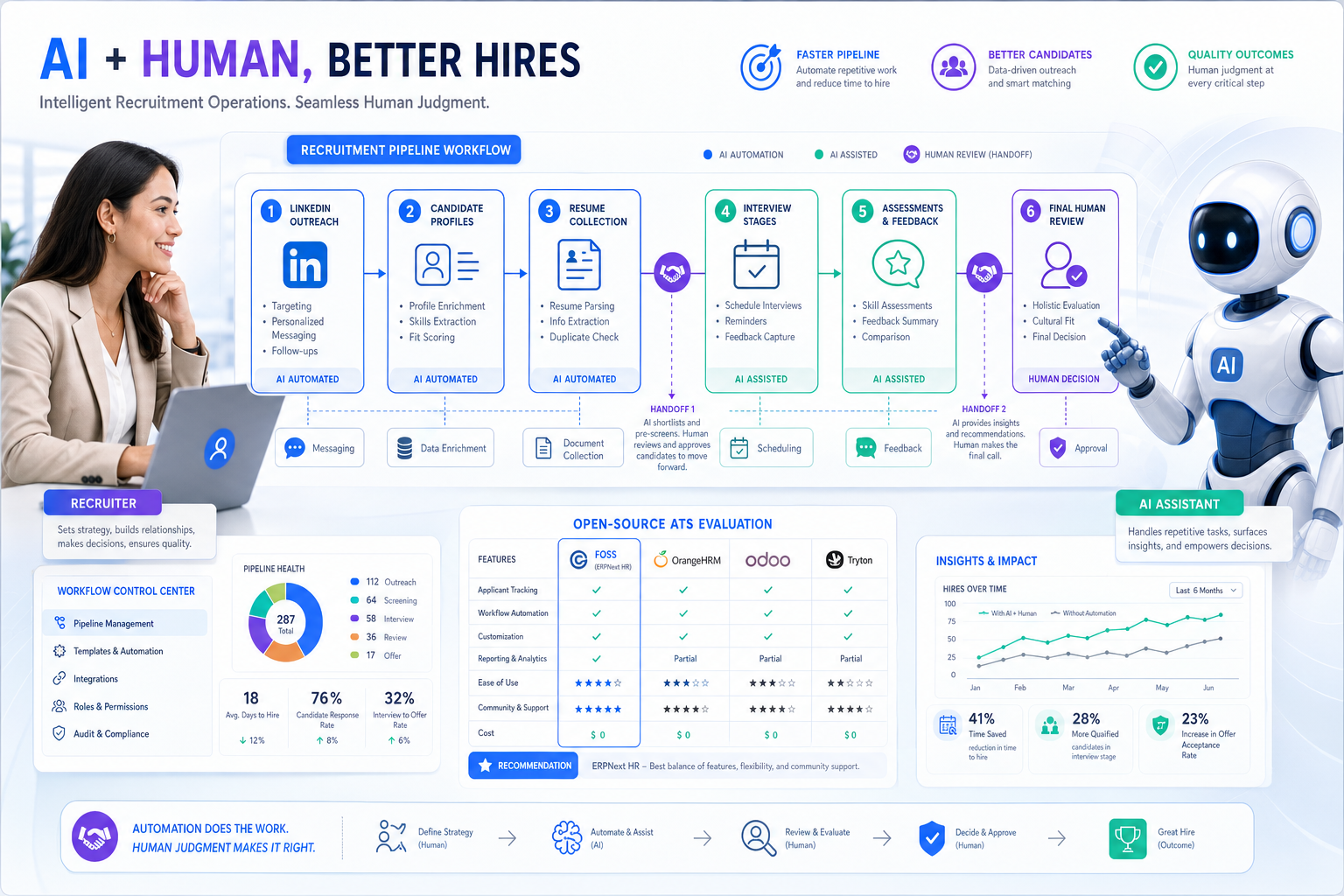
A better way to assess open source recruitment software is to see which tools cut admin without obscuring recruiter judgment or slowing hiring.
That distinction matters more than most software comparisons admit. In real hiring, the drag usually comes from the same cluster of tasks: chasing replies, logging conversations, moving candidates between stages, and keeping hiring managers aligned. When those routine steps slip, firms lose response momentum, in-house teams lose visibility, and recruiters end up spending their best hours on admin instead of candidate judgment, stakeholder advice, and offer strategy.
That is exactly where tools that support recruiter execution without pretending to replace recruiter thinking become useful. In my own workflow, StrategyBrain AI Recruiter has been most relevant for the repetitive front end of LinkedIn outreach: starting candidate conversations, replying across time zones, and collecting resumes or contact details from interested people. It does not remove the recruiter from the process. The recruiter still decides who is worth pursuing, reviews the CV, and makes the final call on next steps.
The deeper issue is not new. Long before today’s hiring teams started debating automation in every recruiting workflow, the core question was already visible: what part of recruiting is repetitive pattern work, and what part still depends on human judgment? That mirrors the broader history of workplace technology. Industrial machinery took over repeatable manual labor. Computers took over calculation-heavy work. In recruiting, the pressure point is different but familiar: machines are increasingly good at handling prediction-oriented and repeatable tasks, while recruiters are still needed to interpret risk, context, and fit.
Once you see recruiting through that lens, software evaluation gets clearer. The best recruiting software is not simply the longest feature list. It is the system that separates automation from decision-making in the right places. That is why teams comparing open source recruitment software, open source applicant tracking software, or an open source applicant tracking system need to look beyond feature checklists and focus on workflow design, ownership, and recruiter control.
- Why recruiter judgment still matters in software selection
- What open source recruitment software really means
- A practical comparison framework for open-source recruiting tools
- Which option fits which hiring team
- Features that matter most in an applicant tracking system
- Where AI-supported workflow fits without replacing recruiters
- Advantages of applicant tracking system adoption in open environments
- Self-hosted reality: cost, maintenance, and complexity
- How to choose the best recruiting software for your process
- Common selection mistakes
- FAQ
Why recruiter judgment still matters in software selection
One of the biggest mistakes in recruiting tech buying is assuming software should replace recruiters rather than support them. In practice, hiring has always contained two different kinds of work. The first is repetitive execution: posting jobs, sending outreach, storing resumes, tracking status changes, and logging communication. The second is judgment: deciding whether a candidate’s risk profile makes sense for a role, whether a hiring manager is evaluating fairly, whether a process should be accelerated, and whether an offer is likely to hold.
That distinction is useful because it changes how you evaluate the best recruiting software. If a platform is strong at reducing repetitive work but weak at preserving recruiter context, it may create as many problems as it solves. If it gives recruiters clean visibility and better control over decision points, it becomes genuinely valuable.
For teams considering open source recruitment software, this often becomes the central advantage. Open tools can offer more control over workflows, fields, permissions, and data location. But they only become the best recruiting software for your team if they support recruiter judgment rather than bury it under technical overhead.
What open source recruitment software really means
Open source recruitment software is the broad category. It usually means the source code is available, self-hosting is possible, and the organization has more say over customization, security choices, and data storage. In recruiting terms, that can cover job posting, candidate records, workflow stages, communication history, career sites, and sometimes broader HR administration.
Open source applicant tracking software is more specific. It centers on the hiring pipeline itself: requisitions, resumes, candidate stages, interview scheduling, team collaboration, and offers. An open source applicant tracking system is usually what recruiters mean when they want operational control over the hiring funnel without being locked into a closed platform.
The difference matters. Some teams need a true ATS-first tool because candidate movement and interview coordination are the immediate pain points. Others need recruiting to sit inside a wider HR or operations environment. If your biggest problem is tracking people through the process cleanly, ATS depth matters more than platform breadth.
A practical comparison framework for open-source recruiting tools
When people search for the best recruiting software, they often jump too quickly into brand-by-brand comparisons. A more useful first step is to compare categories based on what work the system is taking off the recruiter’s plate and what work it must leave visible for recruiter judgment.
| Option Type | Primary Strength | Best Fit | Main Watchout |
|---|---|---|---|
| Pure open-source ATS | Structured applicant tracking and stage control | Recruiting teams that want direct ATS workflow depth | May require more admin effort and a narrower ecosystem |
| HR or business suite with recruiting module | Connection between hiring and broader HR operations | Organizations prioritizing shared data and wider processes | Recruiting workflow may feel secondary to the platform |
| Custom open-source stack | Maximum flexibility and integration control | Teams with technical support and unusual process needs | Higher implementation and maintenance complexity |
That framework also helps explain why some teams combine an ATS with workflow-specific tools rather than expecting one platform to do everything. In my experience, that is where an AI-supported sourcing layer can help. I have used AI Recruiter alongside a structured ATS process when the problem was not candidate evaluation but candidate response handling. It was useful for keeping LinkedIn outreach active, answering candidate questions after hours, and handing back interested profiles for human screening. That division of labor felt practical because it respected the line between automation and judgment.
Which option fits which hiring team
Small internal recruiting teams
A smaller company usually needs consistency more than complexity. If the team is hiring across a handful of departments, open source recruitment software can be attractive because it offers control without typical per-seat pressure. The best fit is usually a system that makes job posting, resume review, pipeline movement, and hiring-manager collaboration straightforward.
Recruitment agencies and headhunters
Agencies often need a mix of ATS discipline and sourcing speed. A standard open source applicant tracking software setup may be good enough for role-based pipelines, but many agency recruiters also need rapid outreach, candidate re-engagement, and a communication trail that survives handoffs. This is where pairing ATS structure with outreach automation can make sense, especially for recruiters working LinkedIn-heavy searches across time zones or niche talent pools.
HR teams that want one broader system
If HR wants recruiting tied directly to employee records or wider internal workflows, a broader platform may be the better choice. In that setup, an open source applicant tracking system can still work, but the buying decision becomes less about ATS specialization and more about enterprise fit.
Privacy-sensitive or compliance-conscious organizations
Some teams prioritize data ownership above all else. For them, self-hosted software can be attractive because candidate records stay under internal control. That can be a real advantage, but only if the organization can manage permissions, updates, backups, and documentation responsibly.
Features that matter most in an applicant tracking system
The most useful ATS features are still the ones that reduce repeatable friction without hiding the logic behind hiring decisions. In other words, software should improve process visibility while leaving judgment exposed and reviewable.
Careers pages and job posting
Recruiters need a clean way to publish and manage openings. In open source recruitment software, look for role status control, branded posting options, and enough governance to keep outdated jobs from lingering.
Candidate pipeline management
This is the heart of any open source applicant tracking software review. Recruiters should be able to move people through stages, flag blockers, and show hiring managers what is stalled. If stage visibility is messy, adoption usually suffers.
Candidate records and resume handling
Even if resume parsing is basic, storage and retrieval need to be reliable. Notes, attachments, communication history, and evaluation context should be easy to review. Good records are one of the clearest applicant tracking system benefits because they reduce duplicate work and prevent context loss.
Interview scheduling and collaboration
The best recruiting software cuts coordination drag. Recruiters need structured scheduling, stage ownership, and feedback tracking. Hiring managers need a simple way to review candidates and respond without chasing separate emails.
Offer tracking and approvals
A solid open source applicant tracking system should keep final-stage status visible. Recruiters need to see approvals, pending actions, and candidate momentum clearly enough to avoid preventable delays.
Reporting and communication history
Reporting should answer operational questions, not just populate dashboards. Where are candidates dropping off? Which requisitions are aging? Which managers are slow to respond? Communication history is equally important, especially when outreach is happening across multiple channels.
Where AI-supported workflow fits without replacing recruiters
The most useful AI support in recruiting usually appears at the front end of the process, where repeatable communication and tracking tasks consume hours without adding much strategic value. That does not mean AI should decide who gets hired. It means software can handle parts of the process that are administrative, time-sensitive, or volume-heavy while recruiters retain final evaluation authority.
That is why I found StrategyBrain AI Recruiter most useful in searches where candidate outreach volume was high but final fit still required careful human review. It could keep conversations moving, answer routine role questions, and collect resumes and contact details from interested candidates. What it did not do, and should not do, is replace the recruiter’s final read on whether the person actually matched the role, the team, or the risk profile.
For LinkedIn-heavy recruiting, that matters. Many recruiters do not need software to make the hiring decision for them. They need software that prevents missed replies, late follow-up, and inbox sprawl. Used that way, AI support complements an open source applicant tracking system rather than competing with it.
Practical takeaway: Automate repetitive prediction-adjacent tasks such as outreach, response handling, and record capture; protect human judgment for shortlist quality, stakeholder alignment, and hiring decisions.
Advantages of applicant tracking system adoption in open environments
The strongest advantages of applicant tracking system adoption are operational. Open environments can make those benefits more flexible, especially for teams that care about process ownership.
- Data ownership: Candidate information stays within your preferred hosting and governance model.
- Customization: Workflows, forms, fields, and permissions can often be adjusted to match real hiring practice.
- Scalable access: The absence of typical seat-based commercial structures can help when more stakeholders need system access.
- Privacy control: Internal security and retention standards may be easier to align with policy requirements.
- Process transparency: Recruiters and hiring managers can track candidate movement in one place.
These are meaningful applicant tracking system benefits, but they matter most when the team has enough process discipline to use them well. Open software gives you latitude. It does not automatically give you clarity.
Self-hosted reality: cost, maintenance, and complexity
Open source does not automatically mean low-effort or low-cost. It often means lower licensing pressure in exchange for more ownership responsibility.
Self-hosted vs vendor-managed mindset
With self-hosted open source recruitment software, someone must own implementation, upgrades, backups, access controls, and troubleshooting. For recruiting leaders, that means the software choice is partly an operating model choice.
Hidden maintenance costs
You may avoid conventional subscription structures, but internal time still has a cost. Configuration, documentation, user training, and support all require attention.
Implementation complexity
An open source applicant tracking software rollout is easier when the hiring process is already defined. If your team cannot agree on stages, approval points, or feedback expectations, the software will expose that confusion quickly.
Long-term maintenance status
It is worth checking whether a platform is actively maintained and realistically supportable over time. Recruiters can live with a basic interface more easily than they can live with a neglected system that becomes unstable.
How to choose the best recruiting software for your process
When experienced recruiters evaluate the best recruiting software, they usually start with workflow fit rather than vendor hype. A practical process looks like this:
- Map the work that is repetitive versus judgment-based. Identify where recruiters lose time on admin and where they need full visibility for decisions.
- Define the hiring flow before comparing tools. Document stages, approvals, feedback points, and reporting needs.
- Separate ATS depth from broader platform scope. If candidate tracking is the core problem, prioritize ATS functionality first.
- Test the recruiter workflow end to end. Run a sample role from outreach or application through interviews and offer tracking.
- Check manager usability. A system fails if hiring managers will not review, comment, or act inside it.
- Confirm your support model. Decide who owns the software after launch.
- Review AI-supported handoffs carefully. If you use sourcing automation, make sure candidate data, conversation history, and human review points are captured cleanly.
That final step is often overlooked. If you plan to pair an ATS with a tool like AI Recruiter, be explicit about the handoff: where outreach ends, where resume review begins, and where recruiter judgment must remain central.
Common selection mistakes
Teams evaluating open source recruitment software often repeat the same avoidable errors.
- Confusing software categories: A broad HR suite is not automatically a strong ATS.
- Ignoring the difference between automation and judgment: A tool can save time and still be poor at preserving hiring context.
- Overvaluing feature lists: Real adoption depends on workflow clarity, not feature count.
- Skipping recruiter testing: Procurement and IT do not experience day-to-day recruiting friction the way recruiters do.
- Underestimating maintenance: Self-hosting only works if ownership is defined.
- Assuming lower licensing means lower total cost: Internal support and process redesign still matter.
A reliable applicant tracking system for recruiters should reduce friction, improve visibility, and support consistent decisions. If it makes those things harder, it is not the right fit no matter how attractive the open-source label may look.
FAQ
What is open source recruitment software?
Open source recruitment software is a broad category of hiring tools whose code is available for use, modification, or self-hosting. It can include ATS functions, career pages, candidate workflows, and sometimes broader HR capabilities.
What is the difference between open source recruitment software and open source applicant tracking software?
Open source recruitment software is the larger category. Open source applicant tracking software is more ATS-focused and usually centers on jobs, resumes, stages, interviews, offers, and reporting.
What is an open source applicant tracking system best used for?
An open source applicant tracking system is best used for structured hiring workflows where recruiters need visibility into candidate movement, team collaboration, and hiring status while maintaining control over data and configuration.
What features matter most in open source applicant tracking software?
The most important features are job posting, candidate records, pipeline visibility, interview coordination, offer tracking, reporting, and communication history.
What are the main advantages of applicant tracking system use in open environments?
The main advantages of applicant tracking system adoption in open environments are data ownership, customization, privacy control, and better operational transparency when the process is well designed.
Can AI tools work alongside an open source ATS?
Yes. Many teams use AI-supported tools for repetitive outreach, candidate communication, or resume collection while keeping final evaluation, shortlisting, and hiring decisions with recruiters inside the ATS workflow.
Is self-hosting worth it for recruiters?
Self-hosting is worth it when your team values control, customization, and data governance enough to manage the additional technical responsibility.
Conclusion
The best recruiting software is rarely the tool that promises to do all of recruiting for you. It is the one that reduces repetitive work, preserves recruiter context, and keeps final judgment where it belongs. That is especially true when evaluating open source recruitment software.
If your priority is structured hiring control, start with open source applicant tracking software or an open source applicant tracking system that gives recruiters clear stage management and visibility. If your workflow also depends heavily on LinkedIn sourcing and follow-up, a support layer such as StrategyBrain AI Recruiter can help handle repetitive communication without taking decision-making away from the recruiter. That combination is often more practical than chasing an all-in-one promise that never fits real hiring work.