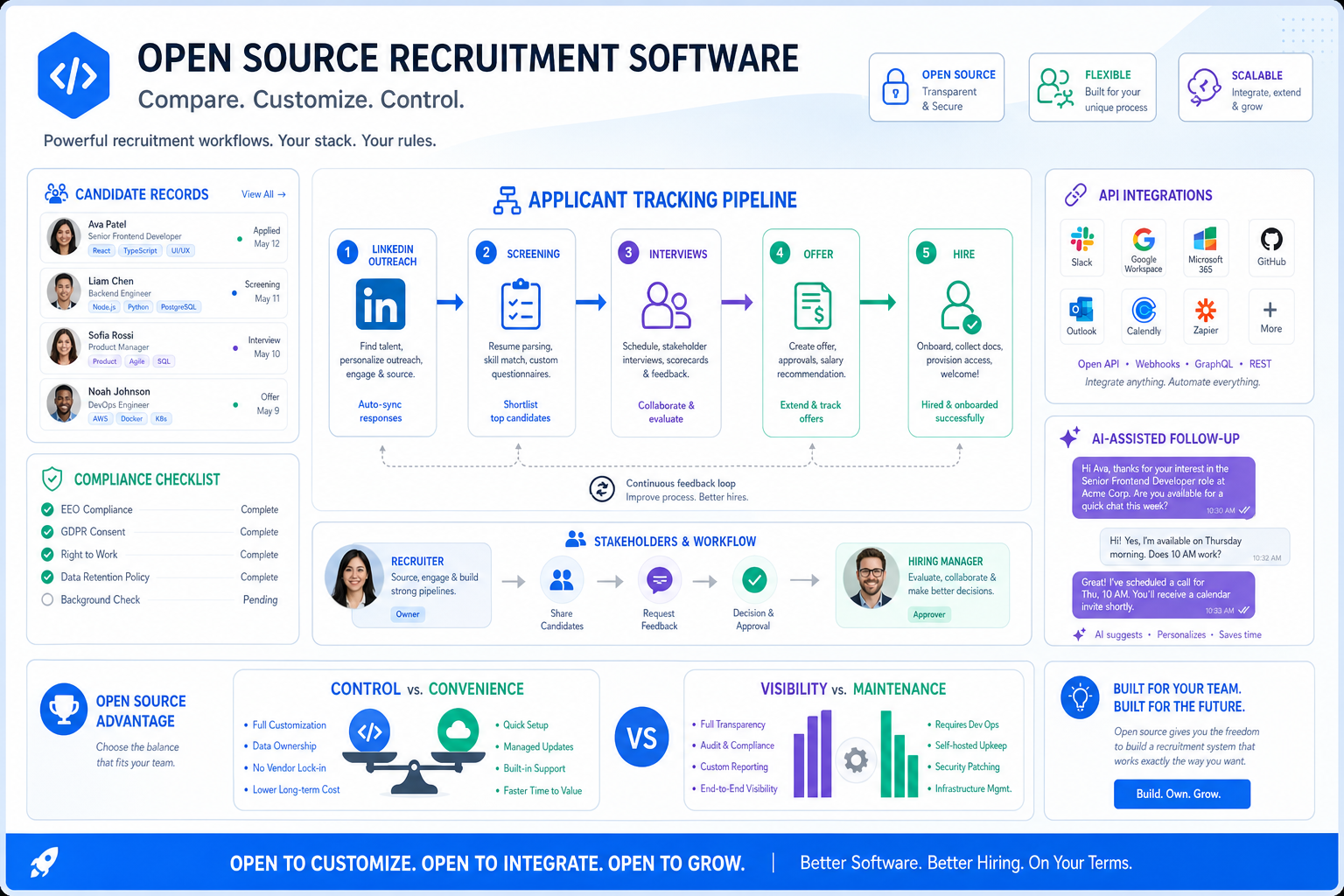
When follow-up stalls across inboxes and spreadsheets, this article helps search firms judge open source recruitment software.
That distinction matters more than most comparison pages admit. In smaller search firms, one recruiter may be juggling client updates, candidate follow-up, interview coordination, and compliance notes at the same time. In an internal talent team, the damage shows up differently: delayed feedback, inconsistent candidate records, missed follow-ups after hours, and hiring managers who lose confidence because the process lives partly in inboxes and partly in spreadsheets.
In my own work, I have found that sourcing and early follow-up often break before the ATS itself does. That is where StrategyBrain AI Recruiter can help as a support layer around recruiting operations, especially for LinkedIn outreach, after-hours candidate replies, and multilingual first-touch conversations. It does not replace recruiter judgment. I still review resumes, decide who moves forward, and own the final shortlist, but it can reduce the manual back-and-forth that usually slows the funnel before candidates are properly logged and advanced.
A useful way to frame this comes from how another professional services field changed when cloud access, automation, bigger data sets, and compliance pressure all started reshaping daily work. Once clients expected real-time visibility instead of periodic updates, the old habit of keeping critical information in disconnected files stopped working. Professionals were pushed into a new role: less clerical chasing, more structured advising, tighter documentation, and clearer handoffs between technical and business stakeholders.
Recruiting teams are living through a similar shift now. Candidates and hiring managers both expect timely updates, searchable records, and a process that holds together across outreach, screening, interviews, and offer steps. That is why the real question behind the best recruiting software search is not just what tool is popular, but whether your open source applicant tracking setup can keep pace with higher expectations, more automation, and stricter process control.
Table of Contents
- Why recruiting software decisions need more context
- What open source recruitment software actually means
- 5 operational shifts shaping ATS decisions
- Comparison of open source recruiting software types
- Which option fits which hiring team
- What to look for in an open source applicant tracking system
- Advantages and tradeoffs
- How I use AI support alongside an ATS
- Common selection mistakes
- FAQ
Why Recruiting Software Decisions Need More Context
Software evaluation gets easier when you stop treating recruiting as a standalone tool purchase. In practice, hiring software sits inside a broader operating environment shaped by expectations from candidates, hiring managers, clients, legal stakeholders, and finance leaders. That is why I rarely start with feature checklists alone.
The better starting point is operational pressure. If your team is dealing with more real-time status requests, more fragmented communication, more reporting demands, and more pressure to document decisions cleanly, then you need software that supports those realities. This is similar to what happened in other advisory functions when cloud systems raised expectations: once stakeholders could ask for immediate visibility, process discipline became non-negotiable.
For recruiting, that means the best system is the one that can connect sourcing activity, candidate records, team collaboration, and later-stage decision tracking without forcing recruiters to rebuild the process elsewhere.
What Is Open Source Recruitment Software?
Open source recruitment software is recruiting software that gives an organization access to the codebase or a source-available model, usually with self-hosting or greater deployment control. The most important subcategory for most recruiting teams is the open source applicant tracking system, because that is the system designed to manage candidates from application through interview and offer stages.
That sounds straightforward, but buyers often mix up adjacent categories:
- Open source recruiting software is the broad umbrella.
- Open source applicant tracking focuses on managing candidate pipelines and recruiter workflow.
- Open source applicant tracking system usually means a full ATS with jobs, candidate records, stages, notes, and interview tracking.
- Job board software is mainly about publishing openings and collecting applications.
- HR suites with recruiting modules combine hiring with broader HR administration.
If your real problem starts after the application arrives, then you are probably not looking for publishing software. You are looking for a system that enforces movement, ownership, and visibility.
5 Operational Shifts Shaping ATS Decisions
One useful lesson from other professional services sectors is that technology rarely changes just one task. It changes expectations, role design, and accountability at the same time. I see five similar shifts affecting how recruiting teams should evaluate software now.
1. Real-time expectations changed the recruiter experience
Cloud systems taught stakeholders to expect up-to-date information on demand. In recruiting, that shows up when hiring managers want instant pipeline visibility and candidates expect timely responses without chasing the recruiter twice. If your ATS does not make status visible, recruiters end up acting as manual translators between systems and people.
This is one reason open source applicant tracking has to be judged on transparency, not just hosting flexibility.
2. Recruiters are expected to act more like advisors
As repetitive administrative work becomes easier to automate, recruiters are pushed toward a more consultative role. That means better intake conversations, stronger market feedback to hiring managers, and clearer decision support rather than just passing resumes around.
A weak system keeps recruiters trapped in clerical work. A stronger ATS gives them a cleaner operating base so they can spend more time on prioritization, candidate quality, and stakeholder alignment.
3. Automation is now part of normal operations
In the same way automated data entry changed finance teams, recruiting automation is steadily taking over repetitive actions like first-touch outreach, message follow-up, and information capture. Used well, automation improves consistency and frees up time; used poorly, it creates noise and weak candidate experience.
That is why I treat automation as a workflow question, not a novelty feature. The right setup supports recruiters. It should not hide the candidate relationship or remove human review where judgment matters.
4. More recruiting data means higher technical demands
As teams collect more signals across sourcing channels, communication history, stage movement, and hiring outcomes, the recruiting function increasingly sits between operational users and technical systems. That makes integrations, exports, APIs, and data structure much more important than they looked a few years ago.
Even a good open source applicant tracking system can become a bottleneck if your team cannot extract information cleanly or connect it to the rest of the workflow.
5. Compliance pressure keeps raising the bar
Compliance is not only an enterprise problem. Any team handling candidate data has to think about access control, retention, consent, disposition records, and process consistency. The more fragmented your workflow is, the harder that becomes.
So when evaluating the best recruiting software, ask not only whether it can move candidates, but whether it can help your team document what happened, who decided what, and where records live.
Comparison of Open Source Recruiting Software Types
| Category | Primary Purpose | Best For | Main Limitation |
|---|---|---|---|
| Dedicated open source ATS | Manage applicants from application to offer | Recruiters, agencies, TA teams | Setup and integration work can be heavier |
| HR suite with recruiting module | Combine hiring with broader HR administration | HR-led teams with moderate hiring volume | Recruiting workflow may feel less specialized |
| Job board-first software | Publish roles and collect applications | Very small teams or low-complexity hiring | Usually weak on collaboration and stage control |
| Recruitment CRM-style setup | Track sourcing and relationship management | Agencies and outbound-heavy recruiters | May not replace a structured ATS fully |
For most people searching open source recruitment software, the practical decision is whether they need a dedicated ATS or something broader. If candidate ownership, interview coordination, and offer-stage discipline are central problems, a dedicated ATS usually fits better than a generic HR suite.
Which Option Fits Which Hiring Team
Small firms and occasional hiring teams
If your team hires infrequently, focus on simplicity. You need a clear careers page, searchable candidate records, straightforward stage tracking, and enough communication support to avoid dropping people between steps. In this case, complexity is often the enemy.
Scaling internal talent teams
When hiring spreads across departments or locations, process consistency matters more. This is where a stronger open source applicant tracking system becomes useful: role-based permissions, standardized stages, and reporting visibility start to matter because more people are touching the process.
Search firms and staffing agencies
Agencies usually feel pain earlier in sourcing, candidate follow-up, and ownership clarity. They often need CRM-like discipline on the front end and ATS discipline later in the funnel. If you work a lot from LinkedIn and candidate outreach, your system choice should reflect that reality rather than pretending everything begins at application stage.
What To Look For in an Open Source Applicant Tracking System
1. Job publishing that routes applicants cleanly
A careers page matters, but routing matters more. Applicants should land in the correct pipeline with as little manual cleanup as possible.
2. Visible pipeline stages
This is where many systems prove their value. Recruiters need immediate clarity on who is in process, what stage they are in, and what action is blocking movement.
3. Structured candidate records
Resume storage, notes, contact history, and searchable profiles are basic but essential. If records become inconsistent, every later workflow gets harder.
4. Interview coordination support
A system should make handoffs visible. That includes interviewer notes, ownership, and next-step clarity, not just a status label.
5. Communication tools or easy communication capture
Email templates, screening questions, and message history reduce repetitive work and help create a more consistent candidate experience.
6. Offer tracking and approvals
Many ATS evaluations focus too heavily on early funnel features. But if approvals and offer movement are weak, the process still breaks at the point where delays are most expensive.
7. Integration and export flexibility
Modern recruiting rarely runs in one tool. Check API access, exports, email connectivity, and calendar support early in the evaluation process.
Practical takeaway: The right ATS does not just collect applicants. It preserves trust when real-time expectations, automation, and compliance pressure all hit the same workflow.
Advantages and Tradeoffs
Why teams choose open source
- More control over data: useful when candidate data governance matters.
- Customization potential: workflows, fields, and permissions may be easier to adapt.
- Deployment flexibility: self-hosted options can fit internal technical standards.
- Less dependence on seat-based pricing models: attractive for some growing teams.
- Greater transparency: technical teams can inspect how the system works.
Where teams struggle
- Maintenance ownership: someone still has to handle updates and security.
- Integration gaps: convenience may lag behind larger commercial ecosystems.
- Documentation quality: implementation can slow down if support is limited.
- Feature unevenness: core ATS workflow may be solid while reporting or automation is lighter.
- Dependence on technical help: recruiters may need IT or engineering more than expected.
The tradeoff is usually control versus convenience. That is why the best recruiting software choice depends less on ideology and more on operating reality.
How I Use AI Support Alongside an ATS
Where I have seen the most practical value is not in trying to make one tool do everything. It is in pairing structured ATS discipline with targeted automation where recruiters lose the most time. For LinkedIn-heavy recruiting, I have used AI Recruiter to handle repetitive first-touch actions, especially connecting with prospects, introducing roles, and keeping conversations alive when replies come in after normal working hours.
What I like about that setup is that it solves a real operating gap rather than pretending to replace recruiter judgment. The system can continue candidate communication, collect resume and contact details from interested prospects, and support multilingual exchanges when a search crosses regions. I still decide whether a profile is actually relevant, whether the resume fits the brief, and whether the candidate should move into the formal ATS pipeline.
That separation matters. One tool helps create momentum at the top of the funnel; the ATS creates structure once candidates are in process. If your workflow includes heavy LinkedIn sourcing, that combination can reduce the classic problem where promising conversations sit in messages too long before they become trackable records.
Recruiters who want to understand that operating model can review the product workflow at StrategyBrain AI Recruiter or see broader company context at StrategyBrain. My own takeaway is simple: AI support works best when it removes repetitive communication tasks while leaving qualification, stakeholder management, and final decisions with the recruiter.
Common Selection Mistakes
Confusing job publishing with applicant management
Collecting applications is not the same as managing a hiring process. Many teams realize that only after candidates start stalling between steps.
Ignoring the shift in stakeholder expectations
If hiring managers now expect near real-time updates, choose software that supports that expectation directly instead of relying on manual recruiter reporting.
Overvaluing license type and undervaluing workflow fit
License terms matter, but recruiters live in the workflow, not in the legal label. A theoretically flexible tool can still be a poor operational fit.
Underestimating compliance and record discipline
When communication lives across email, spreadsheets, and inboxes, clean documentation becomes much harder. That risk grows as teams scale.
Assuming automation removes the need for human review
Automation can improve speed, but it does not replace assessment. Recruiters still need to review resumes, interpret candidate signals, and manage stakeholders.
FAQ
Is open source recruitment software always free?
No. Licensing can lower software cost, but hosting, maintenance, security, setup, and internal support still carry real operating cost.
What is the difference between open source applicant tracking and open source job board software?
Open source applicant tracking is about managing candidates through the hiring funnel. Job board software is mainly about posting openings and collecting applications.
Can an open source applicant tracking system work for agencies?
Yes, if it supports fast stage movement, clear ownership, communication records, and exports. Agencies may also need sourcing support outside the ATS itself.
Do I still need recruiter review if I use AI-assisted outreach?
Absolutely. AI can help with repetitive messaging, follow-up, and resume collection, but recruiters still need to evaluate fit, manage the shortlist, and make advancement decisions.
What matters most when comparing the best recruiting software options?
Look at workflow fit first: visibility, candidate records, handoffs, reporting, and maintenance burden. Feature lists are less useful than seeing whether your real process works inside the system.
Final Thoughts
If you are evaluating the best recruiting software, treat open source recruitment software as an operating model choice, not just a budget choice. The strongest options usually win because they help recruiting teams meet modern expectations around speed, visibility, automation, and documentation.
For most teams, the decision comes down to this: do you need a true open source applicant tracking system that can hold the full process together, or do you only need job publishing and intake? If your pain begins after candidates engage, then the answer is usually ATS discipline.
And if your team also depends heavily on LinkedIn sourcing, pairing a structured ATS with targeted support such as AI Recruiter can be a practical way to reduce manual communication load without giving up recruiter control over final decisions.