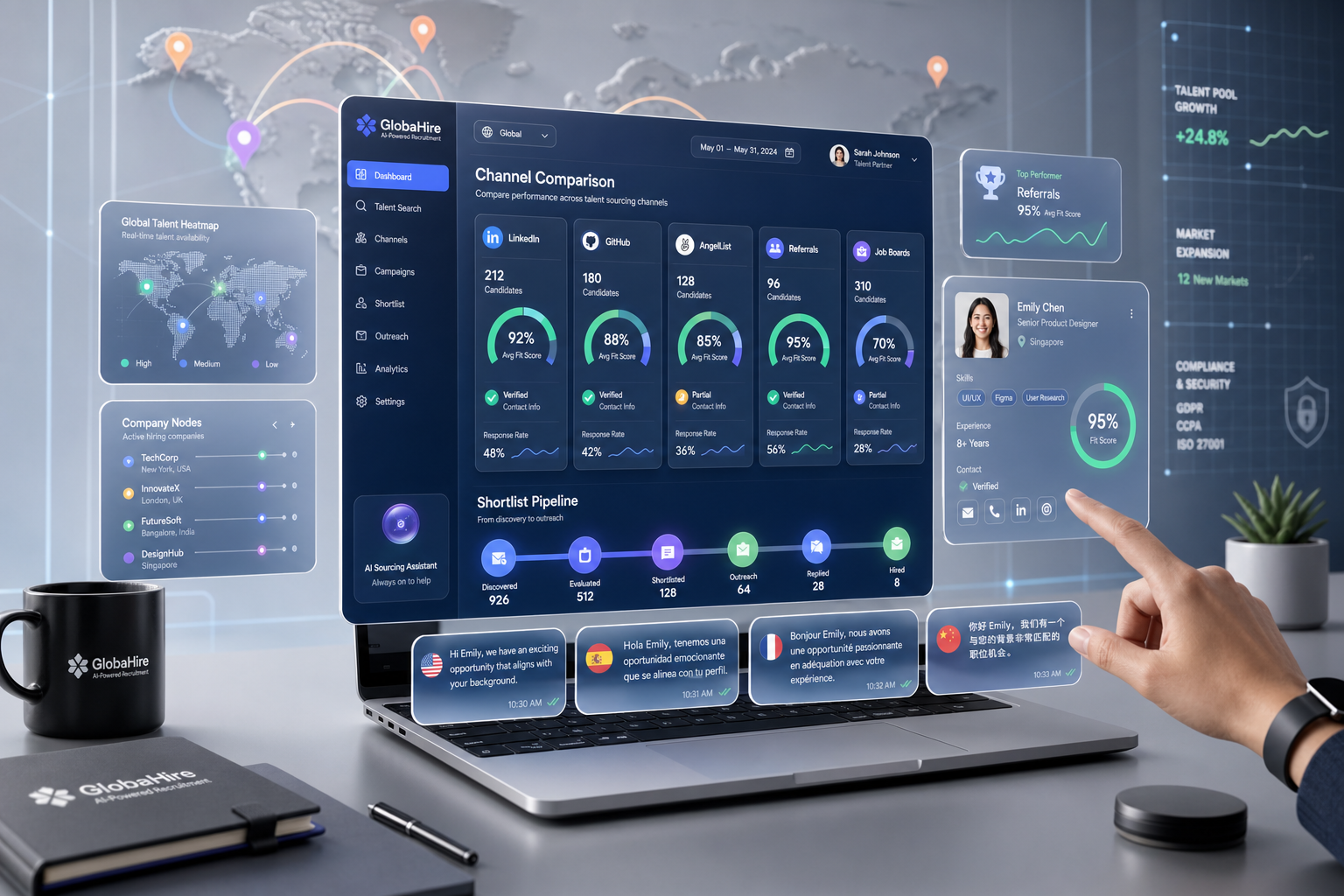
When shortlist quality drops outside familiar channels, this article helps recruiting leaders evaluate talent sourcing tools to avoid slow, low-trust sourcing decisions.
That sounds obvious until a team tries to hire into a new market, expand into a new region, or cover a specialist function with the same old sourcing habits. Then the cracks show quickly. Recruiters lose hours jumping between tabs, candidates reply after hours and wait too long, hiring managers ask why a profile was surfaced, and agency owners feel the commercial pressure of slow shortlist delivery. The damage is not only operational. It affects candidate experience, client confidence, and the recruiter’s own judgment because fragmented sourcing makes every next step harder to trust.
In my own workflow, one of the most practical ways to reduce that friction has been using StrategyBrain AI Recruiter for the repetitive LinkedIn side of outreach while keeping final screening, resume review, and shortlist decisions firmly with the recruiter. What helped most was not hype around automation, but the combination of always-on candidate messaging, multilingual communication for cross-border searches, and automatic collection of resumes or contact details once a prospect showed real interest. In other words, it handled the follow-up rhythm that usually breaks when a recruiter is sourcing across too many channels at once.
A useful way to understand the bigger sourcing problem is to look at what happens when a recruiting business enters a new market with a clear point of view. In one well-known expansion story from Canadian recruitment, a firm opened in Vancouver with a stated promise: use a behavioral, technology-led approach to connect accounting and finance talent with local growth industries, and do it in a way that supports careers rather than just filling jobs. That is not a small positioning shift. It means the recruiters are not just gathering names. They are expected to understand technical fit, cultural fit, client urgency, and candidate confidence well enough to help both sides make a faster, better decision.
Once that standard is set, the day-to-day recruiting actions become more demanding. A recruiter has to map target companies in a new city, review candidate backgrounds beyond headline job titles, reply to inbound interest, summarize fit clearly for the hiring side, and keep momentum without pushing the wrong people into process. The Vancouver example matters because it shows why sourcing breaks when tools only provide volume. If the goal is clarity for candidates and hiring teams, then talent sourcing tools, sourcing platforms, and active sourcing tools must help recruiters search, qualify, communicate, and explain fit in one coherent workflow.
That is the lens for the rest of this article. Instead of treating non-LinkedIn sourcing as a simple database question, we will look at how recruiting teams should evaluate tools when they need stronger market coverage, better candidate-fit judgment, and cleaner recruiter execution across discovery and outreach.
Table of Contents
- Why clarity matters in sourcing
- What talent sourcing tools do now
- Why non-LinkedIn sourcing matters
- The main types of sourcing platforms
- How AI supports active sourcing workflows
- How to evaluate talent sourcing tools
- Best-fit guidance by team type
- Common mistakes when buying active sourcing tools
- A practical selection framework
- FAQ
Why clarity matters in sourcing
One of the strongest ideas in the Vancouver expansion example is not geography. It is clarity. The recruiting team was effectively saying that better hiring decisions come from combining human judgment with better information about fit. In recruiting operations, that principle still holds. Sourcing is not only about finding more profiles. It is about helping the recruiter and the hiring side see why a person belongs on the longlist in the first place.
That is where many teams outgrow single-channel recruiting. A broad professional network can still be useful, but once a role gets niche, regional, technical, or relationship-driven, the recruiter needs a wider view. The process has to cover candidate discovery, context gathering, contact verification, outreach timing, and a way to summarize fit quickly enough that the hiring team can act.
When those steps live in separate tools, recruiters often compensate with manual effort. They write longer search strings, copy notes into spreadsheets, switch messaging windows, and reconstruct candidate context before every hiring-manager update. That can work for a few requisitions, but it is hard to sustain when hiring volume rises or when a firm is trying to establish itself in a new market.
Key insight: The real value of non-LinkedIn sourcing is not just wider access to passive candidates. It is clearer, faster decision-making around who is worth engaging and why.
What talent sourcing tools do now
Modern talent sourcing tools are built to help recruiters find, qualify, and engage candidates before those candidates apply. In practice, that means a platform may search public-web profiles, technical communities, company pages, role-specific directories, and alternative talent pools, then layer on ranking, contact details, and outreach support.
That is a meaningful shift from older sourcing habits. A few years ago, many teams treated sourcing as a Boolean exercise: write a long search string, scan profiles manually, export names, and chase email addresses in separate tools. The current generation of sourcing platforms is increasingly designed around natural-language search, attribute-based matching, and sourcing automation. Instead of searching only by title keywords, recruiters can search by combinations like likely experience, target companies, location, skills adjacency, and signals of role fit.
For recruiting teams, the practical takeaway is simple: if a tool only helps you search but not prioritize, verify, and contact candidates, it may not reduce actual workload. The strongest active sourcing tools support the full flow from discovery to first outreach.
Why non-LinkedIn sourcing matters
Non-LinkedIn sourcing is not mainly about replacing one well-known network. It is about reducing channel concentration and improving access to the right passive talent. Many hard-to-fill roles live in places that are underrepresented on mainstream professional networks, especially technical, healthcare, cleared, regional, or niche-specialist hiring markets.
In real recruiting operations, this matters for three reasons:
- Coverage: some candidates are more visible on community sites, portfolio hubs, code repositories, company pages, or local professional ecosystems than on broad networking platforms.
- Freshness: a profile that exists somewhere does not mean it is current. Teams increasingly care about whether role history, employer changes, and contact data are refreshed often enough to support outreach.
- Workflow efficiency: if your sourcer has to jump across five tabs to identify and contact one person, your process will not scale.
For recruiters and hiring managers, the recommendation is to define what “outside LinkedIn” means for your roles. For software hiring, that may mean technical communities and public code signals. For field hiring, it may mean geography-specific sources. For executive or specialist roles, it may mean talent mapping across company structures rather than broad keyword search.
The Vancouver-style emphasis on helping people make better decisions also matters here. If your internal stakeholders need clearer reasoning around fit, then your sourcing process has to produce more than names. It has to produce context.
The main types of sourcing platforms
One reason buyers get confused is that many products are described as sourcing tools even when they solve different problems. Separating categories makes evaluation easier.
1. Enterprise sourcing platforms
These are broad systems designed for larger recruiting teams that need search, talent intelligence, contact enrichment, candidate ranking, and often collaboration features. They are typically used for recurring hiring across multiple functions or regions.
Best for: enterprise TA teams, high-volume strategic hiring, talent mapping across business units.
What to check: database freshness, permissions, reporting, global coverage, and whether recruiters can move from search to outreach without exporting data manually.
2. Browser-based sourcing tools and extensions
These tools are useful when recruiters discover talent across the public web and want a fast way to capture profiles, enrich contact details, or push prospects into a workflow. They are often lighter-weight than full suites.
Best for: agency sourcers, recruiters who prospect across many sites, lean teams that do not need a heavy platform.
What to check: capture speed, enrichment quality, and how well the extension fits your existing sourcing process.
3. Sourcing plus CRM suites
Some platforms blend candidate sourcing with pipeline management, outreach sequences, and relationship tracking. These are attractive when a team wants one environment for prospecting and follow-up rather than separate sourcing and nurturing systems.
Best for: outbound recruiting motions, talent pools, recurring pipeline building, and passive candidate engagement.
What to check: sequence controls, recruiter collaboration, duplicate management, and whether sourcing records stay usable over time.
4. Niche or vertical databases
Specialized tools are often stronger than general databases for technical, healthcare, cleared, or geography-specific hiring. They may have less apparent scale but much better relevance for the actual role family.
Best for: teams with consistent hiring in narrow skill markets or regulated talent segments.
What to check: niche depth, regional reliability, role-specific search fields, and evidence that the source reflects how that talent community actually presents itself.
For recruiting leaders, the practical advice is not to ask which category is “best” in the abstract. Ask which category matches the way your team actually sources and the level of clarity your hiring process requires.
How AI supports active sourcing workflows
A major market shift is the move from Boolean-first sourcing to natural-language and attribute-based search. That sounds like a usability feature, but operationally it is more important than that. It changes how quickly recruiters can move from a hiring brief to a credible longlist.
In a Boolean-heavy workflow, success depends on the recruiter already knowing every title variation, synonym, and exclusion pattern. In an AI-supported workflow, the recruiter can describe the ideal background more naturally: what kinds of companies matter, what scope is relevant, what adjacent skills are acceptable, and which trade-offs are realistic.
This changes day-to-day work in several ways:
- Faster project ramp-up: new recruiters can get to usable results sooner.
- Better query flexibility: teams can search for attributes rather than exact title matches.
- Improved candidate ranking: the system can surface profiles by likely fit instead of raw keyword occurrence.
- Less manual stitching: sourcing automation can support contact verification and outreach workflow steps.
On the outreach side, I have found that AI Recruiter is most useful when the bottleneck is not search itself but recruiter follow-through. If candidates reply late, ask role questions in different languages, or want to send a resume while the recruiter is off the clock, an always-on workflow keeps momentum alive. The recruiter still has to evaluate the resume and decide whether the candidate truly fits the brief, but the system reduces the lag that often causes warm prospects to go cold.
That said, experienced recruiters should stay realistic. AI can speed up search and prioritization, but it does not replace recruiting judgment. The strongest teams still review role context, calibrate with hiring managers, and refine searches based on response quality rather than trusting any ranking blindly.
How to evaluate talent sourcing tools
When teams compare talent sourcing tools, they often start with profile count because it is easy to market and easy to remember. In practice, that is rarely the deciding factor. More useful evaluation criteria are the ones that affect real recruiter output.
| Evaluation area | Why it matters | What recruiters should ask |
|---|---|---|
| Database freshness | Outdated records waste sourcing time | How often are role, employer, and activity signals refreshed? |
| Niche talent coverage | General databases may miss specialist pools | Does this source reflect the roles we hire most? |
| Contact accuracy | Poor contact data lowers response potential | How are contact details verified and updated? |
| Search quality | Search determines longlist relevance | Can we search by attributes, adjacency, and likely fit? |
| Workflow fit | Disconnected tools create admin work | Can recruiters source and outreach in one workflow? |
| Regional coverage | Talent visibility varies by market | Is the platform credible in our target geographies? |
| Vertical fit | Role families behave differently | Does it support technical, healthcare, cleared, or field hiring needs? |
| Decision support | Hiring teams need clarity, not just names | Can recruiters explain quickly why each candidate belongs on the shortlist? |
Here is the practical advice I would give a recruiting operations team: run a role-based test, not a generic demo. Choose 3 to 5 live reqs with very different sourcing conditions, such as one technical role, one niche regional role, and one business hire. Then compare result relevance, not just result volume.
Questions worth asking during evaluation
- Can the platform surface passive talent beyond major job boards?
- What sources are strongest for our role families?
- How easy is it for a recruiter to move from search to shortlist to outreach?
- Can hiring managers understand why a candidate was surfaced?
- How much manual cleanup is required before outreach begins?
- What happens when prospects reply after hours or from different time zones?
That last question is easy to overlook. In active sourcing, speed and continuity matter. If your team depends heavily on LinkedIn outreach, then a support layer like AI Recruiter can help absorb repetitive connection, follow-up, and resume-capture work while your recruiters focus on assessment and stakeholder management.
Best-fit guidance by team type
Different teams need different sourcing setups. A tool that makes sense for a large internal talent function may be excessive for a small agency desk, while a lightweight browser workflow may break under enterprise coordination needs.
For startup recruiting teams
Startups usually need speed, flexibility, and enough sourcing depth to find passive candidates without building a complicated system. In that environment, the best sourcing platforms are often the ones that help a recruiter move quickly from candidate discovery to contact and outreach.
Advice: prioritize usability, search flexibility, and workflow efficiency over broad enterprise controls you may not use.
For agency recruiters and headhunters
Agency teams often care about speed to shortlist, niche sourcing coverage, and the ability to prospect across many public-web sources. They may also need sharper segmentation by client brief and industry specialization.
Advice: look for active sourcing tools that reduce tab switching and support fast capture, enrichment, and outreach. If LinkedIn remains a major outbound channel, an automation layer that keeps candidate conversations moving can be valuable, provided the consultant still owns judgment and shortlist quality.
For enterprise talent acquisition teams
Larger organizations usually need sourcing consistency, collaboration, reporting, and stronger governance. They are also more likely to run role families across functions and geographies, which makes regional credibility and database freshness more important.
Advice: evaluate workflow fit at scale, not only recruiter preference in a single pilot team. A good enterprise choice should support both strategic talent mapping and day-to-day req execution.
For specialized hiring teams
If your organization hires technical, healthcare, cleared, or geography-specific talent regularly, broad tools may not be enough. Specialized sourcing can require domain-specific fields, alternative web signals, and different assumptions about where passive talent is visible.
Advice: never assume a general platform will outperform a niche source for specialist roles. Test vertical fit directly.
Common mistakes when buying active sourcing tools
Most poor purchasing decisions come from evaluating software as a category rather than evaluating it against the team’s operating model. Here are the mistakes I see most often in sourcing tool selection:
- Choosing based on profile count alone. High profile volume does not guarantee relevant or current candidates.
- Ignoring role-specific sourcing behavior. Technical and healthcare hiring rarely behave like general business hiring.
- Overvaluing AI branding. AI sourcing only matters if it improves search quality and recruiter efficiency.
- Skipping workflow testing. If recruiters still have to manually enrich, export, and message from different systems, the process remains slow.
- Not checking regional coverage. Strong data in one market does not mean strong data in another.
- Forgetting hiring manager alignment. A platform can surface many candidates, but if the role calibration is weak, results will still miss.
- Separating sourcing from communication reality. A strong search tool still underperforms if outreach stalls, candidate questions go unanswered, or resumes are collected too late.
The last mistake is where many teams feel hidden friction. Search looks fine in the demo, but recruiter time disappears later in messaging and follow-up. That is why sourcing evaluation should include the actual handoff from discovery to candidate response.
A practical selection framework
If you need a clean way to choose among talent sourcing tools, use a decision framework that reflects hiring reality rather than vendor messaging.
Step 1: Define your dominant use case
Are you solving for broad pipeline building, passive candidate sourcing, niche role coverage, talent mapping, or sourcing plus outreach in one workflow? Start here, because the right category depends on the use case.
Step 2: Define the full decision context
Borrow a lesson from firms that position themselves around better hiring clarity: you need to know not just the role title, but the wider business context. What does success look like in this hire? What trade-offs are acceptable? What kind of story will the hiring manager need in order to say yes quickly?
Step 3: Choose the most important evaluation criteria
Limit your must-have criteria to 3 to 5 items. For many teams, the shortlist is database freshness, contact accuracy, niche coverage, search quality, and workflow fit.
Step 4: Test against live roles
Do not rely on a generic sample search. Use current roles that represent your hardest sourcing conditions.
Step 5: Review recruiter adoption risk
Even strong software underperforms if recruiters find it hard to use. A natural-language or attribute-based search experience can be a major advantage if your team has mixed sourcing skill levels.
Step 6: Check the communication layer
If your outbound motion depends heavily on LinkedIn, test what happens after a candidate replies. Can conversations continue overnight? Can the tool support multilingual follow-up? Can interested prospects send resumes and contact details without delay? In my experience, this is exactly where AI Recruiter can complement broader sourcing work: it does not replace the recruiter’s evaluation, but it helps keep candidate intent from slipping away between messages.
Practical rule: The best sourcing platform is the one that helps your team repeatedly find relevant passive talent, verify contact details, and act on that information without unnecessary workflow friction.
FAQ
What do talent sourcing tools actually do?
Talent sourcing tools help recruiters find, evaluate, and engage candidates before application. Modern platforms often combine candidate discovery, fit-based search, contact enrichment, talent mapping, and outreach workflow support rather than functioning as simple profile databases.
How do AI sourcing tools work?
AI sourcing tools usually use natural-language or attribute-based search to identify likely candidate matches from multiple sources. They can also rank candidates by fit, suggest relevant profiles, and support sourcing automation, but recruiters still need to validate role alignment and outreach quality.
How are sourcing platforms different from ATS or CRM software?
An ATS is mainly built to manage applicants in a hiring process, while a CRM is built to organize and nurture talent relationships over time. Sourcing platforms focus earlier in the funnel by helping teams discover passive talent and create prospect lists before candidates enter a formal pipeline.
Can active sourcing tools find passive candidates outside LinkedIn?
Yes. That is one of their core use cases. Non-LinkedIn sourcing tools often pull from alternative public-web sources, technical communities, company pages, and role-specific talent pools, which can improve access to passive candidates who are not active on mainstream professional platforms.
Where does LinkedIn automation fit if the article is about non-LinkedIn sourcing?
Non-LinkedIn sourcing and LinkedIn automation solve different parts of the same workflow. You may find candidates through broader web sourcing, niche databases, or market mapping, then still use LinkedIn as one of several outreach channels. In that case, automation can help with repetitive messaging and resume capture while the recruiter keeps control of final evaluation.
How should recruiters choose sourcing tools by role type?
Start by matching the tool to the hiring market. General platforms may work for broad business hiring, while specialist hiring often needs niche databases or stronger vertical fit. Always test tools against real roles, especially if you hire technical, healthcare, cleared, or regional talent.
Conclusion
The conversation around talent sourcing tools has matured. Recruiting teams are no longer just looking for large databases. They want sourcing platforms that surface passive talent, support better search logic, provide verified contact details, and fit naturally into outreach workflows. That is why the strongest active sourcing tools are increasingly evaluated on freshness, niche coverage, contact accuracy, decision support, and workflow fit rather than profile volume alone.
The Vancouver expansion example is a good reminder of what serious recruiting teams are really trying to create: clearer decisions for everyone involved. If you are choosing a platform now, focus less on category hype and more on recruiter reality. Test against live roles, measure relevance over volume, and make sure your workflow supports not only search, but also the communication and context that turn sourced names into credible hiring options.