Headhunters can use this candidate CRM guide to judge which systems keep warm talent recoverable and prevent repeat outreach mistakes.
That standard matters because most recruiting teams do not lose good prospects at the sourcing stage alone. They lose them in the gaps between first contact, later follow-up, and the next relevant opening. For a solo recruiter, that means missed placements and weaker trust. For a small agency owner, it means more manual chasing, uneven delivery, and less predictable revenue. For an in-house hiring lead, it often turns into stale talent pools, duplicated outreach, and a candidate experience that feels transactional instead of thoughtful.
In my own workflow, tools like StrategyBrain AI Recruiter have been most useful when the problem is not finding people once, but staying responsive and organized across long hiring cycles. Its always-on candidate messaging, multilingual communication, and automated resume/contact capture can keep early conversations moving when recruiters are offline or handling too many reqs at once. The recruiter still makes the final call on fit, resume quality, and next steps, but the handoff becomes much cleaner. I found that especially helpful in LinkedIn-heavy outreach where replies often arrive after hours and momentum disappears fast without a system behind it.
A useful way to understand this is to look at engineering recruiting, where candidate decisions are often slow, specialized, and tied to real market demand. The reference market snapshot pointed to engineering as one of the more desirable career paths, with thousands of added opportunities and strong pull across energy, chemical processing, aerospace, biomedical work, and design engineering. In practice, that means a recruiter is not just filling one requisition. They are often revisiting the same niche talent communities while candidates weigh career direction, sector stability, and whether a move is worth it.
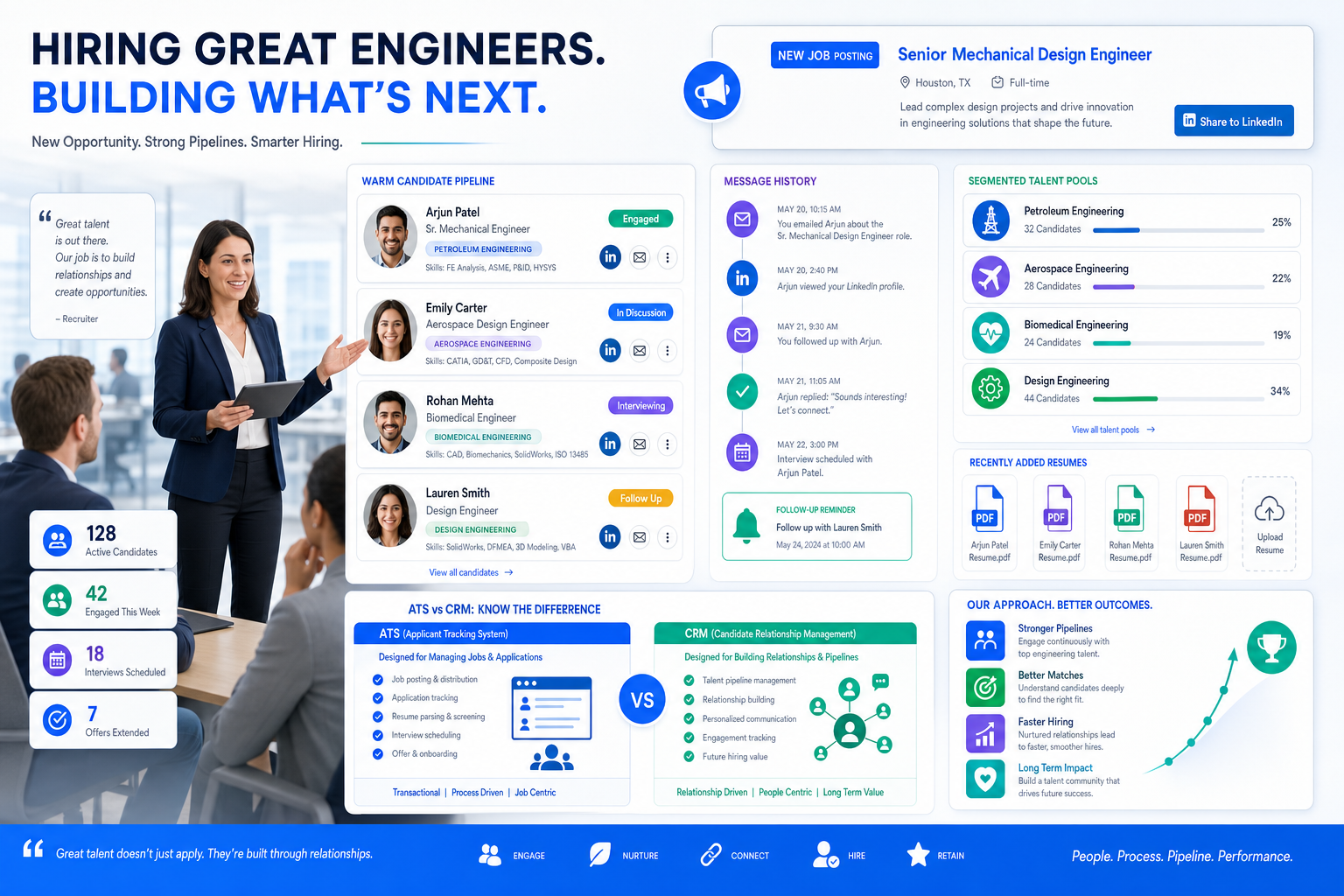
Picture the actual work: a recruiter reopens a search for a petroleum engineer after demand rises in the energy sector, checks an old shortlist from a similar role, replies to a candidate who had asked about compensation months earlier, then tries to recover notes on another engineer who was more interested in aerospace design than field work. Without a reliable candidate history, outreach trail, and segmented talent pool, that relationship to candidate context disappears. That is exactly why the best recruiting software conversation now has to include candidate CRM and the best candidate relationship management software, not just applicant tracking.
Table of Contents
- Why Candidate CRM Matters in Specialized Hiring
- What Engineering-Style Hiring Teaches About Talent Pipelines
- Candidate CRM vs ATS: Where Each Tool Actually Helps
- What the Best Recruiting Software Should Include
- Must-Have Features in the Best Candidate Relationship Management Software
- Three Recruiting Software Approaches Worth Comparing
- Which Teams Need Candidate CRM Most
- How to Choose the Right System for Your Process
- Common Buying Mistakes to Avoid
- FAQ
Why Candidate CRM Matters in Specialized Hiring
A candidate CRM is not just a database. In recruiting, it is the operating layer that helps teams remember who a person is, what they were open to, what changed, and when it makes sense to reach back out. That becomes critical in markets where candidates do not move instantly, and where career choices depend on discipline, sector demand, project type, compensation expectations, and timing.
The engineering example is useful because it reflects a pattern recruiters see in many specialist functions. A chemical engineer, aerospace engineer, design engineer, or biomedical engineer may all fall under one broad talent umbrella, but they do not respond to the same message or opportunity for the same reasons. Some candidates are motivated by technical scope. Some by geography. Some by industry direction. Some by stability. If your system cannot preserve those distinctions, your future outreach becomes generic fast.
Practical takeaway: The best recruiting software should help recruiters keep role-specific context alive long after the initial sourcing sprint ends.
What Engineering-Style Hiring Teaches About Talent Pipelines
The reference material was framed for people considering a career in engineering, not for recruiters evaluating software. That perspective is worth keeping because it reminds us what the candidate is actually deciding. They are asking whether a field is attractive, where demand is strongest, which specialty suits them, and what the trade-offs look like. Recruiters often underestimate how much that candidate-side evaluation affects pipeline quality.
When someone is weighing petroleum engineering against another path, or deciding whether aerospace work is more compelling than a design-focused role, they are not behaving like a simple applicant in a linear funnel. They are evaluating opportunity. That means the recruiter needs a system that supports long-term communication, segmented messaging, and re-engagement based on changing interests.
This is where a stronger relationship to candidate strategy outperforms one-off outreach. If a person was not ready when you first contacted them, the value is not lost. It becomes reusable only if your software stores the conversation in a way that future-you can act on.
In my own LinkedIn recruiting work, I have seen this most clearly with hard-to-fill technical roles. When I used AI Recruiter-assisted outreach workflows, the real advantage was not replacing judgment. It was keeping early-stage conversations alive across time zones, capturing resumes and contact details once interest appeared, and making it easier to return to a warm prospect later with context intact.
Candidate CRM vs ATS: Where Each Tool Actually Helps
Recruiters still confuse these categories, especially when an ATS vendor claims to include “CRM features.” In practice, the difference is straightforward.
| Category | Main Job | Typical Recruiter Action | Best Fit |
|---|---|---|---|
| Applicant Tracking System | Manage requisitions, applicants, stages, and hiring workflow | Move active candidates through interviews and approvals | Structured, active hiring |
| Candidate CRM | Manage relationships, nurture pipelines, and re-engage talent | Source, segment, follow up, and rediscover people over time | Proactive and relationship-driven recruiting |
The ATS is where process control lives. It is useful for compliance, approvals, stage tracking, and current openings. But the CRM is where future hiring leverage lives. If your recruiters are constantly reopening old searches, rebuilding lists, or digging through email and LinkedIn history to remember prior conversations, the ATS is not solving the whole problem.
For most experienced teams, the right question is not ATS or CRM. It is how much CRM depth your process needs, and whether your recruiting software keeps those two systems connected.
What the Best Recruiting Software Should Include
If you are evaluating the best recruiting software, use a workflow lens rather than a feature-count lens.
| Recruiting Situation | What to Prioritize | Why It Matters |
|---|---|---|
| Specialized technical hiring | Rediscovery, detailed notes, segmented pools | Helps recover prior conversations tied to narrow skills |
| Agency and search work | Fast search, outreach cadence, candidate history | Supports repeatable relationship-driven placements |
| High-volume outreach | Automation, response handling, clean capture of resumes and contacts | Reduces dropped conversations and manual admin |
| Global or multilingual recruiting | Language flexibility, after-hours response coverage, recruiter review controls | Keeps momentum without losing oversight |
| Lean in-house teams | Simple UX, ATS sync, useful reporting | Improves adoption and prevents system sprawl |
The strongest setups usually combine ATS structure with CRM depth and selective automation. In other words, they support both the current requisition and the next opportunity that has not opened yet.
Must-Have Features in the Best Candidate Relationship Management Software
1. Segmented talent pools
Good pools mirror how recruiters actually search: by function, sub-specialty, location, seniority, industry, timing, and candidate interest. In engineering-style hiring, broad labels are not enough. You need to know who leaned toward energy, who preferred design-heavy work, and who asked to reconnect later.
Practical advice: Test whether recruiters can build segments that reflect real market distinctions, not just generic tags.
2. Unified candidate history
Profiles should show prior outreach, replies, notes, resumes, contact details, and status changes in one timeline. This is what protects a genuine relationship to candidate from becoming fragmented across inboxes and tools.
Practical advice: Ask how duplicates are merged and whether the interaction record is easy to review before sending a new message.
3. Rediscovery that works on real searches
Rediscovery matters most when recruiters revisit past prospects for a similar role. The system should make it easy to find candidates by skills, location, prior interest, and historic conversation content.
Practical advice: Use an actual scenario in demos, such as finding engineers previously contacted about remote-friendly roles in a specific discipline.
4. Communication tools that preserve momentum
Modern CRM workflows need email or platform-based follow-up, structured sequences, and clear visibility into responses. Done well, automation supports consistency without turning messages into spam.
Practical advice: Review personalization options carefully. Relevance matters more than volume.
5. Resume and contact capture
Interest is often lost between “sounds interesting” and “please send your resume.” Tools that cleanly capture both resume files and direct contact details reduce friction and shorten the handoff to recruiter review.
Practical advice: Confirm how captured data appears in the workflow and whether recruiters can act on it quickly.
6. Multilingual and after-hours support
This is not essential for every team, but it matters for international or passive-talent recruiting where replies often come outside business hours. Prompt engagement can preserve momentum until the recruiter returns to make a judgment call.
Practical advice: If you recruit across regions, test whether messaging support improves responsiveness without compromising tone.
7. ATS integration
The best candidate relationship management software should not become an isolated side system. Recruiters need clean movement from early outreach into formal application and interview process.
Practical advice: Ask whether integrations are true syncs or only exports.
8. Recruiter-controlled AI assistance
AI is most useful when it handles repetitive communication tasks, supports response continuity, and captures structured information while leaving final candidate evaluation to the human recruiter.
Practical advice: Favor systems that assist with volume and responsiveness, while keeping qualification, resume review, and hiring decisions in recruiter hands.
Three Recruiting Software Approaches Worth Comparing
Because this topic is software selection, it helps to compare three broad product approaches recruiters often evaluate in the market.
1. Enterprise ATS suites with light CRM layers
Use experience: Usually strong for approvals, requisitions, interview process, and reporting tied to active hiring. The CRM side often feels secondary.
Effectiveness: Good for process control. Less effective for long-gap follow-up and nuanced candidate nurturing.
Cost profile: Can be expensive once modules, implementation, and admin overhead are added.
Best for: Mid-market to enterprise teams with structured internal workflows.
Working with StrategyBrain AI Recruiter: Useful when you want an external LinkedIn-facing engagement layer that keeps conversations moving before prospects are pushed into the formal ATS process.
2. Standalone candidate CRM platforms
Use experience: Typically better for sourcing workflows, nurture campaigns, tagging, and rediscovery than ATS-first tools.
Effectiveness: Strong when relationship-driven recruiting is the core challenge.
Cost profile: Often more flexible than enterprise suites, but value depends heavily on recruiter adoption.
Best for: Search firms, staffing agencies, and in-house sourcing teams.
Working with StrategyBrain AI Recruiter: A practical pairing when recruiters rely heavily on LinkedIn outreach and want automated first-touch communication, multilingual reply handling, and resume capture feeding into a broader CRM process.
3. Outreach automation tools built around LinkedIn activity
Use experience: Usually faster to deploy for active sourcing than larger systems, especially for recruiters who live in LinkedIn daily.
Effectiveness: Best when the bottleneck is repetitive outreach and slow response handling rather than deep internal workflow.
Cost profile: Often lighter up front, though total value depends on quality controls and recruiter oversight.
Best for: Agencies, headhunters, and lean teams doing high outbound volume.
Working with StrategyBrain AI Recruiter: This is where StrategyBrain AI Recruiter stands out most clearly. Based on my own testing mindset, the appeal is not “set it and forget it.” It is that the system can automate repetitive LinkedIn connection and messaging tasks, respond around the clock, and collect resumes plus contact details from interested candidates, while the recruiter still decides who is truly qualified and who moves to interview.
That division of labor matters. In specialist recruiting, the software should help you maintain pace and coverage. It should not pretend to replace recruiter judgment.
Which Teams Need Candidate CRM Most
In-house talent acquisition teams
Internal teams benefit when recurring roles reopen and past pipelines can be reused. This is especially true in technical hiring, where the same skill families stay relevant across quarters.
Staffing agencies and search firms
Agencies live on accumulated market knowledge. If recruiter notes, prior candidate preferences, and outreach history are searchable, each new assignment starts with an advantage.
High-volume outbound teams
Teams sending large numbers of messages need help handling replies consistently, especially outside office hours. This is where AI-supported communication can reduce dropped conversations.
Niche recruiters in thin talent markets
When candidate supply is limited, timing and memory matter as much as sourcing reach. A good CRM keeps the history that makes re-engagement credible.
How to Choose the Right System for Your Process
- Map where conversations are getting lost. Is the problem first-touch volume, follow-up discipline, rediscovery, or ATS handoff?
- Separate application management from relationship management. Most teams need both, but not in the same depth.
- Test candidate-side scenarios. Use examples where a person is undecided, changes priorities, or becomes relevant again months later.
- Audit your current data quality. Weak tags and scattered notes will limit any new software.
- Run recruiter-led demos. Do not let procurement or ops evaluate relationship tools without recruiter workflows front and center.
- Check human control points. Make sure automation supports speed without taking judgment away from the recruiter.
A simple scorecard should cover search quality, profile completeness, communication workflow, rediscovery, integrations, reporting, and adoption risk.
Common Buying Mistakes to Avoid
Confusing more outreach with better recruiting
Volume can create activity without creating trust. If the software cannot preserve context, scale just makes forgetfulness more efficient.
Assuming candidate interest is static
The engineering example shows why that fails. Candidates reassess based on discipline, compensation, project type, and market direction. Your system should reflect that reality.
Buying ATS features when the real problem is relationship continuity
Many teams already have structured hiring stages. What they lack is a reliable way to return to the right person at the right time with the right context.
Letting automation outrun recruiter accountability
Automation should help with repetitive communication, multilingual responsiveness, and information capture. Final fit assessment should still sit with the recruiter.
FAQ
What is a candidate CRM in recruiting?
A candidate CRM is software that helps recruiters build and maintain ongoing relationships with talent through segmentation, outreach, communication history, and re-engagement workflows.
How is candidate CRM different from an ATS?
An ATS manages active hiring workflows and applicants. A candidate CRM manages long-term talent relationships, passive prospects, and future pipeline activity.
Why does specialized hiring need stronger candidate relationship management?
Because candidates in specialist fields often evaluate opportunities slowly and selectively. Recruiters need systems that preserve prior context and make future outreach relevant.
What is the best candidate relationship management software for LinkedIn-heavy recruiting?
The best fit depends on workflow, but recruiters who rely heavily on LinkedIn should look for tools that support outreach continuity, after-hours messaging, resume capture, and recruiter-controlled handoff into the broader hiring process.
Can AI help without replacing recruiter judgment?
Yes. Used well, AI can automate repetitive messaging, maintain response speed, and capture candidate information while leaving qualification, resume review, and interview decisions to recruiters.
Conclusion
The best recruiting software is not the system with the longest feature list. It is the one that helps recruiters hold onto context when candidates are still evaluating opportunity, especially in specialist markets where timing and trust drive outcomes. That is why candidate CRM should sit at the center of your evaluation.
If your team wants a stronger relationship to candidate communities and less wasted sourcing effort, focus on software that supports memory, responsiveness, and clean handoffs between outreach and hiring workflow. In that environment, the best candidate relationship management software is the one that helps recruiters reconnect with the right people at the right moment, with enough history to make the conversation matter.