This article shows recruiters how to improve recruiting sourcing by judging automation points and preventing candidate drop-off.
That matters because most sourcing problems do not begin with a lack of tools. They begin when good recruiters are forced to manage too many moving parts at once: narrow searches, delayed replies, inconsistent follow-up, forgotten silver medalists, and hiring managers who want stronger slates without waiting longer. For a solo recruiter, that means lost momentum and more after-hours admin. For a small agency owner, it means missed placements, weaker candidate relationships, and rising delivery pressure. For an in-house team, it can quietly damage employer brand when interested people wait too long for a useful response.
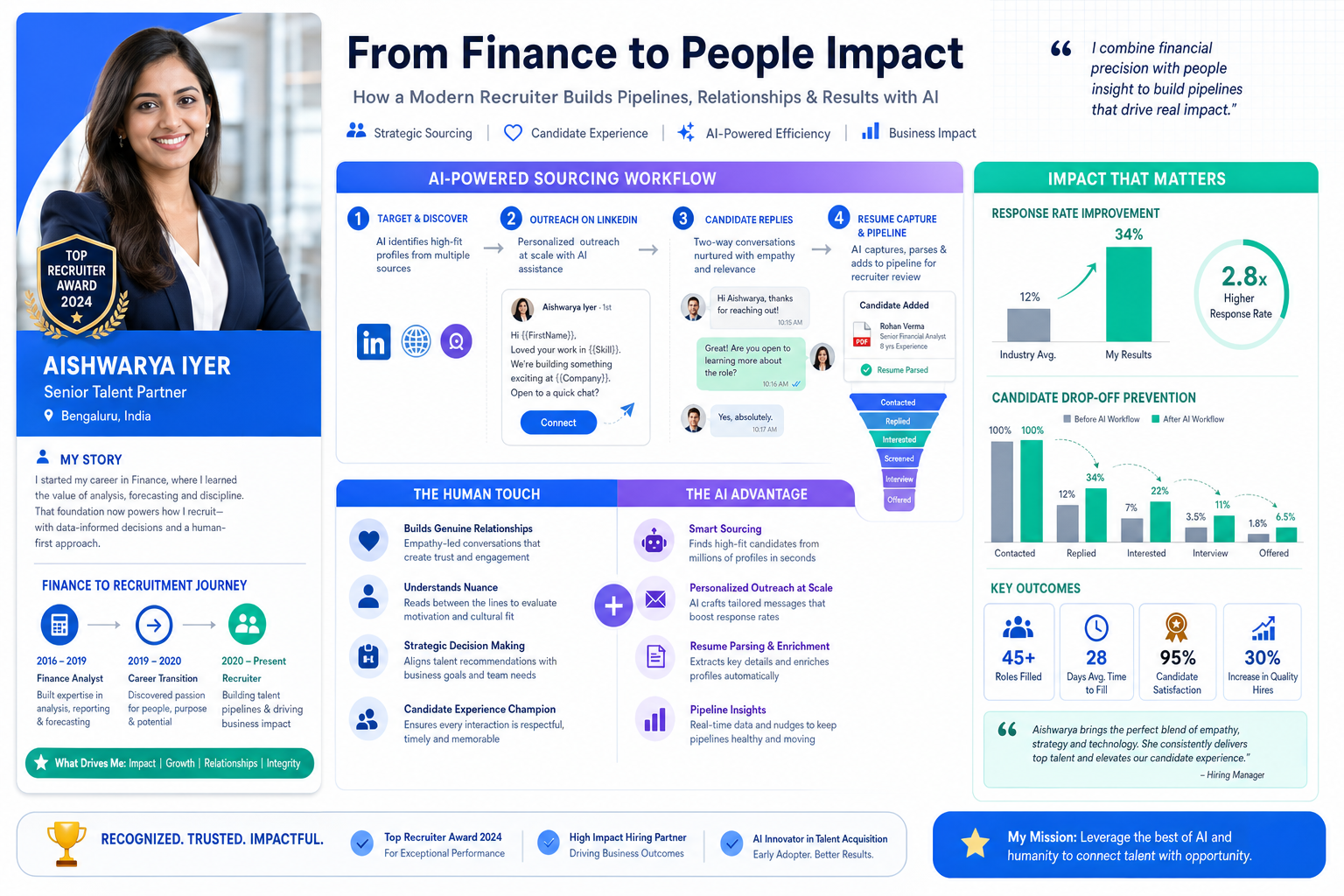
That is where StrategyBrain AI Recruiter can help as a support layer rather than a replacement for recruiter judgment. In my own sourcing workflow, I have found it most useful for three practical jobs tied directly to these bottlenecks: handling first-touch LinkedIn outreach at scale, keeping replies active outside normal working hours, and collecting resumes or contact details from candidates who want to continue the conversation. The recruiter still makes the final call on fit, reviews the resume, and decides whether to move the person into screening or a client shortlist.
A useful way to understand this is to look at a recruiter who did not start in recruiting at all. In the source interview behind this article, Ying moved into recruitment after more than 15 years in finance and accounting. That kind of transition matters in sourcing because domain knowledge changes how conversations unfold. A recruiter with deep finance experience can speak credibly to accounting candidates, understand why a CPA is hesitant to move, and catch details that a generic keyword match would miss.
What stands out even more from that interview is not the career switch itself, but the working reality around it: close collaboration between recruiters and other functions, steady exchange of insights, and the ability to remember candidates well enough to guide them toward a mutual fit. Once you look at modern ai candidate sourcing through that lens, the real question is not whether automation can send messages. It is whether your recruiting sourcing process preserves domain context, keeps conversations warm, and supports a consistent talent sourcing strategy across every touchpoint. That is also why the best sourcing strategies in recruitment still depend on human judgment even when AI handles repetitive steps.
- Why candidate context matters in AI sourcing
- Recruiting sourcing vs. recruiting
- Where AI candidate sourcing actually helps
- A practical sourcing workflow for recruiters
- LinkedIn sourcing: what to automate and what not to
- 8 sourcing strategies in recruitment that still work
- Best channels for passive candidates
- Metrics that show sourcing quality
- How AI support compares across sourcing tools
- Responsible AI use in sourcing
- FAQ
Why candidate context matters in AI sourcing
Candidate sourcing is not just a search exercise. In strong recruiting sourcing, the recruiter has to understand the work itself, the market around it, and the reasons a person might listen. That is why the reference example of a former finance professional becoming a recruiter is more relevant than it first appears. It shows how much sourcing quality improves when the person reaching out can interpret career motives, industry language, and realistic move criteria.
For finance hiring, a candidate may care about audit exposure, reporting lines, systems, hybrid expectations, or whether a move supports a CPA career path. For engineering hiring, the equivalent may be architecture ownership, stack maturity, or pace of delivery. AI candidate sourcing can surface names quickly, but recruiters still need the professional context that makes outreach believable and qualification accurate.
A workable talent sourcing strategy therefore starts with a wider brief than the job description. You need to know the business need, likely motivators, acceptable adjacent backgrounds, and where the hiring manager will compromise. Without that context, AI expands noise rather than insight.
Key insight: The best sourcing systems do not replace recruiter expertise. They protect it by reducing repetitive work and leaving more time for market judgment, candidate conversations, and stakeholder calibration.
Recruiting sourcing vs. recruiting
Many teams still blur these terms, but the distinction matters. Recruiting includes intake, process management, interviews, offers, and close. Recruiting sourcing is the front-end discipline of identifying, approaching, and engaging relevant talent before or alongside the application flow.
| Area | Recruiting Sourcing | Recruiting |
|---|---|---|
| Main purpose | Find and engage qualified talent | Move candidates through the full hiring process |
| Typical audience | Passive or lightly active candidates | Applicants and shortlisted candidates |
| Core work | Search, outreach, mapping, rediscovery | Screening, coordination, assessment, close |
| Outputs | Qualified slate, replies, talent pipeline | Interviews, offers, hires |
| AI support | Search expansion, outreach, follow-up, prioritization | Scheduling, note capture, admin support |
Why does this distinction matter for ai candidate sourcing? Because the strongest value from AI appears early in the funnel, where recruiters lose the most time to manual search, repeated outreach, delayed messaging, and list management.
Where AI candidate sourcing actually helps
Used properly, AI candidate sourcing improves speed and coverage in places where recruiters traditionally burn hours without adding much judgment value.
- Search expansion: AI can suggest related titles, nearby skill sets, and adjacent profiles that a narrow Boolean string may miss.
- LinkedIn outreach support: AI can handle repetitive first-touch messaging and keep candidate conversations active when recruiters are offline.
- 24/7 response continuity: Candidates often reply after work, especially passive talent. AI support helps keep that interest from going cold overnight.
- Resume and contact capture: When someone expresses interest, AI can gather details so the recruiter can step in faster with informed next steps.
- Talent rediscovery: Internal records, past applicants, and old CRM contacts can be surfaced and re-engaged before a team starts from zero.
I have seen the biggest gain on LinkedIn-heavy roles where volume creates delay. In those situations, AI Recruiter is helpful because it can connect with relevant candidates, explain the role at a high level, keep the conversation moving in the candidate's language, and collect resumes from interested people while I stay responsible for fit review and shortlist decisions. If you want to see how that workflow is positioned for active sourcing, the product tutorial and sourcing notes on LinkedIn recruiting automation are directly relevant.
The important boundary is simple: AI can support willingness to engage, but it should not be trusted to make the final qualification call on its own.
A practical sourcing workflow for recruiters
The most reliable recruiting sourcing operation follows a repeatable sequence. AI works best when inserted into that sequence rather than forced to define it.
1. Start with business context, not the job post
The reference interview highlighted something experienced recruiters know well: domain understanding changes candidate conversations. Before you source, clarify what success looks like in the role, what backgrounds are truly required, and what adjacent profiles might work. If a hiring manager only provides a recycled job description, push for the real brief.
2. Build a search map, not one search string
List title variations, target companies, adjacent industries, likely passive talent pools, geography constraints, and must-have skills. In finance, for example, title differences alone can hide viable candidates. The same is true in operations, sales, and technology roles. A durable talent sourcing strategy always maps the market before it messages the market.
3. Decide which steps deserve automation
For LinkedIn sourcing, I separate work into two buckets. High-judgment steps stay human: intake calibration, shortlist review, candidate assessment, and hiring-manager advice. Repetitive steps are where AI helps most: connection requests, first-touch introductions, after-hours replies, and basic interest capture. That is the practical use case for StrategyBrain AI Recruiter in a live workflow.
4. Keep collaboration visible
One of the most useful details from the reference interview was the emphasis on regular insight-sharing across functions. Good sourcing is not a solo act. Recruiters, engagement leaders, hiring managers, and sometimes sales teams need a shared view of target profiles, live candidate signals, and role shifts. Otherwise, sourced leads stall because context is trapped in someone's inbox.
5. Review interest separately from fit
AI-supported outreach can tell you who is willing to talk. That is valuable, but it is not the same as qualification. The recruiter must still review the resume, test the evidence against the brief, and decide whether the candidate belongs in the next stage.
6. Follow up with candidate-specific relevance
Passive candidates reply when the message reflects their likely decision criteria. That may mean career track, reporting line, scope, location flexibility, compensation range, or timing. Generic enthusiasm does not replace relevance.
LinkedIn sourcing: what to automate and what not to
Because this topic often comes up in a LinkedIn context, it helps to be explicit about what should and should not be automated in recruiting sourcing.
| LinkedIn sourcing task | Best owner | Why |
|---|---|---|
| Finding broad candidate pools | Recruiter + AI | AI expands coverage, recruiter keeps search quality high |
| Connection requests and initial introductions | AI-supported | High repetition, time-sensitive, suitable for structured messaging |
| After-hours candidate replies | AI-supported | Prevents warm interest from going cold overnight |
| Resume collection and contact capture | AI-supported | Speeds handoff to recruiter review |
| Final fit assessment | Recruiter | Requires judgment, evidence review, and market context |
| Client or hiring-manager shortlist advice | Recruiter | Needs credibility, nuance, and accountability |
That division of labor is one reason AI candidate sourcing is becoming more practical for agency and in-house teams alike. It removes avoidable admin while preserving human accountability where it matters most.
8 sourcing strategies in recruitment that still work
Even with better automation, the strongest sourcing strategies in recruitment still rely on fundamentals.
1. Calibrate with the hiring manager early
Most sourcing waste starts with a vague brief. Ask what outcomes matter, not just what keywords should appear on a profile.
2. Use domain language in your outreach
The Ying example is useful here. A recruiter with firsthand understanding of the candidate's field can speak more naturally to risk, growth, timing, and trade-offs.
3. Separate willing-to-talk from qualified-to-hire
AI can support the first part well. The second part still depends on recruiter review.
4. Build passive-candidate paths, not just applicant funnels
Passive candidates need a lower-friction conversation, better timing, and stronger reasons to engage.
5. Revisit your own database before starting cold
ATS and CRM rediscovery often produce faster wins than beginning from scratch.
6. Keep channel diversity
Do not rely only on LinkedIn. Referrals, alumni networks, niche communities, internal mobility, and prior applicants all matter.
7. Make follow-up operational, not optional
Many recruiters lose candidates not on the first message, but between the first reply and the next action. This is exactly where AI-supported continuity helps.
8. Treat sourcing as a living pipeline discipline
The best talent sourcing strategy is active before the requisition becomes urgent.
Best channels for passive candidates
The right channel mix depends on role type, urgency, and talent scarcity.
| Channel | Best use case | Main strength | Main risk |
|---|---|---|---|
| Broad market search and direct outreach | Scale and visibility | High message competition | |
| Employee referrals | Warm access to qualified talent | Trust and context | Can become too narrow without checks |
| ATS/CRM rediscovery | Re-engaging known prospects | Faster restart | Data may be stale |
| Internal mobility | Retention and speed | Known performance history | Needs manager alignment |
| Niche communities | Specialist or hard-to-fill roles | High relevance | Lower volume |
| Content and employer brand | Longer-term attraction | Supports trust before reply | Slower payoff |
In practice, LinkedIn remains central for many recruiters, but it works best when its repetitive tasks are supported intelligently. That is why AI-assisted messaging and follow-up have become such a common part of modern recruiting sourcing conversations.
Metrics that show sourcing quality
If you want to know whether ai candidate sourcing is helping, activity volume is not enough.
- Qualified slate rate: How many sourced candidates actually meet the agreed brief?
- Response rate: Are passive candidates replying?
- Positive-interest rate: How many candidates want to continue the conversation?
- Resume capture rate: How often does interest convert into usable next-step information?
- Interview conversion by source: Which channels create real pipeline movement?
- Time-to-first-response: How long do interested candidates wait for engagement?
That fourth metric matters more than many teams admit. In LinkedIn-heavy workflows, you can lose value between candidate interest and recruiter review if resumes, contact details, or communication history are not captured cleanly. That is one of the practical reasons some teams test AI Recruiter conversation workflows as part of their sourcing process.
How AI support compares across sourcing tools
When teams evaluate sourcing software, they usually compare workflow coverage, user experience, expected output, pricing model, and business fit. For software categories commonly used in sourcing, three widely known names often come up alongside AI-led approaches: LinkedIn Recruiter, Gem, and hireEZ.
| Platform | Strengths | Watch-outs | Best fit | How it can work with AI Recruiter |
|---|---|---|---|---|
| LinkedIn Recruiter | Strong native search, large candidate pool, familiar interface | Heavy manual outreach load, recruiter time cost can remain high | In-house and agency teams already centered on LinkedIn | Useful as the search environment while AI Recruiter supports repetitive outreach and candidate-response continuity |
| Gem | CRM workflow, analytics, outreach sequencing | Value depends on process maturity and data discipline | Teams wanting structured pipeline tracking and reporting | Can complement AI-led first-touch activity by organizing downstream engagement and measurement |
| hireEZ | Broad sourcing reach, search aggregation, rediscovery support | Search breadth still needs strong calibration to avoid noisy slates | Teams hiring across multiple channels and functions | Can help identify talent pools while AI Recruiter manages parts of LinkedIn messaging and handoff |
I would not frame these as direct substitutes in every case. The practical question is which system solves your current bottleneck. If the pain is search depth, one set of tools matters. If the pain is LinkedIn follow-up volume, off-hours replies, and resume capture after initial interest, AI-supported outreach matters more. That is why the evaluation should start from workflow friction, not feature lists alone.
Responsible AI use in sourcing
Responsible ai candidate sourcing means preserving recruiter accountability.
- Keep human review on candidate fit. AI may identify interest, but it should not replace resume review and role judgment.
- Check for bias and over-narrow matching. If the system repeatedly favors one profile pattern, you may miss adjacent talent.
- Protect candidate data. Teams should understand how resumes, contact details, and conversation records are stored and used.
- Document your handoff points. Be clear about when AI is messaging and when a recruiter takes over.
For teams evaluating data handling and operating boundaries, the StrategyBrain site and product materials emphasize encrypted credentials, isolated customer environments, and recruiter control over final progression decisions. Whether you use that platform or another, those are exactly the kinds of governance questions serious sourcing leaders should ask.
FAQ
What is AI candidate sourcing?
AI candidate sourcing is the use of artificial intelligence to support proactive talent search and engagement. It can help with search expansion, outreach, follow-up, ranking, and talent rediscovery, while recruiters keep final decision authority.
How is recruiting sourcing different from recruiting?
Recruiting sourcing focuses on finding and engaging talent, especially passive candidates. Recruiting includes the full hiring journey from intake through offer and close.
What makes a good talent sourcing strategy?
A strong talent sourcing strategy combines clear role calibration, realistic market mapping, multi-channel sourcing, disciplined follow-up, and measurement tied to candidate quality rather than message volume alone.
Which sourcing strategies in recruitment still work with AI?
The most reliable sourcing strategies in recruitment still include intake discipline, title-family search, passive-candidate outreach, ATS rediscovery, referral sourcing, and recruiter-led qualification after initial AI support.
Is LinkedIn automation enough to replace a recruiter?
No. Automation can reduce repetitive work and improve response speed, but recruiters still need to assess fit, advise stakeholders, and manage the quality of the candidate experience.
Who benefits most from AI-supported sourcing?
Agency recruiters, independent headhunters, and in-house teams with high outreach volume tend to benefit most, especially when they lose time to manual LinkedIn messaging, off-hours replies, and early-stage follow-up.
Conclusion
The strongest lesson from the reference example is simple: good recruiting sourcing depends on more than finding profiles. It depends on understanding the candidate's world, collaborating across functions, and keeping communication active long enough to turn interest into a real hiring conversation.
That is why AI candidate sourcing works best as reinforcement for recruiter expertise. Use it to expand searches, handle repetitive LinkedIn tasks, maintain momentum with passive candidates, and capture next-step information cleanly. Keep the human recruiter responsible for evaluation, judgment, and trust. That is the foundation of a scalable talent sourcing strategy and the reason the best sourcing strategies in recruitment still look human even when AI supports the workflow.