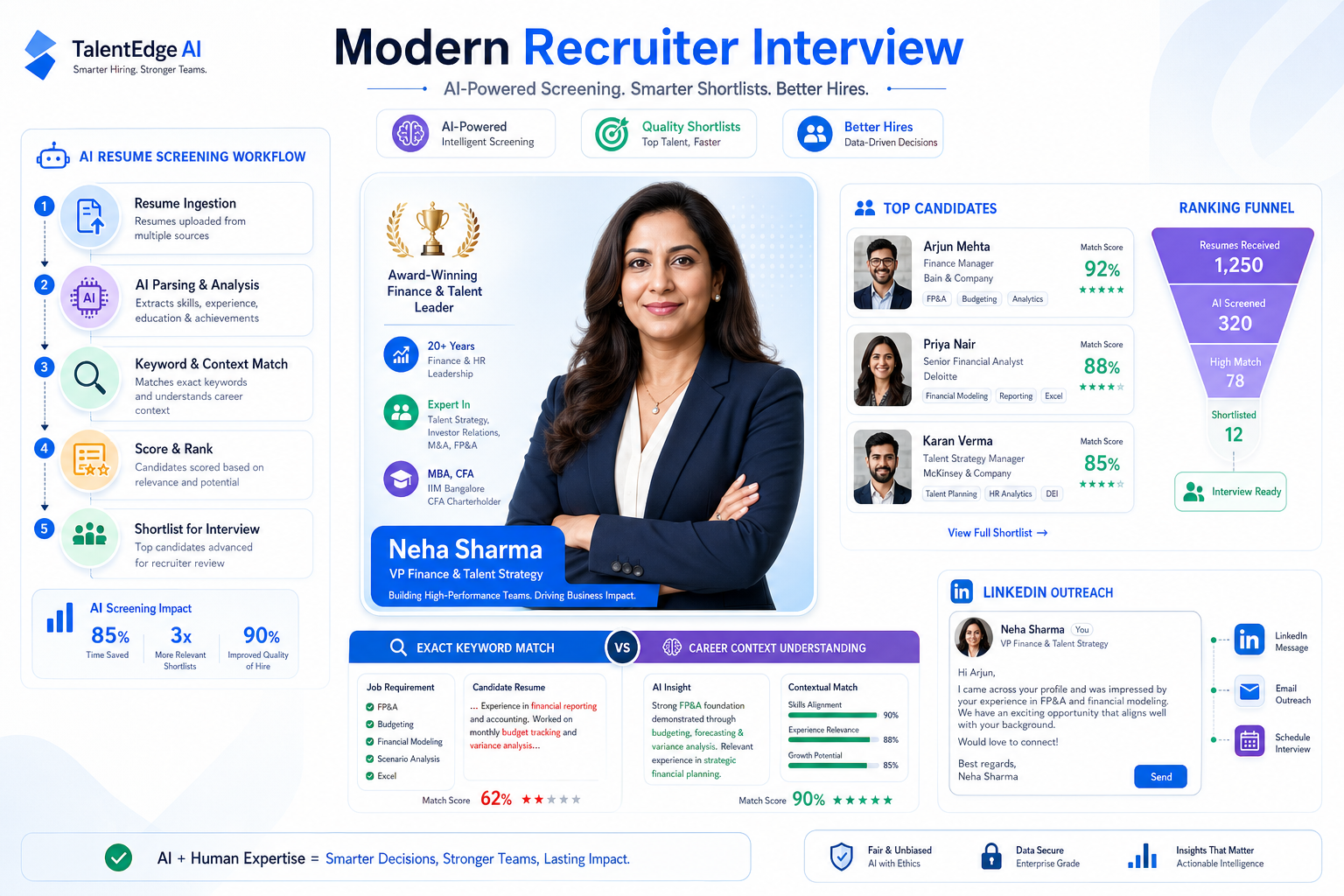
Headhunters can use this guide to judge whether ai resume screening tools surface real fit or bury strong nontraditional talent.
That distinction matters more than many teams admit. In retained search, agency recruiting, and in-house hiring, weak screening logic usually shows up as familiar pain: recruiters review too many resumes that technically match but are commercially wrong, promising candidates get buried because their path looks nontraditional, and hiring managers lose confidence when the shortlist feels narrow, repetitive, or hard to defend. The operational cost is not just time. It affects client trust, candidate experience, team capacity, and the quality of later interview decisions.
In my own workflow, tools that reduce this pressure are the ones that handle repetitive outreach and resume collection cleanly before formal review begins. Used alongside AI Recruiter, I have found it easier to keep candidate conversations moving across time zones, collect resumes from interested prospects, and avoid losing context between outreach and screening. That matters when the same recruiter is juggling sourcing, follow-up, and evaluation. The software can automate early LinkedIn communication and document collection, but the recruiter still has to make the final judgment on resume quality, role fit, and who deserves a serious conversation.
A useful way to think about screening starts with a career path that does not fit the old template. In a conversation published for International Women’s Day, a finance leader described building a varied career across strategy, operations, venture work, startups, and large organizations. She also described a hiring market that once preferred the safer candidate who had done the exact same job at a direct competitor. That is a familiar recruiting scene: a resume lands in the queue, the title does not line up neatly, the recruiter scans the chronology, compares it to the requisition, and hesitates because the story is broader than the job brief was written to catch.
The tension becomes clearer in the next hiring actions. Someone has to reopen the requisition, separate true must-haves from convention, check whether cross-functional experience is actually relevant, and decide whether this is a risky profile or an overlooked one. That is where modern cv screening software can either help or harm. If the setup rewards only exact title repetition, agile candidates disappear. If it recognizes related experience, functional adjacency, and credible skill evidence, the recruiter gets a stronger longlist. The same logic also shapes how to pass ai resume screening: candidates do better when they make their experience legible and relevant, not when they try to game the system.
In this guide, I will break that process down from both sides of the desk: how employers configure AI candidate screening, where screening fails when the hiring brief is too narrow, and what candidates can do to improve their odds of reaching human review.
- Why AI Screening Needs Better Context
- How AI Resume Screening Tools Work
- ATS vs AI Screening
- Keyword Matching vs Career Context
- How Employers Use CV Screening Software Well
- How to Pass AI Resume Screening
- Using LinkedIn Workflows With Screening
- Common Mistakes for Recruiters and Candidates
- Bias, Transparency, and Compliance
- FAQ
Why AI Screening Needs Better Context
One of the most common hiring mistakes is confusing familiarity with fit. Teams often say they want someone who can operate in ambiguity, build across functions, and grow with the business. Then the screening process is configured to favor the person whose last title matches the job description line for line.
That mismatch is not just a candidate problem. It is a setup problem. The reference case above reflects a reality many recruiters know well: some of the best operators do not have linear resumes. They move across industries, step into multifunctional roles, work fractionally, build portfolio careers, and gain range in the process. If your screening logic cannot read that kind of background, your process will quietly narrow your talent pool.
Key insight: The real value of AI candidate screening is not speed alone. It is the ability to surface relevant, reviewable patterns without forcing every strong candidate into the same career template.
That is why experienced recruiting teams start with business context before they start with automation. What problem is the hire expected to solve? Which experiences are truly essential? Which indicators are proxies that may exclude good people? Until those questions are answered, no ranking model is especially trustworthy.
How AI Resume Screening Tools Work
At an operational level, most ai resume screening tools follow a similar sequence, even if the interface and scoring language differ.
- Resume parsing: the system reads the file and identifies sections such as experience, education, skills, certifications, and dates.
- Structured data extraction: resume text is turned into searchable fields so recruiters can filter and compare consistently.
- Requirement matching: the extracted data is compared against job criteria, often including must-haves and preferred qualifications.
- Ranking or grouping: candidates are sorted into review queues based on likely relevance.
- Human shortlisting: the recruiter reviews the ranked pool, checks context, and decides who moves forward.
What matters in practice is not whether software can assign a score. Almost every platform can do that. The more important question is whether the score reflects the real hiring brief. A strong tool should help recruiters recognize related titles, transferable experience, and meaningful evidence in the body of the resume, not just repeated phrase overlap.
| Workflow Stage | What the Tool Does | What Recruiters Should Check |
|---|---|---|
| Parsing | Reads and separates resume sections | Whether titles, dates, and employers are captured correctly |
| Extraction | Creates searchable candidate fields | Whether skills and chronology reflect the original resume |
| Matching | Compares profile against role requirements | Whether the criteria reflect actual business needs |
| Ranking | Prioritizes likely-fit candidates | Whether nontraditional but relevant profiles still surface |
| Shortlisting | Supports recruiter review | Whether final movement is still accountable to human judgment |
ATS vs AI Screening
Recruiters still regularly blur the line between applicant tracking and screening intelligence. They work together, but they do different jobs.
An ATS is the workflow backbone. It handles postings, application records, pipeline stages, internal notes, scheduling, and compliance history. AI screening is the analytical layer that helps interpret resume content, compare applicants against role requirements, and prioritize who should be reviewed first.
| Area | ATS | AI Screening |
|---|---|---|
| Primary role | Manage applicant workflow | Analyze candidate relevance |
| Main output | Status, communication history, process records | Match signals, ranking, filters |
| Best use | Operational control | Decision support |
| Main risk | Admin friction | Overreliance on opaque scoring |
If you are choosing systems for a growing recruiting function, treat them as complementary. Process control and screening quality solve different problems, and both are necessary when hiring volumes rise.
Keyword Matching vs Career Context
Older screening models leaned heavily on exact keyword overlap. Modern tools aim to interpret meaning more broadly by recognizing related skills, adjacent titles, industry context, and responsibility patterns. That shift is useful, but it only works if the hiring criteria are written thoughtfully.
The finance leader in the opening case described a market that once undervalued varied experience. That is still relevant to AI screening today. If the model is trained or configured to look only for one obvious path, it will reinforce the same limitation at scale. If the tool is allowed to read context more intelligently, it becomes more useful for complex hires.
| Approach | What It Looks For | Strength | Weakness |
|---|---|---|---|
| Exact keyword matching | Literal phrase overlap | Fast and simple | Misses candidates with different wording or broader paths |
| Context-aware matching | Meaning, role adjacency, skill clusters | Better relevance interpretation | Still depends on good recruiter setup |
For candidates, this is why keyword stuffing is a poor strategy. The better approach is to use the right language honestly and tie it to actual responsibilities. For recruiters, it is a reminder that a narrow brief can make even advanced software behave like a blunt filter.
How Employers Use CV Screening Software Well
The best use of cv screening software begins before the first application arrives. Teams that get good results usually do three things well: define the work clearly, separate essentials from preferences, and review edge cases deliberately.
1. Define what success looks like in the role
Do not start with a recycled job description. Start with the business problem. Is the company hiring someone to stabilize operations, build a function, support a founder, manage investor reporting, or improve process rigor? Those distinctions change how screening should be configured.
2. Separate must-haves from familiar patterns
A requirement is not a must-have just because it feels conventional. In many searches, teams over-specify backgrounds they have seen before and underweight the capabilities they actually need. That is exactly how varied but relevant candidates get screened out early.
- List the real non-negotiables
- Identify preferred signals separately
- Write down which requirements are proxies rather than necessities
- Agree on how transferable experience will be reviewed
3. Audit the longlist before trusting the ranking
Before you rely on the score, review a sample of high-, mid-, and low-ranked resumes. Check whether parser errors, title rigidity, or wording bias are distorting outcomes. If the shortlist keeps favoring one narrow profile, the setup probably needs work.
Practical takeaway: Good screening design is less about replacing recruiters and more about making recruiter judgment faster, more consistent, and easier to defend.
How to Pass AI Resume Screening
When candidates ask how to pass ai resume screening, I usually give the same answer: make your resume easy to parse, easy to trust, and clearly relevant to the role. There is no durable trick that beats credible alignment.
Use recognizable role language
If your background is relevant but your title is unusual, clarify the connection. You do not need to misrepresent your role, but you should make the market equivalent visible where appropriate.
Mirror important terms naturally
When the job description repeats certain tools, responsibilities, or certifications, those terms probably matter. Use them where they truthfully apply, and place them in context inside your work history.
Keep formatting parser-friendly
- Use standard headings such as Experience, Education, Skills, and Certifications
- Avoid heavy graphics, text boxes, or complex tables
- Make employer names, dates, and titles easy to identify
- Submit the file type requested by the employer
Show evidence, not just labels
A resume that says “operations,” “analysis,” or “stakeholder management” without proof is weak. Strong resumes show where those skills were used and why they mattered.
- Weak: Managed finance operations
- Stronger: Managed finance operations across budgeting, reporting, and cross-functional process improvements in a scaling business
If your path is nonlinear, this matters even more. The system and the recruiter both need help understanding the thread that connects your experience.
Using LinkedIn Workflows With Screening
AI screening rarely exists in isolation. In many searches, the real bottleneck happens earlier: outreach goes out, replies come back at irregular hours, interested candidates ask follow-up questions, and resumes arrive across multiple channels. By the time formal screening starts, the recruiter is already cleaning up process debt.
That is one reason I have found StrategyBrain AI Recruiter useful in sourcing-heavy work. It can automate first-contact messaging on LinkedIn, handle after-hours replies, communicate in the candidate’s language when needed, and collect resumes or contact details from people who want to move forward. In my experience, that does not replace assessment, but it does reduce the admin drag that makes later screening sloppier.
For teams hiring across markets, the multilingual and always-on communication layer is especially practical. If a recruiter wakes up to several overnight candidate replies, AI Recruiter can keep the conversation alive and gather the documents needed for review. The recruiter still decides whether the candidate’s background actually meets the brief. That separation is healthy: AI supports continuity, while hiring judgment stays human.
If you want to see how these LinkedIn conversation flows are structured in practice, the public conversation examples are a useful reference point. The main lesson is operational rather than promotional: outreach, reply handling, and resume collection are different tasks from final qualification, and the workflow works better when each stage is handled deliberately.
Common Mistakes for Recruiters and Candidates
Recruiter mistakes
- Overvaluing career cloning: assuming the best candidate must come from the same title track
- Poor criteria design: turning preferences into hard filters
- Blind trust in ranking: treating software output as a final decision instead of a review aid
- Ignoring workflow gaps: letting outreach, follow-up, and resume collection become fragmented before screening starts
Candidate mistakes
- Keyword stuffing: repeating terms without proving experience
- Overdesigned formatting: making the document harder to parse
- Vague summaries: failing to explain a nontraditional path clearly
- Missing context: listing skills without showing where they were applied
Both sides run into the same truth: clarity wins. Structured information and explicit relevance outperform gimmicks almost every time.
Bias, Transparency, and Compliance
The opening case also points to a broader risk: when screening systems favor the most familiar profile, they can reinforce old market biases under the appearance of efficiency. That is why explainability matters.
Hiring teams should be able to answer basic questions about their screening process:
- Why was a candidate ranked highly or poorly?
- Which criteria were treated as essential?
- Were transferable backgrounds meaningfully considered?
- Can the team audit outcomes across different candidate groups?
Responsible use of AI candidate screening means documenting the rubric, reviewing exceptions, and making sure final progression or rejection decisions are tied to accountable human review.
FAQ
What is AI candidate screening?
AI candidate screening uses software to parse resumes, extract data, compare applicants against job criteria, and support ranking or shortlisting. In most real hiring environments, it helps recruiters prioritize review rather than replace them.
How do ai resume screening tools differ from basic ATS filters?
AI resume screening tools generally go beyond storage and workflow management. They analyze resume content, identify patterns of relevance, and help recruiters sort applicants by likely fit.
What is cv screening software best used for?
CV screening software is best used to create more consistent review queues, reduce manual sorting, and surface candidates whose experience aligns with the role, including people with less obvious but relevant backgrounds.
How can candidates improve their odds of passing AI screening?
If you want to know how to pass ai resume screening, focus on readable formatting, honest alignment with the job, recognizable language, and concrete evidence of skills in context.
Can AI screening reject good candidates?
Yes. That usually happens when the rubric is too narrow, parsing fails, or the tool is configured to reward exact background matches over broader relevance.
Should recruiters rely on AI scores alone?
No. AI scores should help organize review, not replace recruiter judgment. The strongest hiring processes keep human accountability at the shortlisting stage.
Conclusion
The most important lesson from AI candidate screening is the same lesson embedded in the opening career story: strong talent does not always arrive in the most predictable format. If your process is built only to recognize familiar patterns, your shortlist will be narrower than it should be.
For employers, that means configuring ai resume screening tools around real business needs, not recycled assumptions. For candidates, it means presenting experience in a way that is structured, specific, and easy to map to the role. And for recruiters managing sourcing-heavy searches, pairing screening with a disciplined outreach workflow, including tools like AI Recruiter, can reduce process friction before resume review even begins.
Whether you are selecting cv screening software or learning how to pass ai resume screening, the practical standard is the same: clear criteria, credible evidence, and human judgment applied where it matters most.