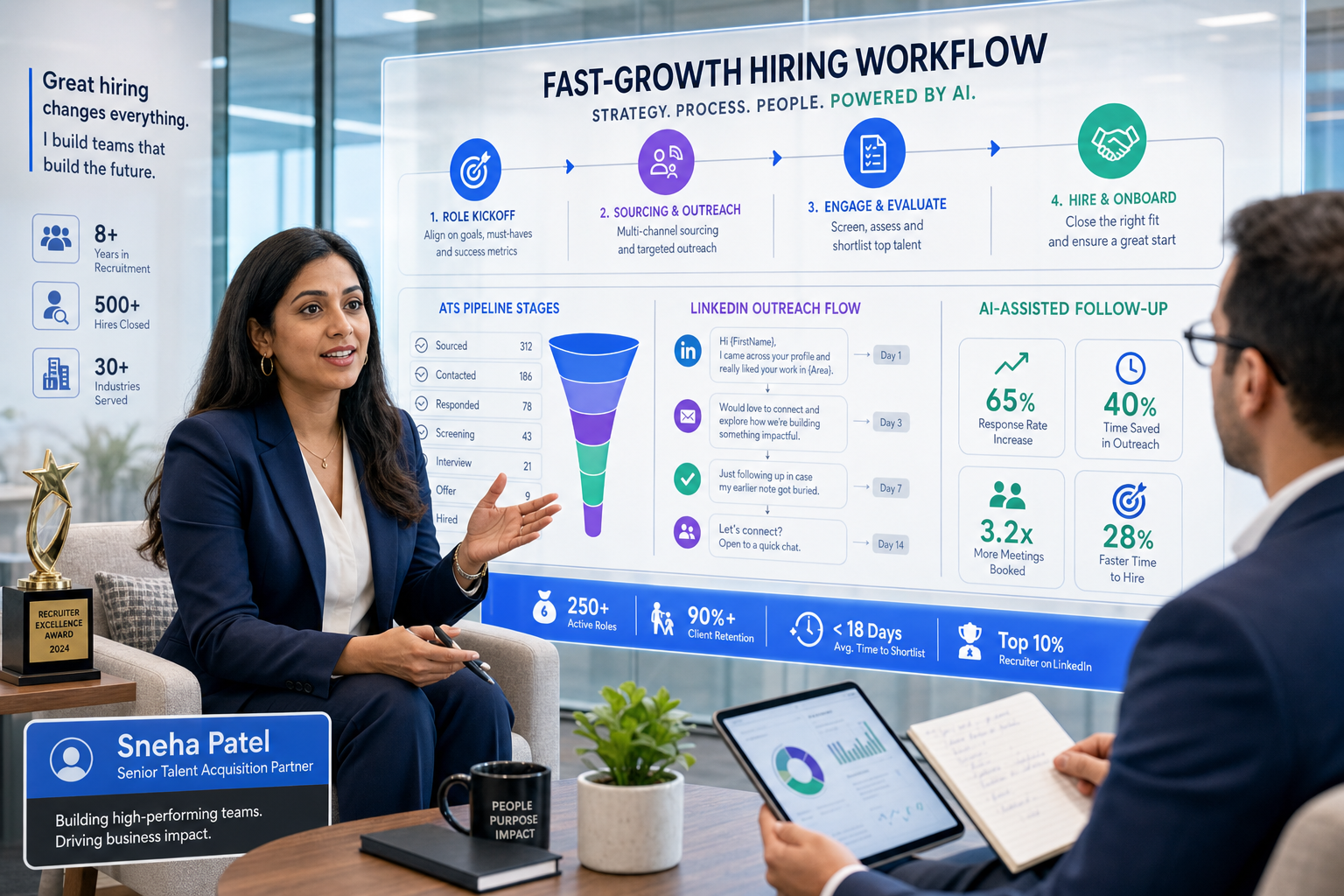
See which recruiting tools fit fast-growth hiring, so HR leaders can avoid workflow chaos, weak follow-up, and costly misalignment.
That matters most when hiring stops feeling routine. In stable environments, recruiters can tolerate scattered notes, delayed feedback, and a patchwork of inboxes, spreadsheets, and social messages. In fast-growth hiring, those gaps become expensive. Agency owners lose consultant time to repeated outreach and status chasing. Solo recruiters miss follow-ups with interested candidates. In-house talent teams struggle to stay aligned with changing priorities from finance, operations, and department leaders. What looks like a software problem often starts as a coordination problem, then becomes a speed, quality, and credibility problem.
In my own workflow, I have found that AI Recruiter is most useful when LinkedIn outreach volume rises faster than recruiter capacity. Its always-on candidate messaging, multilingual communication, and automated collection of resumes and contact details can take repetitive front-end work off the desk without removing recruiter control. I still review resumes, decide who moves forward, and handle the real qualification step, but using AI Recruiter in LinkedIn sourcing makes it easier to keep conversations moving when candidates reply after hours or across time zones.
A useful way to understand this is to look at what happens inside a high-growth environment. In one finance leadership story, a director who had moved through audit, costing, and FP&A described how different startup-style work felt from a larger company. The issue was not just pace. It was the loss of a stable baseline. Metrics changed as the business changed, leaders needed new information quickly, and success depended on staying close to decision-makers while keeping a live pulse on the data. That same operating reality shows up in recruiting long before teams admit it.
When a recruiter is hiring for a business that is redefining priorities in real time, the work shifts from simple requisition filling to constant re-prioritization. One moment you are reviewing a shortlist, the next you are updating candidate stages, nudging a hiring manager, checking a new role brief, and reconnecting with passive talent because the target profile has changed. If your system cannot support changing workflows, stakeholder alignment, and responsive outreach, even the top recruiting tools will feel clumsy. That is why the best recruiting software conversation should start with fast-growth conditions, then move into workflow fit, ATS structure, and where social recruiting tools actually help.
- Why fast-growth hiring changes software needs
- What recruiting software includes today
- How to evaluate recruiting tools before demos
- Best recruiting software by hiring workflow
- Best-fit recruiting tools by team size and model
- Where social recruiting tools fit
- How AI supports LinkedIn recruiting without replacing recruiters
- Applicant tracking system benefits in practice
- Common software buying mistakes
- FAQ
Why fast-growth hiring changes software needs
One of the best lessons from high-growth operating teams is that routine disappears first. In a mature company, recruiters can build around predictable hiring calendars, stable approvers, and familiar role profiles. In a fast-growth company, leaders ask for new reporting, role scope changes midway through a search, and hiring managers need recruiters to understand broader business strategy rather than just resume flow.
That is why the best recruiting software is rarely the platform with the longest feature list. It is the one that helps recruiters stay effective when business conditions are shifting. From experience, three software requirements become more important in these environments:
- Flexible workflow control: stages, ownership, and approvals need to adapt without creating chaos
- Clear stakeholder visibility: recruiters, hiring managers, and leadership need one shared source of truth
- Fast candidate communication: outreach and follow-up need to continue even when recruiter capacity is stretched
This is also where many buyers confuse software categories. They compare an ATS, sourcing tools, CRM-style outreach systems, and social recruiting tools as if they solve the same problem. They do not. A fast-growth team usually needs a stable operating center plus lighter tools around it for top-of-funnel reach and communication speed.
Key insight: In high-growth hiring, software is not just about automation. It is about staying aligned with changing business goals while keeping candidate momentum intact.
What recruiting software includes today
When teams search for recruiting tools, they are usually trying to solve a chain of hiring problems rather than one isolated task. Modern recruiting software can cover candidate relationship management, job posting, applicant tracking, interview scheduling, scorecards, approvals, reporting, sourcing support, and onboarding handoff.
For most teams, the stack falls into four practical layers:
- Core ATS layer: pipeline stages, application records, feedback, and compliance documentation
- Sourcing and outreach layer: search, nurture, direct messaging, talent pooling, and passive candidate engagement
- Collaboration layer: interview coordination, hiring manager feedback, role approvals, and team visibility
- Recruitment marketing layer: employer brand, campaigns, and social distribution
That broader view matters because the best recruiting software is often not one tool doing everything equally well. It is a workable combination where the ATS anchors the process and adjacent systems support sourcing, engagement, or scheduling where needed.
For recruiters working heavily in LinkedIn sourcing, this is where a specialized communication layer can help. I have used AI Recruiter to keep outreach running between manual shortlist reviews. It can introduce roles, respond to candidate questions, and collect resumes from interested people while I stay focused on qualification, hiring manager calibration, and decision-making. That division of labor is sensible because repetitive outreach and final selection are not the same job.
How to evaluate recruiting tools before demos
Strong software evaluation starts with hiring reality, not vendor slides. If you evaluate only by automation claims or polished dashboards, you can miss the basic question: where does your process actually break?
I recommend evaluating recruiting tools against these five criteria first:
- How often priorities change.
If role scope changes mid-search or leaders regularly shift urgency, flexible workflows matter more than static reporting polish.
- How much recruiter time is lost to repetitive outreach.
If your team spends hours connecting, messaging, following up, and collecting resumes, communication automation may deserve more weight.
- How well hiring managers participate.
Even the top recruiting tools fail if interviewers do not submit feedback or if approvals happen outside the platform.
- How much of your funnel depends on direct sourcing versus inbound applicants.
Direct sourcing teams need stronger talent pooling and social channel support than teams hiring mostly from applications.
- How much context recruiters need to do the job well.
In fast-growth environments, recruiters need software that keeps business priorities visible, not just candidate status.
This framing mirrors a practical lesson from high-growth finance teams: when metrics and needs keep changing, operators have to stay close to leadership, understand the larger business goal, and be ready to adjust. Recruiting software should support that same kind of responsiveness.
Build a shortlist around workflow friction
Use three buckets during evaluation:
- Non-negotiable: must-have process capabilities
- Important: meaningful efficiency or collaboration gains
- Nice to have: useful features that should not drive the decision
That keeps demos focused on recruiter reality instead of feature theater.
Best recruiting software by hiring workflow
A more useful way to compare the best recruiting software is by hiring workflow. Different recruiting tools solve different kinds of friction.
| Workflow | What matters most | Best fit for | Common failure point |
|---|---|---|---|
| Applicant tracking | Stage clarity, feedback capture, searchability, reporting | Most in-house teams and agencies | Hiring managers work outside the system |
| Direct sourcing | Talent search, outreach, follow-up, nurture | Headhunters, specialist recruiters, hard-to-fill roles | Too much manual messaging and weak follow-through |
| Interview coordination | Scheduling, scorecards, reminders, decision speed | Teams with many stakeholders | Late feedback and panel confusion |
| Recruitment marketing | Campaign distribution, employer brand, audience engagement | Brand-led hiring teams | High visibility but weak conversion |
| High-volume screening | Automation, consistency, queue management | Large-scale hiring operations | Over-automation without exception handling |
| Post-offer handoff | Data transfer, onboarding continuity | Structured HR operations | Duplicate entry and missing records |
Where ATS strength shows up first
If recruiters are juggling spreadsheets, email folders, and chat threads, an ATS is usually the first upgrade. Applicant tracking system benefits are most visible in stage visibility, feedback consistency, and documentation quality. It gives recruiters one operating center instead of fragmented records.
Where sourcing tools earn their place
For headhunters and search teams, sourcing software matters when the challenge is not application flow but candidate discovery and response. This is especially true in specialized markets where passive talent must be approached thoughtfully and repeatedly.
In that part of the funnel, I have had the best results by combining a structured ATS with AI Recruiter for LinkedIn message continuity. It handles the repetitive parts of outreach, asks whether candidates are open to hearing about a role, and helps capture resumes and contact details. I still make the call on relevance, shortlist quality, and interview progression, but it reduces dead time between outreach and recruiter review.
Where collaboration tools matter more than sourcing
Not every hiring slowdown starts at the top of the funnel. In many companies, the bottleneck is internal: approvals are slow, interviewers are inconsistent, and scorecards arrive late. If that sounds familiar, the best recruiting software for your team may be the one with stronger collaboration design rather than stronger search features.
Best-fit recruiting tools by team size and model
Small agencies and solo recruiters
Smaller recruiting businesses need speed, low admin burden, and strong sourcing productivity. The best fit is usually a lightweight ATS or CRM-supported workflow plus outreach support that prevents follow-up gaps. If LinkedIn is a major sourcing channel, automation support can create real leverage without requiring a larger team.
Lean in-house HR teams
These teams usually need broad functionality without complicated implementation. Candidate management, interview scheduling, and reporting basics matter more than advanced customization. Overbuying is common here.
Mid-market TA teams
Mid-market organizations often need better hiring manager adoption, stronger approvals, and cleaner reporting across departments. This is where applicant tracking system benefits expand from recruiter efficiency into process governance.
Enterprise organizations
Enterprises need permissions, compliance controls, integration depth, and flexibility across functions. The best recruiting software should support multiple hiring models without forcing one rigid process on every business unit.
High-growth hiring teams
These teams deserve their own category because their challenge is not just scale. It is change. As in the finance example earlier, there may be no stable baseline for priorities, metrics, or workflow expectations. Recruiters need systems that support constant adjustment, close contact with stakeholders, and quick visibility into what changed and why.
Where social recruiting tools fit
Social recruiting tools have a real role, but not always the one buyers expect. Their strongest contribution is usually visibility, employer brand reinforcement, and audience engagement over time rather than immediate conversion to qualified hires.
That makes them useful in two situations:
- Brand-sensitive hiring: candidates research the employer before they apply
- Community-based talent markets: familiarity and repeated exposure improve response rates
They are less effective when the hiring need is urgent, highly specialized, or dependent on targeted outbound sourcing. In those cases, structured outreach and recruiter follow-up matter more than broad social reach.
So when comparing the best recruiting software, treat social recruiting tools as a supporting layer. They can amplify awareness and support candidate interest, but they rarely replace a solid ATS and disciplined sourcing process.
How top recruiting tools use social channels well
- Distribute jobs consistently across channels
- Support employer brand storytelling over time
- Track engagement patterns that inform sourcing strategy
- Connect social visibility with recruiter-owned pipeline follow-up
How AI supports LinkedIn recruiting without replacing recruiters
AI has become part of the mainstream recruiting conversation, especially in sourcing, screening support, scheduling, and admin work. But in actual recruiting operations, the best use of AI is narrower and more practical: remove repetitive front-end tasks while preserving human judgment where nuance matters.
For LinkedIn-heavy recruiting, the most credible use cases include:
- Starting outreach at scale
- Responding to candidate questions outside recruiter working hours
- Continuing multilingual communication across regions
- Collecting resumes and contact details from interested candidates
- Reducing manual follow-up load
That is why I see StrategyBrain AI Recruiter as a workflow support tool, not a replacement for recruiter assessment. It can automate connection requests, role introductions, and candidate-interest checks on LinkedIn, then hand the conversation back when recruiter judgment is needed. In practice, that is the right boundary. Interest is not the same as fit, and communication volume is not the same as qualification quality.
For headhunters, this can be especially useful when after-hours replies pile up and sourcing campaigns span multiple time zones. For in-house teams, it helps when recruiter bandwidth is the constraint but final screening still depends on internal role context and hiring manager priorities.
Applicant tracking system benefits in practice
Because many searches for the best recruiting software are effectively ATS searches, it is worth stating the core value clearly. An ATS is still the operational backbone for most recruiting teams.
The most practical applicant tracking system benefits are:
- Pipeline visibility: see where candidates stall and where roles are aging
- Process consistency: reduce ad hoc handling and improve fairness
- Stronger collaboration: centralize interviewer and manager input
- Cleaner reporting: review conversion patterns and workload by stage
- Better handoffs: move accepted candidates into downstream workflows more smoothly
The advantages of applicant tracking system adoption become clearer as hiring gets less routine. In a fast-growth business, recruiters are often dealing with shifting priorities, changing scorecards, and multiple stakeholders asking for updates. A good ATS does not remove complexity, but it stops complexity from becoming disorder.
Common software buying mistakes
- Buying for features instead of operating conditions.
The wrong workflow fit becomes obvious as soon as priorities change or managers delay feedback.
- Treating social visibility as proof of recruiting effectiveness.
Social recruiting tools are valuable, but visibility and hiring conversion are not the same thing.
- Assuming AI can replace recruiter judgment.
Automation can support outreach and admin. It should not replace final fit assessment or hiring decisions.
- Ignoring fast-growth realities.
If the business changes direction frequently, static and overly rigid software will frustrate recruiters quickly.
- Skipping implementation ownership.
Even strong recruiting tools fail when roles, permissions, and team expectations are not defined before rollout.
Practical shortlist tip: Review one recent hire where everything changed midway through the search. If a platform cannot support that scenario cleanly, it is unlikely to be your best recruiting software.
FAQ
What is the best recruiting software for fast-growth teams?
The best recruiting software for fast-growth teams is usually one that combines a strong ATS foundation with flexible workflows, clear stakeholder visibility, and efficient sourcing support. The right choice depends on how often priorities change, how much direct sourcing you do, and how well hiring managers use the system.
How do recruiting tools differ from social recruiting tools?
Recruiting tools cover broader hiring workflows such as applicant tracking, sourcing, collaboration, and reporting. Social recruiting tools focus more on job distribution, employer brand visibility, and audience engagement across social channels.
Are top recruiting tools always ATS platforms?
No. Many top recruiting tools sit outside the ATS category, especially for sourcing, outreach, and recruitment marketing. Still, for most organizations, the ATS remains the operational core.
Can AI help with LinkedIn recruiting?
Yes, especially for repetitive outreach, follow-up, multilingual candidate communication, and resume collection. Tools like AI Recruiter can support those tasks while leaving final qualification and hiring decisions to recruiters.
What should recruiters ask in a software demo?
Ask how the system handles changing role requirements, candidate sourcing, feedback collection, hiring manager adoption, integrations, and recruiter workload. If LinkedIn sourcing matters, ask how outreach, follow-up, and candidate handoff are managed without losing recruiter oversight.
Are social recruiting tools worth it for every team?
Not always. They are worth more in employer-brand-driven markets and long-term audience building. For urgent or niche hiring, direct sourcing and recruiter-led outreach often matter more.
Conclusion
The best recruiting software is the system that holds up when hiring stops being routine. That is the real lesson from fast-growth operating teams: changing priorities expose weak workflows very quickly. For recruiters, that means choosing recruiting tools that support judgment, collaboration, and candidate momentum rather than just offering a long list of features.
If your hiring depends on structured pipeline control, start with ATS strength. If your team wins through outbound sourcing, make sure communication and follow-up are not swallowing recruiter time. If LinkedIn is central to your sourcing strategy, tools such as StrategyBrain AI Recruiter can help keep outreach active and organized while recruiters stay responsible for fit, shortlist quality, and next-step decisions. That is usually how the top recruiting tools earn their place: not by doing everything, but by making the real work easier to execute well.