See how this article helps headhunters evaluate ai talent management software by process quality, fit visibility, and workflow gaps that cost hires.
That matters because most recruiting breakdowns do not start with sourcing volume alone. They start when outreach, candidate replies, résumé collection, hiring-manager context, and stage updates live in too many places at once. Small search firms lose billable hours, solo recruiters lose momentum with warm prospects, and in-house teams lose credibility when strong candidates wait too long for a clear next step.
In my own workflow, tools like AI Recruiter are most useful when they remove repetitive LinkedIn outreach and after-hours message handling without pretending to replace recruiter judgment. Used properly, it can keep candidate conversations moving, respond across time zones, and collect résumés and contact details while the recruiter still owns the final review, shortlist decision, and interview handoff. If you want to see how that kind of workflow is framed in practice, the usage notes here are close to the real pain most recruiters are trying to fix.
A useful way to understand the software question is to start from how professionals judge opportunities. In the reference case behind this article, a candidate did not choose an employer because of a flashy headline. She looked at the people she met during the recruiting process, the organization’s values, the chance to test different practice areas through internships, and whether the environment would actually help her grow. That is a very familiar recruiting reality: serious talent often evaluates process quality and future fit at the same time.
Later in that same career path, the stakes became even clearer. Exposure to multiple clients, frequent context switching, small-team responsibility, and mentorship shaped what kind of work felt meaningful and sustainable. For recruiters, that is the reminder many software demos miss: the best recruiting software is not just a tracking layer. It has to help teams capture context, maintain timely communication, and support better fit decisions across hiring, onboarding, and long-term development. That is where the line between an ATS, ai talent management software, talent management system software, and a broader corporate talent development platform starts to matter.
If you are comparing recruiting tools right now, the practical challenge is not feature overload by itself. It is knowing whether your team needs a tighter hiring engine, smarter LinkedIn execution, or a connected talent model that links candidate experience to internal growth. The rest of this article is built around that distinction so you can evaluate software the way experienced recruiters and candidates both do: by process quality, decision support, and long-term fit.
Table of Contents
- What the best recruiting software actually means
- What recruiters can learn from how candidates judge employers
- Where ATS ends and broader talent systems begin
- Core features to look for in ai talent management software
- How LinkedIn-heavy recruiting fits into the stack
- Quick comparison of software categories
- How to evaluate the best recruiting software
- Which type of platform fits your team
- Common mistakes buyers make
- FAQ
What the best recruiting software actually means
The best recruiting software is the system that helps your team move qualified people from first contact to accepted offer with less friction and better judgment. In day-to-day recruiting, that usually means structured requisitions, candidate tracking, communication history, résumé handling, interview coordination, and reporting that tells you where the process is slowing down.
But in the current market, that same buying journey often pulls teams into broader conversations about ai talent management software. Some platforms are built mainly for active hiring. Others stretch into onboarding, performance, learning, mobility, and succession. That overlap is why buyers often think they are shopping for recruiting software when they are really being shown an entire people-operations architecture.
Key insight: The right system should first make the recruiter’s judgment and workflow stronger. Expansion into broader talent strategy only helps when the hiring process itself is reliable.
From experience, the fastest way to cut through marketing language is to ask one question first: are you trying to fill roles faster, improve pipeline quality, or connect hiring to long-term workforce development? Each problem points to a different type of software.
What recruiters can learn from how candidates judge employers
The reference story behind this article is not a software story on the surface. It is a career decision story. A finance professional chose a firm because the people she met felt credible and well-rounded, because the organization’s values matched what she cared about, and because internships let her test different paths before committing. She later stayed grateful for the training, mentorship, and broad exposure that came from working across many clients and small teams.
That matters in recruiting because candidates often judge an employer through the signals your process sends. Are conversations timely? Do recruiters understand the role beyond the job description? Is there continuity from early outreach to later evaluation? Can the organization explain growth, mentorship, and real work context, not just title and compensation?
Good recruiting software helps with exactly those signals. It does not create culture by itself, but it helps preserve the information that lets recruiters represent culture accurately. When your system loses conversation history, delays responses, or separates sourcing from later-stage context, candidates experience the process as fragmented. And fragmented hiring tends to weaken trust.
This is also why broader talent management system software sometimes becomes relevant earlier than TA teams expect. If a candidate is evaluating mentorship, mobility, learning, and future responsibility, your software stack needs to support those conversations somewhere. A recruiting workflow without downstream visibility can fill jobs while still underselling the opportunity.
Where ATS ends and broader talent systems begin
An applicant tracking system is designed to run the active hiring workflow. It manages roles, applicants, stages, interview steps, hiring feedback, and offer progression. For recruiters, the classic benefits are consistency, visibility, basic compliance support, and clearer collaboration with hiring managers.
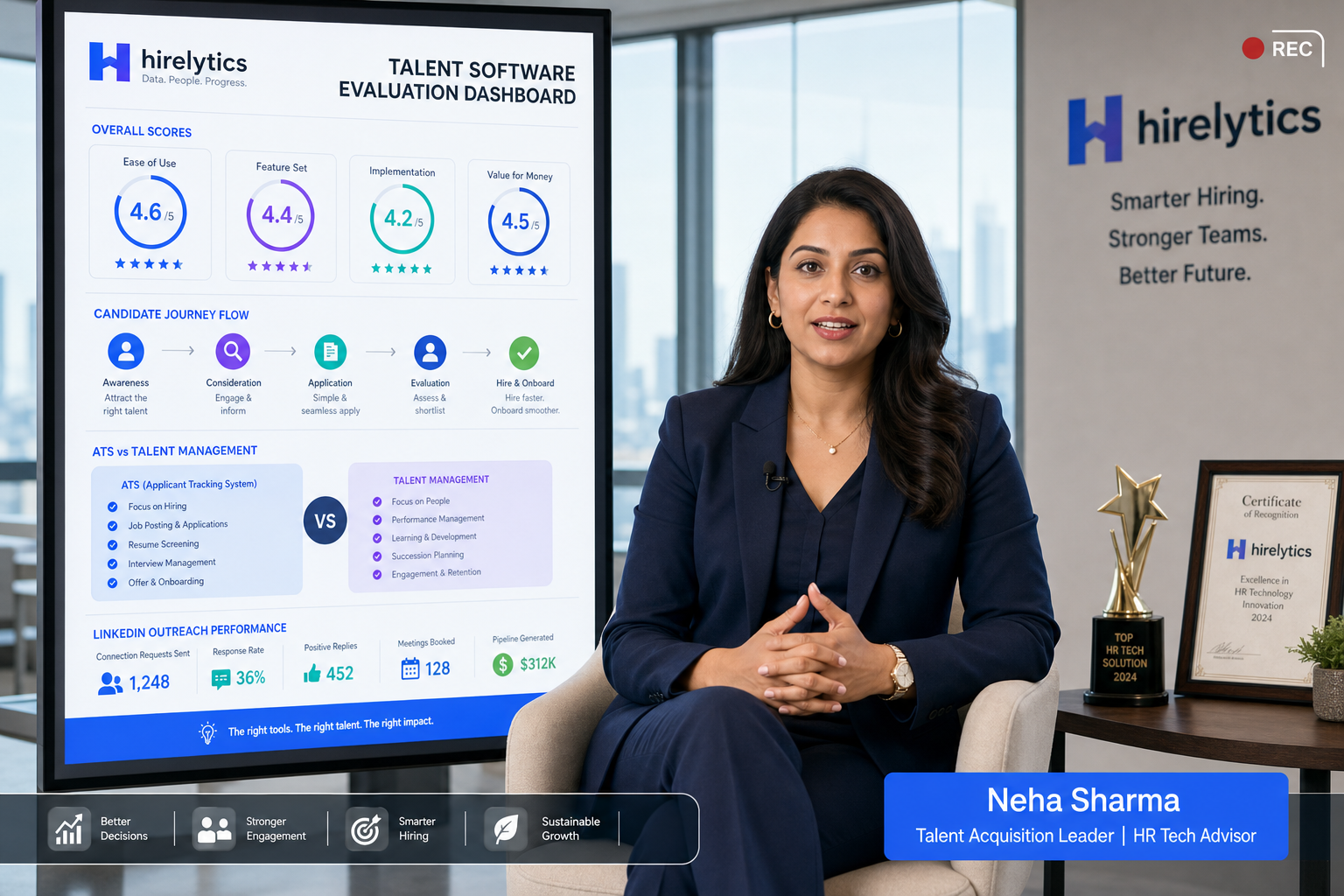
Talent management system software goes beyond that. It usually adds onboarding, learning and development, performance management, compensation workflows, internal mobility, and succession planning. In short, an ATS helps you hire. A broader talent platform helps you connect that hire to what happens next.
A corporate talent development platform sits even closer to the long-term workforce view. It becomes important when the business wants hiring data to feed development plans, manager visibility, readiness discussions, and internal movement across teams.
| Category | Main Focus | Typical Users | Best Fit |
|---|---|---|---|
| Applicant Tracking System | Applicants, interview workflow, hiring decisions | Recruiters, coordinators, hiring managers | Teams fixing core process issues |
| AI Recruiting / Automation | Outreach, screening support, routing, prioritization | Recruiters, recruiting ops, search teams | Teams overloaded by repetitive work |
| Candidate Relationship Management | Talent pools, nurture, rediscovery | Sourcers, recruiters | Teams building longer-term pipelines |
| Talent Acquisition Suite | ATS plus CRM, automation, analytics | Mature TA organizations | Teams standardizing end-to-end hiring |
| Talent Management System Software | Hiring plus onboarding, L&D, performance, succession | HR, TA, people ops, leadership | Organizations aligning hiring with workforce strategy |
| Corporate Talent Development Platform | Growth, mobility, readiness, capability building | HR leaders, business leaders, managers | Organizations treating talent as a long-term asset |
The mistake I see most often is letting enterprise platform ambition outrun recruiting reality. If your recruiters still struggle to keep candidate communications organized, a giant suite will not rescue a weak hiring rhythm. But if leadership already thinks in terms of internal growth and capability planning, a broader platform discussion is legitimate.
Core features to look for in ai talent management software
The strongest ai talent management software does more than add AI language to standard workflow tools. It should help recruiters work faster without losing context, and it should help HR connect hiring data to what happens after the candidate becomes an employee.
1. Reliable applicant tracking and workflow control
Every advanced feature depends on a stable operating layer. You need requisition intake, stage design, interviewer visibility, scorecards, communication logs, and offer tracking that match how your team actually works.
2. AI-supported matching and prioritization
The most useful AI features surface likely-fit candidates, help organize review queues, and reduce manual sorting. But the system should explain why a candidate is being surfaced and allow easy override. Recruiters still need the final say on résumé quality and fit.
3. Candidate communication continuity
This matters more than many buyers admit. Candidates notice broken follow-up faster than they notice elegant dashboards. If the system supports consistent communication across sourcing, screening, and scheduling, recruiters can represent the opportunity more credibly.
4. Pipeline intelligence and reporting
Good analytics should show source quality, stage conversion, response speed, bottlenecks, and drop-off patterns. The goal is not more reports. The goal is better operational decisions.
5. Downstream lifecycle connection
If the business cares about long-term growth, then the platform should connect hiring to onboarding, learning, performance, and mobility. That is the real promise behind both talent management system software and a corporate talent development platform.
6. Governance and human review
Any platform that influences candidate prioritization should support transparent criteria, auditability, and clear human checkpoints. Strong recruiting teams use AI as decision support, not as an invisible gatekeeper.
How LinkedIn-heavy recruiting fits into the stack
For many headhunters and lean in-house teams, LinkedIn is where process strain becomes most visible. The work sounds simple until volume rises: identify prospects, send connection requests, introduce the role, answer questions, see who is actually open, collect résumés, capture contact details, and make sure promising replies are not buried overnight.
That is one area where I have found StrategyBrain AI Recruiter genuinely useful as a layer around the recruiter’s workflow rather than a replacement for it. It can automate first-touch LinkedIn outreach, keep candidate messaging active outside business hours, and communicate in a candidate’s own language when cross-border hiring would otherwise stall. The practical gain is not magic screening. The gain is that interested candidates keep moving while the recruiter focuses on final qualification, résumé review, and interview decisions.
What I would not do is treat any LinkedIn automation tool as a complete recruiting stack. It does not eliminate the need for a sound ATS, clear evaluation criteria, or hiring-manager alignment. Instead, it works best when paired with a process that already knows how candidates will be reviewed once they respond. The conversation examples and setup notes are useful mainly because they show how repetitive front-end work can be separated from final human judgment.
For agency recruiters, this is especially relevant when a single consultant is juggling multiple searches and cannot keep every live LinkedIn exchange warm. For HR leaders, the value is different: recruiter capacity stretches further without forcing the team to answer every candidate message late at night. For both groups, the software question becomes clearer once you see LinkedIn outreach as one workflow layer inside a larger recruiting system.
Quick comparison of software categories
Here is a practical comparison for buyers searching for the best recruiting software.
| Buying Need | Best-Fit Category | Why It Matters | What to Check |
|---|---|---|---|
| Organize applicants and hiring stages | ATS | Creates structure and shared visibility | Stage clarity, reporting, hiring-manager usability |
| Reduce repetitive outreach and message handling | AI recruiting automation | Improves recruiter capacity | How outreach, replies, and résumé capture are handled |
| Build long-term talent pools | CRM | Supports repeat hiring | Segmentation, rediscovery, nurture features |
| Unify multiple hiring tools | Talent acquisition suite | Reduces handoff gaps | Integration depth and workflow consistency |
| Connect hiring to employee growth | Talent management system software | Aligns recruiting with HR strategy | Onboarding, performance, learning, mobility links |
| Support strategic internal development | Corporate talent development platform | Extends value beyond hiring | Readiness, development planning, succession support |
How to evaluate the best recruiting software
When I help teams think through a buying process, I usually come back to the same criteria.
Start with the actual recruiting problem
If the biggest issue is candidate response handling, do not let the demo drift into performance management too early. If the real issue is lifecycle visibility after hire, do not overfocus on sourcing widgets.
Judge the system the way candidates judge employers
The reference case from earlier is a good model. Strong candidates assess people, values, growth path, and fit. Your software should help recruiters communicate those things consistently by preserving context and making handoffs cleaner.
Check where recruiter judgment still lives
Any AI capability should be tested for explainability and override control. If the tool claims to rank or prioritize candidates, ask what data drives that output and how recruiters can challenge it.
Inspect communication workflows closely
This is especially important for LinkedIn-driven recruiting. Can the system support outreach, replies, contact capture, and follow-up without forcing recruiters into constant manual switching? If not, recruiter productivity will plateau no matter how nice the reporting looks.
Review integration logic, not just integration lists
Most vendors can name integrations. Fewer can show whether candidate data moves cleanly into onboarding, HR records, or later development workflows. That distinction is critical if you are evaluating talent management system software.
Test implementation realism
The best recruiting software is usable software. If recruiters and hiring managers need heavy workarounds, adoption will slip and reporting quality will decay quickly.
- For recruiters: prioritize speed, clarity, and communication continuity.
- For agency leaders: prioritize throughput, team visibility, and repeatable outreach processes.
- For HR leaders: prioritize governance, lifecycle integration, and long-term fit.
- For executives: prioritize data quality, consistency, and strategic talent visibility.
Which type of platform fits your team
You likely need an ATS first if...
- Your process changes from role to role with no discipline
- Hiring managers lack visibility into candidate progress
- Feedback and next steps are routinely delayed
- You cannot trust your own pipeline reporting
You likely need AI recruiting support if...
- Your team spends too much time on repetitive outreach
- LinkedIn replies arrive after hours and get missed
- You recruit across time zones or languages
- Recruiters need help collecting résumés and contact details faster
That is often where tools such as AI Recruiter fit best: not as a replacement for evaluation, but as support for the high-friction front end of sourcing and candidate communication.
You likely need talent management system software if...
- Leadership wants one view from hiring through development
- Onboarding and post-hire growth are disconnected
- Internal mobility is a business priority
- Managers need better visibility into future talent needs
You likely need a corporate talent development platform if...
- Workforce planning extends beyond external hiring
- Learning, readiness, and succession are active programs
- Hiring data should inform development investment
- The business wants stronger internal career pathing
Common mistakes buyers make
Confusing process automation with talent judgment
Automation can keep conversations moving, but it cannot replace the recruiter’s responsibility to assess the résumé, calibrate fit, and advise the hiring manager.
Buying feature breadth before fixing workflow basics
If the core recruiting motion is weak, larger suites simply make a messy process more expensive.
Ignoring the candidate’s view of the process
The reference case is a reminder that candidates evaluate employers through every interaction. Delayed replies and lost context do real damage.
Separating recruiting from development too aggressively
When candidates care about growth, mentorship, and mobility, recruiting systems that cannot surface that context leave value on the table.
Underestimating change management
No platform succeeds if hiring managers and recruiters use it inconsistently. Process adoption matters as much as features.
FAQ
What is the difference between an ATS and ai talent management software?
An ATS manages active hiring workflow. Ai talent management software may include hiring, automation, onboarding, development, and broader employee lifecycle functions.
When should a recruiter care about talent management system software?
When the hiring conversation regularly extends into onboarding, learning, mobility, or retention, a broader talent management system software discussion becomes relevant.
What is a corporate talent development platform?
A corporate talent development platform focuses on helping organizations grow, move, and prepare talent internally through learning, readiness, and career development workflows.
Can LinkedIn automation replace recruiter work?
No. It can reduce repetitive outreach and help maintain candidate communication, but recruiters still need to review résumés, assess fit, and decide next steps.
Where does StrategyBrain AI Recruiter fit best?
It fits best in LinkedIn-heavy workflows where teams need help with first-touch outreach, multilingual communication, after-hours responses, and collecting candidate details before human review.
What should I ask vendors about AI capabilities?
Ask what the AI actually does, what data it uses, how outputs are explained, how human override works, and how the system supports auditability.
Conclusion
The search for the best recruiting software becomes easier when you stop treating every platform as the same category. Some teams need a better ATS. Some need stronger front-end automation for sourcing and candidate communication. Others are ready for broader ai talent management software because hiring is already tied to development and internal mobility.
The opening lesson from the reference case is worth keeping in mind: good candidates judge opportunities through people, values, growth, and real work context. The best recruiting software helps your team communicate and evaluate those things with consistency. If your workflow depends heavily on LinkedIn, adding a tool like StrategyBrain AI Recruiter can reduce repetitive communication work while leaving final hiring judgment where it belongs: with the recruiter.
In other words, the right system is not the one with the longest feature sheet. It is the one that supports better talent decisions from first contact through long-term fit.