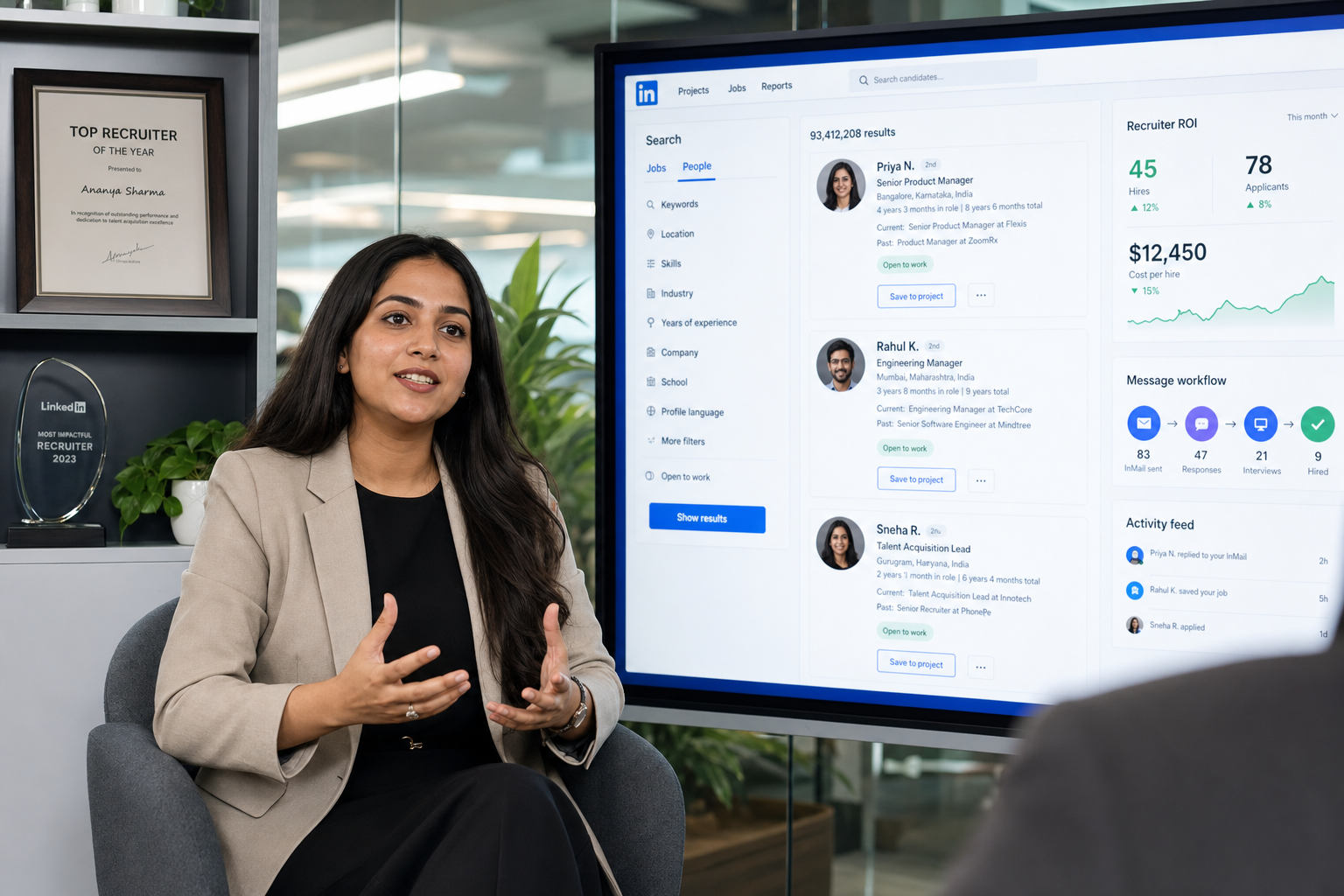
When recruiter ownership is unclear, this article helps hiring teams judge how to find recruiters on LinkedIn, avoid wasted outreach, and improve ROI.
That matters because most LinkedIn recruiting waste does not start with sourcing volume alone. It starts when teams cannot tell which recruiter owns which opening, when follow-up happens too late, when candidate intent is buried in inboxes, and when recruiters spend valuable hours repeating outreach instead of making judgment calls. For solo headhunters, small agency owners, and in-house talent teams, the cost shows up in missed conversations, slower shortlists, weaker hiring-manager trust, and unnecessary subscription spend that never turns into real hiring progress.
In my own LinkedIn recruiting work, one practical way to reduce that drag has been to pair manual judgment with structured automation. Used carefully, StrategyBrain AI Recruiter helps with two of the hardest parts of the workflow: consistent outreach and timely reply handling, including after-hours candidate responses. It can also collect resumes and contact details from interested prospects, while the recruiter still owns final fit assessment, shortlist decisions, and the next conversation with the hiring team.
A useful way to understand the value question is to start from the candidate side rather than the tool side. Consider a finance consultant coming out of a demanding big-firm environment, rethinking what kind of work was sustainable after a difficult personal period and a mental-health reset during 2020. The appeal of project and interim work was not just income. It was flexibility, control over schedule, and a chance to choose assignments more carefully. But that kind of transition only works when the right recruiter, project contact, or hiring manager is actually visible and reachable at the moment the opportunity is being evaluated.
In that kind of scenario, two concrete actions matter immediately: reviewing the visible job poster or hiring contact on a LinkedIn role, and then checking whether that person really covers the project type, geography, and stakeholder group involved. If the listing hides ownership, the next move is a company-based People search for internal recruiters, talent acquisition partners, or function leaders tied to the assignment. That small moment of uncertainty reveals the larger issue behind LinkedIn recruiter value: access is only useful when it supports timely, human decisions about fit, workload, flexibility, and next steps.
That is why this article connects candidate-side opportunity evaluation with recruiter-side ROI. If you want a practical answer to how to find recruiters on LinkedIn, how to get recruiters LinkedIn attention, or how to find the recruiter for a job on LinkedIn, you need to understand both discovery and operating discipline. The same search habits that help a professional evaluate the right opportunity also help recruiting teams measure whether LinkedIn workflows are worth the effort.
Why Recruiter Discovery Starts With Context
Experienced recruiters know that visibility alone is not value. The real test is whether LinkedIn helps you understand the bigger context around an opening quickly enough to act well. That includes the business need behind the role, whether the work is permanent or project-based, who actually owns the search, and what trade-offs matter to the candidate.
The reference case above is useful because it shows how opportunity decisions are made in real life. A candidate weighing project work after years in a large consulting environment is not just asking whether a role exists. They are asking whether the work is sustainable, whether expectations are realistic, and whether the recruiter understands the assignment well enough to have a credible conversation. When recruiters cannot surface that context fast, they create friction for candidates and extra admin for themselves.
That is also where LinkedIn recruiter ROI often gets misread. Teams sometimes evaluate tools by license cost or message volume. In practice, the better measure is whether the workflow helps recruiters make more informed decisions with less repetitive effort. Better search, clearer ownership, faster follow-up, and stronger records of candidate intent all contribute more to ROI than raw activity counts.
Key insight: The same clarity a candidate needs to judge an opportunity is the clarity a recruiter needs to create measurable LinkedIn value.
How to Find Recruiters on LinkedIn
The most reliable method for how to find recruiters on LinkedIn is still a structured LinkedIn search. Start with a specific query, switch to the People filter, and then refine through All filters. Candidates use this to identify the right internal recruiter. Recruiters use the same approach to map talent pools, benchmark competitors, and locate likely hiring contacts.
- Start with a precise query. Search combinations such as recruiter plus company name, talent acquisition plus city, or engineering recruiter plus location.
- Select the People filter. This removes noise from posts, companies, and jobs.
- Use All filters. Narrow by current company, geography, industry, and connection level where relevant.
- Check profile headlines and current roles. Titles often vary: Recruiter, Talent Acquisition Partner, Senior Recruiter, Talent Sourcer, or Hiring Manager.
- Review activity and fit. A visible recruiter is not automatically the right recruiter. Confirm role ownership by discipline, seniority, and region.
If your actual goal is how to get recruiters LinkedIn attention, broad outreach is rarely the answer. Relevance is. The recruiter who owns US finance contract hiring will not help much with an EMEA permanent software role, and vice versa. Precision improves candidate response quality and recruiter efficiency at the same time.
For sourcing teams, this is one area where AI Recruiter can support the process without replacing recruiter judgment. I have found it most helpful when the search criteria are already clear and the bottleneck is repetitive first-touch outreach, follow-up, and collecting resumes from interested people. That keeps the recruiter focused on whether the person actually fits the brief.
What a good recruiter search looks like
- Company-specific targeting: best when a candidate wants an internal recruiter
- Function targeting: useful for specialist areas like finance, engineering, or healthcare
- Location targeting: essential when hiring authority is region-based
- Role-type targeting: important when the opportunity is contract, interim, or permanent
- Warm audience targeting: useful when prior signals of interest matter
How to Find the Recruiter for a Job on LinkedIn
The intent behind how to find the recruiter for a job on LinkedIn is narrower. Here, the user is trying to connect one live role to one likely decision-maker.
The first place to look is the job details page. Some listings show a visible job poster or a Meet the hiring team section. When present, that is the cleanest route because your message can reference an active opening and a specific owner.
- Open the job posting and scan the details panel.
- Check whether the job poster is shown. Review whether the person is a recruiter, hiring manager, or another contact.
- Look for Meet the hiring team. This can reveal direct stakeholders.
- If ownership is hidden, run a company-based People search.
- Refine by company, location, and function. Search terms like recruiter, talent acquisition, project hiring, or the business unit name help.
This matters especially for project and interim work. In those searches, candidates often need to know whether the recruiter understands the assignment scope, timeline, and flexibility expectations before deciding whether to engage. A generic contact is less useful than a recruiter tied to the actual function or client group.
When I cannot see clear ownership on a role, I usually treat LinkedIn as a two-step workflow: first identify likely contacts manually, then use a consistent outreach process so interested responses do not get lost. That is another place where StrategyBrain AI Recruiter can be helpful operationally. It can keep communication moving across time zones and after work hours, but I still review the responses myself before deciding who is worth advancing.
When the posting only shows the company name
If a listing reveals only the employer, search the company name with terms like recruiter, talent acquisition, hiring manager, or the relevant function. Then narrow by current company and geography. This is usually the strongest fallback when someone wants to know how to find the recruiter for a job on LinkedIn but the listing itself provides very little.
How to Get Recruiters LinkedIn Attention
Once you know how to find recruiters on LinkedIn, the next step is writing a message that respects recruiter workflow. If a recruiter is covering several openings, long generic notes are a poor use of their time and yours.
If you are wondering how to get recruiters LinkedIn attention, use a short structure:
- Who you are: your current role or recent background
- Why you are reaching out: the specific role, project, or function
- Why you may fit: two or three relevant points only
- What you want next: a simple ask for fit confirmation or guidance
Example: Hello [Name], I saw the [Job Title] opening and wanted to reach out directly. I am currently working in [field], with experience in [two relevant areas]. The role stood out because of [specific reason]. If you are the right contact for this search, I would appreciate any guidance on fit or next steps. Thank you.
This is where the candidate-side lesson from the earlier finance-consultant scenario matters again. People evaluating a move into project work are often balancing certainty, schedule control, and the risk of stepping into the unknown. A recruiter message that shows you understand the actual assignment earns more trust than one that treats every opportunity the same.
Common messaging mistakes
- Sending a note with no role context
- Contacting the wrong recruiter for the market or function
- Writing a life story instead of a concise pitch
- Asking for referrals before showing fit
- Following up too aggressively when access is limited
Messaging access also depends on connection level, account type, and whether InMail is available. So finding a recruiter does not always guarantee direct contact. That is normal, and it is one more reason why outreach quality matters.
LinkedIn Recruiter Value and ROI
The ROI question is not simply whether LinkedIn recruiting tools cost money. It is whether they improve the quality and speed of recruiter decisions. In practice, value tends to show up first in workflow efficiency: better search precision, more consistent outreach, fewer missed replies, and stronger organization across live projects.
From the employer side, the main value drivers usually include:
- Better search filters: less time wasted reviewing irrelevant profiles
- Saved searches and alerts: less repeat manual work
- Templates and communication support: more consistent outreach
- Project-based organization: clearer tracking across openings
- Resume and contact capture: smoother handoff from interest to screening
My own rule of thumb is simple: if recruiters are spending too much time on first-touch messaging, chasing replies late at night, or manually collecting candidate details from scattered conversations, the workflow is already leaking value. In that setting, AI Recruiter can be useful because it continues candidate communication, answers common role questions, and gathers resumes from people who want to proceed. But the final qualification step still belongs to the recruiter, especially for nuanced project roles or specialist hiring.
| ROI Driver | Why It Matters | Who Benefits Most |
|---|---|---|
| Search refinement | Reduces irrelevant profile review | Sourcers and recruiters |
| Visible role ownership | Improves candidate-recruiter matching | Candidates and in-house teams |
| Consistent outreach | Lowers missed-contact risk | Agency recruiters and small teams |
| After-hours response handling | Keeps live candidates engaged | Lean teams working across time zones |
| Resume/contact capture | Reduces admin between interest and screening | Recruiters managing active pipelines |
So is LinkedIn recruiter value real? Usually yes, but only when search behavior, ownership clarity, and follow-up discipline are all in place. Without those basics, even good tooling can look worse than it is.
Three LinkedIn Recruiting Tools to Compare
Because this topic is also about software use around LinkedIn recruiting, it is worth comparing three well-known options recruiters commonly evaluate: LinkedIn Recruiter, LinkedIn Recruiter Lite, and Gem. Each supports recruiter workflows differently, and each fits a different operating model.
| Tool | Strengths | Limitations | Best Fit | How It Can Work with StrategyBrain AI Recruiter |
|---|---|---|---|---|
| LinkedIn Recruiter | Strong search depth, broad network access, recruiter-focused sourcing workflow | Can be expensive for smaller teams; value depends on disciplined use | Dedicated in-house TA teams, agencies, specialist search | Use Recruiter for targeting and review, then use AI Recruiter to support outreach continuity and resume collection |
| LinkedIn Recruiter Lite | Simpler entry point, lighter workflow, easier for occasional sourcing | More limited reach and workflow depth than full Recruiter | Managers or smaller teams with modest hiring volume | Can pair with AI-supported follow-up when a lean team needs help keeping candidate conversations moving |
| Gem | Popular for CRM-style organization, outreach tracking, and analytics across sourcing workflows | Best value comes when the team already has mature process discipline; can add complexity for very small teams | Scaling teams that want stronger workflow reporting | Useful for tracking and reporting, while AI Recruiter helps reduce manual LinkedIn message handling upstream |
From a user-experience perspective, full LinkedIn Recruiter is usually strongest for direct search depth. Recruiter Lite is easier to justify for lighter use but more constrained. Gem is often appreciated for workflow visibility and reporting rather than for replacing LinkedIn-native sourcing itself.
In terms of cost and business fit, the pattern is straightforward. Larger recruiting teams tend to justify broader workflow stacks more easily because the cost can be spread across more requisitions and users. Small agencies and solo headhunters usually need tighter operational gains: less repetitive work, more consistent response handling, and better visibility into who is genuinely interested. That is why collaboration between a search system and an AI-supported messaging layer can be practical when used carefully.
I would not frame any of these tools as magic on their own. The measurable gains come when the recruiter defines the target well, keeps the messaging relevant, and reviews candidate quality personally instead of outsourcing judgment.
Practical Advice for Recruiters and Hiring Teams
If you are responsible for LinkedIn recruiting outcomes, the strongest improvement usually comes from tightening the workflow before trying to scale it.
What experienced teams do differently
- They define the opportunity clearly. This matters even more for interim or project-based work where candidates are evaluating risk and flexibility.
- They verify contact ownership early. Not every visible recruiter is the right recruiter.
- They separate repetitive tasks from judgment tasks. Outreach and response handling can be systemized; fit evaluation cannot.
- They keep records of candidate intent. Interest, timing, and resume status should not live only inside scattered messages.
- They align recruiters and hiring managers on what “fit” means. That reduces wasted outreach and low-confidence submissions.
The mental-health and workload thread from the opening case also has a recruiting parallel. Many professionals are rewarded for speed, availability, and stamina long after those habits stop being sustainable. Recruiting teams can fall into the same trap, praising heroic inbox management instead of building a process that removes unnecessary manual strain. A better LinkedIn workflow should improve output without forcing recruiters into constant reactive work.
That is one reason I see value in using AI Recruiter selectively for LinkedIn-heavy hiring. If candidates reply after hours, in different time zones, or with basic questions about a role, the system can keep the conversation moving until I step in for the real qualification decision. Used that way, it is less about replacing recruiting and more about protecting recruiter attention for the moments that actually require expertise.
FAQ
Do you need Premium to find recruiters on LinkedIn?
No. You can still use LinkedIn search, the People filter, and company-based searches without Premium. Some visibility and messaging options may be more limited depending on your account.
How do you find the recruiter for a job on LinkedIn?
Start on the job page. Look for a visible job poster or Meet the hiring team section. If neither is visible, search the company name with recruiter, talent acquisition, or the relevant function using the People filter.
Why can’t I always see the recruiter on a LinkedIn job post?
Because not every posting shows the owner publicly. Sometimes the poster hides their profile, or LinkedIn simply does not display a hiring contact for that listing.
How do you get recruiters LinkedIn attention?
Send a short, role-specific message. Mention the exact role or project, show two or three relevant reasons you may fit, and make a modest ask for guidance or confirmation.
How does recruiter discovery connect to ROI?
If recruiters and candidates find the right contact faster, outreach becomes more relevant, response handling improves, and less time is wasted on the wrong people. That is one of the clearest paths to better LinkedIn recruiting ROI.
Can AI support LinkedIn recruiting without replacing recruiter judgment?
Yes. AI can help with repetitive tasks such as outreach continuity, reply handling, and collecting candidate details, while the recruiter still decides who is qualified and what happens next.
Conclusion
The best answer to how to find recruiters on LinkedIn is not a trick. It is a disciplined workflow that starts with context, identifies the right owner, and keeps communication organized. For candidates, that means finding the recruiter who actually understands the opportunity. For recruiting teams, it means creating a process where search precision, timely follow-up, and human judgment combine into measurable ROI.
If LinkedIn recruiting feels slower or noisier than it should, the issue is usually not one missing feature. It is the gap between visibility and action. Close that gap, and recruiter value becomes much easier to see.