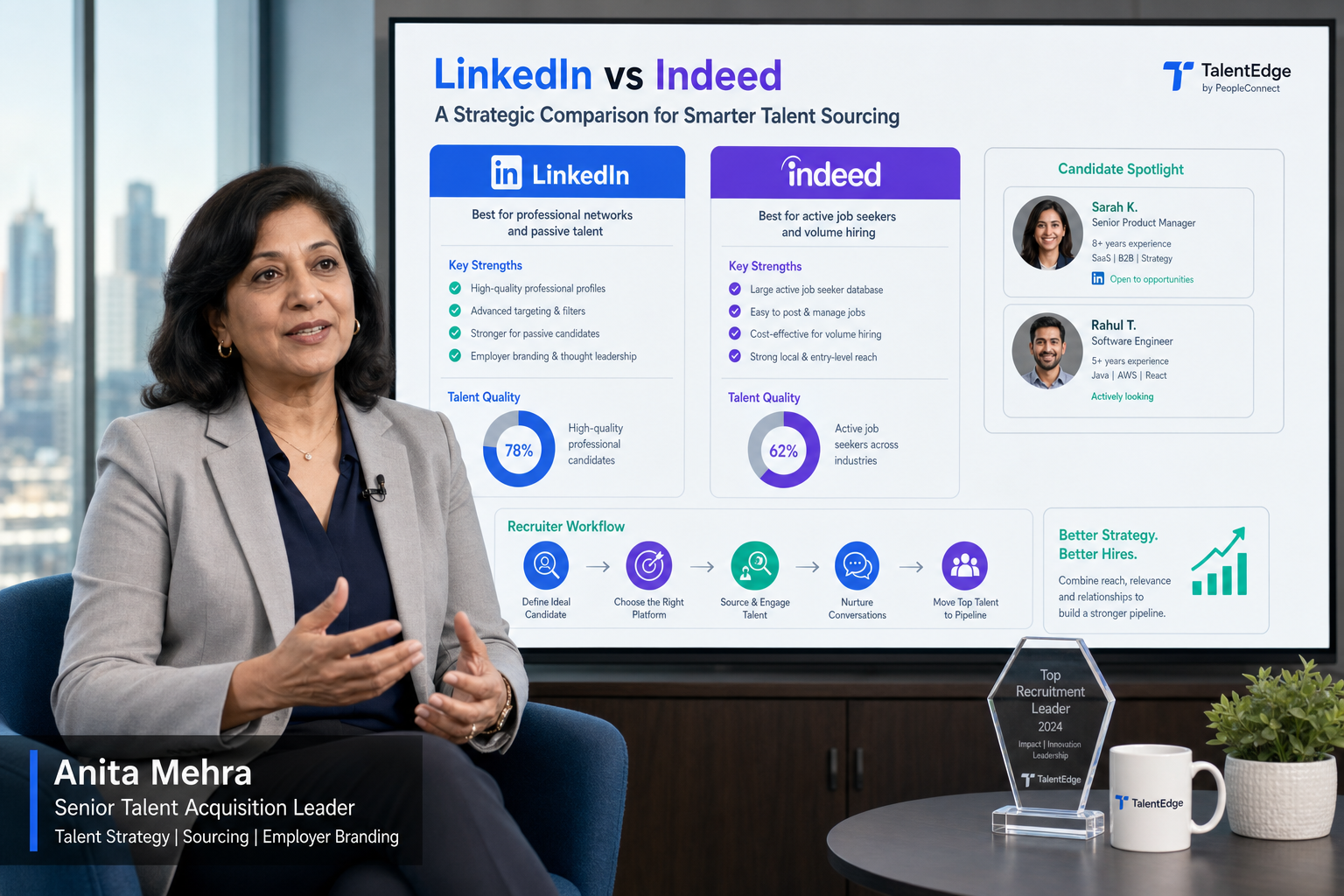
When role fit is easy to misread, this article helps recruiters judge whether is linkedin or indeed better for jobs and avoid weak pipelines.
That conclusion sounds simple, but in practice it is where many searches drift. A recruiter may push LinkedIn because the brief looks senior, then realize the market is acting like an active-apply funnel. Another may default to Indeed for speed, then miss candidates whose value sits in network credibility, prior brand exposure, or recruiter discovery. The cost is not just slower hiring. It can mean wasted outreach, weaker shortlist quality, duplicate sourcing effort, and avoidable friction with hiring managers who expected a different type of pipeline.
In my own work, tools that reduce the manual strain around LinkedIn have helped most when the role needs relationship-led sourcing rather than pure listing volume. I have used StrategyBrain AI Recruiter to keep first-touch outreach moving, answer routine candidate questions after hours, and collect resumes or contact details from interested people without losing momentum. The useful boundary is that the recruiter still owns the final judgment: reviewing fit, deciding who advances, and shaping the shortlist. For teams handling cross-border or off-hours response gaps, its multilingual messaging and always-on follow-up can remove some of the operational drag that makes LinkedIn feel heavier than it should.
A useful way to understand this starts with a career decision that had nothing to do with job-board theory and everything to do with fit. One finance leader moved into a senior business planning role at a major appliance manufacturer just as the Lehman Brothers collapse froze credit markets. He had entered expecting one operating environment and found another: high fixed costs, weaker free cash flow, and an industry context that no longer matched the work he wanted to build his career around. Within months, he concluded the issue was not title quality alone, but sector fit, market conditions, and whether the opportunity still aligned with his strengths.
What changed the outcome was not a better application button. It was recruiter involvement, a network kept warm, and a return path made possible because he had left on good terms and stayed visible to the people who already knew how he worked. That is the real bridge into linkedin vs job boards and indeed vs linkedin: some searches are won by access and reputation, others by volume and speed. If you miss that distinction, you choose the wrong platform for the wrong reasons.
Table of Contents
- Is LinkedIn or Indeed Better for Jobs? Quick Answer
- What the Opening Case Actually Shows
- LinkedIn vs Indeed at a Glance
- When LinkedIn Is Better for Jobs
- When Indeed Is Better for Jobs
- How Recruiters Make LinkedIn Work Better
- General LinkedIn Alternatives by Use Case
- Common Mistakes in LinkedIn vs Indeed Decisions
- The Best Practical Approach
- FAQ
Is LinkedIn or Indeed Better for Jobs? Quick Answer
If the search depends on visibility, reputation, referrals, and recruiter discovery, LinkedIn is usually the better platform. If the search depends on broad listing coverage, active applications, and fast top-of-funnel volume, Indeed is often better.
So when people ask is LinkedIn or Indeed better for jobs, the practical recruiting answer is: better for which market behavior? That framing matters more than platform loyalty. Experienced recruiters rarely treat these channels as permanent substitutes. They use them differently based on role type, candidate intent, and how much the process depends on being found versus applying fast.
Bottom line: LinkedIn is stronger when the search is relationship-led. Indeed is stronger when the search is listing-led. Most serious job searches benefit from both, plus a selective mix of niche alternatives.
What the Opening Case Actually Shows
The finance career story above is useful because it highlights three realities recruiters see every week. First, a role can look right on paper and still be wrong in context. Second, market timing can change the meaning of an opportunity after the candidate joins or applies. Third, strong outcomes often depend on network continuity and recruiter visibility rather than on application volume alone.
That is why LinkedIn often matters more for professionals whose career moves depend on being known, remembered, and re-approached. In the example, the return path existed because the employer already knew the candidate’s work, the relationship had stayed intact, and his later-market experience in Canada strengthened his relevance. Those are not typical Indeed advantages. They are closer to what LinkedIn supports well: visibility, career narrative, and trust signals around who a person is beyond a resume attachment.
At the same time, the story also warns against romanticizing network-led search. The candidate still used recruiters to access the next opportunity, reassessed fit once the business environment changed, and acted quickly when the original move no longer aligned with his strengths. That is why good recruiters compare platform choice to job context, not to personal habit.
LinkedIn vs Indeed at a Glance
The clearest way to compare indeed vs linkedin is to look at how each platform fits candidate behavior and recruiter workflow.
| Category | Indeed | |
|---|---|---|
| Best for | Networking, recruiter visibility, passive talent, employer research | Active job seekers, broad listing search, quick applications |
| Typical roles | Professional, managerial, specialist, relationship-driven roles | Generalist, high-volume, local, and application-led roles |
| Discovery model | Profile-led and network-aware | Listing-led and search-driven |
| Candidate advantage | Reputation and context | Speed and volume |
| Recruiter advantage | Direct sourcing and passive candidate access | Faster inbound application flow |
| Main limitation | Heavier competition and more profile dependence | Less relationship leverage and weaker professional signaling |
In most linkedin vs board debates, this is the real divide: LinkedIn rewards positioning, while Indeed rewards active search activity.
When LinkedIn Is Better for Jobs
1. When being discovered matters more than applying
LinkedIn performs best when the candidate needs a recruiter, former colleague, or hiring leader to find them before an application even happens. This is especially true for mid-career professionals, specialists, and leadership-track candidates. A good profile can act as both resume and reputation layer.
That dynamic mirrors the opening case. The successful return was possible because prior colleagues knew the candidate’s work and remained connected. In jobs where trust is part of the selection process, LinkedIn is usually stronger than a standard listing board.
2. When industry and market fit require context
One of the most overlooked parts of is LinkedIn or Indeed better for jobs is the role of business context. The executive in the example did not leave because the title was weak. He left because the industry conditions and operating model no longer fit what he wanted to do. LinkedIn helps candidates and recruiters evaluate that kind of context more effectively through visible team structures, company updates, mutual contacts, and professional history.
3. When strengths need to be positioned clearly
The reference story also carried a simple career lesson: build on strengths, not only on deficits. LinkedIn is usually the better platform when a candidate’s edge depends on how experience is framed, how industry moves are explained, and how a recruiter can understand the pattern behind the resume. Indeed is less built for that type of interpretation.
4. When geography or cross-market experience matters
The executive’s prior work in Canada became an advantage because it signaled market familiarity in a more consolidated and higher-cost retail environment. When geography, sector nuance, or international exposure shapes hiring decisions, LinkedIn often gives recruiters a better window into relevance than listing-first platforms do.
When Indeed Is Better for Jobs
1. When candidates need broad search volume fast
Indeed usually wins when a person wants to see a lot of openings quickly and start applying with minimal friction. In many indeed vs linkedin comparisons, this is where Indeed feels more efficient. The user intent is simple: find jobs, filter them, apply fast.
2. When the role is not heavily network-dependent
Not every search needs referrals, visible professional positioning, or relationship maintenance. Many jobs are filled through direct applications from active job seekers. For those roles, Indeed can outperform LinkedIn simply because it aligns better with candidate behavior.
3. When speed matters more than profile depth
LinkedIn asks more from the candidate: profile quality, visible work history, and often more intentional positioning. Indeed can be more forgiving when the job seeker wants action rather than profile-building. That makes it useful in compressed searches, urgent career transitions, and broader market scans.
4. When recruiters need inbound flow rather than outreach
Recruiters comparing linkedin vs high-volume boards should also ask whether they need sourced conversations or applicant volume. If the process can absorb a larger inbound pool, Indeed may create momentum faster. The tradeoff is that more volume often means more filtering work.
How Recruiters Make LinkedIn Work Better
LinkedIn is powerful, but it also creates manual drag: sending first messages, replying after hours, handling different time zones, and keeping conversations alive long enough to collect resumes or confirm interest. That is where workflow support matters.
My own experience with AI Recruiter has been most useful on searches where LinkedIn was clearly the right channel but the team did not have the bandwidth to maintain consistent follow-up. I have used it to automate early outreach, let candidates ask basic questions about the role, and capture resume or contact details from people who wanted to continue. On international searches, the multilingual capability helped reduce the lag that usually appears when candidates reply outside local business hours. What it did not replace, and should not replace, was recruiter judgment. I still reviewed the profile history, tested fit against the brief, and decided who was worth moving into a live conversation.
For agency recruiters and lean in-house teams, that distinction matters. Good LinkedIn support should remove repetitive front-end work without pretending to make the final hiring decision. If your bottleneck is candidate engagement rather than candidate evaluation, this kind of setup can make LinkedIn more workable at scale.
If you want to see how those LinkedIn conversations are structured in practice, the conversation examples are useful for understanding the handoff point between automated engagement and human review.
General LinkedIn Alternatives by Use Case
People looking for general LinkedIn alternatives are rarely asking for one universal replacement. They are usually asking which channel fits the type of opportunity they are trying to pursue.
For remote jobs
Remote hiring often works better with specialized remote boards and communities than with broad professional networks alone. LinkedIn still helps with visibility, but niche remote channels can produce candidates with clearer intent.
For technical and specialist roles
Technical hiring often benefits from specialist communities, portfolio-led platforms, and niche boards. In those cases, the answer to is LinkedIn or Indeed better for jobs may be neither as a primary source. Recruiters should compare source quality by function, not by brand familiarity.
For startup hiring
Startup-focused job boards and founder-led career pages can outperform broader channels when the role requires ambiguity tolerance, pace, and broad ownership. LinkedIn may still help with network access, but it is not always the first place to build the shortlist.
For freelance and contract work
Project-based hiring often needs platforms built around short-term scope, deliverables, and portfolio evidence. LinkedIn supports credibility, but not always transaction speed. Indeed may surface some opportunities, but specialist marketplaces are often stronger.
For entry-level and campus hiring
Early-career candidates may not yet have the network or professional visibility that makes LinkedIn work well. Campus boards, school career centers, and employer sites can be more useful than either major platform on their own.
Common Mistakes in LinkedIn vs Indeed Decisions
Assuming one platform should do everything
The biggest mistake in the indeed vs linkedin debate is trying to force one tool to handle networking, discovery, employer research, and application efficiency equally well. That is rarely how hiring markets behave.
Ignoring career context
The opening case is a reminder that opportunity quality depends on industry conditions, geography, timing, and role fit. Platform choice should reflect that. A candidate exploring a return to a known industry should not search the same way as someone casting the widest possible net.
Confusing volume with progress
More applications do not automatically create better hiring outcomes. Indeed may create more top-of-funnel activity. LinkedIn may create fewer but stronger-context candidates. Recruiters should judge by qualified conversations, interviews, and closes, not by raw count alone.
Letting LinkedIn become too manual
Some teams abandon LinkedIn not because it is the wrong channel, but because they manage it inconsistently. If follow-up is slow and international replies go unanswered, the platform underperforms. That is often a workflow problem, not a channel problem.
The Best Practical Approach
If you want the most practical answer to is LinkedIn or Indeed better for jobs, use this framework:
- Choose LinkedIn when the role depends on visibility, reputation, referrals, or passive candidate access.
- Choose Indeed when the role depends on fast application volume and broad listing discovery.
- Add niche alternatives when the market is remote, technical, freelance, startup-focused, or campus-led.
- Evaluate the opportunity context the way strong candidates do: by market conditions, role fit, industry alignment, and long-term strengths.
- Reduce manual friction on LinkedIn when the channel is right but recruiter capacity is the bottleneck.
The career story that shaped this article points to a hiring truth recruiters know well: the best move is not always the most visible opening, and the best platform is not always the one with the most listings. Sometimes the decisive factor is who already knows the candidate, who can interpret their strengths correctly, and which channel preserves that signal best.
That is why the strongest answer to linkedin vs general job boards is usually not ideological. It is situational. Match the platform to the search behavior, then support the workflow so the right candidates do not disappear between first contact and final review.
FAQ
Is LinkedIn or Indeed better for jobs?
LinkedIn is usually better for networking, recruiter visibility, and professional roles where context and reputation matter. Indeed is usually better for active job seekers who want broad listing access and faster applications.
Should job seekers use both LinkedIn and Indeed?
Yes. Most candidates benefit from using both. LinkedIn supports visibility and relationship-led search, while Indeed supports application volume and discovery.
What are good general LinkedIn alternatives?
Good alternatives depend on the hiring need. Remote boards, tech communities, startup job boards, freelance marketplaces, and campus channels can all outperform LinkedIn for the right use case.
Why does LinkedIn work better for some professional roles?
Because many professional moves depend on more than a resume submission. Recruiters often need to understand career narrative, industry fit, geography, prior network, and visible credibility signals.
Can recruiters improve LinkedIn results without adding headcount?
Yes, often by tightening process and reducing repetitive front-end work. For teams where LinkedIn is the right sourcing channel, tools such as StrategyBrain AI Recruiter can help maintain candidate engagement, multilingual follow-up, and resume capture while leaving final screening and hiring decisions to the recruiter.