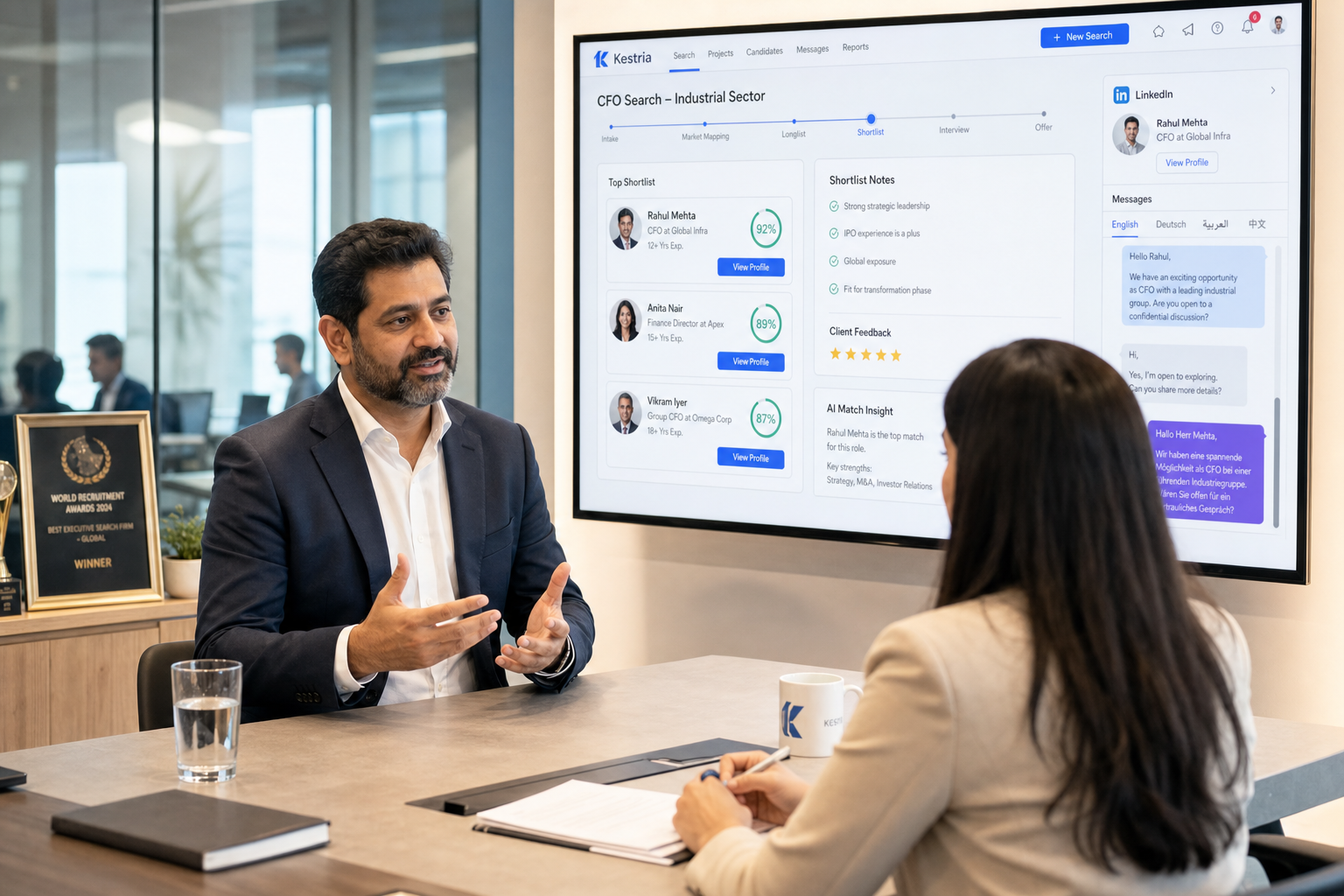
When a headhunter tests people gpt against a messy CFO search, this article shows how to judge fit, refine briefs, and avoid noisy shortlists.
The pressure point is rarely search volume alone. It is the combination of unclear role briefs, slow candidate follow-up, and inconsistent handoff between sourcing and recruiter judgment. For a solo headhunter, that means missed replies and weaker shortlists. For a small agency owner, it means wasted researcher hours and harder client updates. For an in-house team, it often means hiring managers lose confidence because the search looks active but the market map is still noisy.
That is where AI-supported workflow can help, especially when the problem is repetitive outreach and after-hours candidate response management rather than final fit assessment. In my own LinkedIn-heavy sourcing work, AI Recruiter is most useful when I need help with initial candidate messaging, multilingual follow-up, and collecting resumes or contact details from interested prospects while I still keep responsibility for shortlist judgment, resume review, and interview decisions. Used carefully, it reduces dead time between outreach and recruiter action instead of pretending to replace sourcing craft.
A useful way to see the issue is through a scale-up leadership scenario. A newly appointed CEO stepping into a growing software company needed immediate visibility into the business, a stronger operating plan, and better decision support during transition. Part of that meant finding a fractional CFO who could handle an intensive review period first, then shift into strategic advising. The hiring challenge was not just locating anyone with finance credentials. It was identifying someone who understood the company model, could work through ambiguity, and could help answer urgent questions about the path forward.
That same leader also described a familiar talent problem: people say they want growth, ambiguity, and room to stretch, but many struggle once those expectations become real. In recruiting terms, that creates two concrete sourcing actions right away. First, someone has to translate business goals into a sharper search brief than a title alone. Second, someone has to keep candidate conversations moving while checking whether the person is actually suited to a gray-area scale-up environment. When those steps are weak, even a promising search for a finance leader turns into delays, mismatched outreach, and frustration that spreads beyond the recruiter.
That opening case is exactly why recruiters search for terms like people gpt, ai people search, and ai person finder. The real question is not whether AI can return names. It is whether it helps a recruiter turn messy business context into a credible target profile, maintain candidate momentum, and separate surface matches from people who can actually do the job in that environment. The rest of this article focuses on that workflow.
What people gpt actually solves
People gpt is best understood as natural-language candidate discovery for recruiters. Instead of forcing every search into a rigid Boolean string from the start, it lets a recruiter describe the target in business terms and then refine matches against evidence.
That distinction matters. In recruiting, ai people search and ai person finder should not mean general people lookup. They should mean role-based professional discovery: finding candidates by skills, seniority, operating context, location, company background, and career trajectory.
The opening leadership example shows why this matters. A search for a fractional CFO in a growing company is not really a title search. It is a decision-support search. The recruiter needs to understand why the business needs full financial visibility, why the engagement may be intensive at first and more advisory later, and why comfort with ambiguity matters to retention. If the search brief ignores that bigger picture, the results may look relevant on paper but fail in outreach and screening.
Key insight: The value of people gpt is not faster keyword entry. It is better translation of business context into searchable candidate patterns.
From business question to search brief
The strongest ai candidate sourcing work starts before anyone opens LinkedIn or a talent database. It starts with the business question behind the hire.
In the scale-up scenario above, the real questions were clear:
- Who can quickly assess financial health and support a new business plan?
- Who understands the SaaS operating model rather than finance in the abstract?
- Who is comfortable moving from hands-on review work into ongoing strategic support?
- Who can operate in ambiguity without creating friction across the team?
Those are much more useful than a basic request for “fractional CFO, SaaS preferred.”
What experienced recruiters extract before searching
- Trigger event: Why the hire is happening now
- Immediate assignment: What the person must handle in the first phase
- Longer-term value: What the role becomes after the urgent period
- Environment: Whether the company is stable, ambiguous, regulated, founder-led, or process-light
- Risk factors: What usually causes mismatch or early frustration
When you feed this level of context into people gpt-style search, the output is more usable because the search is anchored in recruiter logic, not just title syntax.
Where ai people search fits best
Good ai people search helps recruiters in three places: query drafting, adjacent-match discovery, and response continuity.
1. Query drafting in natural language
Recruiters often think in narrative form before they think in Boolean. For example:
- Find fractional CFOs who have stepped into post-transition finance cleanup for a software company and can move into strategic advising.
- Show operators who have worked in mobile-first SaaS and can interpret financial health for a new leadership plan.
- Surface finance leaders who are strong with ambiguity and have supported scaling teams where role boundaries are not fully defined yet.
This is where people gpt is genuinely useful. It mirrors the way recruiters talk to hiring managers and to each other.
2. Adjacent-match discovery
Many of the best candidates sit just outside the obvious title pool. An AI-assisted search can surface people with the right work pattern even when their headline is different from the requisition. That is especially valuable in scale-up environments where candidates may have portfolio, advisory, interim, or operator-investor backgrounds.
3. Candidate response continuity
Search quality falls apart if early outreach stalls. In practice, a lot of sourcing loss comes from delayed replies, time-zone gaps, and repetitive first-touch messaging that recruiters cannot maintain every hour of the day.
I have found that AI Recruiter is useful here when used narrowly and honestly. It can handle first outreach, basic role introduction, and ongoing replies in different languages while I stay responsible for resume review and final qualification. For LinkedIn-based sourcing, that means I am not trying to manually catch every after-hours response before momentum dies. It is most helpful when the search is broad enough to generate active conversations but specific enough that I already know my must-have criteria.
People gpt vs Boolean for recruiters
Experienced sourcers usually do not ask whether AI replaces Boolean. They ask where each method performs better.
| Approach | Best at | Weakness | When I use it |
|---|---|---|---|
| People gpt / AI-assisted search | Turning business context into fast first-pass searches | Can over-broaden results if the prompt is vague | Early discovery, intake calibration, adjacent talent mapping |
| Boolean sourcing | Tight precision and transparent keyword logic | Takes longer and can miss title variants | Late-stage narrowing, high-specificity targeting, platform-specific searching |
| AI-supported LinkedIn messaging | Maintaining outreach speed and candidate response flow | Still needs recruiter oversight for fit and tone | High-volume first touch, multilingual follow-up, after-hours continuity |
In most real recruiting teams, the right answer is hybrid. Start with people gpt-style search to define the market faster. Use Boolean when you need exactness. Use AI-supported messaging when your bottleneck is not finding names but keeping qualified candidates engaged long enough to review them properly.
That is one reason the fractional-CFO example matters. The hard part was not simply identifying finance professionals. It was linking a business transition, a time-bounded engagement, and a specific leadership environment to the right set of prospects. Search and communication both mattered.
Using ai person finder with LinkedIn workflows
The phrase ai person finder only becomes useful in recruiting when it is grounded in a workflow. For many teams, that workflow lives partly inside LinkedIn.
Here is the version I recommend:
- Write the brief around outcomes. What does the person need to fix, build, or clarify?
- Translate that into a natural-language search. Include environment, urgency, and likely background.
- Review top profiles for evidence. Do not trust title relevance alone.
- Launch controlled outreach. Keep the message aligned to the real challenge of the role.
- Capture signals quickly. Who is interested, who asks smart questions, who sends a resume, who is clearly off-target?
- Route qualified prospects into recruiter review. Final matching remains human work.
For LinkedIn-heavy campaigns, I have used AI Recruiter mainly to support steps four and five. It automates repetitive connection and early message exchange, keeps candidate conversations moving when I am offline, and gathers resume or contact details from interested people. What it does not do, and should not be expected to do, is decide whether a candidate truly matches the role. That remains my job.
This division of labor matters. Recruiters should use automation to reduce repetitive friction, not to outsource judgment. In the same way a hiring leader needed a finance partner who could understand the business model rather than just a job title, a recruiter still has to decide whether a candidate's background really maps to the assignment.
How to check match quality
The best way to evaluate ai candidate sourcing is to inspect relevance in layers.
Start with these five checks
- Business-fit check: Does the profile match the actual reason the role exists?
- Phase-fit check: Can the person handle both the urgent first-stage work and the likely next phase?
- Environment-fit check: Have they succeeded in similar ambiguity, pace, or resource constraints?
- Evidence check: Are the needed skills visible in work history, scope, or outcomes?
- Engagement check: Did outreach responses show understanding and real interest?
This is where many recruiters improve dramatically with practice. The AI may help surface profiles, but relevance improves only when the recruiter checks whether the person can operate inside the same kind of decision environment described by the hiring leader.
| Signal | What good looks like | What creates doubt |
|---|---|---|
| Role alignment | Past work mirrors the actual assignment | Only title similarity with weak scope evidence |
| Operating context | Experience in comparable company stage or model | Strong background, wrong environment |
| Ambiguity tolerance | History of stretch roles or transition work | Only stable, highly structured settings |
| Communication quality | Thoughtful candidate questions and timely replies | Passive or generic engagement |
| Search traceability | Clear explanation for why the candidate surfaced | Black-box ranking with little evidence |
Common mistakes that create noisy shortlists
Most bad shortlists come from a small set of repeatable sourcing mistakes.
1. Searching titles before understanding the transition
The opening case involved leadership change, planning pressure, and a need for financial visibility. A title-only search would miss the actual assignment. This is common across recruiting.
2. Treating interest as qualification
Candidate replies are useful signals, but they are not proof of fit. Even when AI Recruiter helps keep conversations active, the recruiter still has to evaluate resumes and profile evidence carefully.
3. Ignoring the ambiguity test
Some environments demand people who can operate without perfect structure. If the hiring manager flags that as essential and the sourcing process ignores it, retention risk rises.
4. Letting follow-up lag
A surprising amount of sourcing loss comes from speed. Candidates reply after work, across time zones, or in another language. If nobody responds until the next day or later, momentum drops. This is one of the clearest practical cases for AI-supported recruiting communication.
5. Confusing recruiting search with general people lookup
Professional sourcing should stay focused on hiring relevance: role scope, skills, geography, company context, and candidate intent. That is what makes ai people search useful in a recruiting setting.
FAQ
What does people gpt mean in recruiting?
In recruiting, people gpt means AI-assisted candidate search that starts from natural-language recruiter intent rather than only manual keyword strings. It helps turn role context into candidate discovery and ranking.
How is ai people search different from a normal database search?
AI people search is better at interpreting intent, title variation, and adjacent experience. A normal search often depends more heavily on exact keywords.
What should an ai person finder do for recruiters?
An ai person finder should help identify relevant candidates based on professional evidence such as skills, title history, seniority, location, company background, and operating context. It should not be treated as a consumer lookup tool.
Can AI replace recruiter judgment in candidate sourcing?
No. AI can improve search speed, ranking, and early outreach continuity, but recruiters still need to review resumes, assess fit, and make final decisions about who moves forward.
Where does LinkedIn automation fit into ai candidate sourcing?
It fits best in repetitive first-touch tasks, follow-up, multilingual communication, and resume collection from interested prospects. It should support, not replace, recruiter-led evaluation.
Why does business context matter so much in people gpt searches?
Because the same title can mean very different things across company stage, urgency, and leadership needs. Better context produces better search quality and fewer mismatched candidates.
Conclusion
The most practical way to think about people gpt is not as a buzzword, but as a better front end for recruiter thinking. The opening scale-up case showed the real sourcing challenge clearly: a business had a specific transition problem, a narrow window for the right kind of expertise, and a work environment that would quickly expose weak matches. That is exactly the kind of search where ai candidate sourcing can help if it is grounded in business context and checked against evidence.
For recruiters, the winning approach is usually a blend of natural-language search, recruiter-led validation, and disciplined follow-up. AI people search helps define and expand the market. AI person finder workflows help surface adjacent candidates. LinkedIn automation tools such as AI Recruiter can reduce repetitive outreach drag and keep candidate communication moving, especially across time zones and languages, while the recruiter stays responsible for final fit and next-step decisions. That is the balance experienced sourcing teams should aim for.