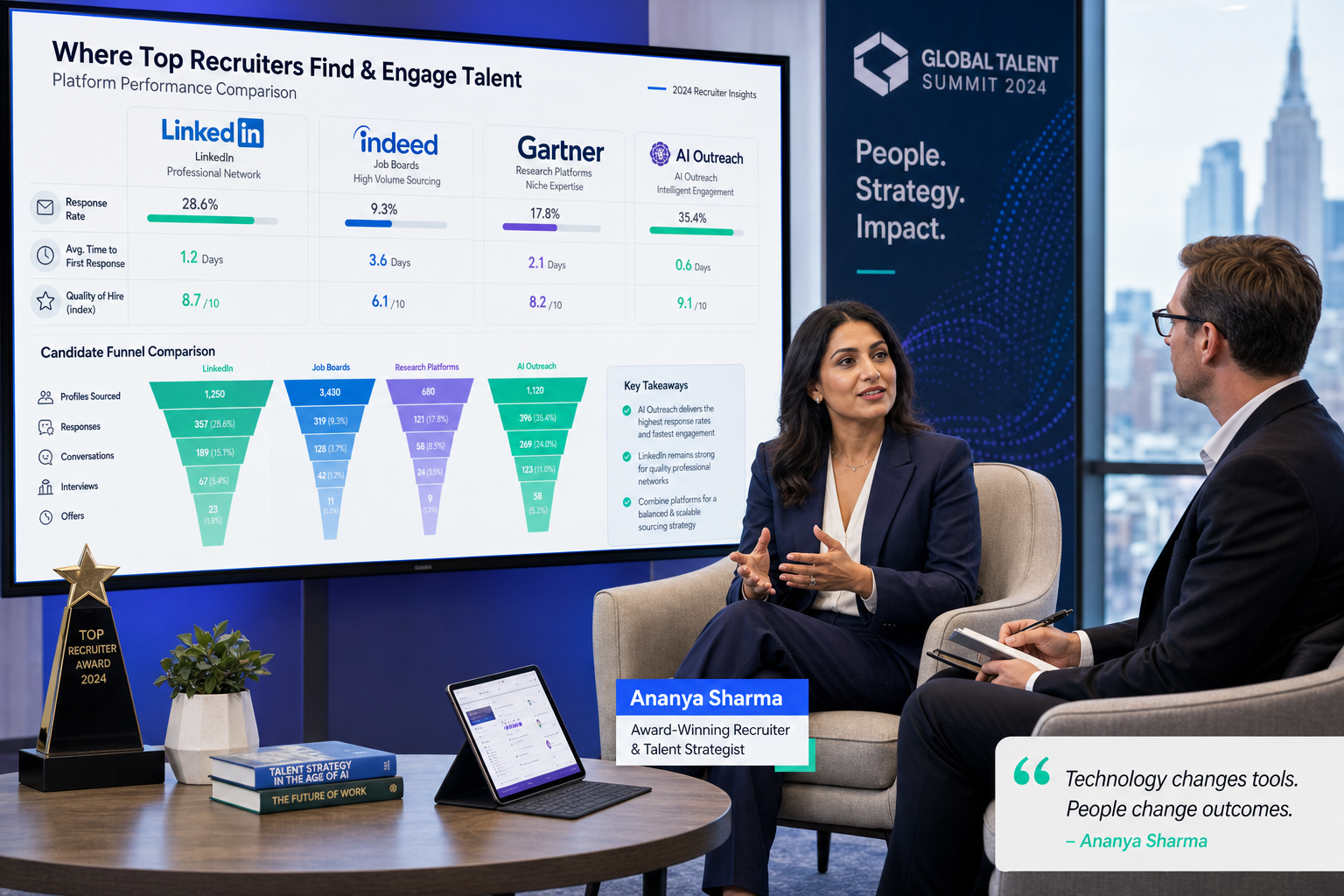
This article shows recruiters how to compare websites like LinkedIn, avoid sourcing waste, and choose channels with better replies.
That matters because relying on one professional network usually creates the same operational problems I see inside agency desks and in-house teams: too much time spent chasing replies, uneven candidate intent, duplicated outreach, and weak visibility into which source actually produces interviewable people. For smaller search firms, that means consultant hours disappear into admin. For solo headhunters, follow-up slips between conversations. For corporate recruiters, the damage shows up as slower hiring, strained hiring-manager trust, and avoidable cost in roles that stay open longer than they should.
In practice, I have found that StrategyBrain AI Recruiter helps most when the problem is not judgment but bandwidth. Its ability to automate first-touch LinkedIn outreach, keep conversations moving after hours, and collect resumes or contact details from interested candidates reduces the repetitive work around sourcing. The recruiter still makes the real call on fit, resume quality, and whether a person should move forward, but the front-end messaging load becomes easier to control.
That gap is easier to understand if you picture a market like Greater Vancouver, where a hiring team or search firm may need to cover a talent area of roughly 3.5 million people spread across Vancouver, Richmond, Surrey, Burnaby, Coquitlam, Langley, North Vancouver, and nearby communities. The challenge is not simply finding more names. It is deciding which recruiting channel deserves attention, which agency or platform is best for a specific mandate, and how to keep candidate communication moving while the search broadens across multiple submarkets.
When recruiters start comparing general job boards, networking platforms, specialist communities, and local search partners under that kind of pressure, the real question becomes bigger than "LinkedIn versus something else." It becomes a sourcing design problem: which linkedin alternatives for job search produce reach, which apps like LinkedIn support better conversations, and which sources help both candidates and recruiters make a faster, better-informed decision.
- No single platform replaces LinkedIn across discovery, networking, and research.
- Broad job boards are best for volume, but they often need tighter screening.
- Research platforms improve decision quality before interviews and offers.
- Niche communities work best when role context matters more than raw applicant count.
- Local recruiting partners can still outperform software alone in geography-specific searches.
- Why one platform is rarely enough
- Quick comparison of websites like LinkedIn
- Best LinkedIn alternatives for job search
- Where professional networking happens outside LinkedIn
- Best platforms for salary and company research
- What the Vancouver recruiter example teaches
- How I combine platforms with AI-supported outreach
- What recruiters and hiring managers should watch
- FAQ
Why One Platform Is Rarely Enough
People searching for websites like LinkedIn are usually not looking for a clone. They are looking for a better outcome. Candidates want more openings, clearer salary context, better company research, or access to startup and remote roles that do not surface well in one feed. Recruiters want a cleaner channel mix, stronger response rates, and less wasted effort.
That is also how experienced search professionals think about market coverage. In a large metro area, no serious recruiter would expect one source to represent the full talent pool. The same logic applies online. Broad channels bring reach. Specialist platforms bring context. Research tools reduce bad applications and weak interviews. Local recruiters and niche communities bring judgment where job boards cannot.
Recruiter takeaway: the best alternative to LinkedIn is usually a combination of sources matched to the role, not a single substitute.
Quick Comparison of Websites Like LinkedIn
| Platform | Best For | Main Strength | Main Limitation | Best Audience |
|---|---|---|---|---|
| Indeed | High-volume job discovery | Large listing volume across industries | More applicant noise and variable fit | General job seekers, high-volume hiring teams |
| Glassdoor | Salary and employer research | Compensation and review insight | Not built for relationship-driven networking | Candidates comparing employers, recruiters monitoring reputation |
| Wellfound | Startup and early-stage hiring | Sharper role context for startup candidates | Narrower outside startup or tech paths | Startup job seekers, founders, tech recruiters |
| Local recruiting firms | Hard-to-fill and geography-specific searches | Market knowledge and direct assessment | Less scalable than self-serve platforms | Employers hiring in defined local talent markets |
The extra row matters. Many roundups of sites like LinkedIn ignore the fact that recruiters are also a channel, not just intermediaries. In city-based searches, a strong local agency can act like a curated sourcing layer, especially when a hiring manager needs talent in a specific geography and not just more applications.
Best LinkedIn Alternatives for Job Search
If the goal is fast role discovery, the strongest linkedin alternatives for job search are usually platforms designed around search speed and listing volume rather than profile-centric networking.
Indeed: Best for broad job discovery
Indeed remains one of the most practical options when candidates want a large number of openings in one place. Recruiters already know what comes with that advantage: faster traffic at the top of the funnel, but wider variance in application quality.
Pros
- High job volume across sectors and seniority levels
- Good for candidates ready to apply quickly
- Useful when hiring teams need broad top-of-funnel reach
Cons
- Can generate many low-fit applications
- Requires stronger filtering and faster screening discipline
Recruiter advice: use it when role titles are standard, markets are broad, and interview capacity is ready. Do not expect it to replace relationship-led sourcing for niche or trust-sensitive hires.
Wellfound: Best for startup-focused searches
Wellfound is one of the more relevant apps like LinkedIn for startup candidates because it narrows the field. People searching there often care about company stage, team access, remote flexibility, and the practical reality of joining a smaller business.
Pros
- Focused startup environment
- More explicit role context than many general boards
- Useful for founders and candidates evaluating growth-stage risk
Cons
- Less useful outside startup or tech-heavy hiring
- Smaller pool for conventional corporate roles
Practical takeaway: if your search looks more like a startup opportunity assessment than a standard corporate move, a focused platform is often more efficient than another week of generic LinkedIn browsing.
Where Professional Networking Happens Outside LinkedIn
When people ask about apps like LinkedIn, they often mean platforms or spaces where professional intent is visible even if the format is different. The key is not whether the interface resembles LinkedIn. The key is whether the channel gives enough signal to support a credible conversation.
From a recruiting standpoint, a useful networking alternative usually offers four things:
- A clear professional or industry audience
- Enough context to personalize outreach
- Visible signs of role interest or career direction
- A communication style that rewards relevance over volume
I have learned to adjust outreach by channel rather than forcing one script everywhere. On LinkedIn, candidates often expect recruiter-first outreach. In narrower communities, the same message can feel lazy unless it reflects the context of that space. That is one reason I now use AI-supported LinkedIn workflows mainly to absorb repetitive front-end work, not to replace recruiter judgment or relationship building.
Best Platforms for Salary and Company Research
Some of the best websites like LinkedIn are not networking platforms at all. They are decision-support tools. Candidates use them to avoid bad employers. Recruiters should pay attention because these same platforms shape expectations before the first interview even begins.
Glassdoor: Best for salary and employer reputation
Glassdoor is especially useful when candidates need compensation benchmarks, employer reviews, and interview impressions. It helps them decide whether a role is worth pursuing, and it helps them enter interviews with sharper questions.
Pros
- Strong salary and employer-review visibility
- Useful before interviews and offer negotiation
- Valuable for employer brand monitoring
Cons
- Not a direct networking or sourcing substitute
- Reviews need context, especially for fast-changing companies
Recruiter advice: assume candidates will triangulate your job post, your outreach, and public employer sentiment. If those signals do not align, conversion drops.
Culture-focused company content
Platforms that emphasize workplace stories, team snapshots, and career advice can be more persuasive than another generic listing. They are particularly helpful when candidates are comparing managers, work style, and mission fit rather than just compensation.
That matters in the same way a local recruiter directory matters in a city market. A list is useful, but context changes decisions. Candidates and employers both choose better when they can see how a team works, not just that a vacancy exists.
What the Vancouver Recruiter Example Teaches
The reference point from Vancouver is valuable because it frames hiring as a selection problem inside a crowded market. In a region covering communities such as Richmond, Delta, Surrey, Langley, Burnaby, New Westminster, Coquitlam, Port Moody, Maple Ridge, North Vancouver, and West Vancouver, employers do not simply need access to people. They need help narrowing the right channel, the right local partner, and the right recruiting method.
That is why lists of established firms in a market still matter. Agencies specializing in permanent, temporary, contract, or executive search solve a different part of the hiring equation than software platforms do. They bring market judgment, role calibration, and candidate assessment. Job boards bring reach. Research platforms bring transparency. LinkedIn brings visibility. None of these channels works best in isolation.
For candidates, the same lesson applies in reverse. If you are exploring local opportunities in a major metro market, it often makes sense to combine direct applications, recruiter relationships, and company research rather than relying on one profile network. That is the practical reason so many searches for websites like LinkedIn come from people who are not anti-LinkedIn at all. They just need a more complete job-search system.
How I Combine Platforms With AI-Supported Outreach
My own workflow changed once the bottleneck became conversation management rather than list building. I can still source manually, but the repetitive part is what drains recruiter time: connection attempts, initial role summaries, follow-up replies after hours, and the back-and-forth needed to collect resumes from interested people. That is where I have found StrategyBrain AI Recruiter most useful.
I use it as a support layer around LinkedIn, not as a replacement for recruiter thinking. It keeps outreach moving, answers common candidate questions based on the brief I provide, and captures resume or contact details when candidates want to continue. I still review the resumes myself, decide whether the background really matches the mandate, and control the next step with the client or hiring manager. In other words, it removes repetitive motion without outsourcing accountability.
For recruiters working across time zones or handling a high number of live conversations, that matters. Candidate replies often arrive when a consultant is interviewing, commuting, or asleep. The system's always-on messaging and multilingual communication can reduce that lag. If your work is heavily LinkedIn-centered, you can also review its broader use cases and workflow examples here: AI Recruiter workflow overview and conversation examples.
A practical sourcing stack that works
- Use LinkedIn for visibility, recruiter access, and profile-based sourcing.
- Add 2 to 3 general job platforms for volume and faster role discovery.
- Use one specialist platform if the search is startup-focused, remote-first, or skill-specific.
- Check research platforms before interviews to validate pay, culture, and employer reputation.
- Layer automation carefully where messaging volume is high but recruiter judgment must stay human.
Where AI-supported workflow helps most
- After-hours candidate replies
- High-volume outreach where consistency matters
- Global or multilingual recruiting communication
- Resume and contact collection after interest is confirmed
- Reducing admin load for solo recruiters and small agency teams
The mistake is treating automation as replacement instead of leverage. In serious recruiting, software should speed up contact and coordination while the recruiter retains the assessment, nuance, and final call.
What Recruiters and Hiring Managers Should Watch
From the employer side, channel choice tells you a lot about candidate behavior.
- Broad job board candidates often optimize for speed and option volume.
- Research-led candidates usually ask sharper questions about pay, reputation, and manager quality.
- Startup-platform candidates care more about scope, growth, and work flexibility.
- Recruiter-referred candidates may come with better role calibration from the start.
- LinkedIn-sourced candidates vary widely, which is why response handling matters so much.
That last point is where process design becomes important. If your team depends on LinkedIn for top-of-funnel sourcing but cannot keep up with outreach and follow-up, quality drops before screening even starts. If your team uses several sites like LinkedIn without a clear source strategy, reporting becomes vague and everyone defaults to guessing which channel works best.
Hiring managers should ask three simple questions:
- Which source produces the strongest interview-to-offer ratio?
- Which source attracts the clearest candidate intent for this role type?
- Where is recruiter time being spent on admin instead of evaluation?
Those questions matter more than platform loyalty. A good sourcing system is built around role type, market difficulty, and team capacity, not habit.
FAQ
What are the best websites like LinkedIn for job seekers?
It depends on the goal. Indeed is strong for broad job volume, Glassdoor is useful for salary and employer research, and Wellfound is a better fit for startup-oriented searches. Most candidates do best by combining these with LinkedIn rather than replacing LinkedIn entirely.
What are the best LinkedIn alternatives for job search?
For pure job discovery, broad job boards usually perform best. For better-fit opportunities, niche platforms and recruiter relationships can be more effective. The strongest linkedin alternatives for job search are usually combinations, not one platform.
Are there apps like LinkedIn for recruiters?
Yes, but they serve different functions. Some platforms support job discovery, some support employer research, and some help recruiters manage messaging and sourcing workload around LinkedIn itself. The right choice depends on whether the bottleneck is reach, response handling, or candidate evaluation.
Should recruiters stop using LinkedIn if they use alternatives?
No. LinkedIn still matters for professional visibility, profile-based sourcing, and referrals. In most workflows, alternatives improve a specific stage of recruiting rather than replacing LinkedIn across the board.
When do local recruiters matter more than online platforms?
They matter most when a search is geography-sensitive, hard to calibrate, or dependent on local market knowledge. In large regional talent markets, a strong local recruiter can narrow the field faster than broad online sourcing alone.
Conclusion
The best websites like LinkedIn are the ones that solve the specific weakness in your current hiring or job-search process. If you need more openings, use broad job platforms. If you need better judgment, add research tools. If you need startup or remote context, use a focused niche source. If you need stronger local market coverage, recruiter relationships still matter.
And if LinkedIn remains central to your sourcing but the real issue is communication volume, follow-up drag, or after-hours candidate handling, an AI-supported workflow can help without removing recruiter control. That is the practical lesson behind both the Vancouver example and modern sourcing strategy in general: better outcomes come from a better channel mix, not from expecting one platform to do every job.