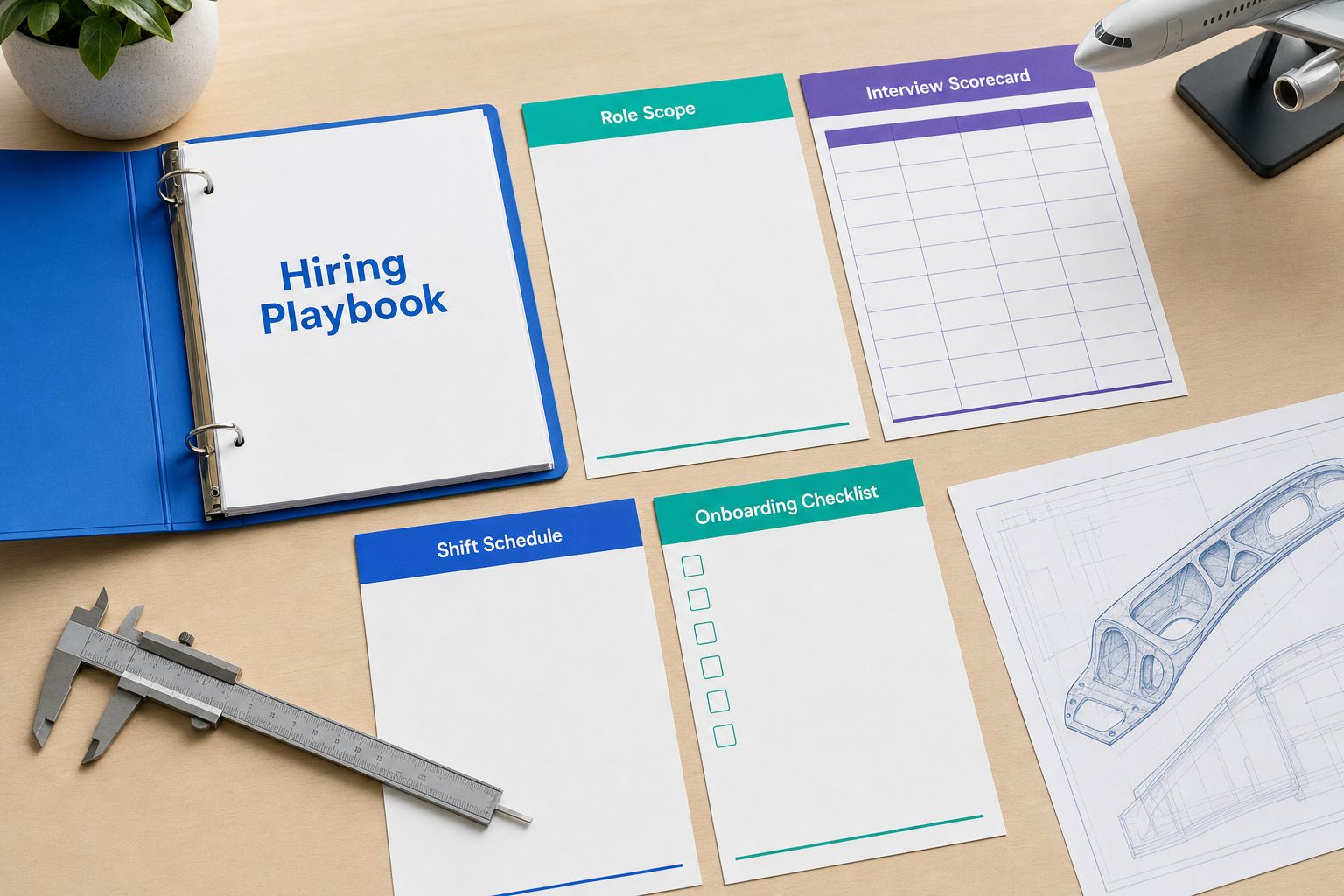
Recruiters will learn to align aerospace production jobs from role scope through onboarding, avoiding costly hiring mismatches.
When those stages drift apart, candidates receive conflicting information about tools, shifts, qualifications, and pay. Independent recruiters lose productive hours rechecking requirements, small staffing firms risk damaging client relationships, and corporate recruiters may advance applicants who cannot meet essential program or schedule conditions.
A well-configured recruitment platform can reduce that friction by keeping requisition details, candidate communications, screening answers, and hiring stages in one workflow. Automated outreach and timely follow-up can support high-volume sourcing, but the recruiter must still evaluate résumés, verify technical evidence, and decide who advances.
The problem becomes visible as soon as a hiring manager opens an aircraft assembler requisition. The manager reviews the production tasks with the recruiter, separates mandatory qualifications from trainable skills, and publishes the position. The recruiter then screens applicants against those agreed criteria and prepares structured interview questions instead of relying on a generic conversation.
That sequence must continue through salary research, a complete offer, and an onboarding checklist that prepares the new employee for training, site access, safety rules, and the assigned shift. It provides the operating framework for filling aerospace production jobs, including specialized inspection roles and high-volume airplane assembly jobs, without treating sourcing as the entire hiring process.
Key principle: Aerospace recruiting starts with an accurate production requirement and ends when the new hire can enter the controlled work environment with the information, access, and training needed to perform safely.
Table of Contents
- The aerospace production hiring workflow
- What aerospace production jobs include
- How to define and advertise the role
- Common role families
- What airplane assembly jobs involve
- Screening and skills assessments
- Structured interviews and selection
- Baseline and specialized qualifications
- Shifts and working conditions
- Compensation and offer preparation
- Production onboarding
- How candidates can search and apply
- Career development
- Frequently asked questions
The Aerospace Production Hiring Workflow
A production requisition is not ready for sourcing merely because it has an approved headcount. Before advertising it, the recruiter and hiring manager should understand what the employee will build, inspect, machine, test, maintain, or document. They should also confirm the worksite, permanent shift, training shift, overtime expectations, physical duties, and any legal or program-specific eligibility conditions.
A practical workflow has eight connected stages:
- Calibrate the requisition. Confirm the production objective, daily tasks, reporting relationship, shift, and business reason for hiring.
- Write the job description. Translate the work into a clear title, responsibilities, essential functions, and categorized qualifications.
- Select sourcing channels. Advertise where relevant local, technical, veteran, trade, and manufacturing talent is likely to search.
- Conduct pre-interview screening. Verify objective requirements before asking candidates to invest time in a full interview.
- Use structured interviews. Ask each candidate comparable, job-related questions and apply documented scoring criteria.
- Validate compensation. Benchmark the correct occupation, location, shift, and skill level rather than using one rate for every production job.
- Communicate the decision. Send a complete offer or a prompt, professional rejection notice.
- Prepare onboarding. Coordinate access, safety orientation, tools, training, and first-week expectations before the start date.
These stages should use the same definition of success. If the posting emphasizes basic assembly but the interview evaluates advanced machining, the process is misaligned. If a second-shift assignment appears only in the offer, the recruiter has screened for the wrong opportunity. Templates can improve consistency, but each template must be adapted to the actual production program.
What Are Aerospace Production Jobs?
Aerospace production jobs are hands-on, technical, and supervisory positions involved in manufacturing, assembling, inspecting, testing, maintaining, and documenting aircraft parts or systems. They combine industrial production practices with demanding expectations for precision, safety, configuration control, quality, and traceability.
The field extends well beyond final aircraft assembly. One employee may machine a precision component, another may install structural fasteners, and another may inspect dimensions or review a nonconformance. Maintenance technicians keep production equipment available, while supervisors coordinate safety, quality, staffing, output, and shift handoffs.
Titles are not consistent across employers. “Production technician” might describe assembly, equipment support, testing, material processing, or troubleshooting. Recruiters should therefore lead with the work itself, and candidates should compare responsibilities rather than relying on titles alone.
Define the Role Before Posting It
A strong aerospace job description enables qualified candidates to recognize the opportunity and gives interviewers a defensible set of selection criteria. A weak description creates avoidable applications, inconsistent interviews, and late withdrawals.
Requisition Questions for the Hiring Manager
- What product, component, system, or production process will the employee support?
- Which tasks must the person perform independently after training?
- Which drawings, work instructions, tools, fixtures, materials, and measurement devices are used?
- Which qualifications are mandatory on the first day, and which can be taught?
- Does the position require a license, process qualification, clearance eligibility, or particular export-control status?
- What are the permanent and training schedules?
- How frequently are overtime and weekend hours required?
- Which physical functions are genuinely essential?
- What does satisfactory performance look like after 30, 60, and 90 days?
- Which technical or leadership role could follow successful performance?
The larger business context also matters. An urgent backfill for a stable production cell is different from hiring a new team for a program ramp. Candidates, screeners, and interviewers need to know whether the priority is immediate process experience, long-term trainability, additional shift coverage, or scarce technical expertise.
A Useful Job-Posting Structure
- Use a recognizable, specific title.
- Explain what the facility or program produces without disclosing restricted information.
- Describe five to eight essential responsibilities in concrete language.
- Separate required, preferred, and trainable qualifications.
- State location, shift, overtime, travel, and onsite expectations.
- Describe physical duties with reasonable frequency and context.
- Publish compensation information where required or appropriate.
- Explain the application and selection stages.
Inviting language does not require lowering standards. It means removing unexplained acronyms, inflated experience demands, and broad phrases such as “must be detail-oriented” when the employer can describe the actual behavior: reading revision-controlled instructions, recording measurements, maintaining tool accountability, and escalating a discrepancy.
Common Aerospace Production Role Families
| Role family | Typical work | Evidence to evaluate |
|---|---|---|
| Aircraft structure assembler | Fits, aligns, drills, fastens, seals, and verifies structural parts | Blueprint reading, mechanical assembly, tool use, precision measurement |
| Production assembler | Builds components or systems according to controlled sequences | Repeatable process work, documentation, quality checks, mechanical aptitude |
| Manufacturing technician | Supports equipment, processes, testing, troubleshooting, and production flow | Technical training, shop math, diagnostics, process discipline |
| CNC machinist | Operates or sets up computer-controlled equipment for precision parts | Machining experience, drawings, metrology, setup or programming knowledge |
| Quality inspector | Checks material, dimensions, workmanship, records, and conformance | Inspection experience, calibrated tools, drawing interpretation, reporting |
| NDT or CMM technician | Evaluates parts through nondestructive methods or coordinate measurement equipment | Method-specific training, technical reporting, inspection discipline |
| Welder or soldering technician | Joins structural, mechanical, or electrical components under controlled procedures | Relevant training, qualification records, workmanship standards |
| Maintenance technician | Maintains and repairs production machinery, tooling, or related systems | Troubleshooting, preventive maintenance, electrical or mechanical knowledge |
| Production supervisor | Coordinates staffing, safety, quality, output, training, and handoffs | Frontline leadership, scheduling, escalation, compliance, coaching |
| Manufacturing engineer | Develops and improves processes, tooling, instructions, and production readiness | Relevant education, process analysis, technical documentation |
Adjacent-industry experience can be valuable. Automotive, defense, electronics, industrial equipment, precision fabrication, and regulated manufacturing may provide transferable evidence. The hiring team should identify which aerospace-specific procedures can be taught rather than rejecting candidates solely because their previous employer built a different product.
What Airplane Assembly Jobs Involve
Airplane assembly jobs involve constructing aircraft structures, subassemblies, or systems to controlled specifications. Depending on the work area, employees may fit parts, drill holes, install fasteners, apply sealants, route wiring, connect components, perform checks, and document completed operations.
Typical Assembly Responsibilities
- Review drawings, travelers, work orders, and current work instructions before starting.
- Gather approved parts, fasteners, materials, tools, fixtures, and protective equipment.
- Position, fit, align, clamp, drill, fasten, bond, seal, or connect components.
- Use gauges and measurement tools to verify dimensions, alignment, torque, or fit.
- Perform authorized in-process checks and support production or functional tests.
- Maintain part identification, foreign-object prevention, and tool accountability.
- Record completed steps accurately and preserve required traceability.
- Stop and escalate when the physical condition does not match the instruction.
Fast work is useful only when it remains controlled. A strong assembler does not conceal a discrepancy or improvise an unauthorized repair to preserve output. Recruiters should look for candidates who can balance pace with procedure, documentation, communication, and quality.
Pre-Interview Screening and Skills Evidence
Pre-interview screening should reduce an applicant pool using criteria that are both job-related and established before applications are reviewed. For aerospace production jobs, an initial screen can confirm location, shift availability, education, relevant experience, credential status, physical duties, compensation expectations, and any clearly stated program eligibility requirement.
Screeners should not attempt to conduct the entire technical interview by telephone. Their job is to verify minimum conditions, identify potentially transferable experience, explain the opportunity accurately, and document matters that a qualified technical interviewer must explore.
Job-Relevant Assessment Options
- A blueprint-reading exercise using nonconfidential sample material
- Basic shop-math questions involving fractions, decimals, and measurements
- A practical measurement exercise using the tools required by the role
- A mechanical reasoning assessment for trainable entry-level positions
- A structured troubleshooting scenario for maintenance technicians
- A method-specific exercise for machining, inspection, welding, or soldering roles
Before using an assessment, define its purpose, administration method, scoring standard, and influence on the final decision. A test should measure an essential or strongly predictive job capability. Personality instruments should not replace evidence of technical performance, safe judgment, or demonstrated behavior.
Prepare Structured Aerospace Interviews
Interview preparation is especially important when recruiters, production leaders, quality representatives, and HR partners all participate. Each interviewer should know which competencies to evaluate, which questions to ask, and how scores will be combined.
Useful Behavioral and Technical Questions
- Tell us about a time a drawing or instruction did not match the part in front of you. What did you do?
- How do you confirm that you are using the current revision of an instruction?
- Describe a measurement that fell outside tolerance and how you handled it.
- What steps do you take when a tool is damaged, missing, or overdue for calibration?
- How do you prepare a complete shift handoff?
- Give an example of learning a controlled process under supervision.
- How have you balanced production targets with safety and quality requirements?
Strong answers usually show a sequence: stop when necessary, verify the condition, protect the product, notify the appropriate person, document the issue, and continue only under approved direction. Interviewers should score the evidence rather than rewarding confidence, familiarity, or personal similarity.
Recruiters should also prepare candidates. Sharing the interview format, worksite instructions, expected duration, and any practical assessment is good candidate care, not inappropriate coaching. Clear preparation reduces preventable confusion and makes the evaluation more consistent.
Entry-Level and Specialized Qualifications
Many aerospace manufacturing positions do not require a four-year degree or previous aircraft experience. The correct threshold depends on the process, its risks, the employer’s training capacity, and program requirements.
Common Baseline Requirements
- High school diploma or GED when specified
- Mechanical aptitude and comfort using tools
- Basic shop math
- Ability to follow controlled instructions
- Ability to read or learn drawings and diagrams
- Reliable attendance and availability for the stated schedule
- Ability to perform the position’s essential physical functions, with accommodation where applicable
Potentially Specialized Requirements
- Welding, brazing, or soldering qualifications
- NDT method training or certification
- CMM programming or advanced dimensional inspection experience
- CNC setup, programming, tooling, or metrology skills
- Airframe and Powerplant credentials for applicable maintenance work
- Engineering or technical education for selected roles
- Security-clearance eligibility or an active clearance when explicitly required
- Citizenship or export-control status applicable to the particular program
Job descriptions should label every qualification as required, preferred, or trainable. A preferred item is not a hidden minimum. Conversely, recruiters should not suggest that a legally mandated status or regulated credential is flexible when it is not.
Shifts and the Production Environment
Most aerospace production work is onsite because employees need controlled parts, tooling, fixtures, inspection equipment, and authorized records. Employers may operate first, second, and third shifts, weekend schedules, or overtime arrangements. Initial training sometimes occurs on a different shift from the permanent assignment.
Working conditions vary among large assembly areas, machine shops, inspection laboratories, maintenance spaces, and controlled production rooms. Depending on the position, an employee may stand for extended periods, lift materials, reach overhead, climb approved platforms, use repetitive hand movements, wear protective equipment, or work around industrial noise.
Questions to Resolve During the First Screen
- Is the schedule fixed, rotating, or subject to change?
- Does training occur on the permanent shift?
- How often is overtime required?
- Is weekend work mandatory or voluntary?
- What lifting, standing, reaching, vision, hearing, or dexterity duties are essential?
- Which protective equipment is required?
- Does the work involve sealants, solvents, coatings, or other controlled materials?
- What conditions should a new employee expect inside the facility?
Early disclosure protects all parties. A qualified applicant who cannot accept the schedule is not a viable hire, and postponing that discussion creates needless interviews and potential offer rejection.
Research Compensation and Prepare the Offer
Compensation varies by occupation, location, shift, experience, credentials, collective bargaining coverage, program conditions, and technical complexity. An entry-level assembler, experienced CNC machinist, NDT technician, licensed maintenance professional, and manufacturing engineer should not be evaluated against one generic aerospace rate.
Hiring teams should review current, occupation-specific information from authoritative labor sources and recent local postings. They should also account for internal equity and applicable pay-transparency rules. Because labor data changes, candidates and employers should verify publication dates rather than relying on an undated figure repeated by a secondary website.
A complete offer should explain:
- Base hourly rate or salary
- Shift differential
- Overtime eligibility and expected schedule
- Worksite and assigned shift
- Benefits and eligibility dates
- Paid time off and retirement provisions
- Contingencies such as background checks or credential verification
- Proposed start date
- Acceptance deadline and contact person
Candidates who are not selected should receive a prompt and respectful update. Silence after an interview can damage the employer’s reputation in concentrated aerospace labor markets where applicants, technicians, and supervisors often know one another.
Build a Production-Ready Onboarding Checklist
The hiring process is not complete when the offer is accepted. Delays involving facility access, training schedules, tools, or supervisor availability can leave an otherwise enthusiastic new hire unable to begin meaningful work.
Before the Start Date
- Confirm the worksite, arrival time, shift, parking, and entry instructions.
- Complete required employment and access documentation.
- Schedule safety, quality, security, and program orientation.
- Assign a supervisor, trainer, or qualified peer.
- Prepare required protective equipment and authorized system access.
- Explain what identification or credentials the employee must bring.
- Maintain appropriate contact if the accepted start date is several weeks away.
During the First Weeks
- Set clear training milestones and first-week goals.
- Introduce the employee to the team and escalation contacts.
- Explain documentation, tool-control, and foreign-object-prevention practices.
- Provide supervised practice before independent work.
- Conduct regular check-ins with the employee and trainer.
- Record completed qualifications and identify additional support needs.
These check-ins are part of production integration, not a continuation of the interview. Their purpose is to align the new employee, trainer, supervisor, and relevant stakeholders around safe performance and realistic development goals.
How to Search for Aerospace Production Jobs
Candidates usually get better results by combining a role family with location and schedule rather than searching one broad phrase.
- Choose a role family. Start with assembly, machining, quality, inspection, maintenance, welding, production leadership, or manufacturing engineering.
- Set a realistic commuting radius. Consider off-peak shift starts, weekend transportation, parking, and overtime.
- Add schedule terms. Try first shift, second shift, third shift, weekend shift, or overtime.
- Search title variations. Use aircraft assembler, structural assembler, production technician, manufacturing technician, quality inspector, NDT technician, CMM technician, or CNC machinist.
- Review eligibility language early. Check education, credential, export-control, citizenship, and clearance statements.
- Tailor the résumé truthfully. Connect previous tasks to tools, materials, drawings, measurement, safety, quality, and documentation.
- Prepare evidence. Describe what you built, operated, inspected, repaired, measured, or documented without revealing confidential information.
If you entered “aerospace com” while looking for work, the search engine may interpret it as a website or navigational query. More precise searches include “aerospace companies hiring near me,” “aerospace manufacturing jobs,” or “aircraft structure assembler second shift.”
Career Pathways and Advancement
Aerospace production can support both technical and leadership careers. Advancement generally depends on sustained quality, dependable performance, broader process knowledge, formal training, and the ability to solve problems without bypassing controls.
| Starting point | Possible next steps | Development priorities |
|---|---|---|
| Production or structure assembler | Senior assembler, lead, inspector, trainer, supervisor | Advanced drawings, measurement, quality records, coaching |
| Machine operator | CNC machinist, setup specialist, programmer, manufacturing technician | Setup, tooling, metrology, troubleshooting |
| Quality inspector | Senior inspector, CMM or NDT specialist, quality lead | Inspection methods, reporting, drawing interpretation |
| Maintenance technician | Senior technician, planner, reliability role, maintenance lead | Diagnostics, preventive maintenance, equipment history |
| Manufacturing technician | Process specialist, lead technician, manufacturing engineer pathway | Technical education, process improvement, documentation |
Candidates should ask about paid training, cross-training, internal postings, qualification support, tuition assistance, and lead opportunities. Employers should describe the capabilities associated with advancement without promising a promotion date they cannot guarantee.
Frequently Asked Questions
Are there entry-level aerospace production jobs?
Yes. Some assembler and manufacturing-support positions accept candidates with a high school diploma or GED, mechanical aptitude, basic shop math, reliable attendance, and the ability to learn controlled instructions. Availability and exact requirements vary by facility, shift, and program.
Do airplane assembly jobs require a college degree?
Many do not. Employers commonly prioritize mechanical ability, tool experience, blueprint reading, accurate measurement, process discipline, and documentation. Engineering and selected advanced technical roles may require a degree or specialized education.
Can I qualify without prior aerospace experience?
Possibly. Experience from automotive production, fabrication, electronics, industrial maintenance, machining, construction, military technical work, or other regulated environments may transfer. The application should show the specific tools, processes, measurements, safety practices, and quality responsibilities involved.
Should candidates apply if they lack a preferred qualification?
A candidate may still apply when the missing qualification is genuinely preferred rather than required. Mandatory licenses, legal eligibility conditions, regulated credentials, and safety-critical qualifications should be treated as firm unless the posting explicitly offers training or sponsorship.
Do all aerospace manufacturing jobs require a security clearance?
No. Some programs require an active clearance or clearance eligibility, while others have export-control or citizenship conditions without requiring a security clearance. Read the exact language and answer screening questions accurately.
What shifts are available?
Employers may offer first, second, or third shift, weekend schedules, and overtime. Training may initially occur on another shift. Candidates should confirm whether the permanent schedule is fixed, rotating, or subject to later reassignment.
How much do aerospace production jobs pay?
Pay depends on occupation, region, shift, experience, credentials, union coverage, and program complexity. Compare base compensation with shift differentials, overtime rules, health coverage, retirement benefits, paid training, and advancement support.
Are these jobs physically demanding?
Some are. A position may involve standing, lifting, reaching, climbing approved platforms, repetitive hand use, or protective equipment. Ask how frequently each activity occurs instead of relying on a generic physical-demand statement.
Do employers provide training?
Some employers provide paid initial training and cross-training, particularly for entry-level or facility-specific processes. Training does not remove every prerequisite; licenses, regulated credentials, welding qualifications, or inspection-method requirements may still apply.
Can an assembler move into quality or leadership?
Yes. Assemblers may progress into senior assembly, training, inspection, planning, lead, or supervisory work after building broader technical and quality knowledge. Engineering pathways may require additional education.
Make Every Hiring Stage Support Production
The strongest aerospace hiring process is consistent from requisition through onboarding. It defines the actual work, distinguishes mandatory qualifications from trainable skills, screens against objective evidence, prepares interviewers, communicates compensation clearly, and equips the successful candidate to begin safely.
For job seekers, the same structure offers a practical way to evaluate an opportunity. Confirm the tasks, tools, shift, qualifications, physical duties, compensation, training plan, and possible next role. For recruiters, those details are not administrative extras; they are the foundation of credible aerospace production hiring.