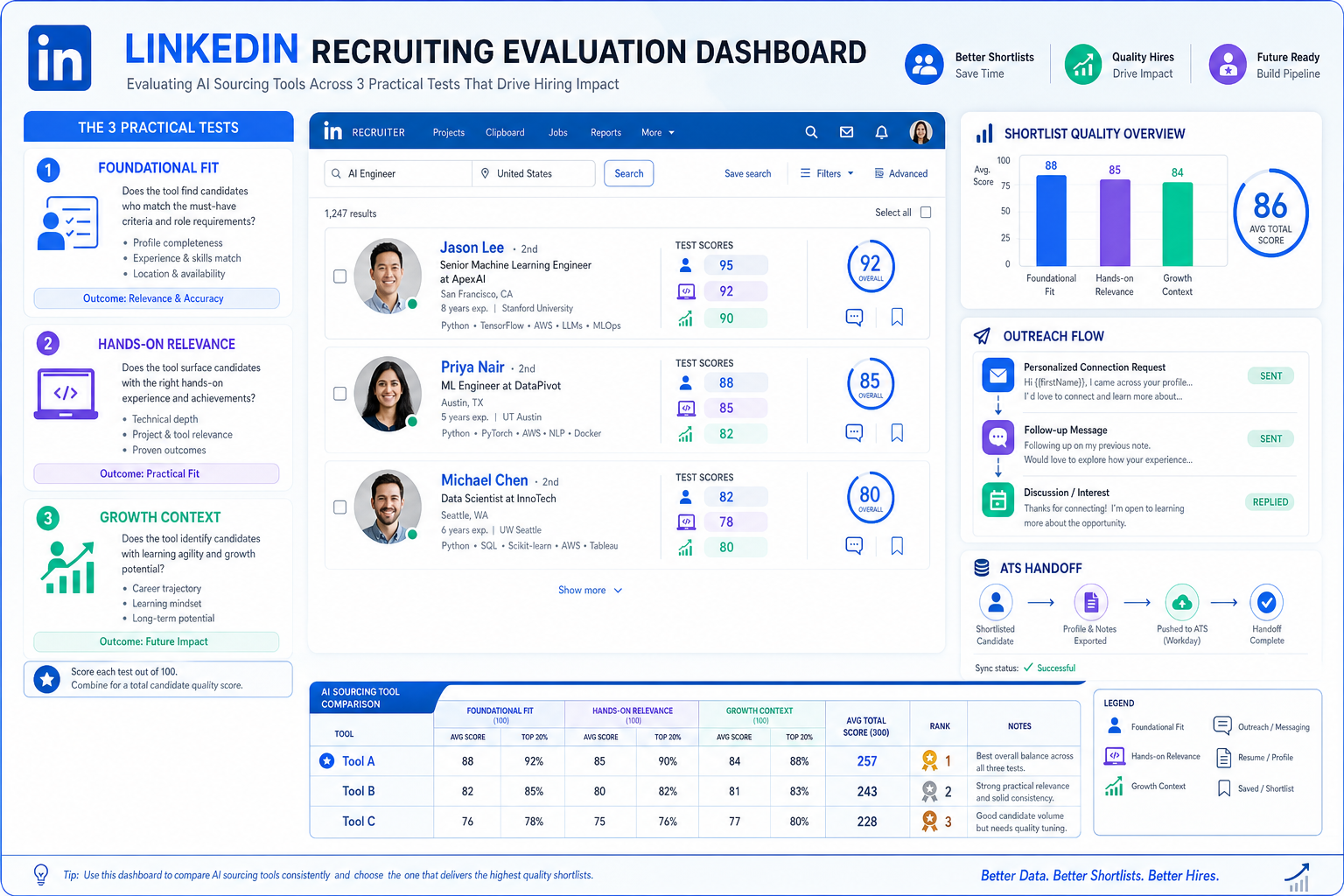
Three recruiter judgment tests in this article help headhunters evaluate an ai recruiting tool, avoid shallow shortlists, and fix wasted sourcing effort.
That distinction matters because most recruiting teams are not struggling with the idea of AI itself. They are struggling with wasted top-of-funnel effort: too much manual search, too many half-relevant profiles, too many outreach threads that go cold after business hours, and too many sourced candidates that never get handed off cleanly into the hiring process. For a small agency owner, that means recruiter capacity gets eaten by admin. For an in-house recruiter, it means slower pipelines and frustrated hiring managers. For an individual headhunter, it means missed replies, inconsistent follow-up, and less time for the conversations that actually move a search forward.
In my own workflow, I have found that a tool such as StrategyBrain AI Recruiter can help most when the problem is repetitive LinkedIn outreach and after-hours candidate communication rather than final candidate evaluation. Its strongest support is practical: automating initial connection and role introduction, keeping conversations moving across time zones, and collecting resumes or contact details from interested candidates. The recruiter still has to review the resume, decide whether the background truly fits, and make the next judgment call, but that division of labor is exactly what makes an AI-supported sourcing workflow useful instead of risky.
A good comparison comes from a much older hiring question: when an employer had to choose among accounting designations, the real decision was never just the label. The hiring team had to ask what kind of capability the role needed. Did they need someone grounded in the nuts and bolts, someone with broad hands-on experience, or someone who had already shown they could grow from junior work into more senior responsibility? In practice, that meant reviewing not only credentials, but also what the person had actually done, how they had progressed, and whether their background matched the demands of the team they were joining.
The same logic applies when a recruiter builds a sourcing shortlist. You are not simply looking for a profile that contains the right keywords. You are checking whether someone has worked at the foundational level, handled increasingly complex responsibilities, and developed in a way that makes sense for the role. That is why so many AI shortlists fail the real-world test: they surface profiles that look close on paper, but miss progression, practical depth, or role context. Once you see sourcing through that lens, evaluating ai candidate sourcing, ai sourcing tools, and broader ai recruiting tools becomes much clearer.
That is the frame for this article. Rather than asking whether AI belongs in recruiting, we will use three grounded evaluation tests drawn from real recruiter judgment: can the tool understand foundations, can it recognize hands-on relevance, and can it support long-term hiring context instead of only instant matching. From there, we will look at where an ai recruiting tool fits in LinkedIn sourcing, what to expect from workflow automation, and how to evaluate adoption without getting lost in hype.
Table of Contents
- Why Most AI Sourcing Evaluations Go Wrong
- The Three Practical Tests for AI Candidate Sourcing
- AI Sourcing Tools vs AI Recruiting Tools
- How LinkedIn Workflows Fit Into AI Candidate Sourcing
- Key Features to Look For
- Benefits for Recruiting Teams
- Limits and Risks
- How to Evaluate Tools in Practice
- ATS and Workflow Fit
- Compliance and Data Privacy
- Implementation Best Practices
- FAQ
Why Most AI Sourcing Evaluations Go Wrong
Many buying teams evaluate sourcing software the same way they evaluate any other HR software category: feature list first, workflow second. That is usually backward. In recruiting, top-of-funnel quality depends on whether the system understands how recruiters actually judge candidates. A resume match percentage is not the same as recruiter confidence. A high volume of outbound activity is not the same as quality pipeline creation.
This is where the earlier accounting example is useful. When employers compared different designations, they were really comparing readiness for a particular kind of work. They wanted to know who could handle the details, who had real operating experience, and who had already demonstrated growth over time. Recruiters use very similar mental models when sourcing talent, especially for passive candidates on LinkedIn or in external talent pools.
That means the best ai recruiting tool is not the one that produces the longest candidate list. It is the one that helps a recruiter surface the right kind of evidence faster, keeps outreach moving, and preserves enough transparency for a human to make the final call.
Key Insight: Strong AI candidate sourcing does not replace recruiter judgment; it organizes evidence so judgment can happen faster and with less manual effort.
The Three Practical Tests for AI Candidate Sourcing
The reference framework maps surprisingly well to sourcing technology. When I evaluate ai sourcing tools, I usually come back to three practical tests.
1. Can it detect foundational fit, not just keyword overlap?
In accounting, the employer wanted to know whether the candidate understood the fundamentals before trusting them with more analytical or strategic work. In sourcing, the parallel question is whether the tool can recognize underlying capability rather than only title similarity.
For example, if a role requires someone who has built process discipline from the ground up, a useful system should identify signals such as core responsibilities, progression through increasingly complex tasks, and relevant systems exposure. Semantic search can help here, but only if it improves understanding rather than broadening noise.
This is one reason I still prefer systems that support both semantic and Boolean search. Semantic search can uncover profiles that use different language, while Boolean gives experienced sourcers control when the role has nonnegotiable criteria.
2. Can it separate hands-on experience from surface-level alignment?
The second lesson from the reference article is about depth. Employers valued candidates who had already worked across junior, intermediate, and senior responsibilities because that breadth signaled operating maturity. Recruiters need the same distinction in AI sourcing.
Many tools can identify people who appear relevant. Fewer can help you tell the difference between someone who observed the work and someone who actually did it. This matters in functions where titles travel badly across companies, and it matters even more for passive candidates whose profiles are brief.
Good ai candidate sourcing should therefore help you inspect evidence such as scope, seniority, career progression, and likely ownership. If the system only returns a list with generic ranking scores, the recruiter still has to do all the interpretation alone.
3. Can it support growth and context, not only immediate matching?
The third lesson is about trajectory. Employers were not just buying current skills; they were assessing whether a person could grow with the company. In recruiting, that maps to a broader sourcing question: is the tool helping you hire for the next stage of the business, or only matching this week’s requisition language?
This is where broader ai recruiting tools sometimes outperform narrower point solutions. If the system can connect sourcing activity with CRM notes, hiring manager calibration, outreach history, and ATS records, the recruiter gets a fuller picture of why a candidate may matter now and later. Long-term hiring context is hard to maintain in fragmented workflows.
| Evaluation Test | Recruiter Question | Why It Matters |
|---|---|---|
| Foundational fit | Does the tool understand core role requirements beyond exact title matching? | Reduces shallow shortlists |
| Hands-on relevance | Can it show evidence of real scope and operating depth? | Improves shortlist quality |
| Growth context | Does it preserve longer-term candidate and workflow context? | Supports better hiring decisions over time |
AI Sourcing Tools vs AI Recruiting Tools
If you are comparing categories, it helps to separate focused sourcing software from broader platform coverage.
| Category | Primary Focus | Typical Capabilities | Best Fit |
|---|---|---|---|
| AI sourcing tools | Talent discovery and outreach | Search, matching, enrichment, passive candidate discovery, outreach sequences | Teams that need stronger top-of-funnel execution |
| AI recruiting tools | Broader recruiting workflow | Sourcing, CRM, scheduling, screening, automation, reporting | Teams trying to reduce fragmentation |
| AI-enabled ATS | System of record with embedded AI | Requisition workflows, candidate stages, search, communications, reporting | Teams prioritizing consolidation and process visibility |
AI sourcing tools are usually the right choice when your ATS is acceptable but your recruiters are spending too much time building lists, enriching profiles, and manually following up. Broader ai recruiting tools make more sense when sourcing is only one visible symptom of a more fragmented recruiting stack.
That distinction also matters for headhunters. A solo recruiter or small boutique firm may get more immediate value from better sourcing and LinkedIn workflow support than from a full platform replacement. A larger in-house function may need the opposite.
How LinkedIn Workflows Fit Into AI Candidate Sourcing
For many recruiting teams, LinkedIn is still where sourcing effort piles up fastest. Search happens there, first contact often happens there, and candidate replies arrive there at awkward times. That is exactly why LinkedIn workflow support has become such a visible use case for an ai recruiting tool.
In my experience, the operational gain is not that AI magically qualifies people. It is that repetitive front-end actions can continue without constant recruiter presence. When I tested a workflow using AI Recruiter, the most useful parts were simple but meaningful: it could initiate outreach based on search criteria, answer early role questions, keep messages moving after hours, and request resumes or contact details from interested candidates. That reduced the stop-start rhythm that usually happens when prospects respond outside recruiter working hours.
Just as important, it did not remove the recruiter from the process. Resume review, fit assessment, and the decision to move someone into interview steps still sat with the recruiter. That division is healthy. It keeps automation focused on speed and continuity while keeping evaluation with the human operator.
For teams hiring across geographies, multilingual communication can also matter. If candidates reply in their native language or from different time zones, a 24/7 conversation layer can reduce drop-off. Used responsibly, that is a workflow advantage, not just a novelty.
Key Features to Look For
Not all ai sourcing tools are equal. The strongest products usually perform well in a few practical areas.
Database quality and relevance
A large database sounds impressive, but relevance matters more. Ask whether the platform is strong in your target geographies, functions, and seniority bands.
Matching transparency
If the system surfaces a candidate, recruiters should be able to understand why. Opaque ranking tends to create extra review work and lower trust.
Semantic and Boolean search
Experienced sourcers still need control. Semantic search is useful, but Boolean remains valuable for precision.
Profile enrichment
Useful enrichment adds enough context for better personalization and faster triage. It should help answer practical questions, not just add noise.
Outreach automation
Look for editable, reviewable messaging workflows. Automation should scale thoughtful outreach, not generic spam.
LinkedIn workflow support
If LinkedIn is a major sourcing channel, evaluate how the tool handles connection steps, early conversations, response capture, and recruiter handoff. This is where tools like StrategyBrain AI Recruiter are most relevant because they focus on repetitive recruiter actions that often slow down active sourcing.
ATS and CRM integration
A candidate discovered through sourcing has to land somewhere. If records do not sync cleanly, visibility disappears fast.
Ease of adoption
The best feature set means little if recruiters avoid the tool after the demo. Daily usability matters.
Benefits for Recruiting Teams
Used well, an ai recruiting tool can improve how recruiters spend their time.
- Better passive candidate coverage: Teams can reach beyond inbound applicants.
- Faster list building: Search and matching reduce manual discovery time.
- More consistent follow-up: Outreach workflows reduce dropped conversations.
- Improved after-hours responsiveness: Candidate replies do not have to wait for the next workday.
- Cleaner recruiter focus: More time is available for calibration, persuasion, and candidate assessment.
For headhunters especially, the biggest benefit is leverage. If AI takes on repetitive top-of-funnel communication, a recruiter can spend more energy on market mapping, client alignment, and closing work.
Limits and Risks
There is real value here, but experienced recruiters should stay clear-eyed about the limits.
Interest is not qualification
A system can identify willingness to engage, but it may not determine whether the resume truly fits the role. That final step still needs recruiter review.
Weak intake creates weak output
If the job brief is vague, AI will not rescue the search. Calibration still matters.
Automation can damage outreach quality
Volume without relevance hurts response rates and employer brand.
Bias and narrow matching risk
If the ranking logic overweights similar backgrounds, adjacent but strong talent may be missed.
Workflow fragmentation
If sourced candidates, outreach history, and next steps live in different systems, any efficiency gains can disappear.
In short, AI is best at reducing repetitive work and maintaining activity continuity. It is much less reliable when asked to replace nuanced hiring judgment.
How to Evaluate Tools in Practice
When comparing ai sourcing tools and ai recruiting tools, I recommend keeping the evaluation grounded in live recruiting tasks.
Start with your actual bottleneck
Are you losing time in search, profile review, outreach follow-up, or ATS handoff? Name the problem first.
Run real roles through the system
Test one hard-to-fill role and one more common role. See whether the shortlist logic holds up in both cases.
Check whether the tool passes the three tests
- Foundational fit: Does it understand the core of the role?
- Hands-on relevance: Can it surface real evidence of practical scope?
- Growth context: Does it preserve enough workflow and candidate history to support better decisions?
Review workflow proof, not just claims
Ask what repetitive steps actually disappear. If the answer is vague, the value probably is too.
Inspect candidate handoff
How does a sourced and interested person move into the next stage? Clean handoff is often where tools win or fail.
| Evaluation Area | What to Ask | Why It Matters |
|---|---|---|
| Search quality | Does the system find strong candidates with different profile language? | Improves discovery |
| Shortlist quality | Are the top results directionally right for the actual role? | Protects recruiter time |
| LinkedIn workflow | Can the tool keep outreach moving when recruiters are offline? | Reduces dropped conversations |
| Resume and contact capture | How are interested candidates handed back to recruiters? | Supports next-step speed |
| Human oversight | Where does recruiter judgment remain required? | Protects quality and compliance |
ATS and Workflow Fit
Sourcing does not happen in isolation. A candidate found through LinkedIn or external search needs to move into a visible process with notes, outreach history, ownership, and stage tracking.
That is why ATS fit matters more than many buyers expect. If your ai recruiting tool creates strong top-of-funnel activity but weak downstream visibility, you have only shifted the bottleneck.
For recruiters, the most important workflow questions are straightforward:
- Where does candidate history live?
- Who owns the next step after interest is confirmed?
- How are duplicates handled?
- Can hiring managers see the sourcing rationale?
- Does outreach context remain attached to the candidate record?
If those answers are unclear, the stack is probably not mature enough yet.
Compliance and Data Privacy
Compliance should be part of tool evaluation from the beginning, especially for outbound sourcing and LinkedIn communication.
Consent and outreach documentation
Teams should maintain records of candidate communication and follow internal outreach policies.
Data minimization
Collect what the recruiting process actually needs, not whatever happens to be available.
Regional privacy requirements
Cross-border recruiting requires careful review of privacy expectations and local legal standards.
Model and data governance
It is reasonable to ask whether candidate data is used to train models, how credentials are handled, and how information is secured. For example, AI Recruiter positions privacy, encrypted credentials, and customer-isolated data handling as part of its operating model, which is exactly the kind of governance detail buyers should validate during review.
Implementation Best Practices
Even a promising tool can fail if rollout is rushed.
Start with a narrow use case
Choose one or two role families where sourcing effort is high and process pain is obvious.
Keep recruiter review in place
Especially early on, make sure outreach, resume review, and fit decisions stay visible to human operators.
Train around workflow, not features
Recruiters need to understand where the tool helps, where judgment still sits, and how candidate handoff works.
Measure operational changes
Track shortlist build time, candidate response continuity, recruiter follow-up consistency, and handoff completeness rather than making inflated hiring outcome claims.
Document what the tool is not allowed to decide
This is an underrated governance step. If everyone knows the tool supports communication and sourcing while recruiters own qualification and advancement decisions, adoption tends to be healthier.
FAQ
What is AI candidate sourcing?
AI candidate sourcing is the use of software to help recruiters identify, rank, and engage potential candidates. It often includes search, matching, profile enrichment, and outreach support.
What is the difference between AI sourcing tools and AI recruiting tools?
AI sourcing tools focus mainly on finding and engaging talent. AI recruiting tools usually include a broader workflow such as CRM, scheduling, reporting, and ATS-related functions.
Can an AI recruiting tool qualify candidates automatically?
It can help identify candidate interest and organize relevant information, but recruiters should still review resumes and make final fit decisions.
Why does LinkedIn matter so much in AI candidate sourcing?
For many teams, LinkedIn is where passive sourcing, first outreach, and early candidate replies happen. That makes it one of the most time-intensive parts of the workflow and a common target for automation.
What should recruiters test before buying AI sourcing tools?
Test search relevance, shortlist quality, outreach workflow, resume capture, handoff into ATS or CRM, and where human judgment remains required.
Do AI recruiting tools replace recruiters?
No. The best use case is reducing repetitive work, maintaining communication momentum, and organizing information so recruiters can focus on judgment, persuasion, and stakeholder alignment.
Conclusion
The easiest way to cut through the noise around ai candidate sourcing is to evaluate tools the way experienced recruiters evaluate candidates: look past labels, inspect the foundation, test for real hands-on relevance, and keep long-term context in view.
That is why the best ai recruiting tool is rarely the one with the loudest automation claims. It is the one that helps recruiters build stronger shortlists, keep LinkedIn outreach moving, capture candidate interest cleanly, and hand the process back to human judgment at the right moment.
If you are comparing ai sourcing tools or broader ai recruiting tools, start with the three tests in this article and run them against your live workflow. You will learn far more from that exercise than from any feature grid alone.