When shortlists keep missing the brief, this article helps recruiting leaders judge which ai recruiting tool improves quality without losing control.
That matters most when a lean agency owner, solo recruiter, or in-house talent lead is already stretched across intake calls, sourcing, outreach, screening, and stakeholder follow-up. Without better support, the same pattern repeats: too much time spent refining searches, too many profiles that look close but miss the brief, and too many hours lost chasing candidates who were never likely to engage. The damage is not just operational. Weak shortlists slow hiring managers down, make recruiters look less credible, and create avoidable cost when a role stays open or has to be restarted.
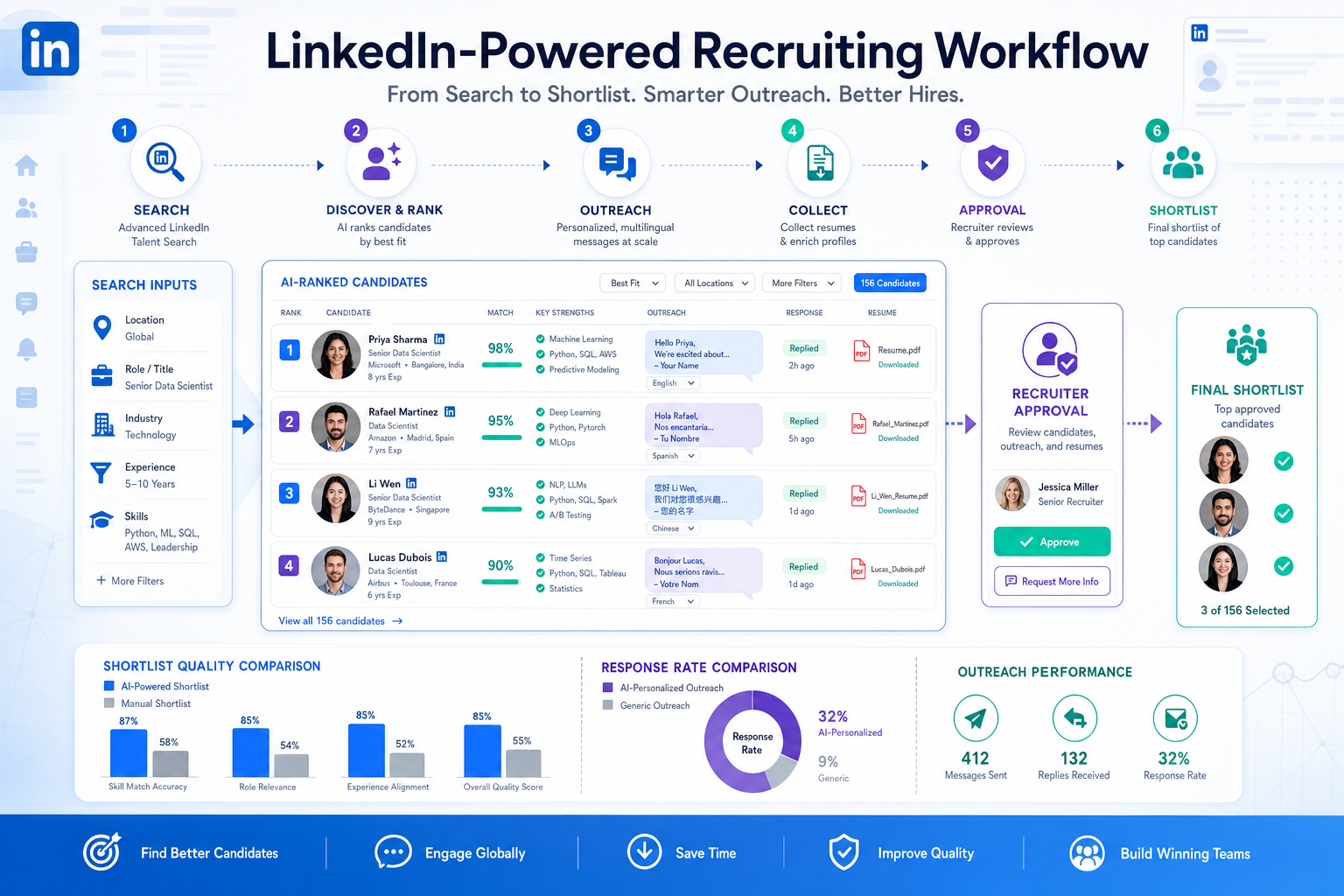
In that kind of workflow, I have found that StrategyBrain AI Recruiter is most useful when treated as support for the repetitive front end of sourcing rather than a substitute for recruiter judgment. For LinkedIn-heavy searches, it can keep candidate communication moving after hours, handle multilingual replies when international outreach is involved, and collect resumes or contact details from interested prospects so the recruiter can focus on review and next-step decisions. That division of labor is important: the recruiter still decides who belongs on the shortlist and whether the resume actually matches the role.
A familiar version of this problem shows up when a company needs to hire an accountant and the internal team is thin or nonexistent. The business owner or department head already has a full day of operational demands, but now also has to define the role, write a credible brief, sort through incoming resumes, and decide who is actually strong enough to meet the finance team’s standard. At the same time, the shortlist on the desk is underwhelming, and the people reviewing it may not have the market reach or recruiting depth to know whether better candidates are realistically available.
That is usually the moment the real bottleneck becomes visible. The issue is not simply that there are too few applicants; it is that the team lacks time, network access, and a reliable way to surface stronger passive talent before settling for a mediocre slate. In today’s market, that same decision point is exactly where AI candidate sourcing enters the picture. The right ai recruiting tool should help recruiters build a better shortlist, especially for specialist roles, while the best ai recruiting software and other recruiting tools to find candidates are judged on whether they improve discovery, outreach continuity, and recruiter control rather than just profile volume.
Table of Contents
- Why Shortlists Break Down in Candidate Sourcing
- What AI Candidate Sourcing Actually Does
- Three Practical Triggers for Buying an AI Recruiting Tool
- How LinkedIn-Heavy Sourcing Benefits From AI Support
- How to Evaluate the Best AI Recruiting Software
- Workflow Fit, ATS Handoffs, and Recruiter Control
- Common Use Cases for Recruiters and Hiring Teams
- Mistakes That Hurt Adoption and Results
- Practical Comparison Checklist
- FAQ
Why Shortlists Break Down in Candidate Sourcing
In recruiting, a weak shortlist usually comes from one of three conditions. First, there is no real internal sourcing capacity, so hiring leaders are trying to do recruiter work between other priorities. Second, the team is seeing candidates but not the right candidates, which often means the search logic is too narrow, the network is too shallow, or passive talent is not being reached. Third, there is simply not enough time to keep searching, screening, messaging, and following up at the quality level the role demands.
Those problems are not unique to finance hiring, but finance hiring makes them easy to see. If you need an accountant, controller, or other detail-sensitive hire, a bad shortlist wastes everyone’s time quickly. The same dynamic applies to technical, commercial, and operational searches. A recruiter does not need more names on a spreadsheet. A recruiter needs better names, clearer ranking, and faster iteration.
Key insight: The strongest sourcing workflow does not replace recruiter expertise. It protects that expertise from being buried under repetitive search and outreach work.
What AI Candidate Sourcing Actually Does
AI candidate sourcing uses semantic search, skills relationships, profile data, and engagement signals to help recruiters identify people who may fit a role even when the match is not obvious from exact keywords. That matters because good candidates rarely describe themselves in the same language used in a requisition.
A solid ai recruiting tool typically helps in five areas:
- Natural-language search so recruiters can search by intent instead of spending too much time rewriting Boolean strings.
- Related-skill discovery so adjacent experience and transferable backgrounds are not missed.
- Candidate ranking so recruiters can review likely-fit profiles first rather than scrolling through low-signal results.
- Outreach support so the first message, follow-up, and candidate reply process moves faster.
- Workflow handoff so sourcing output can move into structured recruiter review and hiring stages.
The practical point is simple: sourcing technology should expand your field of vision, not remove your judgment. Recruiters still need to read profiles carefully, review resumes, test assumptions with hiring managers, and decide who belongs in process.
Three Practical Triggers for Buying an AI Recruiting Tool
Borrowing from the shortlist logic above, there are three common moments when teams seriously start looking for an ai recruiting tool.
1. You do not have enough internal recruiting capacity
Smaller firms and overstretched internal teams often do not lack intent; they lack time and specialist sourcing muscle. When the person filling the role is also running operations, managing clients, or leading a department, search quality drops because recruiting is being squeezed into the gaps.
In that situation, AI sourcing can help by shortening the path from intake to viable prospects. It does not replace a recruiter, but it can remove enough repetitive work to make a recruiter’s time count more.
2. Your shortlist is disappointing
If hiring managers keep saying, “None of these profiles are quite right,” the issue may not be screening discipline. It may be that your search method is surfacing only the obvious candidates. One of the better uses of recruiting tools to find candidates is widening the search to adjacent titles, related skill clusters, and passive talent that would not appear in basic keyword matching.
Experienced recruiters know that the strongest hire is often not sitting in the first page of exact-match search results. AI sourcing can help surface that second layer of talent faster.
3. Time pressure is forcing shortcuts
When deadlines are tight, recruiting teams tend to overvalue speed signals like title similarity and underinvest in broader discovery. That is when shortlists become safe, repetitive, and underpowered. AI support is valuable here if it reduces manual steps without pushing the process into blind automation.
The best result is not “more automation.” It is more recruiter attention available for calibration, outreach quality, and candidate conversations.
How LinkedIn-Heavy Sourcing Benefits From AI Support
Because so much modern sourcing runs through LinkedIn, this is also where many teams feel the administrative drag most sharply. Messages arrive outside working hours. International candidates reply in different languages. Recruiters lose time moving between search, outreach, follow-up, and resume collection. In practice, that is where an AI-assisted workflow can help most.
In my own testing of LinkedIn-centric sourcing processes, the useful pattern has been to let AI handle the repetitive first layer while keeping recruiter review at the center. Tools such as AI Recruiter from StrategyBrain are built around that front-end workload: connecting with targeted candidates, introducing a role, responding across time zones, and gathering resumes or contact details from people who want to continue. For cross-border searches, the multilingual piece is especially practical because misunderstandings in early outreach can quietly kill response quality.
What I would not outsource is final qualification. Even when a system keeps conversations moving and captures resumes efficiently, the recruiter still has to review the actual background, test alignment against the brief, and decide whether the candidate should move forward. Used that way, AI becomes a sourcing assistant rather than an unchecked gatekeeper.
For recruiters who rely heavily on LinkedIn, that balance can save meaningful time while preserving quality. It is also one of the more realistic ways to think about the best ai recruiting software: not as software that promises fully automated hiring, but as software that helps you search, engage, and collect next-step information without losing control of the shortlist.
How to Evaluate the Best AI Recruiting Software
If you are comparing the best ai recruiting software, evaluate it as a recruiting workflow tool, not as a generic AI category. The right questions are the same questions a strong recruiter asks of any sourcing process: Does it improve discovery? Does it expand access to better candidates? Does it save time where time is actually being lost? And can the recruiter still explain and defend the shortlist?
Database coverage and freshness
Ask where candidate data comes from, how often profiles are refreshed, and whether the platform is strong in the markets and functions you hire for. A large database sounds attractive, but scale without freshness creates false confidence.
Semantic relevance
Test realistic prompts, not demo prompts. Search for difficult roles, regional title variants, and adjacent backgrounds. A worthwhile ai recruiting tool should return candidates who make sense, even when their titles are not exact matches.
Passive-talent reach
A sourcing workflow is far more valuable when it helps you engage people who are not actively applying. This is one reason recruiters continue to invest in LinkedIn-centered processes: the target pool includes professionals who will not appear in inbound channels.
Outreach continuity
Ask whether the tool can support follow-up, after-hours responses, resume collection, and multilingual communication without making outreach feel robotic. That support is often the difference between a search that stalls and one that keeps moving.
Explainability
Recruiters should be able to understand why a candidate was surfaced or ranked. If the logic is opaque, trust drops quickly and adoption usually follows.
Human control
The final test is whether the recruiter remains in charge of qualification, shortlist decisions, and next steps. Any system that obscures those controls tends to create more risk than value.
| Evaluation Area | What to Check | Why It Matters |
|---|---|---|
| Profile quality | Coverage, freshness, sourcing methods | Weak data leads to weak shortlists |
| Search performance | Natural-language search, title variants, skill adjacency | Improves discovery beyond exact matches |
| Passive engagement | Messaging support, follow-up, response handling | Helps reach candidates who are not applying |
| Global hiring support | Language handling, time-zone continuity | Useful for cross-border or distributed recruiting |
| Recruiter oversight | Review checkpoints, ranking transparency, editable outreach | Protects hiring judgment and trust |
Workflow Fit, ATS Handoffs, and Recruiter Control
One reason sourcing projects fail is that teams treat sourcing, outreach, and formal recruiting operations as separate universes. In reality, they have to connect. AI candidate sourcing helps identify and engage people before they enter the formal pipeline, but recruiter notes, status updates, and next-step decisions still need a clean home.
That is why workflow fit matters as much as sourcing power. Once a candidate replies, shares a resume, or expresses interview interest, the recruiter should be able to move that person into a structured process without losing context. This matters whether you are an agency building a client shortlist or an internal team feeding candidates into a hiring workflow.
The handoff should be simple:
- AI sourcing support expands discovery and keeps communication active.
- The recruiter reviews responses, resumes, and fit.
- The hiring workflow captures qualified prospects and stakeholder decisions.
- The hiring manager sees a better, more defensible shortlist.
That structure directly addresses the opening problem from the accountant-hiring example: when time is limited and the initial shortlist is weak, the answer is not just more searching. The answer is a workflow that improves candidate discovery and makes strong candidates easier to identify, engage, and move forward.
Common Use Cases for Recruiters and Hiring Teams
Specialist hiring with limited internal expertise
When the internal team is not deep in a function, AI sourcing can help surface more relevant profiles while the recruiter interprets quality. This is especially useful in finance, technical, or niche commercial hiring.
Shortlist rebuilding
If the first slate disappoints, AI search can broaden the field to related backgrounds and transferable experience instead of recycling the same obvious profiles.
LinkedIn-heavy agency work
Agency recruiters often feel the value fastest in outreach-heavy searches. Keeping candidate conversations moving, especially after hours, can increase the number of viable prospects a consultant can manage without dropping quality.
International sourcing
For teams contacting candidates across regions, multilingual support can reduce early friction and help maintain response continuity without forcing recruiters to be online at every hour.
Lean in-house recruiting teams
When a small talent team is balancing many requisitions, AI support can remove repetitive steps so recruiters spend more time calibrating with hiring managers and less time manually pushing messages.
Mistakes That Hurt Adoption and Results
Confusing bigger pipelines with better pipelines
More profiles do not automatically solve a sourcing problem. If the shortlist quality is not improving, volume is just noise.
Ignoring the passive-candidate question
A tool may search well but still fall short if it does not help engage people who are not actively applying. For many recruiters, that is where the real market advantage sits.
Automating beyond good judgment
AI can support messaging and qualification flow, but resume review and fit decisions still need recruiter scrutiny. Skipping that step risks weak submissions and damaged credibility.
Buying without testing real roles
Always test live or recently filled reqs. Generic demos rarely show how a tool behaves in the messy middle of real recruiting work.
Underestimating workflow friction
If the sourcing output creates extra copy-paste work or duplicate records, adoption suffers quickly no matter how strong the search looks in a demo.
Practical Comparison Checklist
- Can it improve a weak shortlist? Test with a role where your current search method is underperforming.
- Does it find adjacent talent? Look for transferable experience, not just exact titles.
- Can it help reach passive candidates? Assess outreach support, not just search depth.
- How well does it support LinkedIn-based workflows? This matters for many recruiters more than broad feature lists.
- Can it handle global communication needs? Especially important for multilingual or time-zone-spread hiring.
- Does it keep recruiter control intact? Reviewability and explainability matter.
- Can resumes and contact details be captured cleanly? Small admin steps become large bottlenecks at scale.
- Will hiring managers receive a better shortlist? That remains the most practical success test.
FAQ
What is AI candidate sourcing?
AI candidate sourcing is the use of AI-based search, matching, and outreach support to help recruiters identify and engage likely-fit candidates more efficiently. It is most useful when it improves discovery and saves time without removing recruiter judgment.
How does an ai recruiting tool improve shortlists?
It can widen the search beyond exact title matches, surface adjacent skills, rank more relevant profiles first, and support outreach to passive candidates. The recruiter still decides who belongs on the shortlist.
What should recruiters look for in the best ai recruiting software?
Look for search relevance, quality data, passive-candidate reach, explainable ranking, editable outreach, workflow fit, and clear recruiter oversight.
Are recruiting tools to find candidates replacing recruiters?
No. They are best used to remove repetitive sourcing work, maintain communication flow, and organize early candidate engagement so recruiters can focus on assessment, relationship building, and hiring decisions.
Can AI help with LinkedIn recruiting?
Yes. In LinkedIn-heavy sourcing, AI can support candidate messaging, after-hours follow-up, multilingual communication, and resume collection. Recruiters should still review interested candidates before moving them forward.
When is AI sourcing especially useful?
It is especially useful when internal recruiting capacity is thin, when the shortlist is weak, when passive talent matters, or when recruiters are losing too much time to repetitive outreach and follow-up.
Conclusion
The most practical reason to adopt AI candidate sourcing is not novelty. It is to solve familiar recruiting problems: limited internal bandwidth, disappointing shortlists, and too much manual effort spent on tasks that do not deserve your best recruiting time.
If you are evaluating an ai recruiting tool, use the same standard that strong recruiters have always used. Ask whether it helps you find better candidates, whether it gives you a better chance of reaching passive talent, and whether it protects the quality of recruiter judgment. That is what separates interesting software from the best ai recruiting software and from the many recruiting tools to find candidates that look useful in a demo but fail in daily recruiting work.