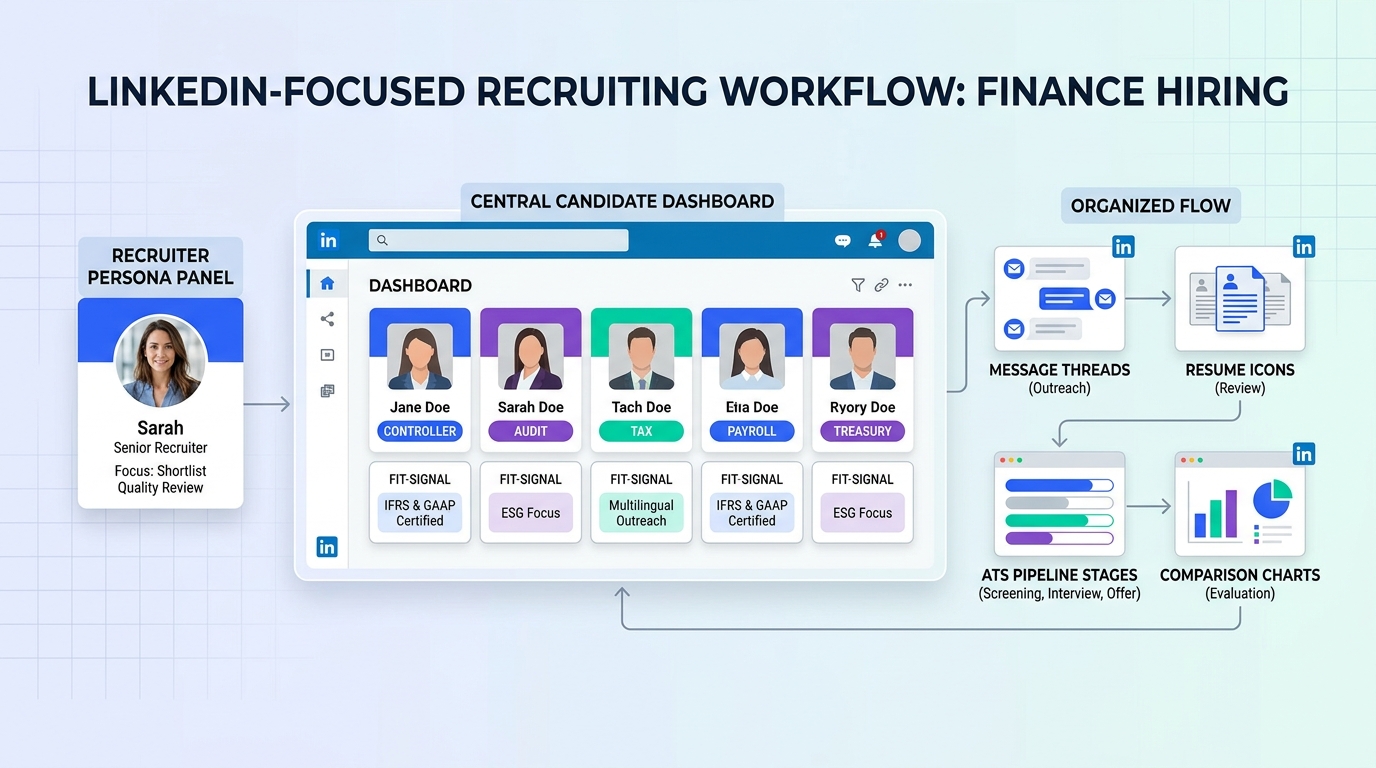
This article helps headhunters judge an ai recruiting tool before messy finance hiring weakens shortlist quality and candidate trust.
That matters most when hiring is not generic. A recruiter filling accounting, finance, audit, tax, payroll, treasury, or controller roles is not simply matching keywords to resumes. The work involves technical depth, business judgment, compliance sensitivity, and candidate expectations around flexibility, growth, and credibility. When sourcing is handled through scattered tabs, inboxes, and spreadsheets, the cost shows up fast in slower response times, weak shortlist quality, repeated outreach, missing notes, and damaged trust with both hiring managers and candidates.
In that gap between finding names and delivering an interview-ready shortlist, I have found that tools like StrategyBrain AI Recruiter can help most when used as workflow support rather than recruiter replacement. Its always-on candidate messaging, multilingual communication, and automated collection of resumes and contact details can reduce the repetitive back-and-forth that stalls passive outreach on LinkedIn. The recruiter still owns the final judgment, resume review, and next-step decision, but the handoff becomes cleaner and easier to manage.
You can see why this matters in accounting and finance hiring. In markets shaped by natural resources, tech, healthcare, real estate, logistics, and manufacturing, employers often need people who can do more than close the books. One requisition calls for a controller who can handle reporting and business partnering. Another needs audit or tax depth that is already scarce. A third requires payroll accuracy with no room for operational disruption. Recruiters start by reviewing the role brief, then checking whether the must-haves are truly technical, regulatory, or strategic before they even open a sourcing project.
Then the friction appears. The recruiter messages passive candidates, tracks who asked about flexibility, notes who has IFRS, GAAP, ESG, or treasury exposure, and tries to remember which hiring manager wanted strategic leadership versus day-to-day precision. Without structured support, the process breaks at the exact point where nuanced recruiting matters most. That is why ai candidate sourcing is no longer just a speed tool. It is a workflow decision involving an ai recruiting tool, an ai based recruitment platform, and sometimes specialized ai sourcing software that can carry complex roles from outreach to shortlist without losing context.
Table of Contents
- Why complex hiring needs better sourcing
- What AI candidate sourcing means today
- Why accounting and finance roles expose the real gaps
- AI recruiting tool vs AI based recruitment platform
- Features that matter in live recruiting operations
- LinkedIn outreach and workflow support in practice
- How AI sourcing should work with your ATS
- How to evaluate without buying hype
- Common mistakes recruiting teams make
- FAQ
Why complex hiring needs better sourcing
Some recruiting categories reveal tool quality faster than others. Accounting and finance is one of them. These roles sit close to compliance, reporting accuracy, strategic planning, cash management, audit readiness, and leadership decision-making. Employers are not only hiring for technical competence. They are hiring for integrity, business insight, adaptability, and the ability to operate inside changing regulatory conditions.
That is why sourcing for specialized functions feels different from sourcing for broader roles. A title match does not tell you whether a candidate has handled public-company reporting, tax specialization, cost accounting, treasury exposure, ESG disclosure work, or cross-border finance environments. In recruiting terms, this creates a top-of-funnel problem that basic search alone cannot solve.
In my own work, that has been the dividing line between tools that look impressive in demos and tools that help in the real world. The best systems help recruiters preserve the role context, compare adjacent profiles more intelligently, support passive candidate sourcing, and keep outreach organized enough that good people do not disappear because the process got messy.
Key insight: The harder the role is to define cleanly on paper, the more valuable workflow-aware sourcing becomes.
What AI candidate sourcing means today
Today, ai candidate sourcing means using software to identify likely-fit candidates, prioritize them based on relevance signals, support outreach, and move the best options into a structured recruiting process. The practical point is not just automation. It is reduction of recruiter drag between search, contact, qualification, and handoff.
That is also why the seed keyword matters as a semantic anchor. An ai recruiting tool should not be judged only by whether it retrieves profiles quickly. It should be judged by whether it helps a recruiter turn role complexity into a useful shortlist without flattening nuance.
A modern ai based recruitment platform may combine semantic search, natural-language prompts, profile summaries, outreach support, conversation tracking, and routing into recruiter workflows. Some ai sourcing software is narrower and focuses on talent discovery only. Both can be useful, but they solve different problems.
Why accounting and finance roles expose the real gaps
The reference case behind this article is valuable because it highlights a recruiting category where skill shortages, regulation, and strategic expectations all collide. In accounting and finance hiring, employers may need tax depth, audit capability, reporting discipline, leadership presence, or the ability to translate numbers into business decisions. Those are not interchangeable signals.
Consider how hiring demand shifts across sectors. Resource-heavy businesses may need finance talent who understand cyclical markets and risk. Tech employers may value cross-border reporting or investor-facing finance experience. Healthcare, logistics, agriculture, manufacturing, and real estate all create their own variations. The recruiting challenge is not simply that talent is scarce. It is that relevance is highly specific.
This is where many teams overestimate what generic search can do. A recruiter may find a pool of senior accountants, but still need to separate public accounting backgrounds from industry controllers, strategic finance candidates from transactional operators, or compliance-heavy profiles from business-partnering profiles. If the sourcing system does not support these distinctions, recruiters end up doing the hard work manually after the search is supposedly finished.
What these roles usually require beyond title matching
- Technical precision: reporting, tax, audit, payroll, treasury, or cost accounting depth
- Strategic capability: connecting finance work to business planning and growth
- Regulatory awareness: working knowledge of changing standards and compliance demands
- Trust signals: communication, judgment, integrity, and leadership fit
- Adaptability: readiness for system change, hybrid work expectations, or evolving business models
When recruiters source for these conditions, the workflow has to preserve nuance from intake onward. Otherwise, outreach becomes generic, qualification becomes slow, and shortlist confidence drops.
AI recruiting tool vs AI based recruitment platform
Many buyers use these terms loosely, but in recruiting operations they point to different buying decisions.
An ai recruiting tool may focus on one job well, such as search, matching, outreach, or screening support. An ai based recruitment platform usually implies broader workflow coverage across sourcing, engagement, qualification, and routing. AI sourcing software often sits closer to the discovery end of the process.
| Question | Dedicated AI sourcing software | Broader AI based recruitment platform |
|---|---|---|
| Primary value | Faster discovery and profile matching | Source-to-shortlist workflow continuity |
| Best fit | Teams with a strong existing ATS and clear process | Teams with fragmented sourcing, outreach, and handoff |
| Main risk | Good search but weak downstream execution | More change management and process design needed |
| Recruiter experience | Often specialist-oriented | Often broader and more operational |
| When it works best | Hard-to-find talent with mature workflow controls | Complex hiring where context gets lost between steps |
For many recruiting teams, the right answer depends on where the real bottleneck sits. If your recruiters already manage handoff, notes, and stakeholder alignment well, then specialized ai sourcing software may be enough. If the problem starts after search results appear, then a broader ai based recruitment platform may be the better fit.
Features that matter in live recruiting operations
When recruiters evaluate AI tools against real hiring pressure, a few capabilities matter far more than generic marketing language.
1. Natural language and semantic search
Good search should recognize adjacent titles, nonstandard profile wording, and transferable experience. This matters in specialized hiring because the strongest candidate may not mirror the job description exactly.
Practical test: Run a difficult role with multiple adjacent titles and compare the results against recruiter judgment, not just volume.
2. Passive candidate sourcing support
Many of the best candidates for finance, compliance, or niche operational roles are not active applicants. A useful sourcing system should help recruiters build target pools without forcing endless filter work.
Practical test: Check whether the workflow makes refinement easier over time or simply produces another list to clean manually.
3. Candidate summaries and fit signals
Summaries can save time if they support triage. They become risky when teams treat them as final truth. Recruiters still need to examine actual evidence in the profile and resume.
Practical test: Compare AI summaries with recruiter notes on five to ten mixed-quality profiles.
4. Outreach and response handling
This is where sourcing often fails operationally. Recruiters can find the right people, but message timing, follow-up, after-hours replies, and resume collection become inconsistent. In LinkedIn-heavy workflows, I have seen the biggest productivity gain come from using AI Recruiter to handle repetitive first-touch conversations, answer common role questions, and keep interested passive candidates moving while I focus on evaluating fit. It is especially helpful when candidates respond outside business hours or in different languages, because the recruiter does not lose momentum overnight.
I would still not hand over final qualification. What worked best for me was letting the system surface intent, gather resumes or contact details, and keep outreach active while I reviewed who actually matched the brief. That balance matters in specialist recruiting, where interest and fit are related but not the same.
5. Qualification and routing
The tool should support a clean move from sourced profile to reviewed prospect to shortlist. If that transition requires copy-paste work, side spreadsheets, or duplicate note entry, recruiter productivity gains disappear quickly.
LinkedIn outreach and workflow support in practice
For many headhunters and internal talent teams, LinkedIn remains the most active channel for passive candidate sourcing. The problem is that LinkedIn recruiting creates a very specific kind of workload: repeated outreach, repeated explanations, repeated follow-up, and repeated tracking of who replied, who asked questions, who is open later, and who shared a resume.
That is one reason the best ai recruiting tool choices are often judged by what happens after the first message. A workflow can look efficient at the search stage and still collapse under message volume.
In that environment, my own LinkedIn workflow experience with AI Recruiter reinforced a simple lesson: the value is not only in automation, but in continuity. If the system can keep candidate conversations moving, capture contact details, and return resumes for recruiter review without losing context, it protects the part of the process where recruiters usually burn time. For agencies and solo recruiters, that can also help manage more open searches without immediately adding more staff.
Use cases where this kind of support makes the most sense include:
- High-volume passive outreach on LinkedIn
- After-hours candidate replies that would otherwise sit unanswered
- Cross-border or multilingual recruiting
- Agency teams juggling multiple searches at once
- Roles where recruiters need to separate interest capture from final qualification
How AI sourcing should work with your ATS
Even strong sourcing workflows break if the handoff into your applicant tracking system is weak. For recruiters, the ATS remains the source of truth for stages, ownership, notes, and visibility.
That means the real evaluation question is not whether AI sits inside or outside the ATS. It is whether the recruiting team can move candidates into the managed workflow without losing history or creating duplicate work.
What good ATS alignment looks like
- Candidate records move cleanly from sourced status into pipeline stages
- Recruiter notes and interaction history remain visible
- Hiring managers can review shortlists without chasing updates in email
- Recruiters decide what gets pushed forward and when
- Data changes can be reconciled without manual cleanup
If your team already has a mature ATS process, a specialist sourcing layer may complement it well. If ATS discipline is weak, adding more sourcing power alone can actually create more noise.
How to evaluate without buying hype
AI recruiting claims are easy to make and hard to validate. A grounded evaluation process works better than a polished demo every time.
- Test live roles, not idealized examples. Include at least one role with high title ambiguity and one where passive outreach matters.
- Define the bottleneck first. Is your problem search relevance, outreach capacity, shortlist quality, or ATS handoff?
- Check difficult profiles. See whether the system recognizes transferable experience, not just exact matches.
- Review outreach reality. Ask how it handles replies, language differences, candidate questions, and resume capture.
- Inspect recruiter controls. Confirm where humans approve, override, or stop automation.
- Ask governance questions. Look at privacy handling, data use boundaries, and auditability.
If you are evaluating LinkedIn-heavy workflows specifically, it is also reasonable to review a live trial environment for AI Recruiter so you can see whether automated outreach and response handling actually reduce friction for your team. The key is to test whether it improves the recruiter's operating rhythm, not just whether it sends messages.
Common mistakes recruiting teams make
Choosing based on impressive search demos
Search quality matters, but downstream workflow usually decides whether the tool earns adoption.
Confusing interest capture with qualification
A candidate who replies quickly is not automatically a fit. Recruiters still need to assess evidence, context, and role alignment.
Ignoring complexity in specialist roles
Hard-to-fill finance, audit, tax, or compliance positions often require more than title logic. If the tool cannot preserve nuance, shortlist quality suffers.
Overlooking recruiter trust
Teams adopt tools faster when they can see, edit, and control what the AI is doing. Opaque automation often creates resistance.
Underestimating integration work
If sourced candidates, notes, and decisions do not move cleanly into the ATS, manual reconciliation returns and the gains fade.
FAQ
What does AI candidate sourcing actually do?
It helps recruiters find, prioritize, and engage relevant candidates more efficiently. Stronger systems also support outreach, summaries, and shortlist routing.
Is an AI recruiting tool the same as an AI based recruitment platform?
No. An ai recruiting tool may solve one part of the workflow, while an ai based recruitment platform usually supports a wider source-to-shortlist process.
When is AI sourcing software enough on its own?
If your team already has strong ATS discipline and a reliable downstream process, focused ai sourcing software may be enough to improve discovery and matching.
Can AI help with passive candidates on LinkedIn?
Yes. It can support first-touch outreach, response handling, follow-up, and resume collection, especially when candidate replies come after hours or across time zones.
Should recruiters let AI make final hiring decisions?
No. AI should support discovery, outreach, and triage. Recruiters should still review resumes, assess fit, and decide the next step.
Why are accounting and finance roles useful when evaluating sourcing tools?
Because they expose whether a tool can handle nuance. These roles often require technical precision, regulatory awareness, business judgment, and careful matching beyond job titles.
Conclusion
The real value of ai candidate sourcing appears when hiring gets complex. Accounting and finance recruiting makes that obvious, because title matching alone is rarely enough. Teams need context, workflow discipline, and better handling of passive outreach, qualification, and shortlist delivery.
That is why choosing an ai recruiting tool should start with workflow fit rather than hype. In some organizations, specialized ai sourcing software will be the right answer. In others, a broader ai based recruitment platform will make more sense. Either way, the best outcome comes from keeping recruiter judgment at the center while using AI to remove repetitive work, preserve context, and keep hard-to-fill searches moving.